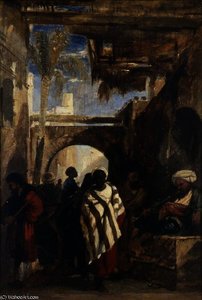
Retrato de William James Müller

Pinturas de William James Müller: As 100 mais famosas, sob o olhar de uma galeria

Atualizado em Novembro 2026 · classificado pela nossa pontuação de popularidade (pesquisas, visitas e pedidos de cada obra) · 210 obras de William James Müller em nosso catálogo

Em resumo

Aos olhos da galeria, a pintura mais famosa de William James Müller é Interior of a Welsh cottage (1843), cuja obra original está exposta no National Library of Wales, em Aberystwyth. Eastern Landscape (1843) e Clearing after Rain, Pont Hoogan completam o trio que todos reconhecem. Dos 210 trabalhos de William James Müller em nosso catálogo, a galeria apresenta abaixo as 100 obras mais famosas, cada uma original, com seu ano, seu museu e o que a torna única.

1812 – 1845, Bristol Romanticism Mais obras: Birmingham Museum and Art Gallery

As 10 principais pinturas de William James Müller na galeria

1
Interior of a Welsh cottage (1843) de William James Müller

Interior of a Welsh cottage

1843 · Oil · National Library of Wales, Aberystwyth

The dim interior of this rustic Welsh cottage is defined by a heavy, low-key lighting scheme. Light enters from a small window on the left, casting a sharp chiaroscuro effect across the textured stone walls and a seated figure. This illumination creates a stark contrast against the deep shadows that shroud the rest of the room. The composition feels enclosed and somber, emphasizing a sense of quiet, humble domesticity within…

2
Eastern Landscape (1843) de William James Müller

Eastern Landscape

1843 · Oil On Canvas

In this work, titled Eastern Landscape, we encounter the specific vision of William James Müller. Created about 1843, the painting reflects a period of significant exploration for the artist. Müller, a British landscape and figure painter, was born in Bristol, United Kingdom, in 1812. His career was marked by a deep engagement with the topography and people of distant locales, a focus that defined much of his output before his…

3
Clearing after Rain, Pont Hoogan de William James Müller

Clearing after Rain, Pont Hoogan

Clearing after Rain, Pont Hoogan is a painting by William James Müller. The artist was a British landscape and figure painter. He was the most prominent figure associated with the Bristol School, an informal association of artists working in Bristol, England, during the early 19th century.

4
The young anglers de William James Müller

The young anglers

This work reflects a romantic sensibility, focusing on the peaceful coexistence of people and their surroundings. There is a palpable sense of stillness, as if the scene has been paused in a moment of calm. The painting avoids the dramatic tension found in more turbulent historical works, opting instead for a study of light and the simple rhythms of daily life. It remains a quiet observation of a landscape at…

5
Landscape, young anglers de William James Müller

Landscape, young anglers

Oil

The scene unfolds in 1843, a moment captured by the hand of William James Müller. Titled Landscape, young anglers, the work invites the viewer into a quiet riverside setting. This piece is also recognized by the name River Scene with Children (The Young Anglers), a title that brings the presence of youth and the gentle movement of water to the forefront of the composition.

6
Gillingham on the Medway (1842) de William James Müller

Gillingham on the Medway

1842 · Acrylic On Canvas · Yale Center for British Art, New Haven

William James Müller’s “Gillingham on the Medway,” painted in 1842, isn’t merely a landscape; it’s a carefully constructed tableau of Victorian England’s relationship with its waterways and its burgeoning sense of national identity. The painting captures a tranquil afternoon scene along the River Medway, a vital artery for trade and naval power during this era. The composition immediately draws the eye to the gently flowing river, bisected by two small…

7
Heidelberg de William James Müller

Heidelberg

Painting

The work reflects a romantic sensibility through its treatment of landscape and light. There is a tension between the permanence of the mountains and the transient nature of the people and boats below. The scene is not a static view but a recorded moment of daily life. The interplay of water, stone, and sky creates a layered environment where the scale of the natural world meets the industry of the…

8
Landscape With Windmill (1828) de William James Müller

Landscape With Windmill

1828 · Oil · Walters Art Museum, Baltimore

In this work, Landscape With Windmill, created by William James Müller about 1828, the viewer is positioned at a low vantage point, looking out across a wide-angle expanse. This perspective lends a sense of scale to the landscape, drawing the eye toward a receding horizon line. The composition is anchored by two primary vertical elements: a large, dark tree on the far left and a prominent windmill on the right.…

10
The Entrance to Venice (1832) de William James Müller

The Entrance to Venice

1832 · Oil On Canvas

A wooden sailing vessel navigates choppy, white-capped waters under a heavy, overcast sky. The composition is defined by a sense of instability, with the boat positioned slightly off-center to the right, its tan sails catching a diffused light filtered through thick cloud cover. Diagonal brushstrokes define the cresting waves, creating a rhythmic movement that suggests the constant struggle of maritime life. In the far distance, the architectural silhouette of Venice…

Pinturas de William James Müller, classificadas de 11 a 100

11A Venetian Scene (1840) de William James MüllerA Venetian Scene1840 12A View of Eton and the Fellows Eyot (1840) de William James MüllerA View of Eton and the Fellows Eyot1840 · Yale Center for British Art 13Hanham Lock on the Avon (1840) de William James MüllerHanham Lock on the Avon1840 · Yale Center for British Art 14Cleve Toot, near Bristol (1840) de William James MüllerCleve Toot, near Bristol1840 · Yale Center for British Art 15Gillingham (1842) de William James MüllerGillingham1842 16Study of a Man, Bust-Length, in Moorish Costume (1841) de William James MüllerStudy of a Man, Bust-Length, in Moorish Costume1841 17Gillingham, kent de William James MüllerGillingham, kent 18Boy fishing de William James MüllerBoy fishing 19Athens with the Acropolis de William James MüllerAthens with the Acropolis 20Landscape with Old Cottages, Winter de William James MüllerLandscape with Old Cottages, Winter 21Dol-y-Garrog Mill near Llanrwst, Caernarvonshire de William James MüllerDol-y-Garrog Mill near Llanrwst, Caernarvonshire 22Bristol harbour de William James MüllerBristol harbour 23Two arab figures seated de William James MüllerTwo arab figures seated 24Stable interior de William James MüllerStable interior 25Scene in Algier de William James MüllerScene in Algier 26Elizabethan interior - the court messenger de William James MüllerElizabethan interior - the court messenger 27Forging the Anchor de William James MüllerForging the Anchor 28A Muslim at Prayer de William James MüllerA Muslim at Prayer 29Eastern Scene (The White Slave) de William James MüllerEastern Scene (The White Slave) 30A woody landscape de William James MüllerA woody landscape 31The baronial hall de William James MüllerThe baronial hall 32French interior de William James MüllerFrench interior 33A welsh interior de William James MüllerA welsh interior 34Interior of a Cottage in Wales de William James MüllerInterior of a Cottage in Wales 35Mountain River with a Boy Fishing de William James MüllerMountain River with a Boy Fishing 36Landscape with Frenchay Church in the Distance de William James MüllerLandscape with Frenchay Church in the Distance 37Covered Wagon Crossing a Heath, with a Herdsman Driving Stock de William James MüllerCovered Wagon Crossing a Heath, with a Herdsman Driving Stock 38Medway river de William James MüllerMedway river 39On the Medway, Kent de William James MüllerOn the Medway, Kent 40Scene near Whitchurch de William James MüllerScene near Whitchurch 41Rural scene de William James MüllerRural scene 42The Temple of Theseus de William James MüllerThe Temple of Theseus 43Rocky coast scene de William James MüllerRocky coast scene 44Dredging on the Medway de William James MüllerDredging on the Medway 45View of Bristol de William James MüllerView of Bristol 46Gillingham churchyard, kent de William James MüllerGillingham churchyard, kent 47Arab shepherds de William James MüllerArab shepherdsBirmingham Museum and Art Gallery 48Grand canal, venice de William James MüllerGrand canal, venice 49Tomb in the Water, Telmessos, Lycia de William James MüllerTomb in the Water, Telmessos, Lycia 50An Encampment in the Desert de William James MüllerAn Encampment in the Desert 51Santa Maria della Salute, Venice de William James MüllerSanta Maria della Salute, Venice 52The Piazza San Marco, with a procession de William James MüllerThe Piazza San Marco, with a procession 53On the River Avon de William James MüllerOn the River Avon 54Hauling timber de William James MüllerHauling timber 55A mountain stream de William James MüllerA mountain stream 56Gillingham On The Medway de William James MüllerGillingham On The Medway 57View of Bristol from Clifton Wood de William James MüllerView of Bristol from Clifton Wood 58St benet's abbey de William James MüllerSt benet's abbey 59View of Bristol Cathedral de William James MüllerView of Bristol Cathedral 60After the Storm de William James MüllerAfter the Storm 61Winter scene, porlock de William James MüllerWinter scene, porlock 62The doge's palace, venice de William James MüllerThe doge's palace, venice 63Standing Figure in a White Turban with a Red Sash de William James MüllerStanding Figure in a White Turban with a Red Sash 64Pandy mill, north wales de William James MüllerPandy mill, north wales 65A Winter Landscape at Sunset with Figures on a Frozen River de William James MüllerA Winter Landscape at Sunset with Figures on a Frozen RiverCalke Abbey 66Landscape with a Cottage de William James MüllerLandscape with a CottageFitzwilliam Museum 67Sand pits, hampstead heath de William James MüllerSand pits, hampstead heath 68Coast Scene with a Windmill de William James MüllerCoast Scene with a Windmill 69The Bay of Naples de William James MüllerThe Bay of Naples 70A Street in Cairo de William James MüllerA Street in Cairo 71Keynsham, near Bristol de William James MüllerKeynsham, near Bristol 72A Sketch in Wales de William James MüllerA Sketch in Wales 73The Ramesseum at Thebes, Sunset de William James MüllerThe Ramesseum at Thebes, Sunset 74Fruit piece de William James MüllerFruit piece 75Alpine landscape de William James MüllerAlpine landscape 76The acropolis, athens de William James MüllerThe acropolis, athens 77The Falls of Tivoli de William James MüllerThe Falls of Tivoli 78Ruined Temples at Thebes de William James MüllerRuined Temples at Thebes 79An alpine scene de William James MüllerAn alpine scene 80A Street in Cairo, Egypt de William James MüllerA Street in Cairo, Egypt 81Coombe Glen Near Bristol de William James MüllerCoombe Glen Near Bristol 82Landscape with Trees and a Cottage de William James MüllerLandscape with Trees and a Cottage 83Avenue of Sphinxes, Moonlight, Thebes de William James MüllerAvenue of Sphinxes, Moonlight, Thebes 84The Slave Market at Cairo, Egypt de William James MüllerThe Slave Market at Cairo, Egypt 85Near lynton, north devon de William James MüllerNear lynton, north devon 86A Lowering Day in Winter de William James MüllerA Lowering Day in Winter 87Winter Landscape with Figures de William James MüllerWinter Landscape with Figures 88Prayers in the Desert de William James MüllerPrayers in the DesertBirmingham Museum and Art Gallery 89Stream with Peasants Driving Cattle de William James MüllerStream with Peasants Driving Cattle 90Classical landscape de William James MüllerClassical landscape 91A peasant girl de William James MüllerA peasant girl 92Swiss chalet de William James MüllerSwiss chalet 93Sketch for a Landscape de William James MüllerSketch for a Landscape 94A Woodland Track de William James MüllerA Woodland Track 95Woodland scene de William James MüllerWoodland scene 96Landscape with Church de William James MüllerLandscape with Church 97Splügen Pass with Travellers Attacked by Bandits de William James MüllerSplügen Pass with Travellers Attacked by Bandits 98Salmon Trap, near Pont-y-Pridd, South Wales de William James MüllerSalmon Trap, near Pont-y-Pridd, South Wales 99Oriental and Girl de William James MüllerOriental and Girl 100Hampstead Heath, the Bird Trap de William James MüllerHampstead Heath, the Bird TrapBirmingham Museum and Art Gallery

Pinturas famosas de William James Müller, período por período

Os temas que cativaram o olhar de William James Müller

Os quatro temas que mais se repetem nestas obras originais, cada um com o seu melhor exemplo.

Os museus que guardam os originais de William James Müller

Os 6 museus que detêm a maioria das pinturas desta página.

Museus Cidade Obras de William James Müller Pinturas desta lista
Birmingham Museum and Art Gallery, BirminghamBirmingham Museum and Art Gallery Birmingham 7 Interior Collegiate Church Of St Paul , Antwerp, Arab shepherds, Prayers in the Desert
Yale Center for British Art, New HavenYale Center for British Art New Haven 4 Gillingham on the Medway, A View of Eton and the Fellows Eyot, Hanham Lock on the Avon
Fitzwilliam MuseumFitzwilliam Museum 3 Landscape with a Cottage
National Library of Wales, AberystwythNational Library of Wales Aberystwyth 1 Interior of a Welsh cottage
Walters Art Museum, BaltimoreWalters Art Museum Baltimore 1 Landscape With Windmill
Calke AbbeyCalke Abbey 1 A Winter Landscape at Sunset with Figures on a Frozen River

William James Müller, uma pintura emblemática por década

Obras por década

Escolha uma década para ver a obra original que a define.

Pinturas de William James Müller: a galeria responde

Qual pintura de William James Müller é a mais famosa de todas?Revelar a resposta

Interior of a Welsh cottage (1843), National Library of Wales, Aberystwyth. Eastern Landscape (1843) e Clearing after Rain, Pont Hoogan vêm a seguir.

Qual era a idade de William James Müller ao concluir Interior of a Welsh cottage?Revelar a resposta

31 anos: Interior of a Welsh cottage data de 1843, e William James Müller nasceu em 1812.

Quais são as 10 principais pinturas de William James Müller?Revelar a resposta

Interior of a Welsh cottage, Eastern Landscape, Clearing after Rain, Pont Hoogan, The young anglers, Landscape, young anglers, Gillingham on the Medway, Heidelberg, Landscape With Windmill, Interior Collegiate Church Of St Paul , Antwerp e The Entrance to Venice. O ranking acima apresenta o ano e o museu de cada uma.

Quantas obras William James Müller criou?Revelar a resposta

Nosso catálogo contém 210 obras de William James Müller, datadas de 1828 a 1843.

Onde estão expostos os originais mais famosos de William James Müller?Revelar a resposta

Principalmente em Birmingham Museum and Art Gallery (Birmingham), Yale Center for British Art (New Haven) e Fitzwilliam Museum. A tabela de museus acima lista todos eles.

Quando é que William James Müller criou as suas pinturas mais famosas?Revelar a resposta

Em 1840s: 9 das 100 obras nesta página foram feitas então, sendo Interior of a Welsh cottage delas.

Quais são as obras mais famosas de William James Müller no início e no fim de sua carreira?Revelar a resposta

Nesta página, a mais antiga é Landscape With Windmill (1828) e a mais recente é Interior of a Welsh cottage (1843).

Quais temas William James Müller mais explorou?Revelar a resposta

Landscape (20), River (8) e Water (8), entre as 100 obras nesta página.

Em qual técnica William James Müller mais trabalhou?Revelar a resposta

Oil, para 5 das 100 obras nesta página.

Com qual movimento William James Müller está associado(a)?Revelar a resposta

Romanticism, a julgar pelos originais nesta página.

Quais obras originais de William James Müller o Birmingham Museum and Art Gallery possui?Revelar a resposta

Interior Collegiate Church Of St Paul , Antwerp, Arab shepherds e Prayers in the Desert: o Birmingham Museum and Art Gallery, Birmingham detém 4 das obras desta página.

William James Müller: o artista

William James Müller: Um Pintor da Alma Oriental

Nascido em Bristol, no coração da Inglaterra, em 1812, William James Müller emergiu como uma figura singular na paisagem artística do século XIX. Mais do que um mero retratista de paisagens, ele foi um explorador visual, um poeta da cor e da luz, que capturou a essência de culturas distantes com uma sensibilidade rara e um talento inegável. Sua trajetória, marcada por viagens audaciosas ao Oriente Médio e uma profunda ligação com a vibrante comunidade artística de Bristol, revela um artista moldado tanto pela observação meticulosa quanto pela imaginação fértil.

Os primeiros anos de Müller foram tecidos na atmosfera da paisagem inglesa. A influência do “Bristol School”, com sua ênfase na representação direta da natureza e um toque de romantismo, certamente moldou seu estilo inicial. Pinturas de campos verdejantes, rios sinuosos e vilarejos pitorescos revelam uma aptidão natural para capturar a atmosfera e o espírito do ambiente que o cercava. No entanto, foi a sede de Müller por novas experiências e a fascinação pelo desconhecido que o impulsionaram a trilhar um caminho diferente.

Viagens ao Oriente: Uma Transformação Artística

Por volta da década de 1830, Müller embarcou em uma série de viagens que transformariam radicalmente sua arte e sua visão do mundo. A primeira grande aventura o levou ao Egito, à Líbia (atual Turquia) e a outras regiões do Oriente Médio. Essas jornadas não foram meras expedições turísticas; elas representaram um encontro profundo com culturas distintas, paisagens exóticas e uma rica tapeçaria de costumes e tradições. As cores vibrantes dos mercados orientais, a grandiosidade das ruínas antigas, a vida cotidiana das pessoas locais – tudo isso se tornou fonte de inspiração para Müller.

Ao retornar à Inglaterra, Müller incorporou os elementos do Orientalismo em sua obra. Seus quadros passaram a apresentar cenas de cidades como Cairo e Alexandria, retratando o movimento frenético dos mercados, as cores intensas das roupas, a arquitetura exuberante e a atmosfera mágica da vida urbana oriental. Ao mesmo tempo, ele manteve seu interesse pelas paisagens britânicas, agora infundidas com a sensibilidade e a paleta de cores adquiridas em suas viagens.

Temas e Estilo: Uma Fusão de Observação e Imaginação

A obra de Müller é caracterizada por uma notável combinação de detalhe meticuloso e imaginação romântica. Seus quadros são ricos em detalhes, com cores vibrantes e uma atenção cuidadosa à luz e sombra. Ele era um mestre em capturar a atmosfera de seus temas, criando pinturas que parecem pulsar com vida. Ao mesmo tempo, Müller não se limitava a reproduzir o que via; ele adicionava sua própria interpretação pessoal, infundindo suas obras com emoção e simbolismo.

Entre os temas recorrentes em sua obra destacam-se as paisagens (tanto britânicas quanto orientais), eventos históricos (como os tumultuosos “Riots de Bristol”) e cenas do cotidiano. A pintura dos “Riots de Bristol” é particularmente significativa, pois oferece um registro visual de um evento histórico importante na cidade, capturando a energia e o caos daquele dia. A série de pinturas que retratam a vida em Alexandria e Cairo demonstra uma capacidade notável de transmitir a atmosfera vibrante e a complexidade social dessas cidades.

Obras Notáveis e Legado

Algumas das obras mais reconhecidas de Müller incluem “The Acropolis, Athens”, um estudo magistral da grandiosidade arquitetônica da cidade grega; “Study of a Man in Moorish Costume”, que revela sua habilidade em capturar a essência de uma cultura estrangeira; e “Bristol Riots - The Burning of the Toll Houses on Prince Street Bridge with St Mary Redcliffe”, um testemunho visual de um evento histórico crucial para a cidade. Sua pintura dos “Riots de Bristol” é considerada um documento histórico valioso, oferecendo um retrato vívido daquele momento turbulento.

William James Müller faleceu em 1845, aos poucos anos de idade, mas seu legado perdura até hoje. Ele foi um dos artistas mais importantes do “Bristol School” e um pioneiro no desenvolvimento do Orientalismo na pintura britânica. Suas obras continuam a ser apreciadas por sua beleza estética, sua riqueza histórica e sua capacidade de transportar o espectador para outras culturas e tempos.