Retrato de William Henry Hunt

As 100 Pinturas Mais Famosas de William Henry Hunt, Cada Uma Única

Atualizado em Novembro 2026 · classificado pela nossa pontuação de popularidade (pesquisas, visitas e pedidos de cada obra) · 102 obras de William Henry Hunt em nosso catálogo

Em resumo

Still Life Of A Dead Goose With A Basket, (1835) é a pintura de William Henry Hunt que mais atrai olhares. Depois disso, o olhar recai sobre The gardener (1825) e A Sportsman with a Boy, a Pony and a Dog (1827). Entre as 102 obras de William Henry Hunt em nosso catálogo, estas 100 são as mais famosas, cada uma uma original única apresentada com o seu ano, o seu museu e a razão pela qual perdura.

1827 – 1910, Cheapside Naturalism Mais obras: Birmingham Museum and Art Gallery

As 10 principais pinturas de William Henry Hunt, sob o olhar da galeria

1
Still Life Of A Dead Goose With A Basket, (1835) de William Henry Hunt

Still Life Of A Dead Goose With A Basket,

1835 · Watercolor

A single goose rests within a basket, its form settled deeply into a bed of hay. The bird appears motionless, its presence defined by a quietude that borders on sleep. This composition focuses on the textures of the natural world: the coarse weave of the basket, the dry, scattered stalks of hay, and the soft, organic contours of the bird. The scene captures a moment of profound stillness, stripping away…

2
The gardener (1825) de William Henry Hunt

The gardener

1825 · Watercolor

A man stands in profile, his weight settled against the steady rhythm of rural labor. He is a gardener, captured in the soft, diffused light of a day that feels neither bright nor dark, but merely present. His silhouette is defined by a simple waistcoat and a tall hat, the attire of a man whose life is measured by the seasons and the soil. Across his shoulders, two heavy baskets…

3
A Sportsman with a Boy, a Pony and a Dog (1827) de William Henry Hunt

A Sportsman with a Boy, a Pony and a Dog

1827 · Oil On Canvas

In A Sportsman with a Boy, a Pony and a Dog, William Henry Hunt captures a quiet moment from 19th-century rural life. The scene unfolds with a sportsman walking alongside a young boy, accompanied by a sturdy pony and a loyal dog. They move through a landscape that feels lived-in and breathing, a world where the pace of life follows the rhythms of the countryside. This gathering of figures suggests…

4
Sunday morning (1831) de William Henry Hunt

Sunday morning

1831 · Watercolor

In "Sunday morning" by William Henry Hunt, the composition centers on a single female figure. Positioned slightly off-center, she anchors the domestic scene. A large window dominates the background, establishing the primary architectural boundary of the room. Around the woman, various furniture elements—including a chair, a table, and a dresser—are arranged to define the intimate interior space.

5
The farmers daughter (1837) de William Henry Hunt

The farmers daughter

1837 · Watercolor

The farmers daughter, painted by William Henry Hunt about 1837, presents a quiet study of youth and rural life. The subject is a young girl, likely from an agricultural background, as suggested by the title. She is positioned centrally, seated in a chair and facing the viewer directly. Her expression is marked by a sense of quiet introspection or a slight melancholy, lending a wistful quality to the portrait.

6
Mrs Gurney Hoare (1837) de William Henry Hunt

Mrs Gurney Hoare

1837 · Oil On Canvas

In Mrs Gurney Hoare, William Henry Hunt positions the subject slightly off-center to the right, creating a balanced tension with the fireplace situated on the left. The woman is seated within an interior setting, her attention entirely absorbed by a book. This quiet, domestic arrangement focuses the viewer's eye on her contemplative posture. The composition relies on a series of intersecting lines, where the verticality of the architectural elements and…

7
Slumber (1840) de William Henry Hunt

Slumber

1840 · Oil On Canvas · Birmingham Museum and Art Gallery, Birmingham

In the artwork Slumber by William Henry Hunt, a young girl is shown asleep within the confines of a rustic barn or shed. The subject matter focuses on a quiet moment of rural life, centered on the figure of the child resting amidst hay. This scene, painted about 1840, captures a period of stillness and innocence through its depiction of a child in a simple, agricultural setting.

8
Boy and goat (1836) de William Henry Hunt

Boy and goat

1836 · Watercolor · Victoria and Albert Museum, Londres

William Henry Hunt's “Boy and Goat,” painted in 1836, isn’t merely a depiction of rural life; it’s a carefully constructed tableau brimming with quiet observation and a subtle yearning for simpler times. The watercolor captures a young boy, seemingly lost in contemplation, standing beside a sturdy black goat within a sun-drenched field. The scene unfolds with an immediacy that draws the viewer into its gentle embrace – a feeling of…

9
A Primula And A Bird's Nest On A Mossy Bank de William Henry Hunt

A Primula And A Bird's Nest On A Mossy Bank

Watercolor

A quiet corner of the English countryside is distilled into a concentrated study of life and fragility. In this composition, a bird's nest containing three eggs rests within a lush, mossy embankment, tucked away from the wider landscape. Nearby, a cluster of primula flowers provides a soft counterpoint to the structural complexity of the nest. The scene focuses on the minute details of the natural world, where the texture of…

Pinturas famosas de William Henry Hunt, números 11 a 100

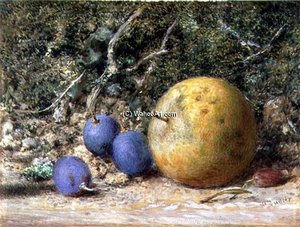
11An Oysterman, (1827) de William Henry HuntAn Oysterman,1827 12Barn Interior, (1836) de William Henry HuntBarn Interior,1836 13Boy And Goat, (1836) de William Henry HuntBoy And Goat,1836 14The Turnip Lantern, (1838) de William Henry HuntThe Turnip Lantern,1838 15Still Life of a dead goose with a Basket (1835) de William Henry HuntStill Life of a dead goose with a Basket1835 16Old Mill and Lock Gates (St.Catherine's) (1840) de William Henry HuntOld Mill and Lock Gates (St.Catherine's)1840 17A Young Woman Sewing de William Henry HuntA Young Woman Sewing 18Study Of A Young Girl de William Henry HuntStudy Of A Young Girl 19Astonishment, Lithograph de William Henry HuntAstonishment, Lithograph 20A Woman Sewing In A Cottage Garden, Edgware de William Henry HuntA Woman Sewing In A Cottage Garden, Edgware 21Head Of A Bearded Man de William Henry HuntHead Of A Bearded Man 22A Study Of A Boy With A Dog de William Henry HuntA Study Of A Boy With A Dog 23Christmas Pie de William Henry HuntChristmas Pie 24Interior Of A Barn With Chickens de William Henry HuntInterior Of A Barn With Chickens 25A Boy With A Begging Dog de William Henry HuntA Boy With A Begging Dog 26Mother and child de William Henry HuntMother and child 27Morris river landscape de William Henry HuntMorris river landscape 28Fancy Dress de William Henry HuntFancy DressMuseu Nacional de Varsóvia 29Cottages At St. Albans de William Henry HuntCottages At St. Albans 30Study From Nature At Twickenham de William Henry HuntStudy From Nature At Twickenham 31A Young Lady, Seated On A Chair, Seen From The Back de William Henry HuntA Young Lady, Seated On A Chair, Seen From The Back 32Still Life de William Henry HuntStill Life 33Still Life_2 de William Henry HuntStill Life_2 34A Mulatto Boy de William Henry HuntA Mulatto Boy 35Grapes And Peaches, 19th Century de William Henry HuntGrapes And Peaches, 19th Century 36Roses And Bird's Nest de William Henry HuntRoses And Bird's Nest 37The Frugal Meal de William Henry HuntThe Frugal Meal 38Primulas And A Bird's Nest On A Mossy Bank de William Henry HuntPrimulas And A Bird's Nest On A Mossy Bank 39Bubbles de William Henry HuntBubbles 40Wild Roses And Birds' Nests de William Henry HuntWild Roses And Birds' Nests 41Long Tailed Tits' Nest de William Henry HuntLong Tailed Tits' Nest 42Still Life With Fruit In A Basket And A Peony de William Henry HuntStill Life With Fruit In A Basket And A Peony 43The Broken Pitcher de William Henry HuntThe Broken Pitcher 44A Field On The Outskirts Of Bushey, Hertfordshire de William Henry HuntA Field On The Outskirts Of Bushey, Hertfordshire 45Schoolboys With A Stolen Nest de William Henry HuntSchoolboys With A Stolen Nest 46The butcher's boy de William Henry HuntThe butcher's boy 47The Eavesdropper de William Henry HuntThe Eavesdropper 48Hearing Lessons de William Henry HuntHearing Lessons 49Still Life Of A Shell And Berries On A Mossy Bank de William Henry HuntStill Life Of A Shell And Berries On A Mossy Bank 50The silver lining de William Henry HuntThe silver lining 51Still Life With Bird's Nest de William Henry HuntStill Life With Bird's Nest 52Magnum Bonum And Orleans Plums de William Henry HuntMagnum Bonum And Orleans Plums 53Head Of A Gypsy Boy de William Henry HuntHead Of A Gypsy Boy 54Portrait Of One Of The Swain Brothers Holding A Pitcher de William Henry HuntPortrait Of One Of The Swain Brothers Holding A Pitcher 55Still Life With Fruit de William Henry HuntStill Life With Fruit 56Still-life With White And Black Grapes And Redcurrents de William Henry HuntStill-life With White And Black Grapes And Redcurrents 57A Young Boy Viewing A Picture By Candlelight de William Henry HuntA Young Boy Viewing A Picture By Candlelight 58Study Of A Young Girl Reclining On A Sofa de William Henry HuntStudy Of A Young Girl Reclining On A Sofa 59Still-life Of Rosehips, Blackberries And Plums, On A Mossy Bank de William Henry HuntStill-life Of Rosehips, Blackberries And Plums, On A Mossy Bank 60The Faithful Old Servant de William Henry HuntThe Faithful Old Servant 61Still-life With Basket, Nest, Egg, Red Currants And Ladybird de William Henry HuntStill-life With Basket, Nest, Egg, Red Currants And Ladybird 62The Barber de William Henry HuntThe Barber 63The Finishing Touches de William Henry HuntThe Finishing Touches 64Still Life With Plums And Hazelnuts On A Mossy Bank de William Henry HuntStill Life With Plums And Hazelnuts On A Mossy Bank 65Plumsplums de William Henry HuntPlumsplums 66Still Life Of Grapes, A Tankard And A Sprig Of Holly de William Henry HuntStill Life Of Grapes, A Tankard And A Sprig Of Holly 67Three Grapes And An Apple de William Henry HuntThree Grapes And An Apple 68The Faggot-gatherers Meal de William Henry HuntThe Faggot-gatherers Meal 69Still-life With Birds Nest And Hawthorne On A Mossy Bank de William Henry HuntStill-life With Birds Nest And Hawthorne On A Mossy Bank 70Still Life With Birds' Nests de William Henry HuntStill Life With Birds' Nests 71Still Life With Two Apples And A Snail Shell de William Henry HuntStill Life With Two Apples And A Snail Shell 72Landscape With Elm Trees And A Farm, Near Bayswater de William Henry HuntLandscape With Elm Trees And A Farm, Near Bayswater 73New Court de William Henry HuntNew Court 74Asking For Trouble de William Henry HuntAsking For Trouble 75Grapes And A Pineapple de William Henry HuntGrapes And A Pineapple 76Chaffinch Nest And May Blossom de William Henry HuntChaffinch Nest And May Blossom 77The Young Connoisseur de William Henry HuntThe Young Connoisseur 78The Musical Conversation - de William Henry HuntThe Musical Conversation - 79Still Life Of Flowers And Nest de William Henry HuntStill Life Of Flowers And Nest 80Girl in Candlelight de William Henry HuntGirl in Candlelight 81A Lady Reading, called Mrs William Hunt, c.1835 de William Henry HuntA Lady Reading, called Mrs William Hunt, c.1835 82The Musical Conversation de William Henry HuntThe Musical Conversation 83A Gardener In His Potting Shed de William Henry HuntA Gardener In His Potting Shed 84Farmyard With Pond de William Henry HuntFarmyard With Pond 85A Lady At Her Toilette de William Henry HuntA Lady At Her Toilette 86Portrait of a boy, bust-length, wearing a hat de William Henry HuntPortrait of a boy, bust-length, wearing a hat 87Branch Of Apple Blossom And Bird's Nest de William Henry HuntBranch Of Apple Blossom And Bird's Nest 88A Distant View Of Windsor Castle de William Henry HuntA Distant View Of Windsor CastleAnglesey Abbey 89Still Life Of A Dead Bird; And Still Life Of Two Shells On A Mossy Bank de William Henry HuntStill Life Of A Dead Bird; And Still Life Of Two Shells On A Mossy Bank 90Still Life With A Pineapple And Three Plums de William Henry HuntStill Life With A Pineapple And Three Plums 91Still Life Of Fruit de William Henry HuntStill Life Of Fruit 92Self Portrait - de William Henry HuntSelf Portrait -National Portrait Gallery 93Glass Vase And Flowers de William Henry HuntGlass Vase And Flowers 94Self Portrait de William Henry HuntSelf Portrait 95Head Study Of A Gentleman, Traditionally Identified As The Artist's Uncle de William Henry HuntHead Study Of A Gentleman, Traditionally Identified As The Artist's Uncle 96The Green Drawing Room Of The Earl Of Essex At Cassiobury de William Henry HuntThe Green Drawing Room Of The Earl Of Essex At Cassiobury 97Plucking The Fowl de William Henry HuntPlucking The Fowl 98Still life with greengages and plums on a mossy bank de William Henry HuntStill life with greengages and plums on a mossy bank 99Still Life With roses In A vase And A Birds Nest de William Henry HuntStill Life With roses In A vase And A Birds Nest 100Still life with sea shells on a mossy bank de William Henry HuntStill life with sea shells on a mossy bank

Pinturas famosas de William Henry Hunt, período por período

Os temas que cativaram o olhar de William Henry Hunt

Os quatro temas que mais se repetem nestas obras originais, cada um com o seu melhor exemplo.

Os museus que guardam os originais de William Henry Hunt

Os 5 museus que detêm a maioria das pinturas desta página.

Museus Cidade Obras de William Henry Hunt Pinturas desta lista
Birmingham Museum and Art Gallery, BirminghamBirmingham Museum and Art Gallery Birmingham 2 Slumber, Lobster, Crab and Cucumber
Victoria and Albert Museum, LondresVictoria and Albert Museum Londres 1 Boy and goat
Museu Nacional de Varsóvia, VarsóviaMuseu Nacional de Varsóvia Varsóvia 1 Fancy Dress
Anglesey AbbeyAnglesey Abbey 1 A Distant View Of Windsor Castle
National Portrait Gallery, LondresNational Portrait Gallery Londres 1 Self Portrait -

William Henry Hunt ao longo dos anos: os originais únicos de cada um

Entre 1835 e 1840, totalizando 6 anos, William Henry Hunt criou cada original datado aqui exibido: um curto período, ano após ano.

Obras por ano

Escolha um ano para ver as obras originais.

Pinturas de William Henry Hunt: perguntas para a galeria

Qual é a obra mais famosa de William Henry Hunt?Revelar a resposta

Still Life Of A Dead Goose With A Basket, (1835). The gardener (1825) e A Sportsman with a Boy, a Pony and a Dog (1827) vêm a seguir.

Com que idade William Henry Hunt criou Still Life Of A Dead Goose With A Basket,?Revelar a resposta

8 anos: Still Life Of A Dead Goose With A Basket, data de 1835, e William Henry Hunt nasceu em 1827.

Quais são as dez pinturas mais famosas de William Henry Hunt?Revelar a resposta

Still Life Of A Dead Goose With A Basket,, The gardener, A Sportsman with a Boy, a Pony and a Dog, Sunday morning, The farmers daughter, Mrs Gurney Hoare, Slumber, Boy and goat, A Primula And A Bird's Nest On A Mossy Bank e Lobster, Crab and Cucumber. O ranking acima apresenta o ano e o museu de cada uma.

Quantas obras de William Henry Hunt são conhecidas?Revelar a resposta

Nosso catálogo contém 102 obras de William Henry Hunt, datadas de 1835 a 1840.

Onde se pode ver os originais mais famosos de William Henry Hunt?Revelar a resposta

Principalmente em Birmingham Museum and Art Gallery (Birmingham), Victoria and Albert Museum (Londres) e Museu Nacional de Varsóvia (Varsóvia). A tabela de museus acima lista todos eles.

Em que período William Henry Hunt criou as suas pinturas mais conhecidas?Revelar a resposta

Em 1836: 3 das 100 obras nesta página foram feitas então, sendo Boy and goat delas.

Qual pintura famosa de William Henry Hunt é a mais antiga e qual é a mais recente?Revelar a resposta

Nesta página, a mais antiga é Still Life Of A Dead Goose With A Basket, (1835) e a mais recente é Slumber (1840).

Quais temas William Henry Hunt preferia?Revelar a resposta

Life (19), Animals (8) e Flowers (6), entre as 100 obras nesta página.

Com quais materiais William Henry Hunt mais pintou?Revelar a resposta

Watercolor, para 6 das 100 obras nesta página.

A qual movimento pertence a obra de William Henry Hunt?Revelar a resposta

Naturalism, a julgar pelos originais nesta página.

Quais originais de William Henry Hunt posso ver no Birmingham Museum and Art Gallery?Revelar a resposta

Slumber e Lobster, Crab and Cucumber: o Birmingham Museum and Art Gallery, Birmingham detém 2 das obras desta página.

William Henry Hunt: um retrato do artista

O Legado Luminoso de William Henry Hunt

Na era de ouro da aquarela britânica, poucas mãos possuíam a precisão delicada e a observação profunda de William Henry Hunt. Nascido no coração pulsante de Cheapside, Londres, Hunt emergiu como uma figura fundamental da era vitoriana, um período em que a intimidade da natureza era frequentemente capturada através de uma lente de profunda sensibilidade espiritual e estética. Sua jornada rumo ao domínio da luz e do pigmento começou sob a orientação do estimado John Varley, um relacionamento que serviu como muito mais do que uma mera aprendizagem. Por meio de Varley, Hunt foi introduzido a uma linhagem de pensamento visionário, profundamente conectada às tradições místicas e simbólicas de artistas como William Blake. Essa exposição precoce instilou nele uma habilidade vitalícia de olhar além da superfície de um tema, encontrando a essência silenciosa e pulsante dentro de um simples ninho de pássaro ou de um aglomerado de flores silvestres.

À medida que sua destreza técnica amadurecia, Hunt tornou-se parte integrante da crescente cena artística de Londres, especificamente por meio de seu célebre envolvimento com a Society of Painters in Watercolors. Sua ascensão nesta prestigią instituição — passando de associado a membro pleno até 1827 — marcou-o como uma voz de destaque entre seus contemporâneos. Diferente dos estilos acadêmicos rígidos que dominaram grande parte da época, a obra de Hunt abraçava as possibilidades fluidas e emotivas do meio. Ele dominou a arte de sobrepor glazes transparentes para criar uma sensação de luminosidade interna, muitas vezes brincando com as texturas rugosas do papel para sugerir a complexidade orgânica do mundo natural. Suas composições nunca eram meramente decorativas; eram estudos cuidadosamente orquestrados de textura e atmosfera.

Um Domínio da Natureza e da Natureza-Morta

A verdadeira magia da obra de Hunt reside em sua capacidade de elevar o mundano ao magnífico. Ele possuía um talento singular para a natureza-morta, particularmente quando focava no botânico e no ornitológico. Suas obras, como a deslumbrante Primulas And A Bird's Nest On A Mossy Bank, demonstram uma atenção quase científica aos detalhes, combinada com uma atmosfera romântica e onírica. Nessas peças, é possível traçar as delicadas nervuras de uma pétala ou a frágil arquitetura de um ninho, tudo renderizado com uma suavidade que sugere a natureza fugaz da própria vida. Essa preocupação com as maravilhas pequenas e muitas vezes negligenciadas da terra permitiu-lhe criar um senso de intimidade que ressoou profundamente com a fascinação vitoriana pela história natural e pela beleza doméstica.

Além de seus estudos botânicos, o repertório de Hunt estendeu-se a cenas narrativas encantadoras que capturavam os ritmos pastorais da vida no século XIX. Seja retratando a companhia silenciosa em Boy and Goat ou a realidade laboriosa e pé no chão de A Gardener In His Potting Shed, seu trabalho sempre manteve um senso de calor e acessibilidade. Sua técnica permitia-lhe transitar perfeitamente entre:

  • Paisagens Atmosféricas: Utilizando pinceladas soltas e lavagens suaves para evocar a luz enevoada e mutável da campiña inglesa.
  • Estudos Botânicos Detalhados: Empregando linhas finas e precisas para celebrar a beleza intrincada da flora.
  • Cenas de Gênero Narrativas: Infundindo as atividades rurais cotidianas com um senso de dignidade e emoção contida.

Significância Histórica e Impacto Artístico

A importância histórica de William Henry Hunt estende-se muito além de suas conquistas técnicas. Ele posicionou-se na encruzilhada do Romantismo e do realismo emergente de meados do século XIX. Ao rejeitar as convenções pesadas e opacas da pintura a óleo tradicional em favor da transparência e da luz da aquarela, ele ajudou a redefinir os limites do que o meio poderia alcançar. Sua obra serviu como uma ponte entre as tradições visionárias e simbólicas de seus mentores e os movimentos naturalistas e observacionais que viriam a seguir.

Hoje, o legado de Hunt é preservado na beleza serena de suas obras sobreviventes, que continuam a cativar colecionadores e historiadores da arte. Ele permanece como um pilar da Escola Inglesa, lembrado não apenas como um artesão habilidoso, mas como um poeta do minúsculo — um artista capaz de encontrar um universo inteiro dentro de uma única gota de pigmento ou na curva de um banco de musgo. Sua habilidade de imbuir o mundo natural com um senso de permanência e graça garante que sua contribuição para a arte britânica permaneça tão luminosa quanto as aquarelas que ele criou com tanta maestria.