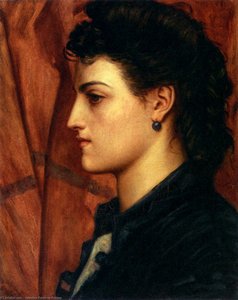
Retrato de Val Prinsep

Pinturas de Val Prinsep: As 33 mais famosas, sob o olhar de uma galeria

Atualizado em Novembro 2026 · classificado pela nossa pontuação de popularidade (pesquisas, visitas e pedidos de cada obra) · 33 obras de Val Prinsep em nosso catálogo

Em resumo

Aos olhos da galeria, a pintura mais famosa de Val Prinsep é Leonora of Mantua (1873), cuja obra original está exposta no Walker Art Gallery, em Liverpool. The first awakening of Eve (1850) e Lisa (possibly from Boccaccio's 'The Decameròn' IV. 5) (1867) completam o trio que todos reconhecem. Dos 33 trabalhos de Val Prinsep em nosso catálogo, a galeria apresenta abaixo as 33 obras mais famosas, cada uma original, com seu ano, seu museu e o que a torna única.

1838 – 1904, Calcutá Pre-raphaelite Mais obras: Birmingham Museum and Art Gallery

As 10 principais pinturas de Val Prinsep na galeria

1
Leonora of Mantua (1873) de Val Prinsep

Leonora of Mantua

1873 · Oil On Canvas · Walker Art Gallery, Liverpool

The oil on canvas titled Leonora of Mantua was painted by Valentine Cameron Prinsep in 1873. This portrait captures an imaginary Italian Renaissance heroine. She is a figure drawn from the shadows of history, perhaps a member of the Gonzaga family. This dynasty once held dominion over the Italian city of Mantua throughout the 15th to 17th centuries.

2
The first awakening of Eve (1850) de Val Prinsep

The first awakening of Eve

1850 · Oil On Canvas

In the quietude of a primordial forest, the first moments of consciousness unfold within The first awakening of Eve. This oil on canvas captures Eve as she stirs from her initial slumber, a figure emerging into existence amidst the lush, untamed greenery of a world yet new. The scene holds a stillness that feels heavy with the weight of a beginning, as if the very air waits for her eyes…

5
Self Portrait (1883) de Val Prinsep

Self Portrait

1883 · Oil On Canvas

In this intimate encounter, we find the artist Valentine Cameron Prinsep gazing back at us through his Self Portrait. Created about 1883, the work captures a moment of quiet introspection. The subject is the painter himself, offering a direct and personal look into his own character. It is a rare glimpse into the psyche of a man who navigated the complex social and artistic circles of the Victorian era.

6
Medea the Sorceress (1880) de Val Prinsep

Medea the Sorceress

1880 · Oil On Canvas

The forest is a tangle of dark limbs and suffocating green. Amidst the thicket, a woman kneels, her form anchored to the damp earth. She is Medea, caught in a moment of heavy, silent ritual. A crimson robe spills across the forest floor, a sharp wound of color against the deep ochres and browns of the woodland. Her white chemise catches a stray beam of light, highlighting the tension in…

7
Ayesha (1887) de Val Prinsep

Ayesha

1887 · Oil

In this oil portrait, Valentine Cameron Prinsep captures a young person titled Ayesha. Painted about 1887, the work focuses on a single figure held in a moment of quiet contemplation. The subject is positioned slightly off-center, cradling a large, polished metallic vessel against the body. This vessel, perhaps a water jug, catches the light with a sharp, reflective sheen that cuts through the surrounding shadows.

8
George Heming Mason de Val Prinsep

George Heming Mason

Oil On Canvas · National Portrait Gallery, Londres

This portrait captures more than a likeness; it captures a state of being. The subject's expression is one of gravity, his eyes lost in a thought that remains unseen by the viewer. The composition, positioned slightly off-center, avoids the stiffness of formal portraiture, opting instead for a sense of lived experience. The darkness surrounding him does not feel empty; rather, it acts as a void that pushes his presence forward,…

9
The Dish of Tea de Val Prinsep

The Dish of Tea

A woman stands poised, her presence defined by the quiet weight of a tray held before her. She is dressed in the fashion of the Victorian era, wearing a red skirt and a hat that frames her figure. On the tray, three tea cups are positioned at varying intervals, suggesting a social ritual in mid-motion. The background features a doorway, a compositional device that provides a sense of spatial depth…

10
An Indian Durbar (1876) de Val Prinsep

An Indian Durbar

1876 · Watercolor · Birmingham Museum and Art Gallery, Birmingham

An Indian Durbar is a watercolor and gouache sketch by Valentine Cameron Prinsep, executed about 1876. The work captures a ceremonial gathering in India, focusing on a procession of figures and decorated elephants set against a bright landscape. The composition reflects the scale of a grand courtly assembly through a wide, slightly elevated perspective.

Pinturas de Val Prinsep, classificadas de 11 a 33

Os temas que cativaram o olhar de Val Prinsep

Os quatro temas que mais se repetem nestas obras originais, cada um com o seu melhor exemplo.

Os museus que guardam os originais de Val Prinsep

Os 7 museus que detêm a maioria das pinturas desta página.

Museus Cidade Obras de Val Prinsep Pinturas desta lista
Birmingham Museum and Art Gallery, BirminghamBirmingham Museum and Art Gallery Birmingham 2 An Indian Durbar, The Avenue, Wildernesse, Kent
Walker Art Gallery, LiverpoolWalker Art Gallery Liverpool 1 Leonora of Mantua
Blickling HallBlickling Hall 1 Lisa (possibly from Boccaccio's 'The Decameròn' IV. 5)
Brooklyn Museum, BrooklynBrooklyn Museum Brooklyn 1 Portrait of Mary Baring Compton, later Fifth Marchioness of Northampton
National Portrait Gallery, LondresNational Portrait Gallery Londres 1 George Heming Mason
Royal Collection, LondresRoyal Collection Londres 1 The Imperial Assemblage held at Delhi, 1 January 1877
Gallery Oldham, OldhamGallery Oldham Oldham 1 At The First Touch of Winter

Val Prinsep, uma pintura emblemática por década

Obras por década

Escolha uma década para ver a obra original que a define.

Pinturas de Val Prinsep: a galeria responde

Qual pintura de Val Prinsep é a mais famosa de todas?Revelar a resposta

Leonora of Mantua (1873), Walker Art Gallery, Liverpool. The first awakening of Eve (1850) e Lisa (possibly from Boccaccio's 'The Decameròn' IV. 5) (1867) vêm a seguir.

Qual era a idade de Val Prinsep ao concluir Leonora of Mantua?Revelar a resposta

35 anos: Leonora of Mantua data de 1873, e Val Prinsep nasceu em 1838.

Quais são as 10 principais pinturas de Val Prinsep?Revelar a resposta

Leonora of Mantua, The first awakening of Eve, Lisa (possibly from Boccaccio's 'The Decameròn' IV. 5), Portrait of Mary Baring Compton, later Fifth Marchioness of Northampton, Self Portrait, Medea the Sorceress, Ayesha, George Heming Mason, The Dish of Tea e An Indian Durbar. O ranking acima apresenta o ano e o museu de cada uma.

Quantas obras Val Prinsep criou?Revelar a resposta

Nosso catálogo contém 33 obras de Val Prinsep, datadas de 1850 a 1887.

Onde estão expostos os originais mais famosos de Val Prinsep?Revelar a resposta

Principalmente em Birmingham Museum and Art Gallery (Birmingham), Walker Art Gallery (Liverpool) e Blickling Hall. A tabela de museus acima lista todos eles.

Quando é que Val Prinsep criou as suas pinturas mais famosas?Revelar a resposta

Em 1880s: 5 das 33 obras nesta página foram feitas então, sendo Portrait of Mary Baring Compton, later Fifth Marchioness of Northampton delas.

Quais são as obras mais famosas de Val Prinsep no início e no fim de sua carreira?Revelar a resposta

Nesta página, a mais antiga é The first awakening of Eve (1850) e a mais recente é Ayesha (1887).

Quais temas Val Prinsep mais explorou?Revelar a resposta

Woman (7), Victorian era (5) e Portrait (4), entre as 33 obras nesta página.

Em qual técnica Val Prinsep mais trabalhou?Revelar a resposta

Oil On Canvas, para 7 das 33 obras nesta página.

Com qual movimento Val Prinsep está associado(a)?Revelar a resposta

Pre-raphaelite, a julgar pelos originais nesta página.

Quais obras originais de Val Prinsep o Birmingham Museum and Art Gallery possui?Revelar a resposta

An Indian Durbar e The Avenue, Wildernesse, Kent: o Birmingham Museum and Art Gallery, Birmingham detém 2 das obras desta página.

Val Prinsep: o artista

Early Life and Artistic Foundations

Valentine Cameron Prinsep, a name often overshadowed by the brilliance of his contemporaries, emerged into the world on February 14th, 1838, in the bustling port city of Calcutta, India. His birth coincided with a period of significant change – the height of British colonial rule – and his early life was inextricably linked to this complex historical context. Born to Henry Thoby Prinsep, a respected civil servant within the British Raj, and Sarah Monckton Pattle, a woman whose lineage intertwined with some of England’s most prominent artistic families, Valentine's upbringing was far from conventional. His mother, Sarah, possessed connections that subtly yet profoundly shaped his future trajectory; she was a sister of Julia Margaret Cameron, the pioneering photographer renowned for her evocative portraits, and Maria Jackson (née Pattle), grandmother to literary giants Virginia Woolf and Vanessa Bell – a familial network brimming with artistic talent and intellectual curiosity. The family’s return to England in 1843 marked a pivotal moment in Valentine's life. They settled at Little Holland House, a magnificent residence that quickly transformed into a vibrant hub of artistic activity under the stewardship of his parents. This wasn’t merely a home; it became a salon, a sanctuary where artists, writers, and thinkers converged to exchange ideas, debate philosophies, and fuel creative inspiration. It was within these walls—surrounded by luminaries such as George Frederic Watts, who would become his early mentor, and the influential poet Alfred Lord Tennyson—that Valentine’s artistic sensibilities began to blossom, nurtured by a constant stream of intellectual stimulation and exposure to groundbreaking artistic practices. A formative experience occurred during the years 1856-57 when he accompanied Watts on an expedition to Sir Charles Thomas Newton's excavations at Halicarnassus, a journey that ignited within him a deep fascination with classical forms, historical narratives, and the allure of antiquity. This exploration profoundly influenced his artistic style, imbuing his later works with a sense of timelessness and a reverence for the past. His formal training continued at Charles Gleyre's atelier in Paris, where he found himself immersed in a vibrant artistic community alongside future masters such as James Abbott McNeill Whistler, Edward Poynter, and George du Maurier—even serving as the inspiration for the character “Taffy” in Du Maurier’s celebrated novel *Trilby*.

Pre-Raphaelite Affiliations and Artistic Development

Following his Parisian studies, Valentine embarked on a period of extensive travel through Italy, forging enduring friendships with fellow Pre-Raphaelites Edward Burne-Jones and John Everett Millais. These encounters proved instrumental in solidifying his artistic direction, drawing him deeper into the core tenets of the movement—a commitment to detailed realism, symbolic imagery, and a rejection of academic conventions. The Italian landscape, with its ancient ruins, vibrant colors, and evocative light, served as a constant source of inspiration, profoundly influencing his palette and compositional choices. He spent time studying the works of the Old Masters, particularly those of Raphael and his predecessors, seeking to recapture the spirit of artistic authenticity that he believed had been lost during the Renaissance. A winter spent in Rome in 1859-60 brought him into contact with Robert Browning, further enriching his intellectual landscape and exposing him to the world of poetry and literary criticism. Prinsep actively participated in the decoration of the Oxford Union Hall alongside Dante Gabriel Rossetti and other members of the movement, demonstrating a commitment to their shared aesthetic principles. His early works, such as *A Girl Carrying Grapes* (1862), clearly reflect the influence of Rossetti’s romanticism and the Pre-Raphaelite emphasis on detail and symbolism. He was known for his meticulous attention to surface texture, employing techniques like layering glazes and using a rich, vibrant palette to create an illusion of depth and luminosity. Prinsep's style evolved over time, moving beyond the purely decorative aspects of the Pre-Raphaelite movement towards a more nuanced exploration of human emotion and psychological complexity.

Major Works and Themes

Valentine’s oeuvre is marked by a compelling blend of historical narratives, romantic themes, and insightful character studies. *Miriam Watching the Infant Moses* (1867), exhibited at the Royal Academy, stands as a significant example of his ability to imbue biblical scenes with emotional depth and Pre-Raphaelite detail—a testament to his skill in capturing the vulnerability and tenderness of motherhood. *A Venetian Lover* (1868) showcases his fascination with Italian settings and romantic entanglements, while *Bacchus and Ariadne* (1869) draws upon classical mythology—a recurring motif in his work, often imbued with a sensual and slightly melancholic undertone. *News from Abroad* (1871) exemplifies his talent for storytelling through painting, capturing a moment of anticipation and emotional connection amidst the bustle of a crowded port. He also demonstrated a keen interest in depicting rural life and the working class with paintings like *The Linen Gatherers* (1876) and *The Gleaners* (1879), offering poignant glimpses into the lives of ordinary people. However, it was his large-scale commission, *Delhi Durbar* (1880), that brought him widespread recognition—a monumental depiction of the proclamation of Queen Victoria as Empress of India, a powerful symbol of British imperial authority and a testament to his ability to capture both grandeur and historical accuracy. Other notable works include *À Versailles*, *The Emperor Theophilus Chooses His Wife*, *The Broken Idol*, and *The Goose Girl*.

Later Life, Literary Pursuits, and Legacy

In 1884, Valentine’s life took a fortunate turn with his marriage to Florence Leyland, daughter of the wealthy art collector Frederick Richards Leyland. This union provided him with financial security, allowing him to pursue diverse interests beyond painting—including business ventures and land ownership. He also turned his hand to writing, penning two plays—*Cousin Dick* and *Monsieur le Duc*, as well as two novels, and the travel journal *Imperial India*. Prinsep was a dedicated volunteer, serving as one of the founders of the Artists Rifles, a testament to his sense of civic duty. Valentine Cameron Prinsep passed away on November 4th, 1904, and was laid to rest alongside his wife Florence in Brompton Cemetery, London, marked by a distinctive Roman-style monument—a fitting tribute to a man who seamlessly blended artistic passion with intellectual curiosity and a deep appreciation for the complexities of Victorian society. His legacy resides within the Pre-Raphaelite movement as a skilled painter who explored diverse themes while maintaining connections to prominent artists of his time. His work offers valuable insight into Victorian artistic trends and social concerns, particularly regarding depictions of historical events and working-class life. *Delhi Durbar*, in particular, remains a significant document of British imperial history, offering a glimpse into the splendor—and complexities—of colonial India.