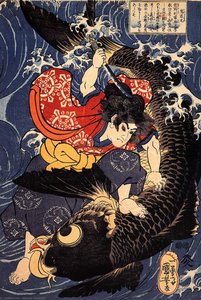
Retrato de Utagawa Kuniyoshi

Pinturas de Utagawa Kuniyoshi: As 100 mais famosas, sob o olhar de uma galeria

Atualizado em Novembro 2026 · classificado pela nossa pontuação de popularidade (pesquisas, visitas e pedidos de cada obra) · 329 obras de Utagawa Kuniyoshi em nosso catálogo

Em resumo

Aos olhos da galeria, a pintura mais famosa de Utagawa Kuniyoshi é Musashi on the back of a whale. Shikamatsu Kanroku Yukishige (1847) e Hatakeyama sitting next to a Go board (1845) completam o trio que todos reconhecem. Dos 329 trabalhos de Utagawa Kuniyoshi em nosso catálogo, a galeria apresenta abaixo as 100 obras mais famosas, cada uma original, com seu ano, seu museu e o que a torna única.

1798 – 1861, Tóquio Japanese ukiyo-e tradition Mais obras: Keio University Library

As 10 principais pinturas de Utagawa Kuniyoshi na galeria

1
Musashi on the back of a whale de Utagawa Kuniyoshi

Musashi on the back of a whale

Woodblock Print

This arresting image, a masterful execution of Ukiyo-e by the legendary artist Utagawa Kuniyoshi, transports us to 19th century Japan. Kuniyoshi, born Yoshisaburō in 1798 and tragically passing in 1861, was a pivotal figure at the close of the *ukiyo-e* movement – a vibrant artistic tradition that captured the essence of everyday life during the Edo period. This particular scene, depicting Musashi, the famed swordsman, astride a colossal whale, is…

2
Shikamatsu Kanroku Yukishige (1847) de Utagawa Kuniyoshi

Shikamatsu Kanroku Yukishige

1847 · Woodblock Print

Utagawa Kuniyoshi’s “Shikamatsu Kanroku Yukishige” (circa 1847) is more than a depiction of a samurai; it’s a potent distillation of Japanese heroism, loyalty, and the fleeting beauty of a moment captured in woodblock form. This iconic image, part of Kuniyoshi's celebrated series “Stories of the True Loyalty of the Faithful Samurai,” transports us to a pivotal scene from the classic tale of Suikoden – a story of betrayal, redemption, and…

3
Hatakeyama sitting next to a Go board (1845) de Utagawa Kuniyoshi

Hatakeyama sitting next to a Go board

1845 · Acrylic On Canvas

Utagawa Kuniyoshi’s “Hatakeyama Sitting Next to a Go Board” is more than just a depiction of a solitary figure; it's a window into the heart of 19th-century Japan. Painted in 1845, during a period of immense social and artistic change, this ukiyo-e masterpiece captures a quiet moment of contemplation – a scene imbued with layers of meaning reflecting the values and aesthetics of the Edo period. Kuniyoshi, one of the…

4
Yukukawa Sanpei Munenori (1848) de Utagawa Kuniyoshi

Yukukawa Sanpei Munenori

1848 · Acrylic

This exceptional ukiyo-e print, created in 1848 by the master artist Utagawa Kuniyoshi, offers a captivating glimpse into the world of Edo-period Japan. Depicting Yukukawa Sanpei Munenori, a figure likely rooted in historical or legendary lore, the artwork is far more than a simple portrait; it’s a dynamic tableau brimming with action, symbolism, and the raw energy of a warrior's spirit. Kuniyoshi’s skill lies not just in his technical prowess…

5
Os Vinte e Quatro Paragonas da Pietas Filial (1852) de Utagawa Kuniyoshi

Os Vinte e Quatro Paragonas da Pietas Filial

1852 · Xilogravura · Keio University Library, Tóquio

Uma Jornada ao Coração da Cultura Japonesa: O Pintado em Madeira "Os Quinze Virtudes Filiais" de Kuniyoshi O pintado em madeira “Os Quinze Virtudes Filiais” (十五孝行の霊感, *Juugo Kyōei no Rei Kan*) é uma obra monumental do artista Utagawa Kuniyoshi, um dos últimos grandes representantes da escola Utagawa e um símbolo da estética japonesa do período Edo (1603-1868). Criado em 1852, este trabalho transcende a mera reprodução visual; ele oferece uma…

6
Ôtaka Gengo Tadao (1848) de Utagawa Kuniyoshi

Ôtaka Gengo Tadao

1848 · Woodblock Print

Within the vibrant tapestry of Ukiyo-e prints, few images capture the raw power and stoic determination of a warrior quite like Utagawa Kuniyoshi's "Otaka Gengo Tadao," created in 1848. This remarkable woodblock print isn’t merely a depiction of a samurai; it’s a window into the heart of Edo-period Japan, brimming with tales of loyalty, honor, and the enduring spirit of martial prowess. Kuniyoshi, one of the last masters of this…

7
Oki no Jiro Hiroari killing a monstrous tengu de Utagawa Kuniyoshi

Oki no Jiro Hiroari killing a monstrous tengu

Woodblock Print

In the vibrant world of Ukiyo-e, few scenes command the eye with as much visceral intensity as Utagawa Kuniyoshi’s masterpiece, Oki no Jiro Hiroari killing a monstrous tengu. This dynamic mythological painting serves as a window into a moment of profound struggle, where the boundaries between the human and the supernatural blur amidst a backdrop of dark, foreboding shadows. The composition is anchored by the figure of Oki no Jiro…

8
Battle of Uji River. Uji kawa kassen no zu de Utagawa Kuniyoshi

Battle of Uji River. Uji kawa kassen no zu

Acrylic On Canvas · Hammer Museum, Los Angeles

Utagawa Kuniyoshi’s “Battle of Uji River,” painted between 1848 and 1850, stands as a quintessential example of *nishiki-e*, or polychrome woodblock printing, capturing the fervor and grandeur of samurai warfare against a backdrop of breathtaking natural beauty. This monumental print transcends mere depiction; it’s an immersive experience designed to evoke emotion and convey profound themes of courage, resilience, and the ephemeral nature of glory.

Pinturas de Utagawa Kuniyoshi, classificadas de 11 a 100

11The Twenty-four Paragons of Filial Piety in China , Script by Tanekazu : Ding Lan (Tei Ran) (1852) de Utagawa KuniyoshiThe Twenty-four Paragons of Filial Piety in China , Script by Tanekazu : Ding Lan (Tei Ran)1852 · Keio University Library 12Thirty-six Famous Battles (1848) de Utagawa KuniyoshiThirty-six Famous Battles1848 13Kiura Okaemon Sadayuki (1848) de Utagawa KuniyoshiKiura Okaemon Sadayuki1848 14The Heavenly Weaver and the Heardsman (1842) de Utagawa KuniyoshiThe Heavenly Weaver and the Heardsman1842 · Bristol Museum - Art Gallery 15Yata Gorôemon Suketake (1848) de Utagawa KuniyoshiYata Gorôemon Suketake1848 16Oniwakamaru and the Giant Carp Fighting Underwater (1835) de Utagawa KuniyoshiOniwakamaru and the Giant Carp Fighting Underwater1835 17A Votive Tablet with Masks of Kabuki Actors at Face Value de Utagawa KuniyoshiA Votive Tablet with Masks of Kabuki Actors at Face ValueFukuoka City Museum 18The actor (12) de Utagawa KuniyoshiThe actor (12) 19The Sixth Month (Right) (1849) de Utagawa KuniyoshiThe Sixth Month (Right)1849 · British Museum 20Bon-bon Uta,Children de Utagawa KuniyoshiBon-bon Uta,ChildrenFukuoka City Museum 21Scene from the play “The Life of Onoe Kikugorō III”\n\nScene from the play “The Life of Onoe Kikugorō III” (1847) de Utagawa KuniyoshiScene from the play “The Life of Onoe Kikugorō III”\n\nScene from the play “The Life of Onoe Kikugorō III”1847 · Art Museum Riga Bourse 22Minamoto Yorimitsu also known as Raiko de Utagawa KuniyoshiMinamoto Yorimitsu also known as Raiko 23Mount Fuji from the Sumida River embankment (1842) de Utagawa KuniyoshiMount Fuji from the Sumida River embankment1842 24A record of origins of the great country of Japan de Utagawa KuniyoshiA record of origins of the great country of Japan 25The actor (16) de Utagawa KuniyoshiThe actor (16) 26Seaweed Gatherers at Omari (1833) de Utagawa KuniyoshiSeaweed Gatherers at Omari1833 27The ghost of Taira Tomomori de Utagawa KuniyoshiThe ghost of Taira Tomomori 28Thaishun with elephants de Utagawa KuniyoshiThaishun with elephants 29Raiko tormented by the earth spider de Utagawa KuniyoshiRaiko tormented by the earth spider 30Benkei holdin a halberd de Utagawa KuniyoshiBenkei holdin a halberd 31A samurai overwhelming a giant serpent de Utagawa KuniyoshiA samurai overwhelming a giant serpent 32The Famous Unrivalled Hidari Jingoro de Utagawa KuniyoshiThe Famous Unrivalled Hidari Jingoro 33Samurai and the conquered de Utagawa KuniyoshiSamurai and the conquered 34Kamigashihime stabbing a giant spider de Utagawa KuniyoshiKamigashihime stabbing a giant spider 35Vesper bell at Todaiji de Utagawa KuniyoshiVesper bell at Todaiji 36Oniwakamaru about to kill the giant carp de Utagawa KuniyoshiOniwakamaru about to kill the giant carp 37Uneme is exorcising the monstrous serpent from the lake de Utagawa KuniyoshiUneme is exorcising the monstrous serpent from the lake 38Shoki and Demon, Edo period (1850) de Utagawa KuniyoshiShoki and Demon, Edo period1850 · Arthur M. Sackler Gallery 39Nichiren going into exile on the island of Sado de Utagawa KuniyoshiNichiren going into exile on the island of Sado 40Uchiwakamaru fighting Benkei on Gojo bridge de Utagawa KuniyoshiUchiwakamaru fighting Benkei on Gojo bridge 41The young Benkei holding a pole de Utagawa KuniyoshiThe young Benkei holding a pole 42New edition of the life of a hundred generals de Utagawa KuniyoshiNew edition of the life of a hundred generals 43Sharks de Utagawa KuniyoshiSharks 44Koga Saburo, suspendeding a basket, watching a dragon de Utagawa KuniyoshiKoga Saburo, suspendeding a basket, watching a dragon 45Kamei Rokuro and the Black Bear in the Snow (1849) de Utagawa KuniyoshiKamei Rokuro and the Black Bear in the Snow1849 46Hattara Sonja with his white tiger de Utagawa KuniyoshiHattara Sonja with his white tiger 47Ishi-jo, wife of Oboshi Yoshio, one of the loyal ronin (1848) de Utagawa KuniyoshiIshi-jo, wife of Oboshi Yoshio, one of the loyal ronin1848 48Untitled (D2X8SB) (801) de Utagawa KuniyoshiUntitled (D2X8SB)801 · Metropolitan Museum of Art 49Yoshida Sadaemon Kanesada (1848) de Utagawa KuniyoshiYoshida Sadaemon Kanesada1848 50Hara Gôemon Mototoki (1848) de Utagawa KuniyoshiHara Gôemon Mototoki1848 51Woodcut (1852) de Utagawa KuniyoshiWoodcut1852 · Museum of Far Eastern Antiquities 52Woodcut (1852) de Utagawa KuniyoshiWoodcut1852 · Museum of Far Eastern Antiquities 53Island Enoshima. The Fuji can be seen far away de Utagawa KuniyoshiIsland Enoshima. The Fuji can be seen far away 54Hayano Kanpei Tsuneyo (1848) de Utagawa KuniyoshiHayano Kanpei Tsuneyo1848 · Cleveland Museum of Art 55In the Waves at Kakuda enroute to Sado Island, Edo period (1835) de Utagawa KuniyoshiIn the Waves at Kakuda enroute to Sado Island, Edo period1835 · Arthur M. Sackler Gallery 56Woman selling decorative bowls de Utagawa KuniyoshiWoman selling decorative bowls 57A fierce depiction of Uesugi Kenshin seated (1844) de Utagawa KuniyoshiA fierce depiction of Uesugi Kenshin seated1844 58The Twenty-four Paragons of Filial Piety in China, Script by Tanekazu : Emperor Wen of Han (Kan no Buntei) (1852) de Utagawa KuniyoshiThe Twenty-four Paragons of Filial Piety in China, Script by Tanekazu : Emperor Wen of Han (Kan no Buntei)1852 · Keio University Library 59The Twenty-four Paragons of Filial Piety in China , Script by Tanekazu : Cai Shun (Sai Jun) (1852) de Utagawa KuniyoshiThe Twenty-four Paragons of Filial Piety in China , Script by Tanekazu : Cai Shun (Sai Jun)1852 · Keio University Library 60Isoai Jûroemon Masahisa (1848) de Utagawa KuniyoshiIsoai Jûroemon Masahisa1848 61Tokuda Sadaemon Yukitaka (1848) de Utagawa KuniyoshiTokuda Sadaemon Yukitaka1848 62Tamakatzura Tamatori attacked by the octopus de Utagawa KuniyoshiTamakatzura Tamatori attacked by the octopus 63Bijin with a dog in the snow (1845) de Utagawa KuniyoshiBijin with a dog in the snow1845 64From Suikoden of Japanese Heroes de Utagawa KuniyoshiFrom Suikoden of Japanese Heroes 65Hatakeyama Shigetada de Utagawa KuniyoshiHatakeyama Shigetada 66The sailor Tokuso and the sea monster de Utagawa KuniyoshiThe sailor Tokuso and the sea monster 67Tokiwa Gozen in the snow de Utagawa KuniyoshiTokiwa Gozen in the snow 68Mongaku doing penace at the Nachi waterfall de Utagawa KuniyoshiMongaku doing penace at the Nachi waterfall 69Eight Hundred Heroes of Our Country de Utagawa KuniyoshiEight Hundred Heroes of Our Country 70The suicide of morozumi Masakiyo de Utagawa KuniyoshiThe suicide of morozumi Masakiyo 71Tametomo rescued from the sea monster by tengu de Utagawa KuniyoshiTametomo rescued from the sea monster by tengu 72Miyamoto Musashi killing a giant de Utagawa KuniyoshiMiyamoto Musashi killing a giant 73The Twenty-four Paragons of Filial Piety in China , Script by Tanekazu : Tanzi (Enshi) (1852) de Utagawa KuniyoshiThe Twenty-four Paragons of Filial Piety in China , Script by Tanekazu : Tanzi (Enshi)1852 · Keio University Library 74The Twenty-four Paragons of Filial Piety in China , Script by Tanekazu : Jiang Shi (Kyo Shi) (1852) de Utagawa KuniyoshiThe Twenty-four Paragons of Filial Piety in China , Script by Tanekazu : Jiang Shi (Kyo Shi)1852 · Keio University Library 75Hawk de Utagawa KuniyoshiHawk 76Tengu de Utagawa KuniyoshiTengu 77Otsu-e Paintings Coming Alive Triptych (1847) de Utagawa KuniyoshiOtsu-e Paintings Coming Alive Triptych1847 78Lady-in-Waiting at Edo Castle (1854) de Utagawa KuniyoshiLady-in-Waiting at Edo Castle1854 79Bando Shuka I as the courtesan Shiraito of Hashimoto-ya (1852) de Utagawa KuniyoshiBando Shuka I as the courtesan Shiraito of Hashimoto-ya1852 · Art Gallery of New South Wales 80Self-portrait of the Shunga album de Utagawa KuniyoshiSelf-portrait of the Shunga album 81Saitogo Kunitake, Japanese actor (1816) de Utagawa KuniyoshiSaitogo Kunitake, Japanese actor1816 82Kuroda Ukinaga, Japanese actor (1816) de Utagawa KuniyoshiKuroda Ukinaga, Japanese actor1816 83Sosan returning to his mother (1840) de Utagawa KuniyoshiSosan returning to his mother1840 84Strings for night firing de Utagawa KuniyoshiStrings for night firing 85Woman catching firefly by a stream de Utagawa KuniyoshiWoman catching firefly by a stream 86Nakamura Kansuke Tadatoki (1848) de Utagawa KuniyoshiNakamura Kansuke Tadatoki1848 87Yazama Shinroku Mitsukaze (1848) de Utagawa KuniyoshiYazama Shinroku Mitsukaze1848 88Oribe Yasubei Taketsune (1848) de Utagawa KuniyoshiOribe Yasubei Taketsune1848 89Katsuta Shin'emon Taketaka (1848) de Utagawa KuniyoshiKatsuta Shin'emon Taketaka1848 90Senzaki Yagorô Noriyasu (1848) de Utagawa KuniyoshiSenzaki Yagorô Noriyasu1848 91Ôboshi Rikiya Yoshikane (1848) de Utagawa KuniyoshiÔboshi Rikiya Yoshikane1848 92Hayano Wasuke Tsunenari (1848) de Utagawa KuniyoshiHayano Wasuke Tsunenari1848 93Writing a Label for Chrysanthemums (1844) de Utagawa KuniyoshiWriting a Label for Chrysanthemums1844 94Shikamatsu Kanroku’s Manservant, Jinzaburô (1848) de Utagawa KuniyoshiShikamatsu Kanroku’s Manservant, Jinzaburô1848 95Tokiwa-Gozen with her three children in the snow (1840) de Utagawa KuniyoshiTokiwa-Gozen with her three children in the snow1840 96Neve, the moon is chilling (1845) de Utagawa KuniyoshiNeve, the moon is chilling1845 97Shoriko kaei shooting a wild goose de Utagawa KuniyoshiShoriko kaei shooting a wild goose 98One Hundred and Eight Heroes from the Chinese Tale, The Water Margin- Zhang Shun, alias White Stripe... de Utagawa KuniyoshiOne Hundred and Eight Heroes from the Chinese Tale, The Water Margin- Zhang Shun, alias White Stripe...Tokyo National Museum 99Head of a Courtesan de Utagawa KuniyoshiHead of a CourtesanHarvard Art Museums 100Ishiyakushi de Utagawa KuniyoshiIshiyakushi

Pinturas famosas de Utagawa Kuniyoshi, período por período

Os temas que cativaram o olhar de Utagawa Kuniyoshi

Os quatro temas que mais se repetem nestas obras originais, cada um com o seu melhor exemplo.

Os museus que guardam os originais de Utagawa Kuniyoshi

Os 8 museus que detêm a maioria das pinturas desta página.

Museus Cidade Obras de Utagawa Kuniyoshi Pinturas desta lista
Keio University Library, TóquioKeio University Library Tóquio 8 Os Vinte e Quatro Paragonas da Pietas Filial, The Twenty-four Paragons of Filial Piety in China , Script by Tanekazu : Guo Ju (Kaku Kyo), The Twenty-four Paragons of Filial Piety in China , Script by Tanekazu : Lu Ji (Riku Seki)
Fukuoka City Museum, FukuokaFukuoka City Museum Fukuoka 4 A Votive Tablet with Masks of Kabuki Actors at Face Value, Bon-bon Uta,Children
Arthur M. Sackler Gallery, Washington, D.C.Arthur M. Sackler Gallery Washington, D.C. 2 Shoki and Demon, Edo period, In the Waves at Kakuda enroute to Sado Island, Edo period
Museum of Far Eastern Antiquities, StockholmMuseum of Far Eastern Antiquities Stockholm 2 Woodcut, Woodcut
Hammer Museum, Los AngelesHammer Museum Los Angeles 2 Battle of Uji River. Uji kawa kassen no zu
Tokyo National Museum, TóquioTokyo National Museum Tóquio 2 One Hundred and Eight Heroes from the Chinese Tale, The Water Margin- Zhang Shun, alias White Stripe...
Bristol Museum - Art Gallery, BristolBristol Museum - Art Gallery Bristol 1 The Heavenly Weaver and the Heardsman
British Museum, LondresBritish Museum Londres 1 The Sixth Month (Right)

Utagawa Kuniyoshi, uma pintura emblemática por década

Obras por década

Escolha uma década para ver a obra original que a define.

Pinturas de Utagawa Kuniyoshi: a galeria responde

Qual pintura de Utagawa Kuniyoshi é a mais famosa de todas?Revelar a resposta

Musashi on the back of a whale. Shikamatsu Kanroku Yukishige (1847) e Hatakeyama sitting next to a Go board (1845) vêm a seguir.

Quais são as 10 principais pinturas de Utagawa Kuniyoshi?Revelar a resposta

Musashi on the back of a whale, Shikamatsu Kanroku Yukishige, Hatakeyama sitting next to a Go board, Yukukawa Sanpei Munenori, Os Vinte e Quatro Paragonas da Pietas Filial, Ôtaka Gengo Tadao, Oki no Jiro Hiroari killing a monstrous tengu, Battle of Uji River. Uji kawa kassen no zu, The Twenty-four Paragons of Filial Piety in China , Script by Tanekazu : Guo Ju (Kaku Kyo) e The Twenty-four Paragons of Filial Piety in China , Script by Tanekazu : Lu Ji (Riku Seki). O ranking acima apresenta o ano e o museu de cada uma.

Quantas obras Utagawa Kuniyoshi criou?Revelar a resposta

Nosso catálogo contém 329 obras de Utagawa Kuniyoshi, datadas de 1816 a 1854.

Onde estão expostos os originais mais famosos de Utagawa Kuniyoshi?Revelar a resposta

Principalmente em Keio University Library (Tóquio), Fukuoka City Museum (Fukuoka) e Arthur M. Sackler Gallery (Washington, D.C.). A tabela de museus acima lista todos eles.

Quando é que Utagawa Kuniyoshi criou as suas pinturas mais famosas?Revelar a resposta

Em 1840s: 33 das 100 obras nesta página foram feitas então, sendo Shikamatsu Kanroku Yukishige delas.

Quais são as obras mais famosas de Utagawa Kuniyoshi no início e no fim de sua carreira?Revelar a resposta

Nesta página, a mais antiga é Saitogo Kunitake, Japanese actor (1816) e a mais recente é Lady-in-Waiting at Edo Castle (1854).

Quais temas Utagawa Kuniyoshi mais explorou?Revelar a resposta

Warrior (14), Samurai (14) e Edo period (14), entre as 100 obras nesta página.

Em qual técnica Utagawa Kuniyoshi mais trabalhou?Revelar a resposta

Woodblock Print, para 55 das 100 obras nesta página.

Com qual movimento Utagawa Kuniyoshi está associado(a)?Revelar a resposta

Japanese ukiyo-e tradition, a julgar pelos originais nesta página.

Quais obras originais de Utagawa Kuniyoshi o Keio University Library possui?Revelar a resposta

Os Vinte e Quatro Paragonas da Pietas Filial, The Twenty-four Paragons of Filial Piety in China , Script by Tanekazu : Guo Ju (Kaku Kyo) e The Twenty-four Paragons of Filial Piety in China , Script by Tanekazu : Lu Ji (Riku Seki): o Keio University Library, Tóquio detém 8 das obras desta página.

Utagawa Kuniyoshi: o artista

A Vida e a Arte de Utagawa Kuniyoshi: Um Mestre da Transição

Utagawa Kuniyoshi, nascido Yoshisaburō em 1º de janeiro de 1798, em Edo (atual Tóquio), é uma figura monumental no final da tradição *ukiyo-e* – as “imagens do mundo flutuante” que capturaram tão vívida a vida japonesa durante o período Edo. Sua jornada não começou nos círculos artísticos, mas sim no reino prático de seu pai, um tintureiro de seda. Essa exposição precoce à cor e ao padrão influenciaria sutilmente seu trabalho posterior, imbuindo-o com uma vibrância distinta. Mesmo jovem, Kuniyoshi foi cativado pelo mundo dramático do *ukiyo-e*, particularmente pela representação de guerreiros e artesãos heroicos que povoavam as estampas populares. Essas impressões formativas acenderam em sua alma uma paixão que definiria sua busca incessante. Ele ingressou no estúdio de Utagawa Toyokuni I em 1811, adotando o nome artístico Kuniyoshi e embarcando em um rigoroso aprendizado que aprimoraria suas habilidades e o apresentaria às convenções da escola Utagawa.

Das Origens Modestas à Inovação Magistral

A carreira inicial de Kuniyoshi foi marcada por um período de relativa obscuridade. Embora proficiente nos estilos estabelecidos, ele lutava para encontrar sua voz única no mar movimentado do grafismo de Edo. Seus primeiros trabalhos refletiam em grande parte os de seu mestre, oferecendo pouco que o distinguisse dos contemporâneos. No entanto, este período de experimentação provou ser crucial. Ele se aventurou em vários gêneros e técnicas, desenvolvendo gradualmente uma abordagem distinta caracterizada por composições dinâmicas, cores ousadas e uma compreensão cada vez mais sofisticada da narrativa. O ponto de virada veio em 1827 com a publicação de *Os Oitenta e Oito Heróis do Popular Suikoden*, uma série monumental baseada no romance chinês *Shui Hu Zhuan*. Esta obra catapultou Kuniyoshi ao estrelato, estabelecendo-o como mestre do *musha-e* – estampas de guerreiros. A série não era apenas uma ilustração de contos heroicos; era uma demonstração da crescente habilidade de Kuniyoshi em composição dramática e caracterização. Ele não simplesmente retratava guerreiros; ele os trazia à vida com emoção convincente e detalhes intrincados.

Uma Síntese de Tradição e Influência Ocidental

O que realmente distingue Kuniyoshi é sua disposição para abraçar a inovação, mantendo-se profundamente enraizado nas tradições artísticas japonesas. À medida que o período Edo chegava ao fim, o Japão experimentava um aumento do contato com o Ocidente, e Kuniyoshi foi um dos primeiros artistas *ukiyo-e* a incorporar elementos da perspectiva e do sombreamento ocidentais em seu trabalho. Isso não era apenas imitação; ele integrava habilmente essas técnicas para aumentar a profundidade, o realismo e o impacto dramático. Suas paisagens, em particular, demonstram um domínio magistral dos efeitos atmosféricos e das relações espaciais, muitas vezes evocando uma sensação de grandeza e admiração. Além da técnica, Kuniyoshi expandiu o assunto das estampas *ukiyo-e*. Embora temas tradicionais como belas mulheres e atores kabuki permanecessem populares, ele se aventurou em novos territórios, retratando cenas históricas, criaturas míticas e até mesmo comentários satíricos sobre a sociedade contemporânea. Sua triptique *Na Residência de Minamoto, uma Aranha Monstruosa Aparece como um Monstro* (1843) é um exemplo primário desta abordagem ousada, disfarçando habilmente críticas políticas dentro de um narrativo fantástico.

Conquistas Notáveis e Legado Duradouro

A influência de Kuniyoshi nas gerações posteriores de artistas é inegável. Ele deixou para trás uma vasta e diversificada coleção de trabalhos – estimada em mais de 5.000 designs – que continuam a inspirar admiração e fascínio hoje. Sua síntese única de estética japonesa tradicional com técnicas ocidentais abriu novos caminhos artísticos, enquanto sua disposição para desafiar convenções ampliou o escopo do *ukiyo-e*. Ele treinou inúmeros alunos, incluindo Yoshitoshi, que continuariam seu legado no período Meiji.
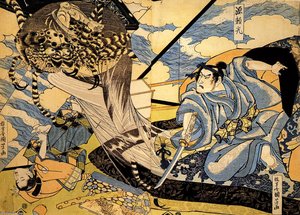
  • Séries Notáveis: *Os Oitenta e Oito Heróis do Popular Suikoden*, uma conquista notável na arte de estampas de guerreiros.
  • Composições Magistrais: Sua capacidade de criar cenas dinâmicas e visualmente impressionantes é incomparável.
  • Técnicas Inovadoras: A integração da perspectiva e do sombreamento ocidentais revolucionou a pintura de paisagens *ukiyo-e*.
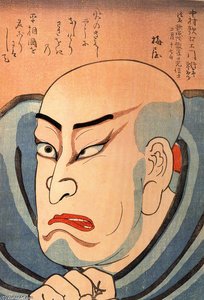
  • Assunto Expandido: Ele expandiu os limites do *ukiyo-e*, explorando novos temas e narrativas.
A arte de Kuniyoshi é mais do que apenas imagens bonitas; é uma janela para uma época fascinante, um testemunho do poder da inovação artística e uma celebração do espírito duradouro do Japão. Ele faleceu em 14 de abril de 1861, deixando para trás um legado que firmemente consolidou seu lugar como um dos últimos grandes mestres do *ukiyo-e*.