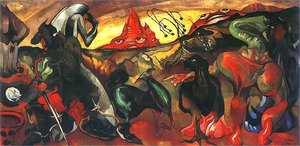
Retrato de Stanisław Ignacy Witkiewicz

Pinturas de Stanisław Ignacy Witkiewicz: As 100 mais famosas, sob o olhar de uma galeria

Atualizado em Outubro 2026 · classificado pela nossa pontuação de popularidade (pesquisas, visitas e pedidos de cada obra) · 165 obras de Stanisław Ignacy Witkiewicz em nosso catálogo

Em resumo

Aos olhos da galeria, a pintura mais famosa de Stanisław Ignacy Witkiewicz é Multiple portrait (1917). General Confusion (1920) e Portrait of Gabriela Czarnocka – Berezowska (1912) completam o trio que todos reconhecem. Dos 165 trabalhos de Stanisław Ignacy Witkiewicz em nosso catálogo, a galeria apresenta abaixo as 100 obras mais famosas, cada uma original, com seu ano, seu museu e o que a torna única.

1885 – 1939, Varsóvia Expressionism Mais obras: Museu Nacional de Cracóvia

As 10 principais pinturas de Stanisław Ignacy Witkiewicz na galeria

1
Multiple portrait (1917) de Stanisław Ignacy Witkiewicz

Multiple portrait

1917 · Black and White Photography

In this intriguing photograph titled Multiple portrait, the artist Stanisław Ignacy Witkiewicz explores the complexities of identity through a series of reflections. Created about 1917, the work functions as a multiple self-portrait in mirrors, capturing the artist in a moment of profound introspection. It is a quiet, experimental piece that moves beyond simple representation to examine how a single presence can be fragmented and multiplied.

2
General Confusion (1920) de Stanisław Ignacy Witkiewicz

General Confusion

1920 · Oil · Muzeum Narodowe w Pozaniu, Poznań

In this 1920 composition, we find ourselves observing a scene that feels both crowded and strangely isolated. The painting presents a collection of figures, some standing in quiet observation while others are seated or reclined, caught in a moment of collective leisure. There is a certain restlessness to the arrangement; people appear to be engaged in games or simple social interaction, yet the atmosphere remains unsettled. A single bird occupies…

4
Portrait of a woman (1918) de Stanisław Ignacy Witkiewicz

Portrait of a woman

1918 · Oil On Canvas · Museu Nacional de Cracóvia, Cracóvia

In the painting Portrait of a woman by Stanisław Ignacy Witkiewicz, the composition is a close-up bust-length portrait. The subject, a young woman, is positioned slightly off-center within the frame. She maintains a direct gaze toward the viewer. Her expression is contemplative and carries a somewhat melancholic quality. The large, luminous eyes of the subject act as the primary focal point of the work. This portrait was created about 1918.

Pinturas de Stanisław Ignacy Witkiewicz, classificadas de 11 a 100

11Portrait of Governess of Urszula Bogdańska, née Komorowska (1907) de Stanisław Ignacy WitkiewiczPortrait of Governess of Urszula Bogdańska, née Komorowska1907 12Fatigued by self-peculiarity (1910) de Stanisław Ignacy WitkiewiczFatigued by self-peculiarity1910 13Casting out of a demon (1907) de Stanisław Ignacy WitkiewiczCasting out of a demon1907 14Portrait of Doctor Ignacy Wasserberg (1910) de Stanisław Ignacy WitkiewiczPortrait of Doctor Ignacy Wasserberg1910 · Museu Nacional de Cracóvia 15Portrait of father (1907) de Stanisław Ignacy WitkiewiczPortrait of father1907 · Tatra Museum in Zakopane 16Death (1910) de Stanisław Ignacy WitkiewiczDeath1910 17Self-portrait (1911) de Stanisław Ignacy WitkiewiczSelf-portrait1911 18Princess Kościełło (1910) de Stanisław Ignacy WitkiewiczPrincess Kościełło1910 19Scene in a Garden (1907) de Stanisław Ignacy WitkiewiczScene in a Garden1907 20Landscape scene (1911) de Stanisław Ignacy WitkiewiczLandscape scene1911 21Copy of Paula Gauguin painting "Te Arii Vahine" (1908) de Stanisław Ignacy WitkiewiczCopy of Paula Gauguin painting "Te Arii Vahine"1908 22Portrait of Helena Czerwijowska (1910) de Stanisław Ignacy WitkiewiczPortrait of Helena Czerwijowska1910 23Decadence (1911) de Stanisław Ignacy WitkiewiczDecadence1911 · Museu Nacional de Cracóvia 24Portrait of Doctor Ignacy Wasserberg (1910) de Stanisław Ignacy WitkiewiczPortrait of Doctor Ignacy Wasserberg1910 · District Museum in Toruń 25Self-portrait against the door background (1910) de Stanisław Ignacy WitkiewiczSelf-portrait against the door background1910 · The National Museum in Poznań 26Death (1906) de Stanisław Ignacy WitkiewiczDeath1906 27Self-portrait based on reflection of the glass (1906) de Stanisław Ignacy WitkiewiczSelf-portrait based on reflection of the glass1906 · Museum of Middle Pomerania in Słupsk 28Self-portrait with apples. (1913) de Stanisław Ignacy WitkiewiczSelf-portrait with apples.1913 · Museu Nacional de Varsóvia 29Portrait of Tadeusz Nalepinski, with sculptures (1912) de Stanisław Ignacy WitkiewiczPortrait of Tadeusz Nalepinski, with sculptures1912 30Portrait of a woman with a little dog (1912) de Stanisław Ignacy WitkiewiczPortrait of a woman with a little dog1912 31Portrait of Eugenia Dunin-Borkowska, with paintings in the background (1912) de Stanisław Ignacy WitkiewiczPortrait of Eugenia Dunin-Borkowska, with paintings in the background1912 32Xerxes Jakszma (1912) de Stanisław Ignacy WitkiewiczXerxes Jakszma1912 33Bronia Malinowski's dream about life in itself (1912) de Stanisław Ignacy WitkiewiczBronia Malinowski's dream about life in itself1912 34Father with daughter (1915) de Stanisław Ignacy WitkiewiczFather with daughter1915 35Portrait of Tadeusz Langer (1912) de Stanisław Ignacy WitkiewiczPortrait of Tadeusz Langer1912 36Batallistic painting (1913) de Stanisław Ignacy WitkiewiczBatallistic painting1913 37Portrait of Bronisław Piłsudski (1912) de Stanisław Ignacy WitkiewiczPortrait of Bronisław Piłsudski1912 38Lithuenian Duke Tadeusz Fiend Korwicz Korniło Korniłowicz, chairman for the preservation of the mountain pine (1912) de Stanisław Ignacy WitkiewiczLithuenian Duke Tadeusz Fiend Korwicz Korniło Korniłowicz, chairman for the preservation of the mountain pine1912 39Aviator Elzenberg, with planes in the background (1912) de Stanisław Ignacy WitkiewiczAviator Elzenberg, with planes in the background1912 40Composition with female figures (1917) de Stanisław Ignacy WitkiewiczComposition with female figures1917 · Museu Nacional de Cracóvia 41Costume composition in a landscape (1912) de Stanisław Ignacy WitkiewiczCostume composition in a landscape1912 · National Museum in Wrocław 42Portrait of Maria Witkiewiczówna (1913) de Stanisław Ignacy WitkiewiczPortrait of Maria Witkiewiczówna1913 43Portrait of Professor Leon Chwistek (1913) de Stanisław Ignacy WitkiewiczPortrait of Professor Leon Chwistek1913 44Portrait of Eugenia Dunin-Borkowska (1912) de Stanisław Ignacy WitkiewiczPortrait of Eugenia Dunin-Borkowska1912 · District Museum in Toruń 45Portrait of Maria Zielińska (1914) de Stanisław Ignacy WitkiewiczPortrait of Maria Zielińska1914 · Museum of Middle Pomerania in Słupsk 46Portrait of an officer with a cigarete (1917) de Stanisław Ignacy WitkiewiczPortrait of an officer with a cigarete1917 · Museu Nacional de Cracóvia 47Two heads (1920) de Stanisław Ignacy WitkiewiczTwo heads1920 · Museum of Art in Łódź 48After-image of the sun (1920) de Stanisław Ignacy WitkiewiczAfter-image of the sun1920 · Museu Nacional de Varsóvia 49Portrait of a woman (1919) de Stanisław Ignacy WitkiewiczPortrait of a woman1919 50Viburnum manors (1921) de Stanisław Ignacy WitkiewiczViburnum manors1921 · Museu Nacional de Varsóvia 51This is this strange vain (1918) de Stanisław Ignacy WitkiewiczThis is this strange vain1918 52The first love of the idiot Demon (1920) de Stanisław Ignacy WitkiewiczThe first love of the idiot Demon1920 53Portrait of Józef Diehl, with mountains in the background (1918) de Stanisław Ignacy WitkiewiczPortrait of Józef Diehl, with mountains in the background1918 54Portrait of a woman, "second painting" (1919) de Stanisław Ignacy WitkiewiczPortrait of a woman, "second painting"1919 55Elemental battle (1921) de Stanisław Ignacy WitkiewiczElemental battle1921 56Struggle (1920) de Stanisław Ignacy WitkiewiczStruggle1920 · National Museum in Kielce 57Crime (1921) de Stanisław Ignacy WitkiewiczCrime1921 58Still life (1921) de Stanisław Ignacy WitkiewiczStill life1921 59Bullying of pępits (1921) de Stanisław Ignacy WitkiewiczBullying of pępits1921 60Composition with monsters and nude (1921) de Stanisław Ignacy WitkiewiczComposition with monsters and nude1921 61Moulay Chekke's confession of love to the Phoenixan princess (1922) de Stanisław Ignacy WitkiewiczMoulay Chekke's confession of love to the Phoenixan princess1922 62Looking for a new star (1922) de Stanisław Ignacy WitkiewiczLooking for a new star1922 · Museu Nacional de Varsóvia 63Composition (1922) de Stanisław Ignacy WitkiewiczComposition1922 · Museu Nacional de Cracóvia 64Composition with rhinoceros (1918) de Stanisław Ignacy WitkiewiczComposition with rhinoceros1918 65Portrait of Anna and Jarosław Iwaszkiewicz (1922) de Stanisław Ignacy WitkiewiczPortrait of Anna and Jarosław Iwaszkiewicz1922 66Composition with a sleeping woman and a monster (Suicide) (1920) de Stanisław Ignacy WitkiewiczComposition with a sleeping woman and a monster (Suicide)1920 · Museu Nacional de Varsóvia 67Nitrogen, Phosphorus and Arsenic (1918) de Stanisław Ignacy WitkiewiczNitrogen, Phosphorus and Arsenic1918 68Visiting a Maharaja (1920) de Stanisław Ignacy WitkiewiczVisiting a Maharaja1920 · District Museum in Toruń 69Marysia with the dog Burek on Ceylon (1920) de Stanisław Ignacy WitkiewiczMarysia with the dog Burek on Ceylon1920 · Museu Nacional de Cracóvia 70Temptation of St. Anthony 1. (1918) de Stanisław Ignacy WitkiewiczTemptation of St. Anthony 1.1918 · Museu Nacional de Cracóvia 71Spirits of drowned women (1921) de Stanisław Ignacy WitkiewiczSpirits of drowned women1921 · Museu Nacional de Cracóvia 72Composition (1922) de Stanisław Ignacy WitkiewiczComposition1922 · Museu Nacional de Cracóvia 73Composition with a dancer (1920) de Stanisław Ignacy WitkiewiczComposition with a dancer1920 · Museu Nacional de Cracóvia 74Laughing boy (1920) de Stanisław Ignacy WitkiewiczLaughing boy1920 75Fantasia – Bajka (1922) de Stanisław Ignacy WitkiewiczFantasia – Bajka1922 · Muzeum Narodowe w Warszawie 76The Drowning (1921) de Stanisław Ignacy WitkiewiczThe Drowning1921 77Creating the world (1922) de Stanisław Ignacy WitkiewiczCreating the world1922 · Museum of Art in Łódź 78Portrait of Maria Stawarska-Golińska (1927) de Stanisław Ignacy WitkiewiczPortrait of Maria Stawarska-Golińska1927 · Museu Nacional de Varsóvia 79Paleofaja (1927) de Stanisław Ignacy WitkiewiczPaleofaja1927 80Composition (1924) de Stanisław Ignacy WitkiewiczComposition1924 81Dream (1923) de Stanisław Ignacy WitkiewiczDream1923 82Self-portrait (1923) de Stanisław Ignacy WitkiewiczSelf-portrait1923 · Podlaskie Museum in Białystok 83Fantastic composition (1923) de Stanisław Ignacy WitkiewiczFantastic composition1923 · Museu Nacional de Varsóvia 84A short romance ... (1924) de Stanisław Ignacy WitkiewiczA short romance ...1924 · Museum of Middle Pomerania in Słupsk 85Self-Portrait, "Convict's Last Cigarette" (1924) de Stanisław Ignacy WitkiewiczSelf-Portrait, "Convict's Last Cigarette"1924 86Michal Choromariski (1928) de Stanisław Ignacy WitkiewiczMichal Choromariski1928 · Muzeum Narodowe w Warszawie 87Siesta (1933) de Stanisław Ignacy WitkiewiczSiesta1933 · Upper Silesian Museum in Bytom 88Feast of fried cherries (1931) de Stanisław Ignacy WitkiewiczFeast of fried cherries1931 · Museu Nacional de Varsóvia 89Fairy tale II (1932) de Stanisław Ignacy WitkiewiczFairy tale II1932 · Upper Silesian Museum in Bytom 90Fairy tale I (1932) de Stanisław Ignacy WitkiewiczFairy tale I1932 · Upper Silesian Museum in Bytom 91Coat of arms of the Schludermann family (1931) de Stanisław Ignacy WitkiewiczCoat of arms of the Schludermann family1931 92Hopeless boredom (1932) de Stanisław Ignacy WitkiewiczHopeless boredom1932 93Portrait of Maria Gałyńska in a landscape with monsters (1929) de Stanisław Ignacy WitkiewiczPortrait of Maria Gałyńska in a landscape with monsters1929 · Museu Nacional de Varsóvia 94The Specter of Odysseus ... (1936) de Stanisław Ignacy WitkiewiczThe Specter of Odysseus ...1936 · Museum of Middle Pomerania in Słupsk 95Avian Aunte ... (1936) de Stanisław Ignacy WitkiewiczAvian Aunte ...1936 · Museum of Middle Pomerania in Słupsk 96Prof. Cynaderkiewicz ... (1936) de Stanisław Ignacy WitkiewiczProf. Cynaderkiewicz ...1936 · Museum of Middle Pomerania in Słupsk 97Portrait of Mieczysław Gajewicz (1936) de Stanisław Ignacy WitkiewiczPortrait of Mieczysław Gajewicz1936 98Two heads (1920) de Stanisław Ignacy WitkiewiczTwo heads1920 99Still life with a clock (1921) de Stanisław Ignacy WitkiewiczStill life with a clock1921 · Museu Nacional de Cracóvia 100Osobita (1891) de Stanisław Ignacy WitkiewiczOsobita1891

Os temas que cativaram o olhar de Stanisław Ignacy Witkiewicz

Os quatro temas que mais se repetem nestas obras originais, cada um com o seu melhor exemplo.

Os museus que guardam os originais de Stanisław Ignacy Witkiewicz

Os 8 museus que detêm a maioria das pinturas desta página.

Museu Cidade Obras de Stanisław Ignacy Witkiewicz Pinturas desta lista
Museu Nacional de Cracóvia, CracóviaMuseu Nacional de Cracóvia Cracóvia 16 Portrait of Gabriela Czarnocka – Berezowska, Portrait of a woman, Portrait of Doctor Ignacy Wasserberg
Museu Nacional de Varsóvia, VarsóviaMuseu Nacional de Varsóvia Varsóvia 15 Composition with five figures, Self-portrait with apples., After-image of the sun
Museum of Middle Pomerania in Słupsk, SłupskMuseum of Middle Pomerania in Słupsk Słupsk 12 Self-portrait based on reflection of the glass, Portrait of Maria Zielińska, A short romance ...
District Museum in Toruń, ToruńDistrict Museum in Toruń Toruń 3 Portrait of Doctor Ignacy Wasserberg, Portrait of Eugenia Dunin-Borkowska, Visiting a Maharaja
Upper Silesian Museum in Bytom, BytomUpper Silesian Museum in Bytom Bytom 3 Siesta, Fairy tale II, Fairy tale I
Museum of Art in Łódź, ŁódźMuseum of Art in Łódź Łódź 3 Two heads, Creating the world
Muzeum Narodowe w Warszawie, WarsawMuzeum Narodowe w Warszawie Warsaw 3 Fantasia – Bajka, Michal Choromariski
Tatra Museum in Zakopane, ZakopaneTatra Museum in Zakopane Zakopane 9 Portrait of father

Stanisław Ignacy Witkiewicz, uma pintura emblemática por década

Obras por década

Escolha uma década para ver a obra original que a define.

Pinturas de Stanisław Ignacy Witkiewicz: a galeria responde

Qual pintura de Stanisław Ignacy Witkiewicz é a mais famosa de todas?Revelar a resposta

Multiple portrait (1917). General Confusion (1920) e Portrait of Gabriela Czarnocka – Berezowska (1912) vêm a seguir.

Qual era a idade de Stanisław Ignacy Witkiewicz ao concluir Multiple portrait?Revelar a resposta

32 anos: Multiple portrait data de 1917, e Stanisław Ignacy Witkiewicz nasceu em 1885.

Quais são as 10 principais pinturas de Stanisław Ignacy Witkiewicz?Revelar a resposta

Multiple portrait, General Confusion, Portrait of Gabriela Czarnocka – Berezowska, Portrait of a woman, Portrait of a boy, Locomotive in a tunnel, Composition with six figures, Portrait of Janek Witkiewicz, Composition with five figures e Composition. O ranking acima apresenta o ano e o museu de cada uma.

Quantas obras Stanisław Ignacy Witkiewicz criou?Revelar a resposta

Nosso catálogo contém 165 obras de Stanisław Ignacy Witkiewicz, datadas de 1893 a 1936.

Onde estão expostos os originais mais famosos de Stanisław Ignacy Witkiewicz?Revelar a resposta

Principalmente em Museu Nacional de Cracóvia (Cracóvia), Museu Nacional de Varsóvia (Varsóvia) e Museum of Middle Pomerania in Słupsk (Słupsk). A tabela de museus acima lista todos eles.

Quando é que Stanisław Ignacy Witkiewicz criou as suas pinturas mais famosas?Revelar a resposta

Em 1910s: 41 das 100 obras nesta página foram feitas então, sendo Multiple portrait delas.

Quais são as obras mais famosas de Stanisław Ignacy Witkiewicz no início e no fim de sua carreira?Revelar a resposta

Nesta página, a mais antiga é Portrait of a boy (1893) e a mais recente é The Specter of Odysseus ... (1936).

Quais temas Stanisław Ignacy Witkiewicz mais explorou?Revelar a resposta

Figures (3), Bird (2) e Woman (2), entre as 100 obras nesta página.

Em qual técnica Stanisław Ignacy Witkiewicz mais trabalhou?Revelar a resposta

Oil On Canvas, para 3 das 100 obras nesta página.

Com qual movimento Stanisław Ignacy Witkiewicz está associado(a)?Revelar a resposta

Expressionism, a julgar pelos originais nesta página.

Quais obras originais de Stanisław Ignacy Witkiewicz o Museu Nacional de Cracóvia possui?Revelar a resposta

Portrait of Gabriela Czarnocka – Berezowska, Portrait of a woman e Portrait of Doctor Ignacy Wasserberg: o Museu Nacional de Cracóvia, Cracóvia detém 13 das obras desta página.

Posso ter uma pintura de Stanisław Ignacy Witkiewicz reproduzida à mão?Revelar a resposta

Sim, como uma reprodução: a obra original permanece no seu museu, mas qualquer pintura desta página pode ser pintada à mão para você, feita sob encomenda uma a uma, a partir da própria página da pintura.

Stanisław Ignacy Witkiewicz: o artista

A Visionary of Polish Modernism: The Life and Art of Stanisław Ignacy Witkiewicz

Stanisław Ignacy Witkiewicz, universally known as Witkacy, remains a profoundly enigmatic yet pivotal figure within the trajectory of 20th-century art. Born in Warsaw in 1885 into an artistic lineage—his father, Stanisław Witkiewicz, was a celebrated painter, architect, and theorist—the younger Witkiewicz inherited not only a creative heritage but also a stimulating intellectual environment that profoundly shaped his multifaceted career. He wasn’t simply a painter; he was a philosopher, playwright, novelist, photographer, and art theorist, a true polymath whose work reflected the turbulent currents of interwar Poland and anticipated many of the artistic concerns that would define the latter half of the century. His life, tragically curtailed in 1939 with the outbreak of World War II, was dedicated to exploring the boundaries of form, perception, and the very essence of reality itself.

Early Influences and Artistic Development

Witkiewicz’s formative artistic training commenced within the familial sphere, absorbing his father's aesthetic principles and a deep engagement with Polish Romantic traditions. However, he swiftly diverged from conventional paths. A particularly significant experience was an anthropological expedition to Australia in 1914 alongside Bronisław Malinowski. Though abruptly interrupted by the onset of World War I, this journey exposed him to radically different cultures and visual languages, sparking a fervent fascination with primitive art and non-Western aesthetics—a fascination that would deeply inform his later work. The subsequent upheaval of war—his experiences as a reserve officer in the Russian Army during the Revolution—left an indelible mark, fostering a sense of disillusionment and premonition regarding the fragility of civilization. This feeling permeated much of his subsequent oeuvre, manifesting as a profound catastrophism that viewed modern society hurtling towards inevitable collapse. Returning to Poland after the war, he settled in Zakopane, a mountain resort town already renowned for its artistic vitality thanks to his father’s pioneering “Zakopane Style” architecture—a synthesis of local traditions and Art Nouveau influences.

A Synthesis of Styles: Painting, Theory, and the Theatre

Witkiewicz's artistic output is remarkably diverse, defying easy categorization. Initially influenced by Symbolism and Expressionism, his paintings evolved into a unique blend of abstraction and figuration. His portraits, in particular, are striking for their distorted forms, vibrant colors, and psychological intensity—often portraying subjects as fragmented or alienated figures grappling with existential anxieties. He developed what he termed “Pure Form” in painting, a theoretical approach that emphasized the autonomy of artistic elements—line, color, composition—over representational accuracy. This pursuit of pure form extended to his theatrical theories, meticulously outlined in *Introduction to the Theory of Pure Form in the Theatre* (1921). He envisioned a theatre that rejected psychological realism and embraced artificiality, grotesque exaggeration, and deliberate disruption of conventional dramatic structures – ideas that presaged the later development of the Theatre of the Absurd. His plays, frequently characterized by their bizarre plots, illogical dialogues, and unsettling atmosphere, were intended to shock audiences out of complacency and confront them with the absurdity of existence.

Major Works and Lasting Legacy

Among Witkiewicz’s most celebrated works are paintings like *Fight* (1922), a dynamic depiction of a man battling animals that embodies his sense of existential struggle, and *Creating the World* (c. 1930), a vibrant and chaotic composition reflecting his philosophical explorations. His numerous portraits, including *Portrait of Helena Białynicka-Birula*, showcase his mastery of pastel and oil techniques while revealing his unique psychological insight. He also created the “Portrait Company,” a series of photographs where he would photograph people in various poses and expressions, creating composite portraits that captured multiple facets of their personality. Witkiewicz’s influence on Polish art and theatre is undeniable. His theoretical writings continue to be studied by artists and scholars, and his plays are still performed internationally. He anticipated many of the key concerns of modernism—the alienation of the individual, the breakdown of traditional values, the search for new forms of expression—making him a remarkably prescient figure whose work resonates powerfully with contemporary audiences. His tragic death in 1939, upon learning of the Soviet invasion of Poland, cemented his status as a symbol of artistic integrity and resistance against oppressive forces.

Exploring Witkacy Further

  • Museum Collections: His works are prominently displayed in numerous Polish museums, notably the Muzeum Narodowe w Warszawie (National Museum in Warsaw), which houses an extensive collection of European paintings.
  • Online Resources: OriginalUniqueArt.com and OriginalUniqueArt.com offer high-quality reproductions and detailed information about his artworks.
  • Further Reading: Explore resources like Britannica and Culture.pl for comprehensive biographical details and critical analyses of his work.
Witkacy’s legacy is not merely that of an artist, but of a visionary who dared to confront the anxieties and uncertainties of his time with unflinching honesty and unparalleled creativity.

Todas as 165 obras de Stanisław Ignacy Witkiewicz →