Retrato de Samuel Morse

As 90 Pinturas Mais Famosas de Samuel Morse, Cada Uma Única

Atualizado em Outubro 2026 · classificado pela nossa pontuação de popularidade (pesquisas, visitas e pedidos de cada obra) · 96 obras de Samuel Morse em nosso catálogo

Em resumo

Erastus Torrey (1816) é a pintura de Samuel Morse que mais atrai olhares. Depois disso, o olhar recai sobre Alexander Metcalf Fisher (1794-1822), B.A. 1813, M.A. 1816 (1822) e Mrs. Addin Lewis (Fanny Lewis) (1790-1832) (1830). Entre as 96 obras de Samuel Morse em nosso catálogo, estas 90 são as mais famosas, cada uma uma original única apresentada com o seu ano, o seu museu e a razão pela qual perdura.

1791 – 1872, Charlestown Romanticism Mais obras: Yale University Art Gallery

As 10 principais pinturas de Samuel Morse, sob o olhar da galeria

1
Erastus Torrey (1816) de Samuel Morse

Erastus Torrey

1816 · Oil On Canvas

The sitter sits with hands clasped, a posture of quiet gravity that defines the early 19th-century portrait. Dressed in formal attire of the period, the man presents a somber, almost severe countenance. The composition focuses heavily on the individual, utilizing a dark, formal palette to emphasize the subject's presence. A hint of a richly upholstered chair and a bench in the background provide a sense of domestic stability and social…

2
Alexander Metcalf Fisher (1794-1822), B.A. 1813, M.A. 1816 (1822) de Samuel Morse

Alexander Metcalf Fisher (1794-1822), B.A. 1813, M.A. 1816

1822 · Oil On Canvas · Yale University Art Gallery, New Haven

The air in the room feels heavy, thick with the scent of old parchment and the quiet weight of intellectual pursuit. A young man sits at a table, his presence commanding a stillness that contrasts sharply with the chaos brewing just beyond the window. He is Alexander Metcalf Fisher, a man whose life is captured here in a moment of profound, somber dignity. The light catches the crisp white of…

3
Mrs. Addin Lewis (Fanny Lewis) (1790-1832) (1830) de Samuel Morse

Mrs. Addin Lewis (Fanny Lewis) (1790-1832)

1830 · Oil On Canvas · Yale University Art Gallery, New Haven

The room falls into a quiet, heavy stillness as she sits. Mrs. Addin Lewis, known to those close to her as Fanny, meets the viewer's gaze with a steady, calm composure. She is positioned in a three-quarter view, her form anchored by an ornate chair that seems to emerge from the darkness. The light does not merely illuminate her; it carves her out of the gloom, catching the pale curve…

4
Jedidiah Morse (1761-1826), B.A. 1783, M.A. 1786 (1810) de Samuel Morse

Jedidiah Morse (1761-1826), B.A. 1783, M.A. 1786

1810 · Oil On Canvas · Yale University Art Gallery, New Haven

The room holds a heavy, scholarly stillness. An elderly man sits in a three-quarter view, his presence commanding the space through a quiet, dignified gravity. He leans slightly forward, a quill in hand, caught in a moment of profound intellectual labor. To his left, a bookshelf rises, its rectangular spines creating a rhythmic, geometric counterpoint to the soft, organic curves of his figure. Above him, a heavy drape falls in…

5
Mrs. David Curtis DeForest  (Julia Wooster), (1795-1873) (1823) de Samuel Morse

Mrs. David Curtis DeForest (Julia Wooster), (1795-1873)

1823 · Oil On Canvas · Yale University Art Gallery, New Haven

The light enters from the upper left, a soft intrusion that catches the curve of a neck and the pale expanse of a chest. Julia Wooster DeForest sits in a quiet, three-quarter pose, her gaze meeting the viewer with a steady, direct presence. She is draped in the cool tones of a blue gown, the fabric catching the light to reveal the delicate architecture of lace and the heavy, intricate…

6
By Candlelight (Mrs. Jedidiah Morse [Elizabeth Ann Breese]) (1766-1828) (1820) de Samuel Morse

By Candlelight (Mrs. Jedidiah Morse [Elizabeth Ann Breese]) (1766-1828)

1820 · Oil On Canvas · Yale University Art Gallery, New Haven

In this intimate portrait from 1820, we find ourselves drawn into a private moment of contemplation. The subject, Elizabeth Ann Breese, is captured in a medium shot, her presence defined by the soft, directional glow of an unseen candle. This light, rising from below the frame, carves her features out of the surrounding darkness, casting upward shadows that lend a sense of profound depth to the composition. There is a…

7
Jedidiah Morse (1761-1826) B.A. 1783, M.A. 1786 (1820) de Samuel Morse

Jedidiah Morse (1761-1826) B.A. 1783, M.A. 1786

1820 · Yale University Art Gallery, New Haven

The room falls away, leaving only the quiet weight of a man’s gaze. He sits in a space defined by darkness, where the light does not merely fall but seems to emerge from the deep, umber shadows to claim his features. This is a portrait of Jedidiah Morse, captured in a moment of profound stillness. His face, marked by the wisdom of years, catches the light upon a high forehead…

8
Jeremiah Day (1773-1867), B.A. 1795, M.A. 1789 (1823) de Samuel Morse

Jeremiah Day (1773-1867), B.A. 1795, M.A. 1789

1823 · Oil On Canvas · Yale University Art Gallery, New Haven

A seated man occupies the center-right of the frame, his body turned slightly toward the viewer in a three-quarter length pose. He is positioned leaning toward a table, his hands resting upon a large, thick volume. The composition is defined by a monochromatic palette of grey, black, and white, emphasizing the sharp edges of a dark coat and the crispness of a white collar. Directional lighting from the upper left…

9
Elizabeth Ann Breese Morse (Mrs. Jedidiah Morse) (1766-1828) (1823) de Samuel Morse

Elizabeth Ann Breese Morse (Mrs. Jedidiah Morse) (1766-1828)

1823 · Oil On Panel · Harvard Art Museums, Cambridge

The room falls away, leaving only the quiet dignity of an elderly woman emerging from a deep, atmospheric darkness. Elizabeth Ann Breese Morse sits before us, her presence felt through the soft textures of her attire and the steady gaze of her expression. The light catches the crisp, white ruffles of her bonnet and the intricate lace of her large collar, pulling her features out of the umber and burnt…

10
Eliphalet Terry (1824) de Samuel Morse

Eliphalet Terry

1824 · Oil On Canvas · National Gallery of Art, Washington

Samuel Finley Breese Morse painted Eliphalet Terry in 1824. This formal portrait captures an elderly man, presenting a likeness intended to convey both status and character. The subject is rendered with a serious expression and a dignified posture, suggesting an individual of authority and wisdom.

Pinturas famosas de Samuel Morse, números 11 a 90

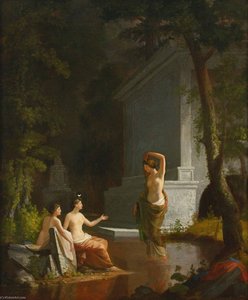
11Eli Whitney (1765-1825) B.A. 1792, M.A. 1795 (1822) de Samuel MorseEli Whitney (1765-1825) B.A. 1792, M.A. 17951822 · Yale University Art Gallery 12Dr. (d.1826) and Mrs. Thomas Holman (Lucia Ruggles), (d.1886) (1819) de Samuel MorseDr. (d.1826) and Mrs. Thomas Holman (Lucia Ruggles), (d.1886)1819 · Yale University Art Gallery 13The Judgment of Jupiter (1814) de Samuel MorseThe Judgment of Jupiter1814 · Yale University Art Gallery 14Dying Hercules (1812) de Samuel MorseDying Hercules1812 · Yale University Art Gallery 15Cyrus Mansfield (1808) de Samuel MorseCyrus Mansfield1808 · Metropolitan Museum of Art 16Self-portrait (1809) de Samuel MorseSelf-portrait1809 17James Monroe (1819) de Samuel MorseJames Monroe1819 18Joseph Gales (1822) de Samuel MorseJoseph Gales1822 · National Gallery of Art 19Scene from Spenser’s "Fairie Queene":  Una and the Dwarf (1827) de Samuel MorseScene from Spenser’s "Fairie Queene": Una and the Dwarf1827 · Toledo Museum of Art 20Portrait of David C. de Forest (1823) de Samuel MorsePortrait of David C. de Forest1823 · Museu Nacional de Belas Artes 21Little Miss Hone (1824) de Samuel MorseLittle Miss Hone1824 · Museu de Belas Artes de Boston 22Mrs. Juliet Kahlenkamp (1829) de Samuel MorseMrs. Juliet Kahlenkamp1829 · New Britain Museum of American Art 23Landscape Composition: Helicon and Aganippe (Allegorical Landscape of New York University) (1836) de Samuel MorseLandscape Composition: Helicon and Aganippe (Allegorical Landscape of New York University)1836 · New York Historical Society 24Mrs. Jacob Morton (Catharine Ludlow, 1767–1849) (1833) de Samuel MorseMrs. Jacob Morton (Catharine Ludlow, 1767–1849)1833 · New York Historical Society 25Jacob Morton (1761-1836) (1833) de Samuel MorseJacob Morton (1761-1836)1833 · New York Historical Society 26Mrs. Christopher Champlin (1815) de Samuel MorseMrs. Christopher Champlin1815 · Fine Arts Museums of San Francisco 27Samuel F. B. Morse. Self-portrait (1812) de Samuel MorseSamuel F. B. Morse. Self-portrait1812 · National Portrait Gallery 28Gallery of the Louvre de Samuel MorseGallery of the Louvre 29Mrs. Daniel DeSaussure Bacot (1820) de Samuel MorseMrs. Daniel DeSaussure Bacot1820 30Mrs. Robert Young Hayne (Rebecca Brewton Motte Alston) (1820) de Samuel MorseMrs. Robert Young Hayne (Rebecca Brewton Motte Alston)1820 31Sketch for the Chapel of the Virgin at Subiaco (1830) de Samuel MorseSketch for the Chapel of the Virgin at Subiaco1830 · Worcester Art Museum 32James Kent (1763-1847) (1823) de Samuel MorseJames Kent (1763-1847)1823 · New York Historical Society 33De Witt Clinton (1826) de Samuel MorseDe Witt Clinton1826 · Metropolitan Museum of Art 34Dr. Frederick Gore King (1827) de Samuel MorseDr. Frederick Gore King1827 35Reverend and Mrs. Hiram Bingham (1819) de Samuel MorseReverend and Mrs. Hiram Bingham1819 · Yale University Art Gallery 36Portrait of Mrs. John Earnest Poyas (Catherine Smith, 1769–1836) de Samuel MorsePortrait of Mrs. John Earnest Poyas (Catherine Smith, 1769–1836)Museum of Fine Arts 37Mrs. Thomas Fuller (Mary Fuller) de Samuel MorseMrs. Thomas Fuller (Mary Fuller)Museu de Belas Artes de Boston 38Dr. Thomas Fuller de Samuel MorseDr. Thomas FullerMuseu de Belas Artes de Boston 39The Reverend Thomas Harvey Skinner de Samuel MorseThe Reverend Thomas Harvey SkinnerMuseu de Belas Artes de Boston 40John W. Forbes (b. ca. 1781) de Samuel MorseJohn W. Forbes (b. ca. 1781)New York Historical Society 41Head of a Man (from McGuire Scrapbook) de Samuel MorseHead of a Man (from McGuire Scrapbook) 42Captain Demaresque of Gloucester, Massachusetts de Samuel MorseCaptain Demaresque of Gloucester, Massachusetts 43Portrait of Dr. James E. B. Finley de Samuel MorsePortrait of Dr. James E. B. FinleyIndianapolis Museum of Art 44The Morse Family de Samuel MorseThe Morse Family 45Reverend Nathaniel Bowen de Samuel MorseReverend Nathaniel Bowen 46De Witt Clinton de Samuel MorseDe Witt Clinton 47Mrs. John Colcock (Melliscent Jones) de Samuel MorseMrs. John Colcock (Melliscent Jones) 48George Hyde Clarke de Samuel MorseGeorge Hyde ClarkeSaint Louis Art Museum 49Portrait of Lucretia Pickering Walker Morse de Samuel MorsePortrait of Lucretia Pickering Walker Morse 50Colonel William Drayton de Samuel MorseColonel William Drayton 51O Marquês de Lafayette (1826) de Samuel MorseO Marquês de Lafayette1826 · Comissão de Arte da Cidade Nova Iorque 52Susan Walker Morse (The Muse) de Samuel MorseSusan Walker Morse (The Muse)Metropolitan Museum of Art 53Jonas Platt de Samuel MorseJonas PlattBrooklyn Museum 54Portrait of a Young Man de Samuel MorsePortrait of a Young ManMilwaukee Art Museum 55Mrs. Robert Young Hayne (Rebecca Motte Alston) de Samuel MorseMrs. Robert Young Hayne (Rebecca Motte Alston) 56Unidentified Woman de Samuel MorseUnidentified Woman 57Portrait of Jonas Platt de Samuel MorsePortrait of Jonas Platt 58Robert Young Hayne de Samuel MorseRobert Young Hayne 59Niagara Falls with Rainbow and Indians de Samuel MorseNiagara Falls with Rainbow and IndiansMuseu de Belas Artes de Boston 60Mrs. James Ladson (Judith Smith) de Samuel MorseMrs. James Ladson (Judith Smith) 61Portrait of De Witt Clinton de Samuel MorsePortrait of De Witt Clinton 62Portrait of Samuel Nelson de Samuel MorsePortrait of Samuel Nelson 63Portrait of William Cullen Bryant de Samuel MorsePortrait of William Cullen Bryant 64Portrait of John Adams de Samuel MorsePortrait of John Adams 65Lydia Coit Terry (Mrs. Eliphalet Terry) de Samuel MorseLydia Coit Terry (Mrs. Eliphalet Terry)National Gallery of Art 66Portrait of Alexander Metcalf Fisher de Samuel MorsePortrait of Alexander Metcalf Fisher 67Portrait of Mrs. James Ladson de Samuel MorsePortrait of Mrs. James LadsonGibbes Museum of Art 68Alexander Calder de Samuel MorseAlexander Calder 69Mrs. Francis Dallas Quash (Emma Doughty) de Samuel MorseMrs. Francis Dallas Quash (Emma Doughty) 70Eliphalet Terry de Samuel MorseEliphalet Terry 71Self-Portrait de Samuel MorseSelf-Portrait 72Portrait of James Monroe de Samuel MorsePortrait of James Monroe 73Portrait of Alexander Calder de Samuel MorsePortrait of Alexander Calder 74Portrait of Benjamin West (copy after Sir Thomas Lawrence) de Samuel MorsePortrait of Benjamin West (copy after Sir Thomas Lawrence) 75Self-Portait de Samuel MorseSelf-Portait 76Mrs. George Watson de Samuel MorseMrs. George Watson 77Mrs. Daniel de Saussure Bacot de Samuel MorseMrs. Daniel de Saussure Bacot 78Portrait of William Henry Harrison de Samuel MorsePortrait of William Henry Harrison 79Chapel of the Virgin at Subiaco de Samuel MorseChapel of the Virgin at SubiacoWorcester Art Museum 80Portrait of Mrs. Samuel Nelson (Catherine Anne Russell) de Samuel MorsePortrait of Mrs. Samuel Nelson (Catherine Anne Russell) 81Self-Portrait 2 de Samuel MorseSelf-Portrait 2 82Lucretia Morse and her Children de Samuel MorseLucretia Morse and her Children 83Mrs. Richard C. Morse and Her Two Children (Elizabeth Ann and Charlotte) (aka The Goldfish) de Samuel MorseMrs. Richard C. Morse and Her Two Children (Elizabeth Ann and Charlotte) (aka The Goldfish) 84Portrait of a Man de Samuel MorsePortrait of a Man 85Study for the Old House of Representatives de Samuel MorseStudy for the Old House of RepresentativesSmithsonian American Art Museum 86Diana at the Fountain de Samuel MorseDiana at the Fountain 87The Goldfish Bowl (Mrs. Richard Cary Morse and Family) de Samuel MorseThe Goldfish Bowl (Mrs. Richard Cary Morse and Family)Smithsonian American Art Museum 88Gallery of the Louvre (1833) de Samuel MorseGallery of the Louvre1833 · Terra Fondation für Amerikanische Kunst 89The House of Representatives de Samuel MorseThe House of RepresentativesNational Gallery of Art 90Marquis de Lafayette (1825) de Samuel MorseMarquis de Lafayette1825 · Crystal Bridges Museum of American Art

Pinturas famosas de Samuel Morse, período por período

Os temas que cativaram o olhar de Samuel Morse

Os quatro temas que mais se repetem nestas obras originais, cada um com o seu melhor exemplo.

Os museus que guardam os originais de Samuel Morse

Os 8 museus que detêm a maioria das pinturas desta página.

Museus Cidade Obras de Samuel Morse Pinturas desta lista
Yale University Art Gallery, New HavenYale University Art Gallery New Haven 12 Alexander Metcalf Fisher (1794-1822), B.A. 1813, M.A. 1816, Mrs. Addin Lewis (Fanny Lewis) (1790-1832), Jedidiah Morse (1761-1826), B.A. 1783, M.A. 1786
Museu de Belas Artes de Boston, BostonMuseu de Belas Artes de Boston Boston 5 Little Miss Hone, Mrs. Thomas Fuller (Mary Fuller), Dr. Thomas Fuller
New York Historical Society, Nova YorkNew York Historical Society Nova York 5 Landscape Composition: Helicon and Aganippe (Allegorical Landscape of New York University), Mrs. Jacob Morton (Catharine Ludlow, 1767–1849), Jacob Morton (1761-1836)
National Gallery of Art, WashingtonNational Gallery of Art Washington 4 Eliphalet Terry, Joseph Gales, Lydia Coit Terry (Mrs. Eliphalet Terry)
Metropolitan Museum of Art, Nova YorkMetropolitan Museum of Art Nova York 3 Cyrus Mansfield, De Witt Clinton, Susan Walker Morse (The Muse)
Worcester Art Museum, WorcesterWorcester Art Museum Worcester 2 Sketch for the Chapel of the Virgin at Subiaco, Chapel of the Virgin at Subiaco
Smithsonian American Art Museum, Washington, D.C.Smithsonian American Art Museum Washington, D.C. 2 Study for the Old House of Representatives, The Goldfish Bowl (Mrs. Richard Cary Morse and Family)
Harvard Art Museums, CambridgeHarvard Art Museums Cambridge 1 Elizabeth Ann Breese Morse (Mrs. Jedidiah Morse) (1766-1828)

Samuel Morse ao longo das décadas: uma obra original única para cada uma

Obras por década

Escolha uma década para ver a obra original que a define.

Pinturas de Samuel Morse: perguntas para a galeria

Qual é a obra mais famosa de Samuel Morse?Revelar a resposta

Erastus Torrey (1816). Alexander Metcalf Fisher (1794-1822), B.A. 1813, M.A. 1816 (1822) e Mrs. Addin Lewis (Fanny Lewis) (1790-1832) (1830) vêm a seguir.

Com que idade Samuel Morse criou Erastus Torrey?Revelar a resposta

25 anos: Erastus Torrey data de 1816, e Samuel Morse nasceu em 1791.

Quais são as dez pinturas mais famosas de Samuel Morse?Revelar a resposta

Erastus Torrey, Alexander Metcalf Fisher (1794-1822), B.A. 1813, M.A. 1816, Mrs. Addin Lewis (Fanny Lewis) (1790-1832), Jedidiah Morse (1761-1826), B.A. 1783, M.A. 1786, Mrs. David Curtis DeForest (Julia Wooster), (1795-1873), By Candlelight (Mrs. Jedidiah Morse [Elizabeth Ann Breese]) (1766-1828), Jedidiah Morse (1761-1826) B.A. 1783, M.A. 1786, Jeremiah Day (1773-1867), B.A. 1795, M.A. 1789, Elizabeth Ann Breese Morse (Mrs. Jedidiah Morse) (1766-1828) e Eliphalet Terry. O ranking acima apresenta o ano e o museu de cada uma.

Quantas obras de Samuel Morse são conhecidas?Revelar a resposta

Nosso catálogo contém 96 obras de Samuel Morse, datadas de 1808 a 1836.

Onde se pode ver os originais mais famosos de Samuel Morse?Revelar a resposta

Principalmente em Yale University Art Gallery (New Haven), Museu de Belas Artes de Boston (Boston) e New York Historical Society (Nova York). A tabela de museus acima lista todos eles.

Em que período Samuel Morse criou as suas pinturas mais conhecidas?Revelar a resposta

Em 1820s: 20 das 90 obras nesta página foram feitas então, sendo Alexander Metcalf Fisher (1794-1822), B.A. 1813, M.A. 1816 delas.

Qual pintura famosa de Samuel Morse é a mais antiga e qual é a mais recente?Revelar a resposta

Nesta página, a mais antiga é Cyrus Mansfield (1808) e a mais recente é Landscape Composition: Helicon and Aganippe (Allegorical Landscape of New York University) (1836).

Quais temas Samuel Morse preferia?Revelar a resposta

Men (17), Portraits (14) e Women (10), entre as 90 obras nesta página.

Com quais materiais Samuel Morse mais pintou?Revelar a resposta

Oil On Canvas, para 14 das 90 obras nesta página.

A qual movimento pertence a obra de Samuel Morse?Revelar a resposta

Romanticism e Neoclassical portraiture, a julgar pelos originais nesta página.

Quais originais de Samuel Morse posso ver no Yale University Art Gallery?Revelar a resposta

Alexander Metcalf Fisher (1794-1822), B.A. 1813, M.A. 1816, Mrs. Addin Lewis (Fanny Lewis) (1790-1832) e Jedidiah Morse (1761-1826), B.A. 1783, M.A. 1786: o Yale University Art Gallery, New Haven detém 12 das obras desta página.

Samuel Morse: um retrato do artista

Uma Vida Unindo Arte e Inovação: Samuel Finley Breese Morse

Samuel Finley Breese Morse, um nome indissociável do amanhecer da comunicação moderna, foi muito mais do que apenas o inventor do telégrafo e do código Morse. Ele foi um artista talentoso e ambicioso cujas telas capturaram o espírito da América do início do século XIX, refletindo tanto sua crescente identidade nacional quanto os ecos persistentes das tradições artísticas europeias. Nascido em Charlestown, Massachusetts, em 27 de abril de 1791, em uma família imersa em fervor intelectual e religioso – seu pai, Jedidiah Morse, era um proeminente ministro calvinista e geógrafo – a vida de infância do jovem Samuel foi moldada por uma criação rigorosa que lhe instilou um profundo senso de propósito. Embora destinado à renome científica, sua paixão inicial residia firmemente no reino da arte. Após graduar-se com honras no Yale College em 1810, Morse embarcou em uma carreira como pintor, sustentando-se por meio de encomendas de retratos enquanto, simultaneamente, cultivava suas ambições artísticas.

Anos Formativos e Desenvolvimento Artístico

Reconhecendo a necessidade de um treinamento formal indisponível no nascente mundo da arte americana, Morse viajou para a Inglaterra em 1811, buscando tutela sob o estimado artista britânico Washington Allston. Este período provou ser crucial na moldagem de seu estilo artístico. Allston, um defensor do Romantismo, incentivou a exploração de composições dramáticas, pinceladas expressivas e temas emocionalmente carregados por parte de Morse. As primeiras obras de Morse revelam uma clara dívida para com mestres europeus como Benjamin West e J.M.W. Turner, mas ele rapidamente começou a forjar sua própria voz distinta. Sua obra monumental, The Dying Hercules, concluída durante este período, permanece como um testemunho de sua habilidade em desenvolvimento na precisão anatômica e na narrativa dramática. Mais do que apenas um exercício de técnica artística, a pintura é frequentemente interpretada como um comentário político velado – uma representação simbólica dos Estados Unidos lutando contra a percepção de tirania do domínio britânico e das políticas federalistas. A poderosa imaginação da obra ressoou com um crescente senso de nacionalismo americano. Ao retornar à América em 1815, Morse continuou a pintar retratos e cenas históricas, incluindo Landing of the Pilgrims, o que consolidou ainda mais sua reputação como um pintor capaz de capturar tanto semelhanças individuais quanto grandes narrativas. Esta pintura vinculou astutamente as crenças calvinistas com a história compartilhada entre a Grã-Bretanha e a América, navegando sutilmente pela complexa paisagem política da época. Judgment of Jupiter, outra obra significativa deste período, demonstrou a capacidade de Morse de fundir a habilidade artística com suas convicções espirituais profundamente arraigadas, ao mesmo tempo em que expressava sentimentos anti-federalistas.

A Busca pela Inovação: Da Tela ao Telégrafo

Apesar de alcançar reconhecimento como artista, Morse sentia-se cada vez mais frustrado pela instabilidade financeira e pelas oportunidades limitadas disponíveis no mundo da arte americana. Um ponto de virada ocorreu durante uma viagem de volta da Europa em 1832, quando ele tomou conhecimento dos recentes avanços no eletromagnetismo. Isso despertou uma nova curiosidade intelectual que, por fim, o levaria por um caminho diferente – o da inovação científica. Movido pelo desejo de criar um meio de comunicação mais rápido e confiável, Morse dedicou-se ao desenvolvimento de um sistema para transmitir mensagens a longas distâncias usando sinais elétricos. Ele não estava sozinho nesta busca; inúmeros cientistas europeus experimentavam tecnologias semelhantes. No entanto, o gênio de Morse residia em sua capacidade de sintetizar ideias existentes em um sistema prático e comercialmente viável. Ele colaborou com Alfred Vail, que contribuiu significativamente para o desenvolvimento do agora famoso código Morse – um sistema de pontos e traços representando letras e números. Em 1837, ele patenteou seu sistema de telégrafo de fio único, marcando um momento crucial na história da comunicação.

Legado Além da Pincelada

Os anos subsequentes foram marcados por esforços incansáveis para promover e implementar sua invenção. Morse garantiu financiamento do Congresso para a construção de uma linha telegráfica experimental entre Washington D.C. e Baltimore, que transmitiu com sucesso sua primeira mensagem – “O que Deus operou?” – em 1844. Esta demonstração catapultou Morse para o destaque nacional, consolidando seu lugar como um inventor visionário. Embora tenha continuado a pintar ao longo de toda a vida, seus empreendimentos artísticos passaram a ocupar um plano secundário diante de seu trabalho no telégrafo e nos projetos de cabos transatlânticos. Ele enfrentou inúmeras batalhas legais sobre direitos de patente, mas acabou recebendo reconhecimento internacional por suas contribuições à tecnologia de comunicação. Samuel Finley Breese Morse faleceu na cidade de Nova York em 1872, deixando um legado que se estende muito além do reino da arte. Ele foi membro tanto da American Antiquarian Society quanto da American Academy of Arts and Sciences, o que reconhece suas conquistas multifacetadas. Suas pinturas permanecem como testemunhos convincentes de seu talento artístico, enquanto sua invenção revolucionou a comunicação, alterando para sempre o curso da história humana. Hoje, as obras de arte de Morse podem ser encontradas em museus proeminentes, como o New York Museum of Art, e também são memorializadas no Cemitério Green-Wood, em Nova York, um tributo digno a um homem que uniu dois mundos aparentemente díspares – a arte e a inovação.