Retrato de Salvator Rosa

Pinturas de Salvator Rosa: As 100 mais famosas, sob o olhar de uma galeria

Atualizado em Novembro 2026 · classificado pela nossa pontuação de popularidade (pesquisas, visitas e pedidos de cada obra) · 274 obras de Salvator Rosa em nosso catálogo

Em resumo

Aos olhos da galeria, a pintura mais famosa de Salvator Rosa é The Baptism of the Eunuch (1660), cuja obra original está exposta no Chrysler Museum of Art, em Norfolk. Pitágoras Emergindo do Submundo (1662) e Landscape with St Jerome (1670) completam o trio que todos reconhecem. Dos 274 trabalhos de Salvator Rosa em nosso catálogo, a galeria apresenta abaixo as 100 obras mais famosas, cada uma original, com seu ano, seu museu e o que a torna única.

1615 – 1673, Nápoles Baroque style Mais obras: Bavarian State Painting Collections

As 10 principais pinturas de Salvator Rosa na galeria

1
The Baptism of the Eunuch (1660) de Salvator Rosa

The Baptism of the Eunuch

1660 · Oil On Canvas · Chrysler Museum of Art, Norfolk

In "The Baptism of the Eunuch" by Salvator Rosa, a profound moment of spiritual transformation unfolds within a rugged landscape. Created in 1660, the scene captures the precise instant of a man's rebirth through water. A figure, dressed in a white robe, receives the sacrament from another person. This act of baptism occurs amidst a natural setting where rocks rise from the earth, grounding the sacred event in a physical,…

2
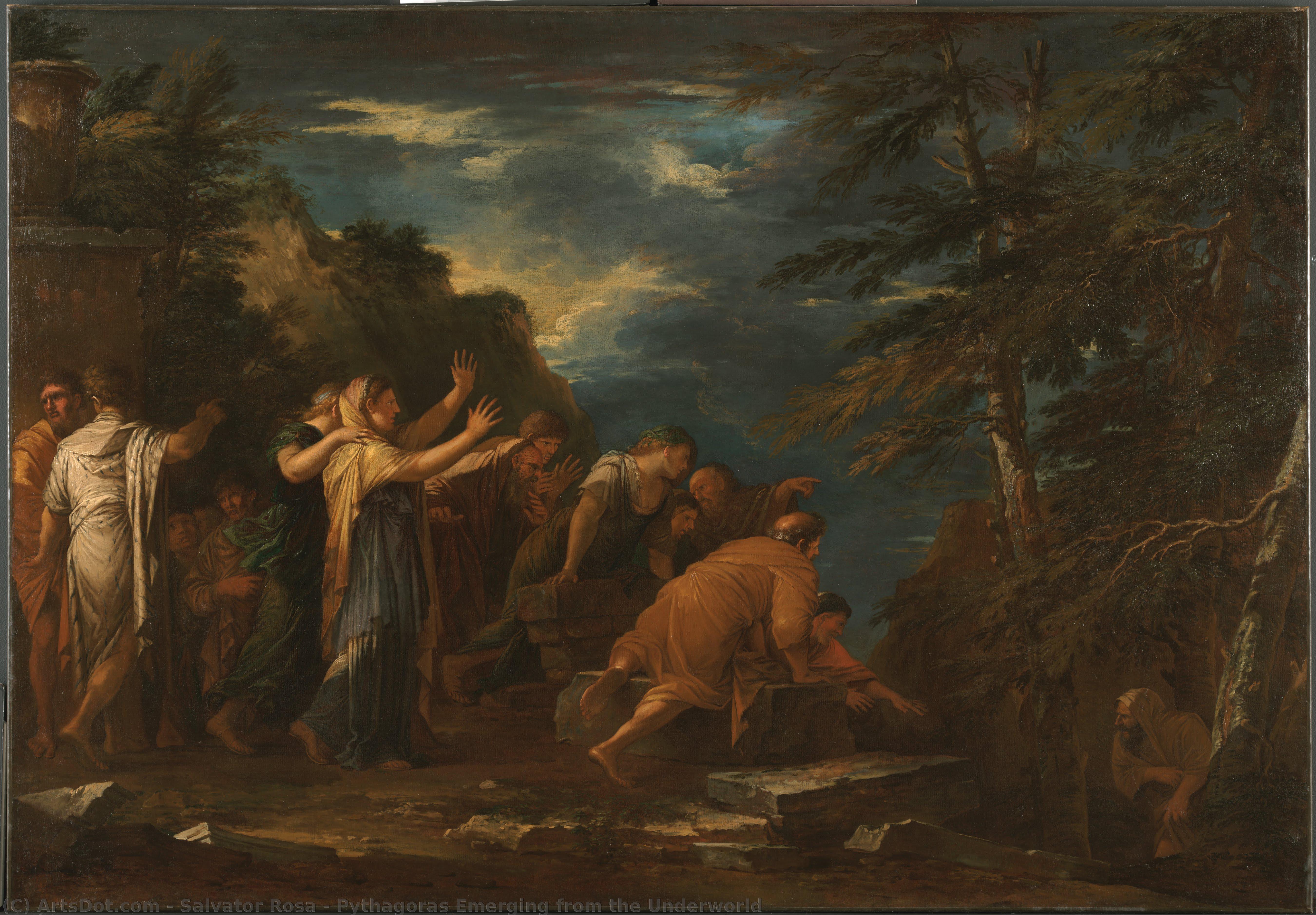
Pitágoras Emergindo do Submundo (1662) de Salvator Rosa

Pitágoras Emergindo do Submundo

1662 · Óleo sobre tela · Kimbell Art Museum, Fort Worth

Pythagoras Emerging from the Underworld: A Baroque Vision of Myth and Philosophy Salvator Rosa’s “Pythagoras Emerging from the Underworld” is more than just a depiction of an ancient Greek myth; it's a masterful embodiment of baroque artistic principles, reflecting a profound engagement with philosophical ideas. Painted in 1662, this monumental canvas showcases Rosa’s distinctive style—characterized by dramatic lighting, turbulent landscapes, and a palpable sense of movement—creating an immersive experience for…

3
Landscape with St Jerome (1670) de Salvator Rosa

Landscape with St Jerome

1670 · Oil On Canvas · Musée Condé, Chantilly

A rugged, mountainous gorge dominates the vertical composition, creating a sense of isolation through deep, narrow canyons. The landscape is defined by jagged, irregular rock faces and the skeletal, tangled branches of overhanging trees. Earthy tones of ochre, deep brown, and muted green establish a somber atmosphere, while a luminous patch of sky at the top center provides a sharp contrast to the shadows below. Within this untamed environment, a…

4
Head of a Man with a Turban (1652) de Salvator Rosa

Head of a Man with a Turban

1652 · Oil On Canvas · Birmingham Museum and Art Gallery, Birmingham

A single light source strikes the left side of a weathered face, carving it out of a heavy, ink-black void. The man’s gaze is steady, meeting the viewer with a quiet, stoic intensity. He wears a voluminous turban, its cream and ochre folds catching the light, revealing the coarse texture of the cloth. Deep shadows swallow the right side of his head, merging his beard and the nape of his…

5
Tobias and the Angel (1662) de Salvator Rosa

Tobias and the Angel

1662 · Oil On Canvas · Musée Condé, Chantilly

The canvas holds a vertical tension, a sudden movement between the heavens and the earth. A celestial figure descends, cutting through a darkness that feels heavy and thick. This is the moment of intervention, where the divine enters the realm of the mortal. Light does not merely illuminate; it strikes. It catches the curve of a reaching hand and the pale skin of a kneeling figure, leaving the rest of…

6
Return of Astrea (1642) de Salvator Rosa

Return of Astrea

1642 · Oil On Canvas · Kunsthistorisches Museum, Viena

A heavy, weathered stone structure anchors the left side of the canvas, its crumbling edges catching the light. Beside it, a gnarled tree leans into the frame, its dark branches reaching like fingers toward a vast, cloud-filled sky. In the lower foreground, rustic figures move through the shadows of the ruins. A man in white and blue stands amidst the earthy tones of ochre and sienna. Above this earthly realm,…

7
Daniel in the Lion's Den (1662) de Salvator Rosa

Daniel in the Lion's Den

1662 · Oil On Canvas · Musée Condé, Chantilly

Salvator Rosa painted Daniel in the Lion's Den as a profound exercise in religious art. This oil on canvas work emerged after 1662, a period when the artist sought to expand his reputation beyond the rugged landscapes for which he was known. The composition belongs to a larger, cohesive cycle of five thematically linked Biblical stories. These paintings were executed for Carlo de' Rossi, intended to decorate a private chapel…

8
Crucifixion of Polyclitus (1650) de Salvator Rosa

Crucifixion of Polyclitus

1650 · Oil · Museu Nacional de Varsóvia, Varsóvia

In this dramatic Baroque oil painting, we find ourselves witnessing a moment of profound martyrdom. The composition is built upon a restless diagonal, pulling the eye from a crowded, agitated group of figures in the lower left toward the central figure of Polyclitus, suspended upon the cross in the upper right. The landscape is not a place of peace; it is a rugged, mountainous terrain of craggy rocks and turbulent…

9
Jesus carrying the cross (1667) de Salvator Rosa

Jesus carrying the cross

1667 · Oil · Musée Condé, Chantilly

A heavy, wooden cross dominates the composition, its diagonal thrust cutting through a turbulent scene of physical and spiritual struggle. Christ is caught in a moment of intense exertion, his body strained under the burden of the timber. Around him, a crowd of onlookers and tormentors creates a sense of claustrophobic chaos. The arrangement of figures is agitated, driving the eye across the canvas in a series of sharp, conflicting…

10
Witches at their Incantations (1646) de Salvator Rosa

Witches at their Incantations

1646 · Oil On Canvas · National Gallery, Londres

The shadows deepen as we encounter Witches at their Incantations, a work that pulls the viewer into a dark, nocturnal ritual. Painted by Salvator Rosa about 1646, the scene captures a gathering of figures caught in the midst of a witches' sabbath. This macabre assembly unfolds beneath a heavy, cloud-covered sky, where the line between the human and the monstrous begins to blur. It is a moment of profound unrest,…

Pinturas de Salvator Rosa, classificadas de 11 a 100

11Group of Warriors (1644) de Salvator RosaGroup of Warriors1644 · Bavarian State Painting Collections 12Self-Portrait as Philosopher of Silence (1641) de Salvator RosaSelf-Portrait as Philosopher of Silence1641 · National Gallery 13Landscape with Bather (1660) de Salvator RosaLandscape with Bather1660 · Yale University Art Gallery 14Saint John the Baptist Baptizing Christ in the Jordan (1655) de Salvator RosaSaint John the Baptist Baptizing Christ in the Jordan1655 · Kelvingrove Art Gallery and Museum 15Jeremie pulled from the cistern (1622) de Salvator RosaJeremie pulled from the cistern1622 · Musée Condé 16Armed Robbers in Rocky Countryside (1644) de Salvator RosaArmed Robbers in Rocky Countryside1644 · Bavarian State Painting Collections 17Jonah Preaching to the People of Niniveh (1645) de Salvator RosaJonah Preaching to the People of Niniveh1645 · Statens Museum For Kunst 18Prometheus on the Rock (1644) de Salvator RosaPrometheus on the Rock1644 · Bavarian State Painting Collections 19Mountain Landscape (1644) de Salvator RosaMountain Landscape1644 · Bavarian State Painting Collections 20Landscape with Saint Anthony Abbot and Saint Paul the Hermit (1662) de Salvator RosaLandscape with Saint Anthony Abbot and Saint Paul the Hermit1662 · Scottish National Gallery 21Study for 'Il Genio di Rosa' de Salvator RosaStudy for 'Il Genio di Rosa' 22Astraea Leaves The Earth (1665) de Salvator RosaAstraea Leaves The Earth1665 · Kunsthistorisches Museum 23An Evangelist (1635) de Salvator RosaAn Evangelist1635 · Museu de Israel 24The War People of Gideon (1644) de Salvator RosaThe War People of Gideon1644 · Bavarian State Painting Collections 25Allegory of Study (1647) de Salvator RosaAllegory of Study1647 · John and Mable Ringling Museum of Art 26Scenes of Witchcraft: Night (1640) de Salvator RosaScenes of Witchcraft: Night1640 · Cleveland Museum of Art 27Scenes of Witchcraft: Evening (1640) de Salvator RosaScenes of Witchcraft: Evening1640 · Cleveland Museum of Art 28Scenes of Witchcraft: Day (1640) de Salvator RosaScenes of Witchcraft: Day1640 · Cleveland Museum of Art 29Scenes of Witchcraft: Morning (1640) de Salvator RosaScenes of Witchcraft: Morning1640 · Cleveland Museum of Art 30A Philosopher (1643) de Salvator RosaA Philosopher1643 · Kedleston Hall 31The Founding of Thebes (1645) de Salvator RosaThe Founding of Thebes1645 · Statens Museum For Kunst 32The Martyrdom of Saint Januarius and his Fellows (1650) de Salvator RosaThe Martyrdom of Saint Januarius and his Fellows1650 · Städel Museum 33Head of a Philosopher, called 'Democritus' (1659) de Salvator RosaHead of a Philosopher, called 'Democritus'1659 34Bandits robbing Travellers (1656) de Salvator RosaBandits robbing Travellers1656 · Knole House 35Anchorites Tempted by Demons (1660) de Salvator RosaAnchorites Tempted by Demons1660 · Galleria Nazionale d'Arte Antica 36Three Marys at the Tomb (1665) de Salvator RosaThree Marys at the Tomb1665 · John and Mable Ringling Museum of Art 37Christ expelling the Money Changers from the Temple (1664) de Salvator RosaChrist expelling the Money Changers from the Temple1664 · Attingham Park 38The Angel Leaving the House of Tobias (1662) de Salvator RosaThe Angel Leaving the House of Tobias1662 39Cavalieri in Marcia (1673) de Salvator RosaCavalieri in Marcia1673 40Self-Portrait (1650) de Salvator RosaSelf-Portrait1650 · Detroit Institute of Arts 41Saint Simon the Apostle (1673) de Salvator RosaSaint Simon the Apostle1673 · Georgia Museum of Art 42Landscape with Armed Men (1640) de Salvator RosaLandscape with Armed Men1640 · Museu de Arte do Condado de Los Angeles 43St. Francis in Ecstasy de Salvator RosaSt. Francis in EcstasyThe Phillips Collection 44Fall of the Giants de Salvator RosaFall of the Giants 45Saint Humphrey (Onuphrius) (1660) de Salvator RosaSaint Humphrey (Onuphrius)1660 · Minneapolis Institute of Art 46Landscape with an "Arco Naturale" (1651) de Salvator RosaLandscape with an "Arco Naturale"1651 · Statens Museum For Kunst 47Odysseus and Nausicaa (1655) de Salvator RosaOdysseus and Nausicaa1655 · Museu de Arte do Condado de Los Angeles 48Sleeping Warrior (1644) de Salvator RosaSleeping Warrior1644 · Bavarian State Painting Collections 49Ceres and Phytalus (1662) de Salvator RosaCeres and Phytalus1662 · Museu de Arte do Condado de Los Angeles 50Witches at their Incantations de Salvator RosaWitches at their Incantations 51A Cavalry Battle (1652) de Salvator RosaA Cavalry Battle1652 · Auckland Art Gallery Toi o Tāmaki 52Desolate Landscape with Two Figures (1662) de Salvator RosaDesolate Landscape with Two Figures1662 · Scottish National Gallery 53Landscape with Mercury and the Dishonest Woodman (1652) de Salvator RosaLandscape with Mercury and the Dishonest Woodman1652 · National Gallery 54Landscape with Warriors (1644) de Salvator RosaLandscape with Warriors1644 · Bavarian State Painting Collections 55Landscape with Armed Men (1640) de Salvator RosaLandscape with Armed Men1640 · Museu de Arte do Condado de Los Angeles 56Glaucus and Scylla (1661) de Salvator RosaGlaucus and Scylla1661 · Museu de Arte do Condado de Los Angeles 57The Raising of Lazarus de Salvator RosaThe Raising of LazarusMusée Condé 58Still Life (1673) de Salvator RosaStill Life1673 · Bavarian State Painting Collections 59Youth with An Effigy of Diana of Ephesus (1657) de Salvator RosaYouth with An Effigy of Diana of Ephesus1657 · Royal Collection 60River Landscape with Apollo and the Cumean Sibyl (1655) de Salvator RosaRiver Landscape with Apollo and the Cumean Sibyl1655 · Wallace Collection 61Rocky Landscape with a Huntsman and Warriors (1670) de Salvator RosaRocky Landscape with a Huntsman and Warriors1670 · Museu do Louvre 62The Finding of Moses (1650) de Salvator RosaThe Finding of Moses1650 · Kimbell Art Museum 63Bandits on a Rocky Coast (1656) de Salvator RosaBandits on a Rocky Coast1656 · Metropolitan Museum of Art 64Standing Warror with Shield (1657) de Salvator RosaStanding Warror with Shield1657 · Museu de Arte do Condado de Los Angeles 65Saint John the Baptist Revealing Christ to the Disciples (1655) de Salvator RosaSaint John the Baptist Revealing Christ to the Disciples1655 · Kelvingrove Art Gallery and Museum 66Pythagoras and the Fisherman (1662) de Salvator RosaPythagoras and the Fisherman1662 · Staatliche Museen zu Berlin 67Rocky Landscape (1644) de Salvator RosaRocky Landscape1644 · Bavarian State Painting Collections 68A Pass with Travellers attacked by Bandits (1627) de Salvator RosaA Pass with Travellers attacked by Bandits1627 · Knole House 69Bay in a Calm Sea (1644) de Salvator RosaBay in a Calm Sea1644 · Bavarian State Painting Collections 70Sea Storm (1644) de Salvator RosaSea Storm1644 · Bavarian State Painting Collections 71Sea Bay with Rocky Coast (1644) de Salvator RosaSea Bay with Rocky Coast1644 · Bavarian State Painting Collections 72Landscape with Riders (1644) de Salvator RosaLandscape with Riders1644 · Bavarian State Painting Collections 73Sea Storm (1644) de Salvator RosaSea Storm1644 · Bavarian State Painting Collections 74Mountain Landscape (1644) de Salvator RosaMountain Landscape1644 · Bavarian State Painting Collections 75Rocky Coast at a Bay (1644) de Salvator RosaRocky Coast at a Bay1644 · Bavarian State Painting Collections 76Bay by Turbulent Sea (1644) de Salvator RosaBay by Turbulent Sea1644 · Bavarian State Painting Collections 77Seastorm (1644) de Salvator RosaSeastorm1644 · Bavarian State Painting Collections 78Wild rocky landscape (1644) de Salvator RosaWild rocky landscape1644 · Bavarian State Painting Collections 79Sea bay with castle ruins (1644) de Salvator RosaSea bay with castle ruins1644 · Bavarian State Painting Collections 80Coastal Landscape with Castle (1644) de Salvator RosaCoastal Landscape with Castle1644 · Bavarian State Painting Collections 81Lucrezia as Poetry (1641) de Salvator RosaLucrezia as Poetry1641 · Wadsworth Atheneum Museum of Art 82Evening Landscape (1640) de Salvator RosaEvening Landscape1640 83Harbour with Ruins (1640) de Salvator RosaHarbour with Ruins1640 · Szépművészeti Múzeum 84St John Preaching (1660) de Salvator RosaSt John Preaching1660 · York Art Gallery 85Rocky Landscape with Figures (1660) de Salvator RosaRocky Landscape with Figures1660 86The Finding of Moses (1660) de Salvator RosaThe Finding of Moses1660 · Detroit Institute of Arts 87The Return of the Prodigal Son (1660) de Salvator RosaThe Return of the Prodigal Son1660 · Galeria Nacional do Canadá 88A Seaport (1651) de Salvator RosaA Seaport1651 · Statens Museum For Kunst 89Southern Harbour (1651) de Salvator RosaSouthern Harbour1651 · Statens Museum For Kunst 90Rocky landscape with figures (1651) de Salvator RosaRocky landscape with figures1651 91Landscape with figures (1651) de Salvator RosaLandscape with figures1651 92Landscape with Tower and Boat (1660) de Salvator RosaLandscape with Tower and Boat1660 · Musée Condé 93Christ resurrected de Salvator RosaChrist resurrectedMusée Condé 94the Witches' Sabbath (1654) de Salvator Rosathe Witches' Sabbath1654 · Museum of Fine Arts 95Glaucus and Scylla (1661) de Salvator RosaGlaucus and Scylla1661 · Art Gallery of South Australia 96Diogenes Throwing Away His Drinking Cup. (1651) de Salvator RosaDiogenes Throwing Away His Drinking Cup.1651 · Statens Museum For Kunst 97Wooded Landscape (1650) de Salvator RosaWooded Landscape1650 98Portrait of the Artist's Wife Lucrezia (1657) de Salvator RosaPortrait of the Artist's Wife Lucrezia1657 · Galleria Nazionale d'Arte Antica 99Diogenes Casting away his Cup (1650) de Salvator RosaDiogenes Casting away his Cup1650 · Museum of Fine Arts 100Landscape with a Wide River, Waterfall and Three Figures (1665) de Salvator RosaLandscape with a Wide River, Waterfall and Three Figures1665 · John and Mable Ringling Museum of Art

Pinturas famosas de Salvator Rosa, período por período

Os temas que cativaram o olhar de Salvator Rosa

Os quatro temas que mais se repetem nestas obras originais, cada um com o seu melhor exemplo.

Os museus que guardam os originais de Salvator Rosa

Os 8 museus que detêm a maioria das pinturas desta página.

Museus Cidade Obras de Salvator Rosa Pinturas desta lista
Bavarian State Painting Collections, MuniqueBavarian State Painting Collections Munique 21 Group of Warriors, Armed Robbers in Rocky Countryside, Prometheus on the Rock
Musée Condé, ChantillyMusée Condé Chantilly 9 Landscape with St Jerome, Tobias and the Angel, Daniel in the Lion's Den
Statens Museum For Kunst, CopenhagueStatens Museum For Kunst Copenhague 10 Jonah Preaching to the People of Niniveh, The Founding of Thebes, Landscape with an "Arco Naturale"
Museu de Arte do Condado de Los Angeles, Los AngelesMuseu de Arte do Condado de Los Angeles Los Angeles 7 Landscape with Armed Men, Odysseus and Nausicaa, Ceres and Phytalus
Cleveland Museum of Art, ClevelandCleveland Museum of Art Cleveland 5 Scenes of Witchcraft: Night, Scenes of Witchcraft: Evening, Scenes of Witchcraft: Day
National Gallery, LondresNational Gallery Londres 7 Witches at their Incantations, Self-Portrait as Philosopher of Silence, Landscape with Mercury and the Dishonest Woodman
John and Mable Ringling Museum of Art, SarasotaJohn and Mable Ringling Museum of Art Sarasota 4 Allegory of Study, Three Marys at the Tomb, Landscape with a Wide River, Waterfall and Three Figures
Kunsthistorisches Museum, VienaKunsthistorisches Museum Viena 4 Return of Astrea, Astraea Leaves The Earth

Salvator Rosa, uma pintura emblemática por década

Obras por década

Escolha uma década para ver a obra original que a define.

Pinturas de Salvator Rosa: a galeria responde

Qual pintura de Salvator Rosa é a mais famosa de todas?Revelar a resposta

The Baptism of the Eunuch (1660), Chrysler Museum of Art, Norfolk. Pitágoras Emergindo do Submundo (1662) e Landscape with St Jerome (1670) vêm a seguir.

Qual era a idade de Salvator Rosa ao concluir The Baptism of the Eunuch?Revelar a resposta

45 anos: The Baptism of the Eunuch data de 1660, e Salvator Rosa nasceu em 1615.

Quais são as 10 principais pinturas de Salvator Rosa?Revelar a resposta

The Baptism of the Eunuch, Pitágoras Emergindo do Submundo, Landscape with St Jerome, Head of a Man with a Turban, Tobias and the Angel, Return of Astrea, Daniel in the Lion's Den, Crucifixion of Polyclitus, Jesus carrying the cross e Witches at their Incantations. O ranking acima apresenta o ano e o museu de cada uma.

Quantas obras Salvator Rosa criou?Revelar a resposta

Nosso catálogo contém 274 obras de Salvator Rosa, datadas de 1627 a 1673.

Onde estão expostos os originais mais famosos de Salvator Rosa?Revelar a resposta

Principalmente em Bavarian State Painting Collections (Munique), Musée Condé (Chantilly) e Statens Museum For Kunst (Copenhague). A tabela de museus acima lista todos eles.

Quando é que Salvator Rosa criou as suas pinturas mais famosas?Revelar a resposta

Em 1640s: 36 das 100 obras nesta página foram feitas então, sendo Return of Astrea delas.

Quais são as obras mais famosas de Salvator Rosa no início e no fim de sua carreira?Revelar a resposta

Nesta página, a mais antiga é A Pass with Travellers attacked by Bandits (1627) e a mais recente é Cavalieri in Marcia (1673).

Quais temas Salvator Rosa mais explorou?Revelar a resposta

Sky (25), People (25) e Figures (18), entre as 100 obras nesta página.

Em qual técnica Salvator Rosa mais trabalhou?Revelar a resposta

Oil On Canvas, para 50 das 100 obras nesta página.

Com qual movimento Salvator Rosa está associado(a)?Revelar a resposta

Baroque style, a julgar pelos originais nesta página.

Quais obras originais de Salvator Rosa o Bavarian State Painting Collections possui?Revelar a resposta

Group of Warriors, Armed Robbers in Rocky Countryside e Prometheus on the Rock: o Bavarian State Painting Collections, Munique detém 21 das obras desta página.

Salvator Rosa: o artista

Primeiros Anos, Família e Formação

Nos arredores de Nápoles, especificamente em Arenella, Salvator Rosa entra no mundo. A data de seu nascimento permanece como um ponto de debate histórico, situando-se entre 20 de junho ou 21 de julho de 1615. Ele nasce em uma família de linhagens distintas; sua mãe, Giulia Greca Rosa, pertence a uma das famílias gregas da Sicília, enquanto seu pai, Vito Antonio de Rosa, trabalha como agrimensor. A sombra do Vesúvio paira sobre seus primeiros anos, uma presença geológica que acabará por moldar sua linguagem visual.

O conflito define seu caminho em direção a uma vocação. Seu pai, buscando uma vida mais estável e tradicional para o filho, pretende que Salvator Rosa entre para o sacerdócio ou siga a carreira de advogado. O convento dos Padres Somaschi é o destino preparado para ele. No entanto, os interesses do jovem o puxam para outro lado. Ele se afasta da vida religiosa para buscar as artes em segredo. Sob a tutela silenciosa de seu tio materno, Paolo Greco, ele começa a dominar os fundamentos de seu ofício. Este treinamento clandestino continua enquanto ele se aproxima da orientação de Francesco Fracanzano, absorvendo as bases técnicas que mais tarde lhe permitiriam desafiar as normas estéticas estabelecidas da era Barroca.

Carreira Artística em Nápoles, Roma e Florença

A trajetória da carreira de Salvator Rosa oscila conforme as marés políticas e sociais da Itália do século XVII. Em 1635, ele deixa sua Nápoles natal rumo a Roma, adentrando o centro artístico indiscutível da época. Retorna a Nápoles em 1637, mas sua presença na cidade torna-se cada vez mais volátil. Por volta de 1648, o artista é forçado a fugir de Nápoles definitivamente, após envolver-se em uma revolta fracassada contra os governantes espanhóis. Este período de rebeldia marca uma ruptura definitiva com os seus anos de formação.

Seu movimento subsequente leva-o a Florença. Este segundo período na cidade oferece um tipo diferente de envolvimento. Para além do estúdio, Rosa mergulha na vida intelectual e sensorial dos círculos florentinos. Ele dedica suas horas à música, à escrita de poesias e ao estudo da filosofia estoica. Essa existência multifacetada confere profundidade à sua produção posterior, à medida que seus interesses pela palavra escrita e pelo pensamento filosófico começam a se cruzar com sua prática visual.

Técnica e Estilo

A pincelada de Salvator Rosa rejeita as superfícies polidas e as formas idealizadas que definiram grande parte da era Barroca. Em vez disso, ele abraça um estilo heterodoxo e extravagante, favorecendo o que é bruto e indomado. Ele domina o chiaroscuro, utilizando o jogo dramático entre luz e sombra para esculpir a forma e o estado de espírito. Esta técnica faz mais do que apenas definir formas; ela cria uma sensação de tensão que percorre toda a tela. Suas paisagens não são refúgios idílicos para a contemplação, mas são, pelo contrário, caracterizadas como selvagens e escarpadas. Céus turbulentos e terrenos rochosos e irregulares dominam suas composições, refletindo uma fascinação pelo poder volátil da natureza.

A temática de sua obra frequentemente se afasta das cenas religiosas comuns de seus contemporâneos. Ele seleciona com frequência temas obscuros e esotéricos extraídos da Bíblia, da mitologia e das vidas de filósofos. Este rigor intelectual transforma a paisagem de um mero pano de fundo em um participante central e ativo na narrativa. Em suas mãos, o ambiente torna-se um palco para a investigação moral e filosófica. Ele frequentemente retrata a figura humana como marginal, diminuída pela escala imensa e, muitas vezes, hostil do mundo natural.

Obras-Primas e Legado Visual

A tela, nas mãos de Salvator Rosa, torna-se frequentemente um palco para uma intensa investigação psicológica. Na obra de 1641, Autorretrato como Filósofo do Silêncio, preservada na National Gallery, em Londres, o artista confronta o espectador através de uma lente de quietude profunda. Esta peça funciona como uma meditação sobre a sabedoria, utilizando uma atmosfera sombria e contemplativa para estabelecer a sua própria identidade. De forma semelhante, o seu Autorretrato como um Filósofo de 1645, também na National Gallery, reforça esta persona do homem pensador, afastando-se da mera representação física para alcançar uma expressão de rigor intelectual.

A natureza, sob o domínio de Rosa, raramente é um cenário pacífico; ela é uma força turbulenta. Por volta de 1640, surgiu Ruínas em uma Paisagem Rochosa, uma obra que se encontra hoje no Cleveland Museum of Art, que utiliza ruínas clássicas e uma luz iridescente para sugerir um mundo em constante mutação. Esta rusticidade estende-se às suas composições mitológicas e alegóricas. A obra de 1662, Pitágoras Emergindo do Submundo, localizada no Kimbell Art Museum, em Fort Worth, utiliza uma composição de paisagem dramática para construir uma ponte entre o plano físico e o metafísico. Na mesma linha, o Demócrito e Protágoras de 1664, no Hermitage Museum, em São Petersburgo, emprega uma alegoria filosófica imersa num cenário de grande dramaticidade.

Até mesmo as narrativas religiosas sofrem uma metamorfose sob o seu pincel. O Batismo do Eunuco, criado em 1660 e guardado no Chrysler Museum of Art, em Norfolk, infunde a cena bíblica com um drama avassalador. A sua extraordinária capacidade de navegar por temas tão diversos — do mitológico ao sagrado — é o que define a essência da sua produção artística.

  • Autorretrato como Filósofo do Silêncio (1641)
  • Pitágoras Emergindo do Submundo (1662)
  • Demócrito e Protágoras (1664)
  • O Batismo do Eunuco (1660)
  • Ruínas em uma Paisagem Rochosa (c. 1640)

Legado e Influência

O impacto de Salvator Rosa reverbera através da evolução da arte barroca. Sua ruptura com as paisagens idealizadas e ordenadas de seus contemporâneos cria uma fricção que altera o curso da pintura do século XVII. Essa influência atravessa décadas, alcançando as obras de artistas posteriores como Luca Giordano. Ele não se limita a pintar cenários; ele constrói uma linguagem visual de turbulência que persiste muito tempo após sua morte.

Suas paisagens romantizadas e pinturas históricas exercem uma presença marcante desde o século XVII até o início do século XIX. Estas obras atuam como protótipos para a paisagem romântica, trocando as visões clássicas "pitorescas" por algo muito mais volátil. Em vez de refúgios pastorais e calmos, ele apresenta uma natureza selvagem e, muitas vezes, hostil. Essa mudança de perspectiva antecipa a intensidade emocional que viria a definir o movimento Romântico.

O legado de sua visão encontra-se na tensão entre a figura humana e a natureza indomada. Ao centralizar a paisagem como um tema primordial, em vez de um mero pano de fundo para narrativas religiosas ou mitológicas, ele altera a hierarquia dos gêneros. Seus terrenos áridos e rochosos e seus céus tempestuosos fornecem o modelo para uma estética do sublime, onde a natureza é uma força de temor e introspecção, e não um jardim controlado.

Onde Contemplar suas Obras Hoje

Os vestígios físicos da carreira inquieta de Salvator Rosa encontram-se dispersos pelas grandes capitais artísticas da Europa e das Américas. Em São Petersburgo, o Museu Hermitage preserva a precisão de seus primeiros anos na obra Retrato de um Homem, de 1640. Espalhado pelo continente, o Louvre, em Paris, mantém sua presença através da Batalha Heroica de 1652. Estas obras ancoram a sua importância nas grandes coleções institucionais do século XVII.

As preocupações filosóficas e mitológicas do artista também encontram seu caminho em coleções especializadas. A National Gallery, em Londres, guarda o seu Autorretrato como um Filósofo de 1645, uma obra que captura o seu intenso envolvimento com o pensamento intelectual. Em Fort Worth, o Kimbell Art Museum abriga Pitágoras Emergindo do Submundo, uma composição de 1662 que destaca a sua habilidade de fundir o mito com a paisagem dramática. Enquanto isso, o Metropolitan Museum of Art, em Nova York, contém a sua obra Bandidos em uma Costa Rochosa de 1656, uma peça que reflete a natureza selvagem e indomada que ele tanto favorecia.