Retrato de Paul Sandby

As 79 Pinturas Mais Famosas de Paul Sandby, uma Seleção da Galeria

Atualizado em Novembro 2026 · classificado pela nossa pontuação de popularidade (pesquisas, visitas e pedidos de cada obra) · 79 obras de Paul Sandby em nosso catálogo

Em resumo

De todas as obras originais que Paul Sandby deixou, a mais famosa é Man standing in a landscape. Logo atrás vêm Horse Fair on Bruntsfield Links, Edinburgh (1750) e London Cries: A Muffin Man (1759). Nosso catálogo contém 79 obras de Paul Sandby; a galeria preservou as 79 que o mundo mais admira, cada uma exibida com sua data, seu museu e sua história.

1798 – 1863, Nottingham Romanticism Mais obras: Yale Center for British Art

As 10 principais pinturas de Paul Sandby: a escolha da galeria

1
Man standing in a landscape de Paul Sandby

Man standing in a landscape

Charcoal

Paul Sandby presents a quiet study in Man standing in a landscape. The work captures a gentleman in period clothing, frozen in a three-quarter pose. He looks toward the left, his figure occupying much of the vertical space against a simplified rural scene. The man remains the central focus, a solitary presence amidst the soft suggestions of buildings and structures on the horizon.

2
Horse Fair on Bruntsfield Links, Edinburgh (1750) de Paul Sandby

Horse Fair on Bruntsfield Links, Edinburgh

1750 · Watercolor · Scottish National Gallery, Edimburgo

Paul Sandby: The Father of Modern Landscape Painting Paul Sandby RA stands as a pivotal figure in the history of British landscape painting, recognized not merely for his artistic skill but for establishing a new aesthetic tradition that profoundly impacted subsequent generations. Born in Nottingham to Thomas Sandby, a textile worker, Paul’s early life was marked by self-education and an innate fascination with observation—qualities that would prove instrumental in shaping…

3
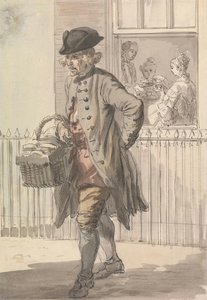
London Cries: A Muffin Man (1759) de Paul Sandby

London Cries: A Muffin Man

1759 · Drawing · Yale Center for British Art, New Haven

This evocative drawing, titled "London Cries: A Muffin Man," transports the modern viewer directly into the bustling, atmospheric heart of 18th-century London. The scene is rendered with a captivating immediacy that speaks volumes about daily commerce and human interaction. At the center moves the muffin man, his basket laden with tempting goods, embodying a moment of everyday ritual. His figure, complete with a distinctive hat and mustache, anchors the composition,…

4
Windsor Castle from the Great Park de Paul Sandby

Windsor Castle from the Great Park

Watercolor

This watercolor on paper, titled Windsor Castle from the Great Park, offers a quiet glimpse into the English landscape through the eyes of Paul Sandby. The work captures the castle as it sits within its surrounding parkland, viewed through a screen of foreground foliage. It is a piece that reflects the artist's deep connection to the terrain, specifically the areas around Windsor where he spent significant time sketching and observing…

5
Miss Marsden - back view de Paul Sandby

Miss Marsden - back view

Chalk

Miss Marsden - back view by Paul Sandby presents a focused portrait study of a woman viewed from behind. The subject is captured in period attire, emphasizing the silhouette and structural details of 19th-century fashion. Her clothing consists of a fitted bodice and a long skirt finished with a ruffled hem.

6
The Laterna Magica (1760) de Paul Sandby

The Laterna Magica

1760 · Watercolor · British Museum, Londres

Paul Sandby’s “The Laterna Magica,” painted in 1760, isn't merely a depiction of a room; it’s a meticulously crafted illusion, a vibrant snapshot of a world fascinated by the burgeoning technology of optical projection. More than just a charming scene of gentlemen observing a theatrical display, this watercolor offers a profound glimpse into the intellectual and social currents of 18th-century England – a period grappling with scientific advancement, artistic convention,…

7
London Cries: A Man with a Bottle (1759) de Paul Sandby

London Cries: A Man with a Bottle

1759 · Acrylic On Canvas · Yale Center for British Art, New Haven

Paul Sandby's "London Cries: A Man with a Bottle," painted in 1759, isn’t merely a depiction of a street scene; it’s a vibrant, almost theatrical window into the bustling heart of eighteenth-century London. This watercolor, now meticulously reproduced as a hand-painted artwork by WahooArt, captures a moment of everyday commerce and perhaps, a touch of wry observation, offering a glimpse into the lives of ordinary people within the grand tapestry…

8
The Meteor of August 18, 1783, as seen from the East Angle of the North Terrace, Windsor Castle (1783) de Paul Sandby

The Meteor of August 18, 1783, as seen from the East Angle of the North Terrace, Windsor Castle

1783 · Watercolor · Yale Center for British Art, New Haven

Paul Sandby's watercolor, “The Meteor of August 18, 1783,” isn’t merely a depiction of a fleeting astronomical event; it’s a window into the collective wonder and scientific curiosity of late 18th-century England. Painted from the East Angle of the North Terrace at Windsor Castle, the scene captures a pivotal moment – the transit of a meteor across the night sky – as observed by a small group of onlookers. The…

A seleção de Paul Sandby continua, de 11 a 79

11Study of a coachman de Paul SandbyStudy of a coachmanNational Portrait Gallery of Sweden 12Thomas Sandby and His Family de Paul SandbyThomas Sandby and His Family 13A Group of Four Children, with Dogs de Paul SandbyA Group of Four Children, with Dogs 14The Bayswater Road, Paddington de Paul SandbyThe Bayswater Road, Paddington 15Sketch of an elegant lady de Paul SandbySketch of an elegant lady 16Two Coaches with Passengers de Paul SandbyTwo Coaches with Passengers 17View of the Powder Magazine in Hyde Park de Paul SandbyView of the Powder Magazine in Hyde Park 18A riverside landscape de Paul SandbyA riverside landscape 19Back of the Public House near Bayswater de Paul SandbyBack of the Public House near Bayswater 20Windsor Park de Paul SandbyWindsor Park 21A Sleeping Woman; Study of a Head de Paul SandbyA Sleeping Woman; Study of a Head 22Travelers Entering a Town de Paul SandbyTravelers Entering a Town 23Ross Castle, Killarney, with villagers on a ferryboat de Paul SandbyRoss Castle, Killarney, with villagers on a ferryboat 24Windsor Great Park de Paul SandbyWindsor Great Park 25St. George's Gate, Canterbury de Paul SandbySt. George's Gate, Canterbury 26Rochester, Kent de Paul SandbyRochester, Kent 27Views of Windsor Castle de Paul SandbyViews of Windsor Castle 28The Iron Forge between Dolgelli and Barmouth 1 de Paul SandbyThe Iron Forge between Dolgelli and Barmouth 1 29The Light Steps, Hastings de Paul SandbyThe Light Steps, Hastings 30An Italianate landscape with women washing clothes de Paul SandbyAn Italianate landscape with women washing clothes 31The Cemetery Gate of St Augustine's Monastery Canterbury de Paul SandbyThe Cemetery Gate of St Augustine's Monastery Canterbury 32The Encampment in St James's Park de Paul SandbyThe Encampment in St James's Park 33A Boy Crawling on the Floor de Paul SandbyA Boy Crawling on the Floor 34A mother and child seated in a garden de Paul SandbyA mother and child seated in a garden 35A wooded river landscape with figures and cattle, a castle beyond de Paul SandbyA wooded river landscape with figures and cattle, a castle beyond 36The North Terrace of Windsor Castle looking west de Paul SandbyThe North Terrace of Windsor Castle looking west 37Naval post with three soldiers de Paul SandbyNaval post with three soldiers 38Part of the Banqueting Hall of the Royal Palace at Eltham de Paul SandbyPart of the Banqueting Hall of the Royal Palace at Eltham 39Man driving a donkey, and man leading a cart de Paul SandbyMan driving a donkey, and man leading a cart 40Woolwich from the Conduit Hill, the Thames estuary beyond de Paul SandbyWoolwich from the Conduit Hill, the Thames estuary beyond 41Young lady writing at a table de Paul SandbyYoung lady writing at a table 42A rural landscape de Paul SandbyA rural landscape 43A cottage by a river with figures in the foreground de Paul SandbyA cottage by a river with figures in the foreground 44The garden front of Old Somerset House, London de Paul SandbyThe garden front of Old Somerset House, London 45Henry VIII Gateway, Windsor Castle de Paul SandbyHenry VIII Gateway, Windsor Castle 46Young boy on a see-saw de Paul SandbyYoung boy on a see-saw 47Children on a see-saw de Paul SandbyChildren on a see-saw 48Young man, seated, holding a riding crop de Paul SandbyYoung man, seated, holding a riding crop 49Two of the artist's children with their nurse, seated in a garden de Paul SandbyTwo of the artist's children with their nurse, seated in a garden 50The Iron Forge between Dolgelli and Barmouth de Paul SandbyThe Iron Forge between Dolgelli and Barmouth 51View from a London terrace de Paul SandbyView from a London terrace 52Windsor Castle: The Round Tower, Royal Court and Devil (1767) de Paul SandbyWindsor Castle: The Round Tower, Royal Court and Devil1767 · National Gallery of Victoria 53Buildwas de Paul SandbyBuildwas 54View down a valley towards distant buildings, trees in the foreground de Paul SandbyView down a valley towards distant buildings, trees in the foreground 55Derwent Waster de Paul SandbyDerwent Waster 56Edinburgh Castle de Paul SandbyEdinburgh Castle 57View of Tonbridge de Paul SandbyView of Tonbridge 58View of Rackett Lodge, Wandsworth, London de Paul SandbyView of Rackett Lodge, Wandsworth, London 59Study of a donkey de Paul SandbyStudy of a donkey 60Old Windsor Green de Paul SandbyOld Windsor Green 61Middleham Castle, Yorkshire de Paul SandbyMiddleham Castle, Yorkshire 62An extensive river landscape with travellers de Paul SandbyAn extensive river landscape with travellers 63A horse and cart leaving a harbour de Paul SandbyA horse and cart leaving a harbour 64Woolwich from the Conduit Hill, the Thames beyond de Paul SandbyWoolwich from the Conduit Hill, the Thames beyond 65Cows in a Park de Paul SandbyCows in a Park 66Study of a Tree de Paul SandbyStudy of a Tree 67Trees and house seen from a meadow - Bishopgate de Paul SandbyTrees and house seen from a meadow - Bishopgate 68A shepherd driving his flock before a Scottish castle de Paul SandbyA shepherd driving his flock before a Scottish castle 69South East View of Windsor Castle From the Park de Paul SandbySouth East View of Windsor Castle From the Park 70A horse de Paul SandbyA horse 71An old grey horse tethered to a tree, a boy resting nearby de Paul SandbyAn old grey horse tethered to a tree, a boy resting nearby 72Foresters In Windsor Great Park de Paul SandbyForesters In Windsor Great Park 73View Of Windsor Castle And Part Of The Town From The Spital Hill de Paul SandbyView Of Windsor Castle And Part Of The Town From The Spital Hill 74An extensive wooded river landscape with an amorous couple making music under a tree de Paul SandbyAn extensive wooded river landscape with an amorous couple making music under a tree 75Sanby paul the spread eagle tavern millbank de Paul SandbySanby paul the spread eagle tavern millbank 76Llangollen, Denbighshire de Paul SandbyLlangollen, Denbighshire 77Part of the Old Bridge at Shrewsbury with two arches of the new one de Paul SandbyPart of the Old Bridge at Shrewsbury with two arches of the new one 78Cow­Girl in the Windsor Great Park de Paul SandbyCow­Girl in the Windsor Great Park 79A Man and a Saddled Horse de Paul SandbyA Man and a Saddled HorseYale Center for British Art

Os temas que cativaram o olhar de Paul Sandby

Os quatro temas que mais se repetem nestas obras originais, cada um com o seu melhor exemplo.

Os museus que guardam os originais de Paul Sandby

Os 5 museus que detêm a maioria das pinturas desta página.

Museus Cidade Obras de Paul Sandby Pinturas desta lista
Yale Center for British Art, New HavenYale Center for British Art New Haven 4 London Cries: A Muffin Man, London Cries: A Man with a Bottle, The Meteor of August 18, 1783, as seen from the East Angle of the North Terrace, Windsor Castle
Scottish National Gallery, EdimburgoScottish National Gallery Edimburgo 1 Horse Fair on Bruntsfield Links, Edinburgh
British Museum, LondresBritish Museum Londres 1 The Laterna Magica
National Portrait Gallery of Sweden, SträngnäsNational Portrait Gallery of Sweden Strängnäs 1 Study of a coachman
National Gallery of Victoria, MelbourneNational Gallery of Victoria Melbourne 1 Windsor Castle: The Round Tower, Royal Court and Devil

Perguntas de colecionadores sobre as pinturas de Paul Sandby

Por qual obra Paul Sandby é mais conhecido(a)?Revelar a resposta

Man standing in a landscape. Horse Fair on Bruntsfield Links, Edinburgh (1750) e London Cries: A Muffin Man (1759) vêm a seguir.

Quais são as dez pinturas mais famosas de Paul Sandby?Revelar a resposta

Man standing in a landscape, Horse Fair on Bruntsfield Links, Edinburgh, London Cries: A Muffin Man, Windsor Castle from the Great Park, Miss Marsden - back view, The Laterna Magica, London Cries: A Man with a Bottle, The Meteor of August 18, 1783, as seen from the East Angle of the North Terrace, Windsor Castle, Boy with a whip e Study of a woman pointing. O ranking acima apresenta o ano e o museu de cada uma.

Quantas pinturas Paul Sandby deixou?Revelar a resposta

Nosso catálogo contém 79 obras de Paul Sandby.

Em quais museus estão expostas as obras-primas de Paul Sandby?Revelar a resposta

Principalmente em Yale Center for British Art (New Haven), Scottish National Gallery (Edimburgo) e British Museum (Londres). A tabela de museus acima lista todos eles.

Quais temas Paul Sandby escolheu com mais frequência?Revelar a resposta

Buildings (16), Landscape (10) e Gardens and parks (10), entre as 79 obras nesta página.

Qual técnica Paul Sandby mais utilizou?Revelar a resposta

Watercolor, para 4 das 79 obras nesta página.

A qual movimento artístico pertence Paul Sandby?Revelar a resposta

Romanticism e Neoclassicism, a julgar pelos originais nesta página.

Quais obras de Paul Sandby estão expostas no Yale Center for British Art?Revelar a resposta

London Cries: A Muffin Man, London Cries: A Man with a Bottle e The Meteor of August 18, 1783, as seen from the East Angle of the North Terrace, Windsor Castle: o Yale Center for British Art, New Haven detém 4 das obras desta página.

Paul Sandby: vida e obra

Paul Sandby RA: O Pai da Pintura de Paisagens Moderna

Paul Sandby (1731 – 7 de novembro de 1809) é uma figura fundamental na história da pintura britânica, reconhecido não apenas por sua habilidade artística, mas também por estabelecer uma nova tradição estética que impactou profundamente as gerações seguintes. Nascido em Nottingham, filho de Thomas Sandby, um tecelão, a vida inicial de Paul foi marcada pela educação autodidata e por uma fascinação intrínseca pelo observação – qualidades que se provaram cruciais para moldar sua extraordinária carreira como cartógrafo e pintor. Ao contrário de muitos artistas da época que buscavam treinamento formal, Sandby aperfeiçoou seu ofício independentemente, imergindo-se no mundo natural e documentando meticulosamente sua beleza através da aquarela.
  • Infância e Formação: Os anos formativos de Paul despertaram nele uma profunda apreciação por detalhes e precisão – habilidades que mais tarde se traduziram perfeitamente em seus empreendimentos cartográficos. Seu irmão Thomas, também um desenhista, fomentou essa inclinação artística, incentivando a experimentação e promovendo um espírito colaborativo.
  • Serviço Militar e a Topografia Escocesa: O envolvimento de Sandby com o departamento de desenho militar da Torre de Londres impulsionou-o a um papel que o expôs à grandiosidade da Escócia durante a Rebelião Jacobita. Essa comissão lhe foi confiada a criação de mapas topográficos e desenhos de paisagens altas da região – um projeto que consolidou sua reputação como registrador visual da história e transformou-o em um dos artistas de paisagem mais renomados de sua época.
  • Colaboração e Estilo Artístico: A parceria com Thomas foi crucial para o desenvolvimento artístico de Sandby. Juntos, estabeleceram uma academia em Nottingham, atraindo jovens artistas ansiosos para aprender com sua experiência. Seu estilo distinto – caracterizado por lavagens luminosas de cor e uma representação magistral da perspectiva atmosférica – tornou-se instantaneamente reconhecível e profundamente influente.
  • Patrocínio Real e Contribuições Arquitetônicas: O contato de Sandby com George III elevou seu status dentro da comunidade artística, garantindo-lhe posições na Academia Militar de Woolwich e no Parque Windsor Great. Seus projetos arquitetônicos, notavelmente Cumberland Lodge, demonstraram sua versatilidade e consolidaram seu legado como um construtor visionário que buscava harmonizar arte e natureza.
  • Legado e Influência: As aquarelas de Sandby são celebradas por seu realismo incomparável – um testemunho de sua dedicação em capturar as sutilezas da iluminação natural e da textura. Ele empregou habilmente técnicas como o glacê e o scumbling para alcançar efeitos impressionantes de luz e sombra, criando imagens que não apenas expressam beleza visual, mas também evocam uma sensação palpável de humor e atmosfera. Sua atenção meticulosa aos detalhes se estendeu além da mera representação; ele buscava evocar a essência do lugar – a própria alma das paisagens escocesas e inglesas – transformando paisagens em veículos para transmitir emoção e contemplação intelectual.
Sandby’s contribution to the Royal Academy was particularly noteworthy, establishing it as a center for artistic innovation and fostering a tradition of scholarly engagement with visual art. Sandby’s lectures on architecture further solidified his reputation as an intellectual leader who championed the fusion of art and science – a conviction that underpinned his lifelong pursuit of beauty and truth.

A Ascensão e o Trabalho Cartográfico

Antes de se tornar um renomado pintor de paisagens, Paul Sandby começou sua carreira como cartógrafo, uma habilidade que influenciou profundamente seu estilo artístico posterior. Sua experiência no departamento de desenho militar da Torre de Londres lhe forneceu a oportunidade de trabalhar em projetos importantes, incluindo a criação de mapas detalhados da Escócia e do País de Gales. A precisão e o cuidado com os detalhes que ele desenvolveu como cartógrafo se traduziram em sua pintura, permitindo-lhe capturar as nuances da paisagem com uma clareza impressionante. Em 1746, Sandby foi encarregado de mapear as terras altas escocesas durante a Rebelião Jacobita, uma tarefa que o expôs à beleza selvagem e inóspita da região. Os desenhos que ele fez durante essa expedição são considerados alguns dos mais importantes da sua carreira, pois capturam a essência da paisagem escocesa de uma forma única e memorável. A experiência de Sandby como cartógrafo também lhe ensinou a importância da observação cuidadosa e do registro preciso – qualidades que ele aplicou à sua pintura com grande sucesso.

A Influência de Thomas Sandby

A parceria com seu irmão, Thomas Sandby, foi fundamental para o desenvolvimento artístico de Paul. Juntos, eles estabeleceram uma academia em Nottingham, onde ensinaram seus métodos e técnicas a jovens artistas ansiosos para aprender. O estilo distinto que eles desenvolveram – caracterizado por lavagens luminosas de cor e uma representação magistral da perspectiva atmosférica – tornou-se rapidamente reconhecido como um dos mais influentes do seu tempo. Thomas Sandby também foi um cartógrafo talentoso, e seus conhecimentos complementaram os de Paul. Juntos, eles trabalharam em vários projetos cartográficos importantes, incluindo a criação de mapas detalhados da Escócia e do País de Gales. A colaboração entre os irmãos Sandby ajudou a promover o desenvolvimento da pintura de paisagens na Grã-Bretanha, e seu trabalho continua a ser admirado até hoje.

O Legado de Paul Sandby

Paul Sandby faleceu em Londres em 1809, deixando para trás um legado duradouro como um dos mais importantes pintores de paisagens da Grã-Bretanha. Suas aquarelas são celebradas por sua beleza e realismo incomparáveis, e suas obras estão expostas em museus e galerias de todo o mundo. Sandby é lembrado como “o pai da pintura de paisagens moderna”, um título justificado por seu papel pioneiro na formação da cultura artística britânica e no estabelecimento de uma linguagem visual que continua a ressoar com os públicos hoje. Sua influência pode ser vista nas obras de pintores românticos posteriores, que adotaram seus princípios estilísticos e abraçaram seu compromisso em retratar a natureza com honestidade implacável. Sandby’s enduring influence can be seen in the works of subsequent Romantic painters, who adopted his stylistic principles and embraced his commitment to portraying nature with uncompromising honesty. He remains regarded as “the father of modern landscape painting,” a title justly earned for his pioneering role in shaping British artistic culture and establishing a visual language that continues to resonate with audiences today.