Em resumo
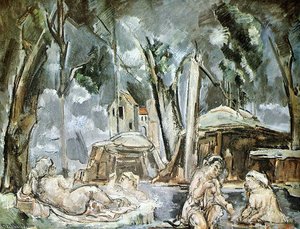
Aos olhos da galeria, a pintura mais famosa de Max Weber é Gauguin Girl (1907). Figures in a Landscape (1911) e Woman Reading (1916) completam o trio que todos reconhecem. Dos 76 trabalhos de Max Weber em nosso catálogo, a galeria apresenta abaixo as 75 obras mais famosas, cada uma original, com seu ano, seu museu e o que a torna única.
As 10 principais pinturas de Max Weber na galeria
Pinturas de Max Weber, classificadas de 11 a 75
Pinturas famosas de Max Weber, período por período
Early Period
1916 · 9 obras nesta listaEarly Modern
3 obras nesta listaOs temas que cativaram o olhar de Max Weber
Os quatro temas que mais se repetem nestas obras originais, cada um com o seu melhor exemplo.
Nude figures 3 obras
Melancholy mood 2 obras
American art 2 obras
Russia 2 obras
Os museus que guardam os originais de Max Weber
Os 8 museus que detêm a maioria das pinturas desta página.
| Museu | Cidade | Obras de Max Weber | Pinturas desta lista |
|---|---|---|---|
| Washington, D.C. | 5 | High Noon, Colonial Bowl, Rabbi | |
| Brooklyn | 2 | The Visit, The Cellist | |
| Sarasota | 1 | Untitled (Still Life) | |
| Boston | 1 | Path in the Woods | |
| Nova Iorque | 1 | Adoration of the Moon | |
| Chicago | 1 | Still Life | |
| Nova York | 1 | Pacific Coast | |
| Washington, D.C. | 1 | Summer |
Max Weber, uma pintura emblemática por década
Obras por década
Escolha uma década para ver a obra original que a define.
Pinturas de Max Weber: a galeria responde
Qual pintura de Max Weber é a mais famosa de todas?Revelar a resposta
Gauguin Girl (1907). Figures in a Landscape (1911) e Woman Reading (1916) vêm a seguir.
Qual era a idade de Max Weber ao concluir Gauguin Girl?Revelar a resposta
26 anos: Gauguin Girl data de 1907, e Max Weber nasceu em 1881.
Quais são as 10 principais pinturas de Max Weber?Revelar a resposta
Gauguin Girl, Figures in a Landscape, Woman Reading, Untitled (Still Life), Path in the Woods, untitled (1109), untitled (2416), untitled (5652), untitled (8675) e untitled (7238). O ranking acima apresenta o ano e o museu de cada uma.
Quantas obras Max Weber criou?Revelar a resposta
Nosso catálogo contém 76 obras de Max Weber, datadas de 1907 a 1952.
Onde estão expostos os originais mais famosos de Max Weber?Revelar a resposta
Principalmente em The Phillips Collection (Washington, D.C.), Brooklyn Museum (Brooklyn) e John and Mable Ringling Museum of Art (Sarasota). A tabela de museus acima lista todos eles.
Quando é que Max Weber criou as suas pinturas mais famosas?Revelar a resposta
Em 1940s: 5 das 75 obras nesta página foram feitas então, sendo Untitled (Still Life) delas.
Quais são as obras mais famosas de Max Weber no início e no fim de sua carreira?Revelar a resposta
Nesta página, a mais antiga é Gauguin Girl (1907) e a mais recente é Pacific Coast (1952).
Quais temas Max Weber mais explorou?Revelar a resposta
Nude figures (3), Melancholy mood (2) e American art (2), entre as 75 obras nesta página.
Com qual movimento Max Weber está associado(a)?Revelar a resposta
Cubism, a julgar pelos originais nesta página.
Quais obras originais de Max Weber o The Phillips Collection possui?Revelar a resposta
High Noon, Colonial Bowl e Rabbi: o The Phillips Collection, Washington, D.C. detém 5 das obras desta página.
Max Weber: o artista
Early Life and the Seeds of Modernism
Max Weber, born in Białystok, Poland in 1881, embarked on a journey that would indelibly mark the landscape of American art. His formative years were steeped in the traditions of Orthodox Judaism, a heritage that would later permeate his artistic vision—a testament to the enduring influence of familial roots. The family’s emigration to Brooklyn, New York, when Weber was merely ten years old, proved transformative. This relocation thrust him into the pulsating heart of a rapidly evolving society—a crucible where Old World customs and New World aspirations wrestled for dominance. It was at the Pratt Institute in Brooklyn that Weber initially encountered art formally, under the guidance of Arthur Wesley Dow. Dow’s unwavering belief in innovative artistic methodologies, coupled with his profound appreciation for Japanese aesthetics and connections to Paul Gauguin, ignited within Weber a nascent modernist sensibility—a spark that would illuminate his subsequent creative endeavors.The Parisian Awakening and Introduction of Cubism
In 1905, Weber ventured into Europe, specifically Paris, the epicenter of avant-garde intellectual fervor. His brief stint at the Académie Julian served merely as an introductory prelude; it was his immersion in the city’s vibrant artistic milieu that truly catalyzed his artistic evolution. He forged enduring friendships with Henri Rousseau, whose evocative depictions of nature captivated him—a reflection of Weber's fascination with capturing raw emotion and visual beauty. Simultaneously, he found himself drawn into the orbit of luminaries like Henri Matisse and Pablo Picasso—artists who dared to dismantle conventional representations of reality, challenging established artistic conventions. Weber frequented Gertrude Stein’s salon, a legendary gathering place for artists, writers, and intellectuals, absorbing the latest currents in poetic discourse and art theory. This exposure to the School of Paris fundamentally reshaped his artistic trajectory, propelling him toward groundbreaking experimentation. Weber's artistic exploration intensified during his Parisian years. He actively engaged with Cubism’s revolutionary techniques—fragmentation, geometric abstraction, and multiple perspectives—embracing these principles as tools for conveying complex ideas and emotions. Influenced by Picasso’s pioneering efforts to dissect visual forms, Weber sought to capture the essence of subjects through simplified shapes and intersecting planes—a stylistic hallmark that would characterize his early works. His artistic companions included Guillaume Apollinaire, whose poetic explorations mirrored Weber's own quest for expressive innovation.A Bold Debut in New York and Critical Resistance
Upon returning to New York in 1909, Weber assumed the role of a cultural ambassador, bravely introducing Cubism’s radical precepts to an American audience largely unfamiliar with its transformative potential. His debut exhibition at Galerie Vollard showcased his unwavering commitment to artistic experimentation—a defiant assertion against prevailing aesthetic norms. However, this courageous undertaking was met not with universal acclaim but with vehement opposition from segments of the art establishment. Critics levied scathing indictments against Weber’s paintings, dismissing them as “brutal,” “vulgar,” and utterly devoid of artistic merit—accusations that stung deeply and fueled considerable debate within the artistic community. The 1911 exhibition at the 291 Gallery, organized by Alfred Stieglitz, proved to be a pivotal juncture—and an agonizing one for Weber. His canvases were subjected to what many consider “one of the most merciless critical whippings” ever endured by an American artist. The public struggled to comprehend Weber’s stylistic choices, perceiving them as jarring departures from traditional artistic traditions. Despite this disheartening backlash, Weber's talent remained recognized by his peers—artists like Alvin Langdon Coburn and Clarence White championed his work, offering invaluable support during a period of considerable artistic uncertainty.Exploring Jewish Heritage and Figurative Expression
Around 1920, Weber recalibrated his artistic direction, abandoning the strictures of Cubism in favor of more expressive figurative painting—a deliberate move away from geometric abstraction toward capturing human emotion and psychological depth. This stylistic shift reflected a profound engagement with Jewish iconography and traditions—themes that would recur throughout Weber’s oeuvre. His paintings often depicted scenes from Jewish life—families gathered in intimate settings, rabbis engaged in Talmudic study—infused with a palpable sense of nostalgia and a renewed connection to his ancestral heritage. These works stand as poignant reminders of Weber's personal history and artistic convictions. Weber’s legacy extends beyond his stylistic innovations; he remains celebrated for his unwavering dedication to artistic integrity—a steadfast refusal to compromise his vision in pursuit of commercial success or popular acclaim. His pioneering role in establishing modernist art in America cemented his place in art history, securing his reputation as a transformative figure who reshaped the contours of American visual culture.- Born: Bialystok, Poland (1881)
- Died: 1961
- Key Movements: Cubism, Modern Art, Expressionism