Retrato de Luca Signorelli

As 100 Pinturas Mais Famosas de Luca Signorelli, uma Seleção da Galeria

Atualizado em Novembro 2026 · classificado pela nossa pontuação de popularidade (pesquisas, visitas e pedidos de cada obra) · 215 obras de Luca Signorelli em nosso catálogo

Em resumo

De todas as obras originais deixadas por Luca Signorelli, a mais famosa é Retrato de um Velho Homem (1492), da coleção do Staatliche Museen zu Berlin, em Berlim. Logo atrás vêm St Augustine Altarpiece (left wing) (1498) e Christ and the Doubting Thomas (1477). Nosso catálogo contém 215 obras de Luca Signorelli; a galeria preservou as 100 que o mundo mais admira, cada uma exibida com sua data, seu museu e sua história.

1450 – 1523, Cortona Renascimento Mais obras: Basílica de Santa Casa

As 10 principais pinturas de Luca Signorelli: a escolha da galeria

1
Retrato de um Velho Homem (1492) de Luca Signorelli

Retrato de um Velho Homem

1492 · Óleo sobre tela · Staatliche Museen zu Berlin, Berlim

Portrait of an Elderly Man by Luca Signorelli Luca Signorelli’s “Portrait of an Elderly Man,” completed around 1492, stands as a testament to the zenith of Florentine Renaissance artistry—a masterful depiction that transcends mere representation and delves into profound contemplation. Currently housed in the Museo del Prado, Madrid, this painting captures not just a likeness but embodies the spirit of humanist inquiry prevalent during its era. Subject Matter: The portrait…

2
St Augustine Altarpiece (left wing) (1498) de Luca Signorelli

St Augustine Altarpiece (left wing)

1498 · Oil On Canvas · Staatliche Museen zu Berlin, Berlim

The left wing of Luca Signorelli's “St Augustine Altarpiece,” completed in 1498 for the Bichi Chapel within the church of Sant’Agostino in Siena, is more than just a beautiful painting; it’s a profound meditation on faith, charity, and the intertwined destinies of earthly and divine figures. Measuring a modest 146 x 76 centimeters, this panel offers an intimate glimpse into the artistic sensibilities of a master navigating the complexities of…

3
Christ and the Doubting Thomas (1477) de Luca Signorelli

Christ and the Doubting Thomas

1477 · Fresco · Basílica de Santa Casa, Loreto Marches

Within the Loreto basilica, Signorelli’s 1482 fresco, Christ and the Doubting Thomas, captures a heavy, singular instant. We witness Thomas Aquinas reaching out to touch the wounds of Jesus Christ, a gesture bridging skepticism and faith. There is a tension in the air, a meeting of the physical and the spiritual as the apostle seeks tangible proof. The composition draws the eye toward the interaction of hands, where the vulnerability…

4
Madonna and Child (1505) de Luca Signorelli

Madonna and Child

1505 · Acrylic On Canvas · Metropolitan Museum of Art, Nova York

Luca Signorelli’s 1505 “Madonna and Child” is more than just a religious painting; it’s a profound meditation on motherhood, faith, and the enduring power of human connection. Born in Cortona, Italy, around 1441-1445, Signorelli was a pivotal figure in the late Renaissance, renowned for his meticulous draftsmanship and his ability to seamlessly blend classical ideals with deeply felt emotion. This particular work, gifted to his daughter, offers a rare glimpse…

5
The Hell (1502) de Luca Signorelli

The Hell

1502 · Fresco

The Hell is a fresco by Luca Signorelli. Painted in 1502, this work captures a vision of the underworld. It occupies a space of profound movement and spiritual weight. The scene is populated by a multitude of figures, specifically a vast assembly of demons and angels. These entities occupy the air and the ground in a state of constant, restless interaction.

6
The Last Judgment (The right part of the composition - The Damned Consigned to Hell) (1502) de Luca Signorelli

The Last Judgment (The right part of the composition - The Damned Consigned to Hell)

1502 · Fresco

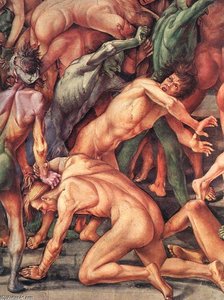
The painting depicts a crowded, chaotic scene of divine retribution set against a structured architectural backdrop. In the center, a figure of Jesus Christ is positioned, surrounded by a gathering of angels and demons. The composition is divided by the movement of various figures, some ascending and others descending. To the right, the focus shifts toward the damned, as humans are shown being cast into a dark, subterranean space. Figures…

7
The Last Judgment (The right part of the composition - The Damned Consigned to Hell; the left part of the composition - The Blessed Taken into Paradise) (1502) de Luca Signorelli

The Last Judgment (The right part of the composition - The Damned Consigned to Hell; the left part of the composition - The Blessed Taken into Paradise)

1502 · Fresco

The fresco presents a bifurcated view of the afterlife, divided by a central archway. On the left side, the composition depicts the blessed being led into Paradise. These figures move toward a celestial realm, characterized by a sense of upward motion and light. On the right side, the scene shifts to the damned being consigned to Hell. This section contains a convoluted mass of human forms, many of them naked,…

8
The Holy Family (1492) de Luca Signorelli

The Holy Family

1492 · Oil On Panel · National Gallery, Londres

In this 1492 oil on panel, the Virgin Mary cradles the Christ Child within a tight, pyramidal composition. Behind them, Saint Joseph is positioned to complete the group, creating a sense of enclosure and quietude. The figures emerge from a dark, undifferentiated background, a technique that utilizes chiaroscuro to push the subjects toward the viewer. Light enters from the upper left, catching the soft skin of the infant and the…

9
Man on a Ladder (1504) de Luca Signorelli

Man on a Ladder

1504 · Oil On Panel · National Gallery, Londres

The world holds its breath as a single figure climbs. A man, caught in mid-motion, pulls himself upward along a wooden ladder that cuts vertically through the frame. He leans forward, his body tensed with the physical effort of the ascent. His face, seen in profile, carries a look of deep focus, perhaps even a hint of strain, as he navigates the rungs. A bright red tunic, trimmed in white,…

10
Figures in a Landscape: Two Nude Youths (1490) de Luca Signorelli

Figures in a Landscape: Two Nude Youths

1490 · Tempera On Panel · Toledo Museum of Art, Toledo

The sun hangs suspended in a hazy sky, casting a diffused light over a rugged, rocky landscape. Two young men exist in this stillness, their bodies rendered with a sculptural weight that feels immediate and tangible. One youth stands with his back turned, a large piece of light blue drapery caught in a moment of movement as he holds it up, partially veiling his head and upper back. His musculature…

A seleção de Luca Signorelli continua, de 11 a 100

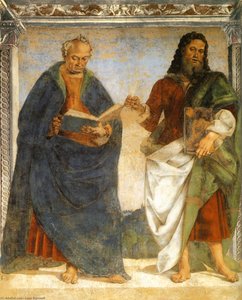
11The Adoration of the Magi (1508) de Luca SignorelliThe Adoration of the Magi1508 · Yale University Art Gallery 12Maria Madalena (1504) de Luca SignorelliMaria Madalena1504 · Museo dell'Opera del Duomo 13The Martyrdom of Saint Catherine of Alexandria (1490) de Luca SignorelliThe Martyrdom of Saint Catherine of Alexandria1490 14Lamentation over the Dead Christ (1489) de Luca SignorelliLamentation over the Dead Christ1489 · Pollok House 15Christ in the House of Simon the Pharisee (1498) de Luca SignorelliChrist in the House of Simon the Pharisee1498 · National Gallery of Ireland 16The Annunciation (1493) de Luca SignorelliThe Annunciation1493 · Philadelphia Museum of Art 17The Archangel Gabriel (1490) de Luca SignorelliThe Archangel Gabriel1490 · Walters Art Museum 18Fifteen Characters (1490) de Luca SignorelliFifteen Characters1490 19The Penitent St. Jerome in Ecstasy (1500) de Luca SignorelliThe Penitent St. Jerome in Ecstasy1500 20Apocalypse (1499) de Luca SignorelliApocalypse1499 21The Resurrected Christ Appearing to His Disciples (1514) de Luca SignorelliThe Resurrected Christ Appearing to His Disciples1514 · Detroit Institute of Arts 22The Resurrected Christ Appearing to St. Magdalene (1514) de Luca SignorelliThe Resurrected Christ Appearing to St. Magdalene1514 · Detroit Institute of Arts 23Martyrs and Saint Virgins (1502) de Luca SignorelliMartyrs and Saint Virgins1502 24Prophet holding a Scroll (1523) de Luca SignorelliProphet holding a Scroll1523 · Musée des Beaux-Arts de Strasbourg 25Madonna of the milk in glory (1475) de Luca SignorelliMadonna of the milk in glory1475 · Pinacoteca di Brera 26The Apostles Peter and John the Evangelist (1477) de Luca SignorelliThe Apostles Peter and John the Evangelist1477 · Basílica de Santa Casa 27Lamentation over the Dead Christ with Angels and Saints (1516) de Luca SignorelliLamentation over the Dead Christ with Angels and Saints1516 28Figures in a Landscape: Man, Woman and Child (1490) de Luca SignorelliFigures in a Landscape: Man, Woman and Child1490 · Toledo Museum of Art 29St Augustine Altarpiece (right wing) (1498) de Luca SignorelliSt Augustine Altarpiece (right wing)1498 · Staatliche Museen zu Berlin 30Madonna and Child with Saints and Angels (1510) de Luca SignorelliMadonna and Child with Saints and Angels1510 31View of the Sacristy of St John (1477) de Luca SignorelliView of the Sacristy of St John1477 · Basílica de Santa Casa 32Life of St Benedict, Scene 28: Benedict Recognizes and Receives Totila (1499) de Luca SignorelliLife of St Benedict, Scene 28: Benedict Recognizes and Receives Totila1499 33Virgin and Child with Sts Jerome and Bernard of Clairvaux (1492) de Luca SignorelliVirgin and Child with Sts Jerome and Bernard of Clairvaux1492 · Galleria Corsini 34Virgin and Child with Sts Michael, Vincent of Saragozza, Margaret of Cortona and Mark (1512) de Luca SignorelliVirgin and Child with Sts Michael, Vincent of Saragozza, Margaret of Cortona and Mark1512 35The Great Cloister (1497) de Luca SignorelliThe Great Cloister1497 36View of the Vaulting of the Sacristy of St John (1477) de Luca SignorelliView of the Vaulting of the Sacristy of St John1477 · Basílica de Santa Casa 37Pair of Apostles in Dispute (1482) de Luca SignorelliPair of Apostles in Dispute1482 38Pair of Apostles in Dispute (1482) de Luca SignorelliPair of Apostles in Dispute1482 39The Flagellation (1480) de Luca SignorelliThe Flagellation1480 40Discussão Entre Dois Apóstolos (1477) de Luca SignorelliDiscussão Entre Dois Apóstolos1477 · Basílica de Santa Casa 41View of the Chapel of San Brizio (1499) de Luca SignorelliView of the Chapel of San Brizio1499 42The Crucifixion (1500) de Luca SignorelliThe Crucifixion1500 43Doctors of the Church (1499) de Luca SignorelliDoctors of the Church1499 44The Elect (detail) (1499) de Luca SignorelliThe Elect (detail)1499 45The Damned (detail) (8) (1499) de Luca SignorelliThe Damned (detail) (8)1499 46Apocalypse (detail) (1499) de Luca SignorelliApocalypse (detail)1499 47Apocalypse (detail) (1499) de Luca SignorelliApocalypse (detail)1499 48The Damned (detail) (1499) de Luca SignorelliThe Damned (detail)1499 49Sermon and Deeds of the Antichrist (detail) (1499) de Luca SignorelliSermon and Deeds of the Antichrist (detail)1499 50Apocalypse (detail) (1499) de Luca SignorelliApocalypse (detail)1499 51Resurrection of the Flesh (detail) (10) (1499) de Luca SignorelliResurrection of the Flesh (detail) (10)1499 52The Elect Being Called to Paradise (1499) de Luca SignorelliThe Elect Being Called to Paradise1499 53Resurrection of the Flesh (detail) (1499) de Luca SignorelliResurrection of the Flesh (detail)1499 54Apocalypse (detail) (1499) de Luca SignorelliApocalypse (detail)1499 55Apocalypse (detail) (1499) de Luca SignorelliApocalypse (detail)1499 56Sermon and Deeds of the Antichrist (detail) (1499) de Luca SignorelliSermon and Deeds of the Antichrist (detail)1499 57Dante and Virgil Entering Purgatory (1499) de Luca SignorelliDante and Virgil Entering Purgatory1499 58The Virgins (1499) de Luca SignorelliThe Virgins1499 59The Damned (detail) (1499) de Luca SignorelliThe Damned (detail)1499 60Dante Alighieri (1499) de Luca SignorelliDante Alighieri1499 61The Damned Being Plunged into Hell (detail) (1499) de Luca SignorelliThe Damned Being Plunged into Hell (detail)1499 62The Angel Arrives in Purgatory (1499) de Luca SignorelliThe Angel Arrives in Purgatory1499 63Sermon and Deeds of the Antichrist (detail) (8) (1499) de Luca SignorelliSermon and Deeds of the Antichrist (detail) (8)1499 64Empedocles (1499) de Luca SignorelliEmpedocles1499 65The Damned (detail) (1499) de Luca SignorelliThe Damned (detail)1499 66Cappellina dei Corpi Santi (1499) de Luca SignorelliCappellina dei Corpi Santi1499 67The Elect (detail) (1499) de Luca SignorelliThe Elect (detail)1499 68Allegory of Fecundity and Abundance (1500) de Luca SignorelliAllegory of Fecundity and Abundance1500 69Marriage of the Virgin (1491) de Luca SignorelliMarriage of the Virgin1491 · National Gallery of Art 70Sermon and Deeds of the Antichrist (detail) (10) (1499) de Luca SignorelliSermon and Deeds of the Antichrist (detail) (10)1499 71Self-Portrait with Niccolò d'Angeli Franceschi (1500) de Luca SignorelliSelf-Portrait with Niccolò d'Angeli Franceschi1500 · Museo dell'Opera del Duomo 72Scenes from the Lives of Joachim and Anne (1490) de Luca SignorelliScenes from the Lives of Joachim and Anne1490 73The Birth of the Virgin (1490) de Luca SignorelliThe Birth of the Virgin1490 74Decoration (detail) (1499) de Luca SignorelliDecoration (detail)1499 75Resurrection of the Flesh (detail) (1499) de Luca SignorelliResurrection of the Flesh (detail)1499 76Lamentation over the Dead Christ with Sts Faustinus and Parentius (1499) de Luca SignorelliLamentation over the Dead Christ with Sts Faustinus and Parentius1499 77Fresco fragment (1499) de Luca SignorelliFresco fragment1499 78Resurrection of the Flesh (detail) (1499) de Luca SignorelliResurrection of the Flesh (detail)1499 79Ceiling Frescoes in the Chapel of San Brizio (1499) de Luca SignorelliCeiling Frescoes in the Chapel of San Brizio1499 80Sermon and Deeds of the Antichrist (detail) (1499) de Luca SignorelliSermon and Deeds of the Antichrist (detail)1499 81The Damned (detail) (1499) de Luca SignorelliThe Damned (detail)1499 82The Damned Being Plunged into Hell (detail) (1499) de Luca SignorelliThe Damned Being Plunged into Hell (detail)1499 83Sallust (1499) de Luca SignorelliSallust1499 84Claudian (1499) de Luca SignorelliClaudian1499 85The Damned (detail) (9) (1499) de Luca SignorelliThe Damned (detail) (9)1499 86Life of St Benedict, Scene 27: Benedict Benedict Discovers Totila's Deceit (1499) de Luca SignorelliLife of St Benedict, Scene 27: Benedict Benedict Discovers Totila's Deceit1499 87The Holy Family with Saint (1490) de Luca SignorelliThe Holy Family with Saint1490 88The Assumption of the Virgin with Saints Michael and Benedict (1493) de Luca SignorelliThe Assumption of the Virgin with Saints Michael and Benedict1493 · Metropolitan Museum of Art 89Saint James the Greater with a Living and a Dead Pilgrim (1508) de Luca SignorelliSaint James the Greater with a Living and a Dead Pilgrim1508 · Szépművészeti Múzeum 90Self-portrait of Luca Signorelli (left) (1503) de Luca SignorelliSelf-portrait of Luca Signorelli (left)1503 91Self-portrait with Vitelozzo Vitelli (1503) de Luca SignorelliSelf-portrait with Vitelozzo Vitelli1503 92Frescoes in the Chapel of San Brizio (1502) de Luca SignorelliFrescoes in the Chapel of San Brizio1502 93The Triumph of Chastity - Love Disarmed and Bound (1509) de Luca SignorelliThe Triumph of Chastity - Love Disarmed and Bound1509 · National Gallery 94The Poet Virgil (1504) de Luca SignorelliThe Poet Virgil1504 95Resurrection of the Dead (1502) de Luca SignorelliResurrection of the Dead1502 96The last judgement, fresk, Orvieto cat (1502) de Luca SignorelliThe last judgement, fresk, Orvieto cat1502 97The Prayer in the Garden. (1502) de Luca SignorelliThe Prayer in the Garden.1502 · Museo Diocesano 98The Capture of Christ (1502) de Luca SignorelliThe Capture of Christ1502 · Museo Diocesano 99Lamentation over the Dead Christ (detail) (1502) de Luca SignorelliLamentation over the Dead Christ (detail)1502 · Museo Diocesano 100The Last Supper (1502) de Luca SignorelliThe Last Supper1502 · Museo Diocesano

Pinturas famosas de Luca Signorelli, período por período

Os temas que cativaram o olhar de Luca Signorelli

Os quatro temas que mais se repetem nestas obras originais, cada um com o seu melhor exemplo.

Os museus que guardam os originais de Luca Signorelli

Os 8 museus que detêm a maioria das pinturas desta página.

Museus Cidade Obras de Luca Signorelli Pinturas desta lista
Basílica de Santa Casa, Loreto MarchesBasílica de Santa Casa Loreto Marches 7 Christ and the Doubting Thomas, The Apostles Peter and John the Evangelist, View of the Sacristy of St John
Museo Diocesano, CortonaMuseo Diocesano Cortona 10 The Prayer in the Garden., The Capture of Christ, Lamentation over the Dead Christ (detail)
National Gallery, LondresNational Gallery Londres 9 The Holy Family, Man on a Ladder, The Triumph of Chastity - Love Disarmed and Bound
Staatliche Museen zu Berlin, BerlimStaatliche Museen zu Berlin Berlim 4 Retrato de um Velho Homem, St Augustine Altarpiece (left wing), St Augustine Altarpiece (right wing)
Metropolitan Museum of Art, Nova YorkMetropolitan Museum of Art Nova York 2 Madonna and Child, The Assumption of the Virgin with Saints Michael and Benedict
Toledo Museum of Art, ToledoToledo Museum of Art Toledo 2 Figures in a Landscape: Two Nude Youths, Figures in a Landscape: Man, Woman and Child
Museo dell'Opera del Duomo, OrvietoMuseo dell'Opera del Duomo Orvieto 2 Maria Madalena, Self-Portrait with Niccolò d'Angeli Franceschi
Detroit Institute of Arts, DetroitDetroit Institute of Arts Detroit 2 The Resurrected Christ Appearing to His Disciples, The Resurrected Christ Appearing to St. Magdalene

Luca Signorelli década a década: a obra original que define cada uma

Obras por década

Escolha uma década para ver a obra original que a define.

Perguntas de colecionadores sobre as pinturas de Luca Signorelli

Por qual obra Luca Signorelli é mais conhecido(a)?Revelar a resposta

Retrato de um Velho Homem (1492), Staatliche Museen zu Berlin, Berlim. St Augustine Altarpiece (left wing) (1498) e Christ and the Doubting Thomas (1477) vêm a seguir.

Qual era a idade de Luca Signorelli quando Retrato de um Velho Homem foi feita?Revelar a resposta

42 anos: Retrato de um Velho Homem data de 1492, e Luca Signorelli nasceu em 1450.

Quais são as dez pinturas mais famosas de Luca Signorelli?Revelar a resposta

Retrato de um Velho Homem, St Augustine Altarpiece (left wing), Christ and the Doubting Thomas, Madonna and Child, The Hell, The Last Judgment (The right part of the composition - The Damned Consigned to Hell), The Last Judgment (The right part of the composition - The Damned Consigned to Hell; the left part of the composition - The Blessed Taken into Paradise), The Holy Family, Man on a Ladder e Figures in a Landscape: Two Nude Youths. O ranking acima apresenta o ano e o museu de cada uma.

Quantas pinturas Luca Signorelli deixou?Revelar a resposta

Nosso catálogo contém 215 obras de Luca Signorelli, datadas de 1475 a 1523.

Em quais museus estão expostas as obras-primas de Luca Signorelli?Revelar a resposta

Principalmente em Basílica de Santa Casa (Loreto Marches), Museo Diocesano (Cortona) e National Gallery (Londres). A tabela de museus acima lista todos eles.

Em que anos Luca Signorelli pintou as suas obras mais famosas?Revelar a resposta

Em 1490s: 60 das 100 obras nesta página foram feitas então, sendo Retrato de um Velho Homem delas.

Quais são as primeiras e as últimas obras originais famosas de Luca Signorelli?Revelar a resposta

Nesta página, a mais antiga é Madonna of the milk in glory (1475) e a mais recente é Prophet holding a Scroll (1523).

Quais temas Luca Signorelli escolheu com mais frequência?Revelar a resposta

People (43), Figures (32) e Man (21), entre as 100 obras nesta página.

Qual técnica Luca Signorelli mais utilizou?Revelar a resposta

Fresco, para 58 das 100 obras nesta página.

A qual movimento artístico pertence Luca Signorelli?Revelar a resposta

Renascimento, a julgar pelos originais nesta página.

Quais obras de Luca Signorelli estão expostas no Basílica de Santa Casa?Revelar a resposta

Christ and the Doubting Thomas, The Apostles Peter and John the Evangelist e View of the Sacristy of St John: o Basílica de Santa Casa, Loreto Marches detém 5 das obras desta página.

Luca Signorelli: vida e obra

Primeiros Anos, Família e Formação

Cortona, na Toscana, serve como o cenário para o despertar de Luca Signorelli. Nascido como Luca d'Egidio di Ventura, sua chegada ocorre em um intervalo de incertezas, provavelmente entre 1441 e 1445. A paisagem de sua juventude é definida pelas correntes humanistas do Renascimento italiano, embora seus anos formativos específicos permaneçam parcialmente obscurecidos pela passagem do tempo.

Perugia oferece o primeiro vislumbre real de suas inclinações artísticas. É ali que suas primeiras impressões sobre a arte ganham forma, absorvendo a linguagem visual da época. Este período de descoberta prepara o terreno para uma educação formal que definiria suas capacidades técnicas. De acordo com relatos históricos, seu caminho para a prática profissional foi assegurado por conexões familiares. Seu tio materno, Lazzaro Vasari, facilitou um aprendizado sob a tutela de Piero della Francesca. Esta conexão o coloca diretamente sob a influência de uma das figuras mais significativas do período, uma mentoria que ancora seu desenvolvimento nos princípios rigorosos da perspectiva e da forma.

Carreira Artística e Viagens

Os primeiros anos de sua trajetória profissional são marcados por um movimento constante através dos principais centros artísticos da Itália central. Em 1472, Luca Signorelli já trabalhava em Arezzo, seguido por um período em Città di Castello em 1474. Esses primeiros encargos estabeleceram sua presença nas paisagens da Toscana e da Úmbria. Já no final da década de 1470, seu horizonte expandiu-se significativamente; entre 1478 e 1484, sua atuação estendeu-se por Florença, Siena e Roma. Durante este período romano, ele contribuiu para a decoração da Capela Sistina, embora a seção específica que ele pintou tenha se perdido nos meandros da história.

Ao entrar na casa dos 40 anos, o movimento incessante entre as cidades-estado começa a desacelerar. Ele retorna à sua terra natal, Cortona, onde se estabeleceria pelo resto de sua vida. Embora tenha fixado sua base em Cortona, Luca Signorelli continuou a viajar para cumprir diversos encargos, mantendo seu prestígio profissional mesmo com sua residência principal ancorada em sua cidade de origem.

  • 1472: Pintura em Arezzo
  • 1474: Pintura em Città di Castello
  • 1478–1484: Trabalho em Florença, Siena e Roma

Técnica e Estilo Artístico

A forma humana ocupa o centro da linguagem visual de Luca Signorelli. Ele transcende a mera representação, concentrando-se em uma fascinação crescente pelo corpo físico e sua capacidade de movimento. Suas figuras possuem uma fisicalidade robusta, renderizada com uma descrição realista que enfatiza a precisão anatômica. Esse foco no corpóreo é impulsionado por uma energia dinâmica que anima suas composições, desafiando as tradições estáticas do passado. Ele não apenas posiciona figuras em um espaço; ele as integra através de um domínio sofisticado da perspectiva linear.

O desenho define sua execução técnica. Signorelli é notável por uma habilidade excepcional como desenhista, uma destreza que lhe permite navegar por arranjos espaciais complexos. Isso é mais evidente em seu uso inovador do escorço, uma técnica que atrai o espectador para a profundidade da cena. Ao manipular a maneira como membros e torsos recuam no espaço, ele cria uma sensação de volume tridimensional que parece imediata e tangível. A luz e a sombra trabalham em conjunto com essas preocupações estruturais. Através do domínio do chiaroscuro, ele esculpe a musculatura de seus temas, utilizando uma modelagem de alto contraste para definir o peso e a tensão do corpo humano.

Obras-Primas e Legado de um Visionário

A magnitude da ambição de Luca Signorelli atinge o seu ápice nas profundezas da Catedral de Orvieto. Foi ali, entre os anos de 1499 e 1503, que ele executou os colossais afrescos do O Juízo Final, obras que retratam o apocalipse com uma intensidade dramática que define o seu período de maturidade. A escala monumental destes afrescos exige um domínio absoluto da narrativa e do espaço, marcando o ponto mais alto de sua carreira como um mestre das cenas religiosas monumentais.

O seu talento, contudo, não se limitou ao sagrado; ele estendeu-se às coleções privadas dos mais poderosos, como exemplificado quando dedicou a pintura "A Escola de Pan" a Lorenzo de' Medici. Esta obra sublinha a sua extraordinária capacidade de transitar entre temas clássicos e uma destreza técnica refinada. Por volta de 1502–1505, o artista voltou o seu olhar para a Crucifixão com Santa Maria Madalena, uma peça que captura uma tensão única em sua abordagem composicional. Já em 1507, Signorelli deu vida ao Políptico de São Medardo, uma obra preservada no Museu San Medardo, em Arcevia, na Itália, que se ergue como um exemplo primoroso do seu tratamento detalhado e naturalista da forma humana.

Entre as suas contribuições mais memoráveis, destacam-se:

  • O Juízo Final (1499-1503)
  • O Políptico de São Medardo (1507)
  • Crucifixão com Santa Maria Madalena (c. 1502–1505)

Legado e Influência

A presença de Luca Signorelli no Renascimento italiano deixa uma marca permanente na trajetória da arte ocidental. Sua precisão técnica, particularmente seu domínio do escorço, fornece um modelo para a precisão anatômica e a profundidade espacial que definiram a era. Os artistas que seguiram seu exemplo adotaram sua abordagem rigorosa ao desenho, afastando-se das tradições mais planas do período medieval em direção a uma realidade física mais robusta. Essa mudança de perspectiva transformou a maneira como a forma humana ocupa o espaço sobre uma superfície.

Sua influência irradia a partir dos afrescos monumentais da Catedral de Orvieto, onde suas representações do apocalipse exigem atenção através de movimentos complexos e clareza estrutural. Essas obras, juntamente com seus estudos detalhados da figura humana, estabeleceram um padrão de intensidade narrativa. Sua habilidade em retratar o corpo humano em movimento ajudou a construir a ponte entre o início do Renascimento e as composições mais complexas do Alto Renascimento. Hoje, sua presença é sentida nos salões silenciosos de vários museus e catedrais por toda a Itália, onde suas obras sobreviventes continuam a ancorar a história das regiões da Toscana e da Úmbria.

  • O Juízo Final (1499-1503)
  • O Políptico de São Medardo (1507)
  • A Crucificação (1507)