Retrato de Kawanabe Kyōsai

As 72 Pinturas Mais Famosas de Kawanabe Kyōsai, Cada Uma Única

Atualizado em Novembro 2026 · classificado pela nossa pontuação de popularidade (pesquisas, visitas e pedidos de cada obra) · 72 obras de Kawanabe Kyōsai em nosso catálogo

Em resumo

Three Kyōgen Dancers (801) é a pintura de Kawanabe Kyōsai que mais atrai olhares; a obra original pertence ao Metropolitan Museum of Art, Nova York. Depois disso, o olhar recai sobre Sketches of East Asian Legendary Figures (801) e Yang Guifei Adjusting her Hair (1850). Entre as 72 obras de Kawanabe Kyōsai em nosso catálogo, estas 72 são as mais famosas, cada uma uma original única apresentada com o seu ano, o seu museu e a razão pela qual perdura.

1831 – 1889, Koga Ukiyo-e Mais obras: Metropolitan Museum of Art

As 10 principais pinturas de Kawanabe Kyōsai, sob o olhar da galeria

1
Three Kyōgen Dancers (801) de Kawanabe Kyōsai

Three Kyōgen Dancers

801 · Ink · Metropolitan Museum of Art, Nova York

A preliminary ink drawing captures three performers in the midst of a kyōgen dance. These figures, rendered with a fluid and spontaneous energy, embody the comedic essence of traditional Japanese theater. Each dancer is frozen in a distinct, expressive pose that suggests movement and rhythmic timing. One figure holds a drum, another a fan, and the third a bag, marking the specific roles and props essential to the performance. The…

2
Sketches of East Asian Legendary Figures (801) de Kawanabe Kyōsai

Sketches of East Asian Legendary Figures

801 · Ink · Metropolitan Museum of Art, Nova York

The ink flows across the paper, capturing a moment of quietude and myth. In this black and white drawing, figures from the realm of legend emerge from the shadows of the everyday. We see Japanese figures like Daikoku and Urashima Tarō sharing space with Chinese immortals and the Twenty-Four Paragons of Filial Piety. There is a strange, casual intimacy to the scene, as if these divine and legendary beings have…

3
Yang Guifei Adjusting her Hair (1850) de Kawanabe Kyōsai

Yang Guifei Adjusting her Hair

1850 · Ink On Paper · Museu de Arte do Condado de Los Angeles, Los Angeles

In "Yang Guifei Adjusting her Hair" by Kawanabe Kyōsai, the brush captures a moment of quiet preparation. The subject is Yang Guifei, a woman known to history as Lady Yang. She was the beloved consort of Emperor Xuanzong of Tang and remains celebrated as one of the Four Beauties of ancient China. Here, she is a figure of grace, focused on the delicate task of arranging her hair.

4
Yamauba and Kintarō (1850) de Kawanabe Kyōsai

Yamauba and Kintarō

1850 · Ink On Paper · Museu de Arte do Condado de Los Angeles, Los Angeles

In this vertical composition, Kawanabe Kyōsai presents a dynamic encounter between two figures from Japanese folklore. The work, created about 1850, centers on the mountain hag Yamauba and the superhuman child Kintarō. A large, standing female figure dominates the space, her presence defined by the voluminous folds of her robes. Beside her, a smaller, crouching male figure provides a sense of scale and tension. The arrangement of these two bodies…

5
Hell Courtesan (1870) de Kawanabe Kyōsai

Hell Courtesan

1870 · Cleveland Museum of Art, Cleveland

The scene unfolds within the delicate confines of a hanging scroll, where the figure of the Hell Courtesan, known in Japanese as Jigoku Tayū, emerges from the silk. This work, titled Hell Courtesan, captures a moment of profound stillness and spiritual weight. The artist, Kawanabe Kyōsai, brings this legendary character to life through a composition that balances the elegance of a high-ranking courtesan with the unsettling imagery of the afterlife.…

6
Frolicking Figures and Animals (1870) de Kawanabe Kyōsai

Frolicking Figures and Animals

1870 · Ink On Paper · Metropolitan Museum of Art, Nova York

In this horizontal handscroll from 1870, we find a quiet, almost whispered dialogue between human presence and the natural world. The composition relies heavily on the use of negative space, a deliberate emptiness that allows the viewer to focus entirely on the gestural energy of the brushstrokes. It is a work of profound restraint, where the absence of color speaks more loudly than a full palette could. The monochromatic shades…

7
Calligraphy and Painting Party (1877) de Kawanabe Kyōsai

Calligraphy and Painting Party

1877 · Ink On Paper

Calligraphy and Painting Party is a hanging scroll created by the Japanese painter and caricaturist Kawanabe Kyōsai. Born in 1831 in Koga, Japan, the artist navigated the shifting tides of the Edo and Meiji periods. This work dates to 1880, a moment when his brush captured the restless energy of a changing nation. His hand moved with the precision of a trained scholar and the wit of a satirist.

8
Wisteria Maiden and Demon Priest (1872) de Kawanabe Kyōsai

Wisteria Maiden and Demon Priest

1872 · Ink · Minneapolis Institute of Art, Minneapolis

In this work, Wisteria Maiden and Demon Priest, Kawanabe Kyōsai presents a dramatic encounter between a maiden and a demon priest. The composition is centered on a woman dressed in an ornate, multi-colored kimono featuring red, blue, and white patterns. She appears to dance or float gracefully above a crouching, monstrous figure. This figure, the demon priest, is depicted with a weathered, muscular, and grotesque face, wearing dark, heavy robes…

9
Painting Party (1880) de Kawanabe Kyōsai

Painting Party

1880 · Woodblock Print · Cleveland Museum of Art, Cleveland

Painting Party is a traditional Japanese ukiyo-e woodblock print by Kawanabe Kyōsai. The artist, born in 1831 in Koga, Japan, lived until 1889. This work emerged from a life defined by the shifting currents of the Meiji era. It captures a specific moment of social gathering through the precision of the woodblock medium.

10
Night Procession of One Hundred Demons (1880) de Kawanabe Kyōsai

Night Procession of One Hundred Demons

1880 · Ink

Kawanabe Kyōsai painted Night Procession of One Hundred Demons about 1880. The work captures a Hyakki Yagyō, a traditional Japanese Night Parade of One Hundred Demons. This supernatural event brings a chaotic procession of various yokai into the light of the viewer's gaze. It is a rhythmic movement of spirits passing through the dark.

Pinturas famosas de Kawanabe Kyōsai, números 11 a 72

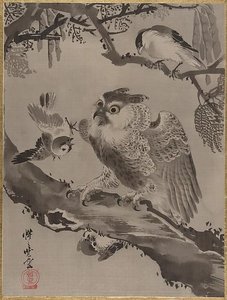
11Hell Courtesan (1880) de Kawanabe KyōsaiHell Courtesan1880 12Jurōjin [center of a triptych] (1884) de Kawanabe KyōsaiJurōjin [center of a triptych]1884 · Minneapolis Institute of Art 13Theatre Curtain of Shintomi-za, with an Impromputu Sketch Monster (1880) de Kawanabe KyōsaiTheatre Curtain of Shintomi-za, with an Impromputu Sketch Monster1880 14Squirrels Eating Chestnuts (1886) de Kawanabe KyōsaiSquirrels Eating Chestnuts1886 · Museu de Arte do Condado de Los Angeles 15A Beauty in Front of King Enma's Mirror (1887) de Kawanabe KyōsaiA Beauty in Front of King Enma's Mirror1887 16Urashima Tarō Riding on a Tortoise (1888) de Kawanabe KyōsaiUrashima Tarō Riding on a Tortoise1888 · Metropolitan Museum of Art 17Two Children Playing with Goldfish (1887) de Kawanabe KyōsaiTwo Children Playing with Goldfish1887 · Metropolitan Museum of Art 18Two Birds on a Branch (1887) de Kawanabe KyōsaiTwo Birds on a Branch1887 · Metropolitan Museum of Art 19Singing Bird on a Branch (1887) de Kawanabe KyōsaiSinging Bird on a Branch1887 · Metropolitan Museum of Art 20滝に燕図 Swallows by a Waterfall (1887) de Kawanabe Kyōsai滝に燕図 Swallows by a Waterfall1887 · Metropolitan Museum of Art 21Tale of the Tongue-cut Sparrow (1800) de Kawanabe KyōsaiTale of the Tongue-cut Sparrow1800 · Museu de Arte do Condado de Los Angeles 22Sketches of Birds and Animals (1870) de Kawanabe KyōsaiSketches of Birds and Animals1870 · Metropolitan Museum of Art 23Three Crossbills on a Leafless Tree (1878) de Kawanabe KyōsaiThree Crossbills on a Leafless Tree1878 · Minneapolis Institute of Art 24Chinese-style Landscape with Man Fishing from a Boat by Moonlight [right of a triptych] (1884) de Kawanabe KyōsaiChinese-style Landscape with Man Fishing from a Boat by Moonlight [right of a triptych]1884 · Minneapolis Institute of Art 25Landscape with River in Mountainous Country [left of a triptych] (1884) de Kawanabe KyōsaiLandscape with River in Mountainous Country [left of a triptych]1884 · Minneapolis Institute of Art 26猿を襲う鷲図 Eagle Attacking a Monkey (1885) de Kawanabe Kyōsai猿を襲う鷲図 Eagle Attacking a Monkey1885 · Metropolitan Museum of Art 27兎を追う鷲図 Eagle Pursuing Rabbit (1885) de Kawanabe Kyōsai兎を追う鷲図 Eagle Pursuing Rabbit1885 · Metropolitan Museum of Art 28Eagle Attacking a Mountain Lion (1885) de Kawanabe KyōsaiEagle Attacking a Mountain Lion1885 · Metropolitan Museum of Art 29White Eagle Eyeing a Mountain Lion (1885) de Kawanabe KyōsaiWhite Eagle Eyeing a Mountain Lion1885 · Metropolitan Museum of Art 30Rocky Landscape (1887) de Kawanabe KyōsaiRocky Landscape1887 · Metropolitan Museum of Art 31Crow on a Branch (1887) de Kawanabe KyōsaiCrow on a Branch1887 · Metropolitan Museum of Art 32Untitled (D2X7KF) (1887) de Kawanabe KyōsaiUntitled (D2X7KF)1887 · Metropolitan Museum of Art 33Fox Catching Bird (1887) de Kawanabe KyōsaiFox Catching Bird1887 · Metropolitan Museum of Art 34Bird and Frog (1887) de Kawanabe KyōsaiBird and Frog1887 · Metropolitan Museum of Art 35松に鴉図 Two Crows on a Pine Branch (1887) de Kawanabe Kyōsai松に鴉図 Two Crows on a Pine Branch1887 · Metropolitan Museum of Art 36Cranes in Marsh (1887) de Kawanabe KyōsaiCranes in Marsh1887 · Metropolitan Museum of Art 37Buffalo and Herdsman (1887) de Kawanabe KyōsaiBuffalo and Herdsman1887 · Metropolitan Museum of Art 38柳に鴉図 Crow and Willow Tree (1887) de Kawanabe Kyōsai柳に鴉図 Crow and Willow Tree1887 · Metropolitan Museum of Art 39岩に鴉図 Crow on a Rock (1887) de Kawanabe Kyōsai岩に鴉図 Crow on a Rock1887 · Metropolitan Museum of Art 40Owl Mocked by Small Birds (1887) de Kawanabe KyōsaiOwl Mocked by Small Birds1887 · Metropolitan Museum of Art 41木に鴉図 Crow on a Branch (1887) de Kawanabe Kyōsai木に鴉図 Crow on a Branch1887 · Metropolitan Museum of Art 42竹に鴉図 Crow on a Bamboo Branch (1887) de Kawanabe Kyōsai竹に鴉図 Crow on a Bamboo Branch1887 · Metropolitan Museum of Art 43旭に群鴉図 Flock of Crows at Dawn (1887) de Kawanabe Kyōsai旭に群鴉図 Flock of Crows at Dawn1887 · Metropolitan Museum of Art 44ムクドリ図 Starlings on a Branch (1887) de Kawanabe Kyōsaiムクドリ図 Starlings on a Branch1887 · Metropolitan Museum of Art 45Fish in a Whirlpool (1887) de Kawanabe KyōsaiFish in a Whirlpool1887 · Metropolitan Museum of Art 46富士図 Mount Fuji (1887) de Kawanabe Kyōsai富士図 Mount Fuji1887 · Metropolitan Museum of Art 47Rocky Landscape (1887) de Kawanabe KyōsaiRocky Landscape1887 · Metropolitan Museum of Art 48瓜に鼠図 Mice in a Melon (1887) de Kawanabe Kyōsai瓜に鼠図 Mice in a Melon1887 49Eagle Attacking Fish (1887) de Kawanabe KyōsaiEagle Attacking Fish1887 · Metropolitan Museum of Art 50Squirrels Gathering Chestnuts (1887) de Kawanabe KyōsaiSquirrels Gathering Chestnuts1887 · Metropolitan Museum of Art 51Monkey Hanging from Grapevines (1887) de Kawanabe KyōsaiMonkey Hanging from Grapevines1887 · Metropolitan Museum of Art 52雪中鴉図 Crow Flying in the Snow (1887) de Kawanabe Kyōsai雪中鴉図 Crow Flying in the Snow1887 · Metropolitan Museum of Art 53Waterfall, Eagle and Monkey (1887) de Kawanabe KyōsaiWaterfall, Eagle and Monkey1887 · Metropolitan Museum of Art 54月に鴉図 Crow and the Moon (1887) de Kawanabe Kyōsai月に鴉図 Crow and the Moon1887 · Metropolitan Museum of Art 55Pheasant Caught by a Snake (1887) de Kawanabe KyōsaiPheasant Caught by a Snake1887 · Metropolitan Museum of Art 56Shakyamuni Conquering the Demons (Shaka Gōma zu) (1888) de Kawanabe KyōsaiShakyamuni Conquering the Demons (Shaka Gōma zu)1888 · Metropolitan Museum of Art 57Eagle Holding Small Bird (1887) de Kawanabe KyōsaiEagle Holding Small Bird1887 · Metropolitan Museum of Art 58Monkeys (1888) de Kawanabe KyōsaiMonkeys1888 · Metropolitan Museum of Art 59Deer and Monkeys (1887) de Kawanabe KyōsaiDeer and Monkeys1887 · Metropolitan Museum of Art 60Rabbits (1887) de Kawanabe KyōsaiRabbits1887 · Metropolitan Museum of Art 61Cat Catching a Frog (1887) de Kawanabe KyōsaiCat Catching a Frog1887 · Metropolitan Museum of Art 62水辺に鴉図 Crow and Reeds by a Stream (1887) de Kawanabe Kyōsai水辺に鴉図 Crow and Reeds by a Stream1887 · Metropolitan Museum of Art 63白衣観音図 White Robed Kannon (1887) de Kawanabe Kyōsai白衣観音図 White Robed Kannon1887 · Metropolitan Museum of Art 64Playful Demon de Kawanabe KyōsaiPlayful DemonYale University Art Gallery 65Frolicking Animals, Nekomata and Tanuki Badger de Kawanabe KyōsaiFrolicking Animals, Nekomata and Tanuki Badger 66Long Arms [right of a pair of Long Legs and Long Arms] de Kawanabe KyōsaiLong Arms [right of a pair of Long Legs and Long Arms]Minneapolis Institute of Art 67Long Legs [left of a pair of Long Legs and Long Arms] de Kawanabe KyōsaiLong Legs [left of a pair of Long Legs and Long Arms]Minneapolis Institute of Art 68Seven Otafukus de Kawanabe KyōsaiSeven OtafukusMinneapolis Institute of Art 69Tanuki (Racoon Dog) Viewing Its Reflection in Water (801) de Kawanabe KyōsaiTanuki (Racoon Dog) Viewing Its Reflection in Water801 · Metropolitan Museum of Art 70Boy’s Day Carp Streamer and Shōki Banner (1870) de Kawanabe KyōsaiBoy’s Day Carp Streamer and Shōki Banner1870 · Metropolitan Museum of Art 71Figure Sketches de Kawanabe KyōsaiFigure Sketches 72Frolicking Figures and Animals de Kawanabe KyōsaiFrolicking Figures and Animals

Pinturas famosas de Kawanabe Kyōsai, período por período

Os temas que cativaram o olhar de Kawanabe Kyōsai

Os quatro temas que mais se repetem nestas obras originais, cada um com o seu melhor exemplo.

Os museus que guardam os originais de Kawanabe Kyōsai

Os 5 museus que detêm a maioria das pinturas desta página.

Museus Cidade Obras de Kawanabe Kyōsai Pinturas desta lista
Metropolitan Museum of Art, Nova YorkMetropolitan Museum of Art Nova York 48 Three Kyōgen Dancers, Sketches of East Asian Legendary Figures, Frolicking Figures and Animals
Minneapolis Institute of Art, MinneapolisMinneapolis Institute of Art Minneapolis 8 Wisteria Maiden and Demon Priest, Jurōjin [center of a triptych], Three Crossbills on a Leafless Tree
Museu de Arte do Condado de Los Angeles, Los AngelesMuseu de Arte do Condado de Los Angeles Los Angeles 4 Yang Guifei Adjusting her Hair, Yamauba and Kintarō, Squirrels Eating Chestnuts
Cleveland Museum of Art, ClevelandCleveland Museum of Art Cleveland 2 Hell Courtesan, Painting Party
Yale University Art Gallery, New HavenYale University Art Gallery New Haven 1 Playful Demon

Kawanabe Kyōsai ao longo das décadas: uma obra original única para cada uma

Obras por década

Escolha uma década para ver a obra original que a define.

Pinturas de Kawanabe Kyōsai: perguntas para a galeria

Qual é a obra mais famosa de Kawanabe Kyōsai?Revelar a resposta

Three Kyōgen Dancers (801), Metropolitan Museum of Art, Nova York. Sketches of East Asian Legendary Figures (801) e Yang Guifei Adjusting her Hair (1850) vêm a seguir.

Quais são as dez pinturas mais famosas de Kawanabe Kyōsai?Revelar a resposta

Three Kyōgen Dancers, Sketches of East Asian Legendary Figures, Yang Guifei Adjusting her Hair, Yamauba and Kintarō, Hell Courtesan, Frolicking Figures and Animals, Calligraphy and Painting Party, Wisteria Maiden and Demon Priest, Painting Party e Night Procession of One Hundred Demons. O ranking acima apresenta o ano e o museu de cada uma.

Quantas obras de Kawanabe Kyōsai são conhecidas?Revelar a resposta

Nosso catálogo contém 72 obras de Kawanabe Kyōsai, datadas de 1850 a 1888.

Onde se pode ver os originais mais famosos de Kawanabe Kyōsai?Revelar a resposta

Principalmente em Metropolitan Museum of Art (Nova York), Minneapolis Institute of Art (Minneapolis) e Museu de Arte do Condado de Los Angeles (Los Angeles). A tabela de museus acima lista todos eles.

Em que período Kawanabe Kyōsai criou as suas pinturas mais conhecidas?Revelar a resposta

Em 1880s: 52 das 72 obras nesta página foram feitas então, sendo Painting Party delas.

Qual pintura famosa de Kawanabe Kyōsai é a mais antiga e qual é a mais recente?Revelar a resposta

Nesta página, a mais antiga é Yang Guifei Adjusting her Hair (1850) e a mais recente é Urashima Tarō Riding on a Tortoise (1888).

Quais temas Kawanabe Kyōsai preferia?Revelar a resposta

Animals (8), Woman (6) e Black ink (6), entre as 72 obras nesta página.

Com quais materiais Kawanabe Kyōsai mais pintou?Revelar a resposta

Ink, para 8 das 72 obras nesta página.

A qual movimento pertence a obra de Kawanabe Kyōsai?Revelar a resposta

Ukiyo-e, a julgar pelos originais nesta página.

Quais originais de Kawanabe Kyōsai posso ver no Metropolitan Museum of Art?Revelar a resposta

Three Kyōgen Dancers, Sketches of East Asian Legendary Figures e Frolicking Figures and Animals: o Metropolitan Museum of Art, Nova York detém 48 das obras desta página.

Kawanabe Kyōsai: um retrato do artista

Uma Vida de Tinta e Rebeldia

Kawanabe Kyōsai chegou ao mundo em 1831, em Koga, nascido no seio de uma família samurai. Seus primeiros anos foram marcados por um encontro súbito e visceral com a mortalidade quando, aos nove anos, descobriu uma cabeça humana separada de um cadáver no rio Kanda. Este choque precoce precedeu uma educação formal sob os mestres da escola Kanō e de Utagawa Kuniyoshi. Embora tenha dominado o pincel preciso exigido pela tradição, seu espírito gravitou em direção aos estilos mais libertadores das escolas populares. Ele mudou-se para Edo, onde seu pai ingressou no corpo de bombeiros oficiais do Xogunato, e foi lá que Kyōsai começou a desenvolver a persona que definiria sua carreira.

Seu caminho nunca foi de conformismo silencioso. Durante as mudanças políticas do período Edo para a era Meiji, ele tornou-se uma figura de fascínio e de fricção. Foi preso três vezes pelas autoridades do Xogunato, frequentemente devido à natureza satírica de sua obra, que ridicularizava oficiais do governo e criticava as políticas vigentes. Esses embates com a lei não diminuíram sua produção; pelo contrário, reforçaram sua reputação como um pensador independente. Sua arte refletia o caos de uma nação que se transformava de um estado feudal em uma potência moderna.

O Demônio do Pincel

A habilidade técnica de Kyōsai era acompanhada por uma energia selvagem e indisciplinada. Ele ganhou o apelido de Shuchu gaki, ou "o Demônio da Pintura", um título que abraçou através do uso de vários selos em seus trabalhos. Sua temática era vasta e muitas vezes estranha, variando do religioso ao grotesco. Ele povoou suas telas com demônios, esqueletos, rãs e animais, imbuindo-os frequentemente de um humor quase humano ou de significados políticos. Uma notável pintura longa em um pergaminho, A batalha dos gases, capturou o fermento político de sua era através da pura caricatura.

Seu processo criativo era tão lendário quanto seus temas. Dizia-se que ele era capaz de pintar após uma noite inteira de bebedeira, entrando em um estado onde o pincel se movia com uma velocidade instintiva. Este estilo espontâneo, por vezes referido como kyōga ou "pinturas loucas", permitia um desenho fluido que parecia vivo. Embora possuísse as bases técnicas da escola Kanō, sua obra inclinava-se para o caos e a comédia, em vez da reverência silenciosa. Ele era um habilidoso artista de xilogravura, produzindo obras como Kyōsai hyakuzu e várias impressões namazu-e que ressoavam com o público.

Um Legado em Traços

Além de suas pinturas individuais, Kyōsai contribuiu para a evolução da narrativa visual. Em 1874, ele ajudou a criar o que é considerado a primeira revista de mangá, Eshinbun Nipponchi, ao lado de Kanagaki Robun. Embora a publicação tenha durado apenas três edições, ela representou uma tentativa precoce de uma nova forma de mídia gráfica. Sua influência estendeu-se muito além do Japão, com suas obras encontrando lugar em coleções como o British Museum e o Museu Guimet, em Paris. Até visitantes ocidentais, incluindo arquitetos como Josiah Conder, documentaram suas habilidades extraordinárias.

O artista faleceu em 1889, devido a um câncer gástrico. Ele deixou para trás um imenso corpo de trabalho, estimado em mais de 10.000 peças, abrangendo gravuras, esboços e álbuns. Sua vida foi um espelho da era em que habitou — turbulenta, em transição e profundamente complexa. Através de sua tinta, a transição da Idade Média para uma sociedade industrial moderna encontrou sua voz mais expressiva.