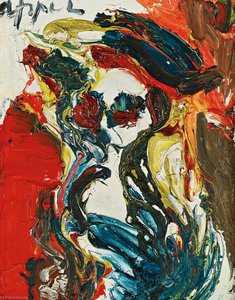
Karel Appel: um retrato do artista
A Life Painted in Bold Strokes: The World of Karel Appel
Christiaan Karel Appel, known affectionately as ‘Kik’ from childhood, burst onto the post-war art scene like a vibrant explosion of color and energy. Born in Amsterdam in 1921, his early life was steeped in the everyday rhythms of working-class Holland – his father a barber, his lineage tracing back to French Huguenots through his mother. This grounding, however, would soon be superseded by an irrepressible artistic drive that defied convention and ultimately reshaped the landscape of European art. A pivotal moment arrived at age fourteen with his first painting, a still life of fruit, followed shortly after by a paint set and easel gifted by his uncle Karel Chevalier, who also provided early instruction. These gifts weren’t merely tools; they were keys unlocking a world where imagination reigned supreme. The shadow of the Second World War loomed large over Appel’s formative years. Studying at the Rijksakademie van Beeldende Kunsten in Amsterdam during the German occupation proved challenging, yet it was there he forged lifelong bonds with fellow artists Corneille and Constant, friendships that would prove crucial to his artistic evolution. Facing opposition from his parents regarding his chosen path and fearing forced labor under Nazi rule, Appel bravely left home, choosing a life dedicated to art over conformity.
Early Life and Artistic Beginnings
Christiaan Karel Appel was born on April 25, 1921, in Amsterdam’s Dapperstraat 7, the son of Jan Appel and Johanna Chevallier. His father operated a barbershop, while his mother descended from French Huguenots—a heritage that instilled in him a certain independence and intellectual curiosity. From a young age, Appel demonstrated an innate fascination with art, producing his first painting at fourteen – a depiction of fruit – which foreshadowed his lifelong commitment to visual expression. A significant catalyst for his artistic journey was the generous gift of a paint set and easel from his uncle Karel Chevalier, who nurtured his talent through early instruction. This familial support wasn’t simply material; it represented encouragement and validation of Appel's burgeoning passion.
The CoBrA Revolution: Spontaneity and the Childlike Vision
Appel’s artistic trajectory truly gained momentum with the formation of the CoBrA group in 1948 – an acronym derived from Copenhagen, Brussels, and Amsterdam—representing the movement’s core cities. Alongside Corneille Guillaume Beverloo and Constant Nieuwenhuys, Appel spearheaded a radical departure from established artistic norms. CoBrA wasn’t merely a style; it was a philosophy rooted in spontaneity, experimentation, and a profound embrace of the untamed creativity found in children's art and primitive cultures. Influenced by masters like Pablo Picasso and Henri Matisse, as well as the raw energy of Jean Dubuffet, Appel rejected rigid formalism in favor of intuitive expression. He began sculpting in 1947, utilizing assemblage techniques – constructing works from found materials painted in a bold palette of white, red, yellow, blue, and black—a technique that would become synonymous with his artistic vision. The CoBrA group’s manifesto declared “La cause était entendue,” rejecting the conventions of Surrealism and De Stijl. They sought to liberate art from dogma, mirroring the spirit of rebellion prevalent in Europe after World War II.
International Horizons: From Paris to New York and Beyond
Recognizing the limitations of CoBrA’s reception within the Netherlands, Appel relocated to Paris in 1950—a city that offered greater artistic freedom and recognition—marking the beginning of an expansive period of international travel and exposure. He immersed himself in Parisian intellectual life, engaging with artists like Jean Dubuffet and Willem de Kooning, whose work profoundly impacted his stylistic development. Appel’s debut exhibition at Martha Jackson Gallery in 1954 garnered critical acclaim and cemented his position within the burgeoning American art scene. Notably, “Child and Beast II” was included in MoMA’s influential “The New Decade” exhibition of 1955—a testament to CoBrA's ability to resonate across continents. Appel continued to sculpt throughout his life, exploring diverse materials and techniques, solidifying his legacy as a multifaceted artist.
Legacy and Influence
Karel Appel’s contribution to post-war European art is undeniable. He established the Karel Appel Foundation in 2002 to safeguard his artworks and promote public awareness of his oeuvre—a testament to his enduring belief in the transformative power of artistic expression. Despite a brief setback when some of his pieces disappeared in 2002, they were thankfully recovered in 2012—underscoring the importance of preserving cultural heritage. Appel’s work continues to inspire contemporary artists who champion experimentation and reject traditional boundaries—ensuring that his bold vision persists for generations to come. His distinctive style—characterized by vibrant colors, simplified forms, and a preoccupation with childlike imagery—remains a significant influence on artists exploring new avenues of creative exploration.