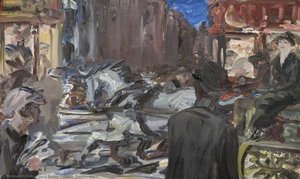
Retrato de Jack Yeats

As 46 Pinturas Mais Famosas de Jack Yeats, uma Seleção da Galeria

Atualizado em Outubro 2026 · classificado pela nossa pontuação de popularidade (pesquisas, visitas e pedidos de cada obra) · 47 obras de Jack Yeats em nosso catálogo

Em resumo

De todas as obras originais deixadas por Jack Yeats, a mais famosa é The Coast of Clare from Dun Aengus (1925), da coleção do Harris Museum - Art Gallery, em Preston. Logo atrás vêm Singing You Made Me Love You (1949) e Grafton Street Conversation Piece (1923). Nosso catálogo contém 47 obras de Jack Yeats; a galeria preservou as 46 que o mundo mais admira, cada uma exibida com sua data, seu museu e sua história.

1871 – 1957, Londres Impressionism Mais obras: Harris Museum - Art Gallery

As 10 principais pinturas de Jack Yeats: a escolha da galeria

A seleção de Jack Yeats continua, de 11 a 46

Os temas que cativaram o olhar de Jack Yeats

Os quatro temas que mais se repetem nestas obras originais, cada um com o seu melhor exemplo.

Os museus que guardam os originais de Jack Yeats

Os 8 museus que detêm a maioria das pinturas desta página.

Museus Cidade Obras de Jack Yeats Pinturas desta lista
Harris Museum - Art Gallery, PrestonHarris Museum - Art Gallery Preston 1 The Coast of Clare from Dun Aengus
Pallant House Gallery, ChichesterPallant House Gallery Chichester 1 The Ox Mountains, Ireland
Art Institute of Chicago, ChicagoArt Institute of Chicago Chicago 1 Roadsters Old and Young
Museu Nacional de Varsóvia, VarsóviaMuseu Nacional de Varsóvia Varsóvia 1 On the Hazard
Galeria Nacional do Canadá, OttawaGaleria Nacional do Canadá Ottawa 1 On Drumcliffe Strand
Leeds Art Gallery, LeedsLeeds Art Gallery Leeds 1 The Mystery Man
Bristol Museum - Art Gallery, BristolBristol Museum - Art Gallery Bristol 1 Humanity's Alibi
Museu de Belas Artes de Boston, BostonMuseu de Belas Artes de Boston Boston 1 Beautiful City of Sligo

Jack Yeats década a década: a obra original que define cada uma

Obras por década

Escolha uma década para ver a obra original que a define.

Perguntas de colecionadores sobre as pinturas de Jack Yeats

Por qual obra Jack Yeats é mais conhecido(a)?Revelar a resposta

The Coast of Clare from Dun Aengus (1925), Harris Museum - Art Gallery, Preston. Singing You Made Me Love You (1949) e Grafton Street Conversation Piece (1923) vêm a seguir.

Qual era a idade de Jack Yeats quando The Coast of Clare from Dun Aengus foi feita?Revelar a resposta

54 anos: The Coast of Clare from Dun Aengus data de 1925, e Jack Yeats nasceu em 1871.

Quais são as dez pinturas mais famosas de Jack Yeats?Revelar a resposta

The Coast of Clare from Dun Aengus, Singing You Made Me Love You, Grafton Street Conversation Piece, Sligo Bay, The Ox Mountains, Ireland, Landing Cargo, Mayo Coast, An Old Car Driver, A Storm Gaillshion, Roadsters Old and Young e Untitled (Two Jockeys on Horses, Leaping a Stone Wall). O ranking acima apresenta o ano e o museu de cada uma.

Quantas pinturas Jack Yeats deixou?Revelar a resposta

Nosso catálogo contém 47 obras de Jack Yeats, datadas de 1910 a 1956.

Em quais museus estão expostas as obras-primas de Jack Yeats?Revelar a resposta

Principalmente em Harris Museum - Art Gallery (Preston), Pallant House Gallery (Chichester) e Art Institute of Chicago (Chicago). A tabela de museus acima lista todos eles.

Em que anos Jack Yeats pintou as suas obras mais famosas?Revelar a resposta

Em 1920s: 12 das 46 obras nesta página foram feitas então, sendo The Coast of Clare from Dun Aengus delas.

Quais são as primeiras e as últimas obras originais famosas de Jack Yeats?Revelar a resposta

Nesta página, a mais antiga é Race Course Town Galway, Ireland (1910) e a mais recente é Roadsters Old and Young (1956).

Quais temas Jack Yeats escolheu com mais frequência?Revelar a resposta

Irish landscape (4), Coastal scene (2) e Solitude (2), entre as 46 obras nesta página.

A qual movimento artístico pertence Jack Yeats?Revelar a resposta

Impressionism, a julgar pelos originais nesta página.

Jack Yeats: vida e obra

Jack Butler Yeats (1871–1957): Ireland's Olympic medalist & leading 20th-century painter

Jack Butler Yeats, born in London, England, on August 29, 1871, was more than just a painter; he was a storyteller, a poet of the canvas, and a uniquely Irish voice resonating within the broader currents of modern art. Though initially overshadowed by his celebrated brother, the poet W.B. Yeats (William Butler Yeats), Jack carved out an artistic identity entirely his own—one deeply rooted in the landscapes, people, and spirit of Ireland. His journey began amidst a family steeped in creativity; his father, John Butler Yeats, was also a painter, instilling in young Jack a love for art from an early age. However, it was his formative years spent with his maternal grandparents in Sligo that truly shaped his artistic vision. The rugged beauty of the Irish countryside, the folklore whispered through generations, and the everyday lives of its inhabitants became enduring themes woven into the fabric of his work.
  • Early Life
  • Romantic Echoes to Expressionist Fire
  • A Champion of Irish Life & Olympic Glory
  • Legacy & Enduring Influence

Early Life

Yeats was born in London, England. He was the youngest son of the Irish portraitist John Butler Yeats and Susan Yeats (née Pollexfen). He grew up in Sligo with his maternal grandparents, before returning to London in 1887 to live with his parents.He attended the Chiswick School of Artwith his sisters Elizabeth Yeats and Susan Yeats,learning “Freehand drawing in all its branches, practical Geometry and perspective, pottery"

Romantic Echoes to Expressionist Fire

His early paintings were characterized by a lyrical romanticism, reminiscent of the Irish landscape tradition but imbued with a personal sensitivity. These works often depicted tranquil scenes of rural life, bathed in soft light and gentle hues.However, around 1920,his style underwent a dramatic transformation.Influenced by the burgeoning Expressionist movement in Europe, Yeats abandoned representational accuracy in favor of conveying raw emotion and subjective experience. His canvases erupted with vibrant, often jarring colors, bold brushstrokes, and distorted forms.This shift wasn’t merely stylistic; it reflected a deeper engagement with the complexities of modern life and the anxieties of a nation grappling with political upheaval and social change. He didn't simply paint what he *saw*; he painted what he *felt*. Recurring motifs emerged—horses galloping across windswept fields, bustling circus scenes brimming with energy, traveling players embodying both joy and melancholy—each serving as a vehicle for exploring universal themes of human existence: loneliness, suffering, resilience, and the search for meaning.

A Champion of Irish Life & Olympic Glory

Central to Yeats’s artistic vision was his unwavering commitment to depicting Irish life in all its multifaceted glory.He wasn't interested in idyllic pastoral scenes or romanticized nationalism;instead, he sought to capture the gritty reality of everyday existence—the hardships faced by ordinary people, the vibrancy of street life, and the enduring spirit of a nation steeped in history and folklore. His paintings are populated with figures who embody this resilience: laborers, musicians, gamblers, and dreamers, each rendered with empathy and psychological depth.Yeats won a silver medal in the arts and culture segment at the 1924 Summer Olympicsin Paris for his painting *The Liffey Swim*, cementing his status not only as Ireland’s leading artist but also as a cultural ambassador.

Legacy & Enduring Influence

Yeats stands as a towering figure in 20th-century Irish art, an artist who defied categorization and forged his own unique path.He was elected to the Royal Hibernian Academy in 1916,further solidifying his position within the Irish art establishment. Beyond painting, he was a prolific writer,producing novels, plays performed at the Abbey Theatre, and insightful essays. His stream-of-consciousness writing style even influenced literary giants like James Joyce.Critics have drawn comparisons between his work and that of Austrian Expressionist Oskar Kokoschka,recognizing a shared intensity of emotion and experimentation with form. Samuel Beckett lauded Yeats as one of the “greatest of our time,” while John Berger praised him as a “great painter” possessing a remarkable sense of the future.His legacy continues to inspire artists today,reminding us of the power of art to capture not just what is seen, but what is *felt*—the very essence of the human condition.