Retrato de Hiroshige

Pinturas de Hiroshige: As 100 mais famosas, sob o olhar de uma galeria

Atualizado em Outubro 2026 · classificado pela nossa pontuação de popularidade (pesquisas, visitas e pedidos de cada obra) · 353 obras de Hiroshige em nosso catálogo

Em resumo

Aos olhos da galeria, a pintura mais famosa de Hiroshige é Early Department from a Daimyo, cuja obra original está exposta no Nakagawa-machi Bato Hiroshige Museum of Art, em Nagasaki. The maple leaves of Mama, Tekona shrine and Tsugi bridge (1857) e Hakone (1834) completam o trio que todos reconhecem. Dos 353 trabalhos de Hiroshige em nosso catálogo, a galeria apresenta abaixo as 100 obras mais famosas, cada uma original, com seu ano, seu museu e o que a torna única.

1797 – 1858, Edo Japanese landscape painting Mais obras: Nakagawa-machi Bato Hiroshige Museum of Art

As 10 principais pinturas de Hiroshige na galeria

1
Early Department from a Daimyo de Hiroshige

Early Department from a Daimyo

Woodblock Print · Nakagawa-machi Bato Hiroshige Museum of Art, Nagasaki

In the delicate dance of lines and muted pigments, Utagawa Hiroshige’s Early Department from a Daimyo invites us to step through a portal into the heart of Edo-period Japan. This exquisite woodblock print captures a moment of vibrant communal life along a bustling riverside, where the rigid structures of social hierarchy melt into the shared leisure of a sunny afternoon. As we gaze upon the scene, we are not merely…

2
The maple leaves of Mama, Tekona shrine and Tsugi bridge (1857) de Hiroshige

The maple leaves of Mama, Tekona shrine and Tsugi bridge

1857 · Woodblock Print · Van Gogh Museum, Amsterdã

Utagawa Hiroshige (1797-1858), arguably the last titan of *ukiyo-e*, didn't merely depict landscapes; he crafted them into meditations on beauty and impermanence. “The Maple Leaves of Mama, Tekona Shrine and Tsugi Bridge,” created in 1857 during a period of significant societal transformation—the waning influence of feudal Japan as Western ideas crept in—stands as a testament to his enduring artistic legacy. More than just a visual record, it’s an embodiment of…

3
Hakone (1834) de Hiroshige

Hakone

1834 · Woodblock Print · Indianapolis Museum of Art, Indianapolis

Utagawa Hiroshige’s “Hakone,” created in 1834, is more than just a landscape; it's a poetic meditation on the beauty and transience of nature within Edo-period Japan. This woodblock print, part of his renowned series "The Fifty-three Stations of the Tōkaidō," captures a specific moment along the vital trade route connecting Tokyo (then Edo) with Kyoto. However, Hiroshige elevates this seemingly simple depiction of a mountain pass into something profoundly evocative,…

4
Station 36, Goyu; Kyoka Tokaido Series (1855) de Hiroshige

Station 36, Goyu; Kyoka Tokaido Series

1855 · Woodblock Print · Indianapolis Museum of Art, Indianapolis

In the delicate interplay of ink and paper, Utagawa Hiroshige’s "Station 36, Goyu; Kyoka Tokaido Series" offers much more than a mere topographical record of a journey. Completed in 1855, this exquisite woodblock print serves as a profound distillation of Edo-period sensibilities, capturing a yearning for tranquility amidst the burgeoning dynamism of a Japan in transition. As the nation stood at a pivotal crossroads between ancient feudal traditions and the…

5
Estação nº 51, Fushimi (1842) de Hiroshige

Estação nº 51, Fushimi

1842 · Acrílico sobre tela · Indianapolis Museum of Art, Indianapolis

Uma Jornada Poética pelas Estações do Tokaido: Hiroshige e a Beleza Efêmera da Paisagem Japonesa Utagawa Hiroshige, um nome que ressoa com força no universo da arte japonesa, permanece como uma figura emblemática da estética tokugawa e uma influência duradoura na cultura ocidental. Sua obra transcende a mera representação visual; ela captura a essência de uma época marcada pela tranquilidade relativa do shogunato Tokugawa e pela crescente abertura ao mundo…

6
Ichikoku Bridge in the Eastern Capital (Tōto: Ichikoku bashi) (1858) de Hiroshige

Ichikoku Bridge in the Eastern Capital (Tōto: Ichikoku bashi)

1858 · Woodblock Print · Indianapolis Museum of Art, Indianapolis

The Ichikoku Bridge spans a quiet stretch of water in the Eastern Capital. Beneath its wooden arch, two boats drift through the current. People move across the structure, some carrying backpacks and others clutching small handbags. A mountain rises in the distance, watching over the scene. Trees frame the edges of the view, their leaves casting shadows near the water's edge.

7
Shinagawa Sunrise from the series Fifty-three Stations on the Tokaido Road (1834) de Hiroshige

Shinagawa Sunrise from the series Fifty-three Stations on the Tokaido Road

1834 · Woodblock Print · Hill-Stead Museum, Farmington

In the soft, burgeoning light of a nineteenth-century morning, Utagawa Hiroshige invites us to witness a moment of profound stillness along the Tōkaidō road. Shinagawa Sunrise is not merely a depiction of a coastal village; it is a masterclass in the art of atmosphere. As the sun begins its ascent, the boundary between the heavens and the earth dissolves into a luminous haze. The water of the bay reflects a…

8
The Rokugo River Ferry, Kawasaki, from the series the Fifty-three Stations of the Tokaido (Hoeido edition ) de Hiroshige

The Rokugo River Ferry, Kawasaki, from the series the Fifty-three Stations of the Tokaido (Hoeido edition )

Woodblock Print · Nakagawa-machi Bato Hiroshige Museum of Art, Nagasaki

In the delicate dance of woodblock printing, few masters captured the ephemeral beauty of Japanese life as profoundly as Utagawa Hiroshige. His masterpiece, The Rokugo River Ferry, Kawasaki, serves as a breathtaking window into the Edo period, inviting the viewer to step onto the bustling banks of one of the most vital crossings on the Tokaido road. This evocative scene from his legendary series, The Fifty-three Stations of the Tokaido,…

9
Itsukushima in Aki Province (1858) de Hiroshige

Itsukushima in Aki Province

1858 · Woodblock Print · Museu do Brooklyn, Brooklyn

In the delicate interplay of mist and water, Itsukushima in Aki Province offers more than a mere glimpse of a Japanese landmark; it provides a profound meditation on the ephemeral nature of existence. Created by the legendary ukiyo-e master Ando Hiroshige in 1858, this woodcut print captures the spiritual essence of the Itsukushima shrine area with a poetic sensitivity that remains unparalleled. As one gazes upon the composition, the eye…

10
Tenryu River Ferry Crossing, Mitsuke, from the series The Fifty-three Stations of the Tokaido (Gyosho Edition) de Hiroshige

Tenryu River Ferry Crossing, Mitsuke, from the series The Fifty-three Stations of the Tokaido (Gyosho Edition)

Woodblock Print · Nakagawa-machi Bato Hiroshige Museum of Art, Nagasaki

The woodblock print depicts a section of the Tenryu River near the station of Mitsuke. In the center of the composition, a large sandbank divides the water into two distinct currents. Several small wooden boats occupy the river, with figures positioned within them to manage the crossing. Some vessels are moored directly against the central sandbank, while others navigate the moving water. The far shore is visible in the distance,…

Pinturas de Hiroshige, classificadas de 11 a 100

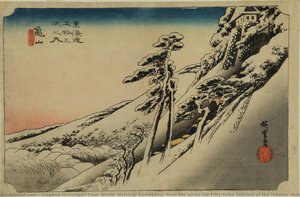
11Pardal e Videiras de Uva (1800) de HiroshigePardal e Videiras de Uva1800 · Indianapolis Museum of Art 12The Pine Woods of Miho in Suruga Province (Suruga Miho no matsubara) (1858) de HiroshigeThe Pine Woods of Miho in Suruga Province (Suruga Miho no matsubara)1858 · Indianapolis Museum of Art 1362 (55) Komakata Hall and Azuma Bridge (1857) de Hiroshige62 (55) Komakata Hall and Azuma Bridge1857 · Museu do Brooklyn 14Evening Snow at Kanbara (1834) de HiroshigeEvening Snow at Kanbara1834 · Museu de Arte do Condado de Los Angeles 15Dawn in the licensed quarters (1857) de HiroshigeDawn in the licensed quarters1857 · Art Gallery of New South Wales 16Ando Hiroshige

Um vislumbre da vida noturna de Edo: o encanto de Saruwakacho

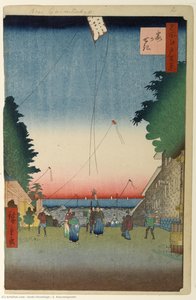
A "Visão Noturna de Saruwakacho" de Ando Hiroshige é mais do que uma simples representação do Japão do século XIX; é um convite para voltar no tempo e vivenciar o pulso vibrant de HiroshigeAndo Hiroshige Um vislumbre da vida noturna de Edo: o encanto de Saruwakacho A "Visão Noturna de Saruwakacho" de Ando Hiroshige é mais do que uma simples representação do Japão do século XIX; é um convite para voltar no tempo e vivenciar o pulso vibrant 17Station 28, Fukuroi (1855) de HiroshigeStation 28, Fukuroi1855 · Indianapolis Museum of Art 18Evening Snow at Asakusa or Woman with Umbrella from the series Eight Views of the Environs of Edo (1800) de HiroshigeEvening Snow at Asakusa or Woman with Umbrella from the series Eight Views of the Environs of Edo1800 · Hill-Stead Museum 19Keishi (Kyoto), Capital (1834) de HiroshigeKeishi (Kyoto), Capital1834 · Indianapolis Museum of Art 20Hara: View of Ashitakayama and Fuji (1855) de HiroshigeHara: View of Ashitakayama and Fuji1855 · Indianapolis Museum of Art 21Yokkaichi (Station #44) (1834) de HiroshigeYokkaichi (Station #44)1834 · Indianapolis Museum of Art 22Desolate Wintry Scene, Hamamatsu, from the series the Fifty-three Stations of the Tokaido (Hoeido edition) de HiroshigeDesolate Wintry Scene, Hamamatsu, from the series the Fifty-three Stations of the Tokaido (Hoeido edition)Nakagawa-machi Bato Hiroshige Museum of Art 23Noge and Yokohama in Musashi Province (Musashi, Noge, Yokohama) (1858) de HiroshigeNoge and Yokohama in Musashi Province (Musashi, Noge, Yokohama)1858 · Indianapolis Museum of Art 24Wild sea breaking on the rocks (1856) de HiroshigeWild sea breaking on the rocks1856 25Shirasuga, Shiomi-zaka zu (Vista da Montanha Shiomi) (1833) de HiroshigeShirasuga, Shiomi-zaka zu (Vista da Montanha Shiomi)1833 · Indianapolis Museum of Art 26Mt.Fuji on the Left, Yoshiwara, from the series the Fifty-three Stations of the Tokaido (Hoeido edition) de HiroshigeMt.Fuji on the Left, Yoshiwara, from the series the Fifty-three Stations of the Tokaido (Hoeido edition)Nakagawa-machi Bato Hiroshige Museum of Art 27Tsukuda Offing in the Eastern Capital (Tōto: Tsukuda oki) (1858) de HiroshigeTsukuda Offing in the Eastern Capital (Tōto: Tsukuda oki)1858 · Indianapolis Museum of Art 28Kawachi (1853) de HiroshigeKawachi1853 · Indianapolis Museum of Art 29The Dye Craft Shops of Arimatsu, Narumi, from the series The Fifty-three Stations of the Tokaido (Gyosho edition) de HiroshigeThe Dye Craft Shops of Arimatsu, Narumi, from the series The Fifty-three Stations of the Tokaido (Gyosho edition)Nakagawa-machi Bato Hiroshige Museum of Art 30View of Shiomi Slope, Shirasuka, from the series The Fifty-three Stations of the Tokaido (Gyosho edition) de HiroshigeView of Shiomi Slope, Shirasuka, from the series The Fifty-three Stations of the Tokaido (Gyosho edition)Nakagawa-machi Bato Hiroshige Museum of Art 31Entrance to Enoshima in Sagami Province (Sagami Enoshima iriguchi) (1858) de HiroshigeEntrance to Enoshima in Sagami Province (Sagami Enoshima iriguchi)1858 · Indianapolis Museum of Art 32Morning Mist, Mishima, from the series the Fifty-three Stations of the Tokaido (Hoeido edition ) de HiroshigeMorning Mist, Mishima, from the series the Fifty-three Stations of the Tokaido (Hoeido edition )Nakagawa-machi Bato Hiroshige Museum of Art 33The Imagire Sea Ferry, Maisaka, from the series The Fifty-three Stations of the Tokaido (Gyosho edition) de HiroshigeThe Imagire Sea Ferry, Maisaka, from the series The Fifty-three Stations of the Tokaido (Gyosho edition)Nakagawa-machi Bato Hiroshige Museum of Art 34Sukiya Riverbank in the Eastern Capital (Tōto sukiya kaigan) (1858) de HiroshigeSukiya Riverbank in the Eastern Capital (Tōto sukiya kaigan)1858 · Indianapolis Museum of Art 35Satta Pass, Yui, from the series the Fifty-three Stations of the Tokaido (Hoeido edition) de HiroshigeSatta Pass, Yui, from the series the Fifty-three Stations of the Tokaido (Hoeido edition)Nakagawa-machi Bato Hiroshige Museum of Art 36True View of Imagire, Maisaka, from the series the Fifty-three Stations of the Tokaido (Hoeido edition) de HiroshigeTrue View of Imagire, Maisaka, from the series the Fifty-three Stations of the Tokaido (Hoeido edition)Nakagawa-machi Bato Hiroshige Museum of Art 37Kanbara, Noite Nevasca (1834) de HiroshigeKanbara, Noite Nevasca1834 · Indianapolis Museum of Art 38Clear Winter Morning, Kameyama, from the series the Fifty-three Stations of the Tokaido (Hoeido edition) de HiroshigeClear Winter Morning, Kameyama, from the series the Fifty-three Stations of the Tokaido (Hoeido edition)Nakagawa-machi Bato Hiroshige Museum of Art 39The Tenryu River, Mitsuke, from the series the Fifty-three Stations of the Tokaido (Hoeido edition) de HiroshigeThe Tenryu River, Mitsuke, from the series the Fifty-three Stations of the Tokaido (Hoeido edition)Nakagawa-machi Bato Hiroshige Museum of Art 40The Seven-ri Ferry Crossing, Kuwana, from the series the Fifty-three Stations of the Tokaido (Hoeido edition) de HiroshigeThe Seven-ri Ferry Crossing, Kuwana, from the series the Fifty-three Stations of the Tokaido (Hoeido edition)Nakagawa-machi Bato Hiroshige Museum of Art 41Aronia and Bullfinch de HiroshigeAronia and Bullfinch 42Gaio Correndo ao Katata (1834) de HiroshigeGaio Correndo ao Katata1834 · Indianapolis Museum of Art 43Yugyoji Temple, Fujisawa, from the series the Fifty-three Stations of the Tokaido (Hoeido edition) de HiroshigeYugyoji Temple, Fujisawa, from the series the Fifty-three Stations of the Tokaido (Hoeido edition)Nakagawa-machi Bato Hiroshige Museum of Art 44Travellers and Soliciting Women, Goyu, from the series the Fifty-three Stations of the Tokaido (Hoeido edition) de HiroshigeTravellers and Soliciting Women, Goyu, from the series the Fifty-three Stations of the Tokaido (Hoeido edition)Nakagawa-machi Bato Hiroshige Museum of Art 45The Totoumi Bank of the Oi River, Kanaya, from the series the Fifty-three Stations of the Tokaido (Hoeido edition) de HiroshigeThe Totoumi Bank of the Oi River, Kanaya, from the series the Fifty-three Stations of the Tokaido (Hoeido edition)Nakagawa-machi Bato Hiroshige Museum of Art 46The Suruga Bank of the Oi River, Shimada, from the series the Fifty-three Stations of the Tokaido (Hoeido edition) de HiroshigeThe Suruga Bank of the Oi River, Shimada, from the series the Fifty-three Stations of the Tokaido (Hoeido edition)Nakagawa-machi Bato Hiroshige Museum of Art 47Kyoka Tokaido Series, Kanagawa (Yokohama) de HiroshigeKyoka Tokaido Series, Kanagawa (Yokohama)Indianapolis Museum of Art 48Distant View of Miho, Ejiri, from the series the Fifty-three Stations of the Tokaido (Hoeido edition) de HiroshigeDistant View of Miho, Ejiri, from the series the Fifty-three Stations of the Tokaido (Hoeido edition)Nakagawa-machi Bato Hiroshige Museum of Art 49Mt. Fuji in the Morning, Hara, from the series the Fifty-three Stations of the Tokaido (Hoeido edition) de HiroshigeMt. Fuji in the Morning, Hara, from the series the Fifty-three Stations of the Tokaido (Hoeido edition)Nakagawa-machi Bato Hiroshige Museum of Art 50A Horse Fair, Chiriu, from the series the Fifty-three Stations of the Tokaido (Hoeido edition) de HiroshigeA Horse Fair, Chiriu, from the series the Fifty-three Stations of the Tokaido (Hoeido edition)Nakagawa-machi Bato Hiroshige Museum of Art 51Wakasa (1853) de HiroshigeWakasa1853 · Indianapolis Museum of Art 52Distant View of Mt.Akiba, Kakegawa, from the series the Fifty-three Stations of the Tokaido (Hoeido edition) de HiroshigeDistant View of Mt.Akiba, Kakegawa, from the series the Fifty-three Stations of the Tokaido (Hoeido edition)Nakagawa-machi Bato Hiroshige Museum of Art 53The Ichiri-Han Sea Ferry, Arai, from the series The Fifty-three Stations of the Tokaido (Gyosho edition) de HiroshigeThe Ichiri-Han Sea Ferry, Arai, from the series The Fifty-three Stations of the Tokaido (Gyosho edition)Nakagawa-machi Bato Hiroshige Museum of Art 54Gateway Entrance to the Atsuta Shrine on the Beach, Miya, from the series The Fifty-three Stations of the Tokaido (Gyosho edition) de HiroshigeGateway Entrance to the Atsuta Shrine on the Beach, Miya, from the series The Fifty-three Stations of the Tokaido (Gyosho edition)Nakagawa-machi Bato Hiroshige Museum of Art 55Akasaka, from the series The Fifty-three Stations of the Tokaido (Gyosho edition) de HiroshigeAkasaka, from the series The Fifty-three Stations of the Tokaido (Gyosho edition)Nakagawa-machi Bato Hiroshige Museum of Art 56The Sakawa River, Odawara, from the series the Fifty-three Stations of the Tokaido (Hoeido edition) de HiroshigeThe Sakawa River, Odawara, from the series the Fifty-three Stations of the Tokaido (Hoeido edition)Nakagawa-machi Bato Hiroshige Museum of Art 57A Footpath between Ricefield, Hiratsuka, from the series the Fifty-three Stations of the Tokaido (Hoeido edition) de HiroshigeA Footpath between Ricefield, Hiratsuka, from the series the Fifty-three Stations of the Tokaido (Hoeido edition)Nakagawa-machi Bato Hiroshige Museum of Art 58Awa Province: Whirlpool at Naruto (1853) de HiroshigeAwa Province: Whirlpool at Naruto1853 5973 The City Flourishing, the Tanabata Festival (1857) de Hiroshige73 The City Flourishing, the Tanabata Festival1857 60Sarugababa Plain, Futagawa, from the series the Fifty-three Stations of the Tokaido (Hoeido edition) de HiroshigeSarugababa Plain, Futagawa, from the series the Fifty-three Stations of the Tokaido (Hoeido edition)Nakagawa-machi Bato Hiroshige Museum of Art 61Local Specialty Teahouse, Mariko, from the series the Fifty-three Stations of the Tokaido (Hoeido edition) de HiroshigeLocal Specialty Teahouse, Mariko, from the series the Fifty-three Stations of the Tokaido (Hoeido edition)Nakagawa-machi Bato Hiroshige Museum of Art 62Sakanoshita de HiroshigeSakanoshitaIndianapolis Museum of Art 63Estação 23, Fujieda de HiroshigeEstação 23, FujiedaIndianapolis Museum of Art 64Marsh Grasses and Mandarin Ducks de HiroshigeMarsh Grasses and Mandarin Ducks 6550th station, Minakuchi de Hiroshige50th station, Minakuchi 66Sakanoshita: the Throwing Away the Brush Peak (1834) de HiroshigeSakanoshita: the Throwing Away the Brush Peak1834 · Museu do Brooklyn 67Shibaura Bay of Musashi Province (801) de HiroshigeShibaura Bay of Musashi Province801 · Metropolitan Museum of Art 68Koyurugi Beach of Sagami Province (801) de HiroshigeKoyurugi Beach of Sagami Province801 · Metropolitan Museum of Art 69Honmoku Bay of Musashi Province (801) de HiroshigeHonmoku Bay of Musashi Province801 · Metropolitan Museum of Art 70Untitled (Two Rabbits, Pampas Grass, and Full Moon) (1851) de HiroshigeUntitled (Two Rabbits, Pampas Grass, and Full Moon)1851 7111. Kiyomizu Hall and Shinobazu Pond at Ueno (1857) de Hiroshige11. Kiyomizu Hall and Shinobazu Pond at Ueno1857 7285. Kinokuni Hill and Distant View of Akasaka and the Tameike Pond (1857) de Hiroshige85. Kinokuni Hill and Distant View of Akasaka and the Tameike Pond1857 7376 Bamboo Quay by Kyōbashi Bridge (1857) de Hiroshige76 Bamboo Quay by Kyōbashi Bridge1857 7458 (52) Sudden Shower over Shin-Ōhashi bridge and Atake (1857) de Hiroshige58 (52) Sudden Shower over Shin-Ōhashi bridge and Atake1857 · Tokyo Fuji Art Museum 75103. Senju Great Bridge (1857) de Hiroshige103. Senju Great Bridge1857 7618. The Ōji Inari Shrine (1857) de Hiroshige18. The Ōji Inari Shrine1857 77113. Aoi Slope Outside Toranomon Gate (1857) de Hiroshige113. Aoi Slope Outside Toranomon Gate1857 78114. Bikuni Bridge in Snow (1857) de Hiroshige114. Bikuni Bridge in Snow1857 7970 (60) The Mouth of the Nakagawa River (1857) de Hiroshige70 (60) The Mouth of the Nakagawa River1857 802. Kasumigaseki (1857) de Hiroshige2. Kasumigaseki1857 8115. Suwa Bluff in Nippori (1857) de Hiroshige15. Suwa Bluff in Nippori1857 8263 (69) The Ayase River and Kanegafuchi (1857) de Hiroshige63 (69) The Ayase River and Kanegafuchi1857 83115. The Takata Riding Grounds (1857) de Hiroshige115. The Takata Riding Grounds1857 8486. Naitō Shinjuku in Yotsuya (1857) de Hiroshige86. Naitō Shinjuku in Yotsuya1857 8516. Flower Park and Dangozaka Slope in Sendagi (1857) de Hiroshige16. Flower Park and Dangozaka Slope in Sendagi1857 8668 (59) Open Garden at the Hachiman Shrine in Fukagawa (1857) de Hiroshige68 (59) Open Garden at the Hachiman Shrine in Fukagawa1857 8710. Sunrise at Kanda Myōjin Shrine (1857) de Hiroshige10. Sunrise at Kanda Myōjin Shrine1857 88Peach and Long-tailed Bird de HiroshigePeach and Long-tailed Bird 89Golden Pheasant in Bracken de HiroshigeGolden Pheasant in Bracken 90The Imado Bridge at the Foot of Mount Matsuchi (801) de HiroshigeThe Imado Bridge at the Foot of Mount Matsuchi801 · Metropolitan Museum of Art 91Dog (1858) de HiroshigeDog1858 · Indianapolis Museum of Art 92118. Kitsunebi on New Year's Night Under the Enoki Tree near Ōji (1857) de Hiroshige118. Kitsunebi on New Year's Night Under the Enoki Tree near Ōji1857 93109. Minami Shinagawa and Samezu Coast (1857) de Hiroshige109. Minami Shinagawa and Samezu Coast1857 94Night View of Matsuchiyama and the San (1857) de HiroshigeNight View of Matsuchiyama and the San1857 · Museu de Arte do Condado de Los Angeles 95Akasaka, No. 37 de HiroshigeAkasaka, No. 37Indianapolis Museum of Art 96Shiojiri Pass in Shinano Province (Shinano Shiojiritōge) (1858) de HiroshigeShiojiri Pass in Shinano Province (Shinano Shiojiritōge)1858 · Indianapolis Museum of Art 97Yoshiwara de HiroshigeYoshiwaraIndianapolis Museum of Art 98Fuchu, No. 20 de HiroshigeFuchu, No. 20Indianapolis Museum of Art 99Woman Walking in the Snow (1850) de HiroshigeWoman Walking in the Snow1850 · Metropolitan Museum of Art 10082. Moon Viewing (1857) de Hiroshige82. Moon Viewing1857

Pinturas famosas de Hiroshige, período por período

Os temas que cativaram o olhar de Hiroshige

Os quatro temas que mais se repetem nestas obras originais, cada um com o seu melhor exemplo.

Os museus que guardam os originais de Hiroshige

Os 8 museus que detêm a maioria das pinturas desta página.

Museu Cidade Obras de Hiroshige Pinturas desta lista
Nakagawa-machi Bato Hiroshige Museum of Art, NagasakiNakagawa-machi Bato Hiroshige Museum of Art Nagasaki 30 Early Department from a Daimyo, The Rokugo River Ferry, Kawasaki, from the series the Fifty-three Stations of the Tokaido (Hoeido edition ), Tenryu River Ferry Crossing, Mitsuke, from the series The Fifty-three Stations of the Tokaido (Gyosho Edition)
Indianapolis Museum of Art, IndianapolisIndianapolis Museum of Art Indianapolis 36 Hakone, Station 36, Goyu; Kyoka Tokaido Series, Estação nº 51, Fushimi
Metropolitan Museum of Art, Nova YorkMetropolitan Museum of Art Nova York 8 Shibaura Bay of Musashi Province, Koyurugi Beach of Sagami Province, Honmoku Bay of Musashi Province
Museu do Brooklyn, BrooklynMuseu do Brooklyn Brooklyn 4 Itsukushima in Aki Province, 62 (55) Komakata Hall and Azuma Bridge, Sakanoshita: the Throwing Away the Brush Peak
Hill-Stead Museum, FarmingtonHill-Stead Museum Farmington 3 Shinagawa Sunrise from the series Fifty-three Stations on the Tokaido Road, Evening Snow at Asakusa or Woman with Umbrella from the series Eight Views of the Environs of Edo
Museu de Arte do Condado de Los Angeles, Los AngelesMuseu de Arte do Condado de Los Angeles Los Angeles 2 Evening Snow at Kanbara, Night View of Matsuchiyama and the San
Van Gogh Museum, AmsterdãVan Gogh Museum Amsterdã 1 The maple leaves of Mama, Tekona shrine and Tsugi bridge
Art Gallery of New South Wales, SydneyArt Gallery of New South Wales Sydney 1 Dawn in the licensed quarters

Hiroshige, uma pintura emblemática por década

Obras por década

Escolha uma década para ver a obra original que a define.

Pinturas de Hiroshige: a galeria responde

Qual pintura de Hiroshige é a mais famosa de todas?Revelar a resposta

Early Department from a Daimyo, Nakagawa-machi Bato Hiroshige Museum of Art, Nagasaki. The maple leaves of Mama, Tekona shrine and Tsugi bridge (1857) e Hakone (1834) vêm a seguir.

Quais são as 10 principais pinturas de Hiroshige?Revelar a resposta

Early Department from a Daimyo, The maple leaves of Mama, Tekona shrine and Tsugi bridge, Hakone, Station 36, Goyu; Kyoka Tokaido Series, Estação nº 51, Fushimi, Ichikoku Bridge in the Eastern Capital (Tōto: Ichikoku bashi), Shinagawa Sunrise from the series Fifty-three Stations on the Tokaido Road, The Rokugo River Ferry, Kawasaki, from the series the Fifty-three Stations of the Tokaido (Hoeido edition ), Itsukushima in Aki Province e Tenryu River Ferry Crossing, Mitsuke, from the series The Fifty-three Stations of the Tokaido (Gyosho Edition). O ranking acima apresenta o ano e o museu de cada uma.

Quantas obras Hiroshige criou?Revelar a resposta

Nosso catálogo contém 353 obras de Hiroshige, datadas de 1833 a 1858.

Onde estão expostos os originais mais famosos de Hiroshige?Revelar a resposta

Principalmente em Nakagawa-machi Bato Hiroshige Museum of Art (Nagasaki), Indianapolis Museum of Art (Indianapolis) e Metropolitan Museum of Art (Nova York). A tabela de museus acima lista todos eles.

Quando é que Hiroshige criou as suas pinturas mais famosas?Revelar a resposta

Em 1850s: 43 das 100 obras nesta página foram feitas então, sendo The maple leaves of Mama, Tekona shrine and Tsugi bridge delas.

Quais são as obras mais famosas de Hiroshige no início e no fim de sua carreira?Revelar a resposta

Nesta página, a mais antiga é Shirasuga, Shiomi-zaka zu (Vista da Montanha Shiomi) (1833) e a mais recente é Ichikoku Bridge in the Eastern Capital (Tōto: Ichikoku bashi) (1858).

Quais temas Hiroshige mais explorou?Revelar a resposta

Edo period (32), Ukiyo-e (23) e Woodblock print (20), entre as 100 obras nesta página.

Em qual técnica Hiroshige mais trabalhou?Revelar a resposta

Woodblock Print, para 59 das 100 obras nesta página.

Com qual movimento Hiroshige está associado(a)?Revelar a resposta

Japanese landscape painting, a julgar pelos originais nesta página.

Quais obras originais de Hiroshige o Nakagawa-machi Bato Hiroshige Museum of Art possui?Revelar a resposta

Early Department from a Daimyo, The Rokugo River Ferry, Kawasaki, from the series the Fifty-three Stations of the Tokaido (Hoeido edition ) e Tenryu River Ferry Crossing, Mitsuke, from the series The Fifty-three Stations of the Tokaido (Gyosho Edition): o Nakagawa-machi Bato Hiroshige Museum of Art, Nagasaki detém 29 das obras desta página.

Posso ter uma pintura de Hiroshige reproduzida à mão?Revelar a resposta

Sim, como uma reprodução: a obra original permanece no seu museu, mas qualquer pintura desta página pode ser pintada à mão para você, feita sob encomenda uma a uma, a partir da própria página da pintura.

Hiroshige: o artista

A Poetic Vision of Edo Japan: The Life and Art of Utagawa Hiroshige

Utagawa Hiroshige, born Andō Tokutarō in 1797 in the bustling city of Edo (modern Tokyo), stands as a pivotal figure in the world of *ukiyo-e*, or “pictures of the floating world.” Though deeply rooted in the traditions of Japanese woodblock printing, Hiroshige transcended mere replication, imbuing his landscapes with a poetic sensibility that resonated profoundly both within Japan and, later, across the Western art world. His life unfolded during a period of relative peace and prosperity under the Tokugawa shogunate, yet also one marked by increasing social change and eventual westernization – forces that would ultimately contribute to the decline of *ukiyo-e* even as they amplified Hiroshige’s enduring legacy. Initially destined for a more conventional path within a samurai family—his father served as a fire warden—Hiroshige's artistic inclinations led him to apprenticeship under Utagawa Toyohiro, a master of the Utagawa school. This proved a crucial turning point, steering him away from the popular depictions of courtesans and actors favored by many *ukiyo-e* artists toward a focus on landscape, a genre he would ultimately redefine.

From Genre Scenes to Evocative Landscapes

Hiroshige’s early work adhered to the conventions of his school, featuring portraits and scenes from daily life. However, it was his embrace of landscape that truly distinguished him. Influenced by earlier masters like Hokusai—whose *Thirty-six Views of Mount Fuji* had already captivated audiences—Hiroshige developed a unique style characterized by atmospheric perspective, subtle color palettes, and a profound sensitivity to the changing seasons. He didn’t merely depict places; he evoked their mood, capturing the essence of a particular moment in time. The series *The Fifty-three Stations of the Tōkaidō* (1833–1834), perhaps his most celebrated achievement, exemplifies this approach. This monumental work documented the journey along the Tōkaidō road, the main route connecting Edo and Kyoto, not as a straightforward travelogue but as a series of evocative vignettes—a sudden rain shower at Shono, a distant view of Mount Fuji from Kanaya, the bustling activity at Odawara. Each print is imbued with a sense of transience and quiet beauty, inviting viewers to experience the journey alongside the travelers. He masterfully employed *bokashi*, a technique involving multiple impressions to create subtle gradations of color, adding depth and atmosphere to his compositions. The use of layered blocks allowed him to build up complex textures and tonal variations, creating an illusion of three-dimensionality that was remarkably effective in capturing the nuances of light and shadow.

A Master of Atmosphere and Technique

Hiroshige’s technical skill was as remarkable as his artistic vision. He wasn't simply interested in accurate representation; he sought to capture the *feeling* of a place. His use of color, though often restrained compared to some of his contemporaries, was crucial in achieving this effect. He frequently employed multiple blocks for a single color, allowing him to create nuanced shades and atmospheric effects that were incredibly difficult to replicate. The delicate washes of blue in his depictions of rain or mist, the warm hues of autumn foliage—these weren’t accidental; they were carefully considered elements designed to evoke specific emotions and sensations. Beyond *bokashi*, Hiroshige was adept at utilizing blank space – *ma* – a concept central to Japanese aesthetics, allowing areas of the print to “breathe” and enhancing the overall sense of tranquility. His series *One Hundred Famous Views of Edo* (1856–1858) further showcased his mastery, offering intimate glimpses into the life and landscapes of his beloved city. These prints weren’t simply depictions of buildings and streets; they were carefully constructed compositions that captured the energy and dynamism of Edo’s urban sprawl.

Influence and Legacy

Hiroshige's work profoundly impacted both Japanese and Western art. His innovative use of color, atmospheric perspective, and his focus on capturing fleeting moments resonated with artists like Hokusai, whose *Thirty-Six Views of Mount Fuji* shared a similar aesthetic sensibility. The popularity of Hiroshige’s landscapes contributed to the rise of *Japonisme* in Europe during the late 19th century, inspiring Impressionist painters such as Monet and Degas to explore new ways of representing light, color, and atmosphere. Vincent van Gogh was particularly captivated by Hiroshige's prints, creating numerous copies that demonstrated his deep admiration for the Japanese master’s ability to convey emotion through landscape. Hiroshige’s legacy extends beyond individual artists; he helped establish landscape printmaking as a respected genre within *ukiyo-e*, paving the way for future generations of artists to explore this medium. His work continues to be celebrated today for its beauty, elegance, and profound sense of atmosphere.

Notable Works

  • The Fifty-three Stations of the Tōkaidō: Hiroshige’s most famous series, depicting the journey along the main road between Edo and Kyoto.
  • One Hundred Famous Views of Edo: A captivating portrayal of life and landscapes in his beloved city.
  • Influence on Vincent van Gogh's Japonaiserie Series: Including “Flowering Plum Tree after Hiroshige,” demonstrating Van Gogh’s deep admiration for the Japanese master.

Todas as 353 obras de Hiroshige →