Retrato de Guercino

Pinturas de Guercino: As 100 mais famosas, sob o olhar de uma galeria

Atualizado em Outubro 2026 · classificado pela nossa pontuação de popularidade (pesquisas, visitas e pedidos de cada obra) · 367 obras de Guercino em nosso catálogo

Em resumo

Aos olhos da galeria, a pintura mais famosa de Guercino é Pietà (1638), cuja obra original está exposta no Musée Condé, em Chantilly. St Peter and the angel (1650) e David with the Head of Goliath (1657) completam o trio que todos reconhecem. Dos 367 trabalhos de Guercino em nosso catálogo, a galeria apresenta abaixo as 100 obras mais famosas, cada uma original, com seu ano, seu museu e o que a torna única.

1591 – 1666, Cento Baroque Mais obras: Bavarian State Painting Collections

As 10 principais pinturas de Guercino na galeria

1
Pietà (1638) de Guercino

Pietà

1638 · Oil On Canvas · Musée Condé, Chantilly

This painting, titled Pietà (or La Pietà), is a significant work by the Italian artist Giovanni Francesco Barbieri, known to history by his nickname Guercino. Created between 1635 and 1640, the work reflects the artist's profound command over the dramatic language of the Baroque period. It is an oil on canvas that captures a moment of intense human sorrow through a highly controlled use of light and shadow.

2
St Peter and the angel (1650) de Guercino

St Peter and the angel

1650 · Acrylic On Canvas · Art Gallery of South Australia, Adelaide

Guercino’s “St Peter and the Angel” is not merely a depiction of biblical figures; it's an intensely felt moment of solace, rendered with a raw emotionalism that distinguishes the artist from his more polished contemporaries. Painted in 1650, this work, measuring a modest 30 x 21 cm, embodies the turbulent spirit of Baroque Italy – a world grappling with religious fervor and social upheaval, yet simultaneously yearning for moments of…

3
David with the Head of Goliath (1657) de Guercino

David with the Head of Goliath

1657 · Oil On Canvas · Museum Boijmans Van Beuningen, Roterdã

A single, heavy silence hangs in the air. David lunges forward, his muscular torso caught in a sudden, sharp light that carves his anatomy from the surrounding shadows. He does not wear the triumphant grin of a conqueror; instead, his face holds a quiet, introspective gravity. His golden cloak, lined with white fur, sweeps across the composition in a diagonal arc, pulling the eye toward the severed head of Goliath.…

4
The Samian Sibyl with a Putto (1651) de Guercino

The Samian Sibyl with a Putto

1651 · Oil On Canvas · National Gallery, Londres

The room is heavy with silence and the weight of unseen truths. A woman, the Samian Sibyl, sits anchored beside a weathered wooden desk, her body forming a stable, pyramidal shape that commands the center of this shadowed space. She is lost in deep introspection, perhaps mourning or contemplating a future only she can perceive. Her face and chest catch a sudden, directional light emerging from the upper left, pulling…

5
Saint-Jean-Baptiste (1661) de Guercino

Saint-Jean-Baptiste

1661 · Oil On Canvas · Musée Fabre, Montpellier

The oil on canvas titled SAINT JEAN-BAPTISTE A LA SOURCE depicts the figure of Saint-Jean-Baptiste. This work was executed by the Italian artist Giovanni Francesco Barbieri, known as Guercino. The painting emerged from his brush about 1661, during the later years of his creative life. It captures a moment of quietude through the depiction of the saint at a spring.

6
La Madonna del passero de Guercino

La Madonna del passero

Oil

In this intimate composition, we find a moment of profound stillness between a mother and her child. The Virgin Mary, draped in a deep red garment, holds the infant Jesus with a tenderness that feels both sacred and deeply human. A small sparrow rests near them, its presence drawing the gaze of both figures. This bird is not merely a casual addition to the scene; it acts as a focal…

7
Painting and Drawing (1656) de Guercino

Painting and Drawing

1656 · Oil On Canvas · Staatliche Kunstsammlungen Dresden, Dresden

The oil on canvas titled Painting and Drawing was executed by the artist Guercino in 1656. This allegorical work captures a quiet moment of creative exchange between two figures. A woman sits at the center, her hands engaged in the act of creation, while an older man observes the progress of a sketch. The scene functions as a visual metaphor for the relationship between different modes of artistic expression.

8
Portrait of a Woman (1628) de Guercino

Portrait of a Woman

1628 · Oil · Bavarian State Painting Collections, Munique

Guercino’s Portrait of a Woman, created about 1628, presents a close-up bust portrait of a young woman. The subject is positioned with her body slightly turned to her right, while her gaze is directed downward and toward the viewer's left. This orientation creates a sense of quiet introspection. The monochromatic color palette of this specific image emphasizes tonal range and the interplay of light rather than hue.

9
Christ and the Moneylender (1628) de Guercino

Christ and the Moneylender

1628 · Oil · Bavarian State Painting Collections, Munique

The composition presents a close-up profile view of two male figures positioned against a dark, indistinct background. On the left, a figure with long dark hair and a beard looks downward, his expression settled into a contemplative or sorrowful state. He is dressed in a reddish-brown garment. To the right, a second figure is shown in profile, wearing a white turban accented with blue stripes. This man possesses a weathered…

10
St Anthony of Padua with the Infant Christ de Guercino

St Anthony of Padua with the Infant Christ

Oil On Canvas

In this intimate composition, we find St. Anthony of Padua cradling the Infant Christ. The scene is stripped of grandiosity, focusing instead on the profound connection between the Franciscan friar and the child. There is a palpable tenderness in the way the figures interact, a moment of stillness that invites the viewer into a private space of devotion. The light falls softly upon the figures, pulling them from the shadows…

Pinturas de Guercino, classificadas de 11 a 100

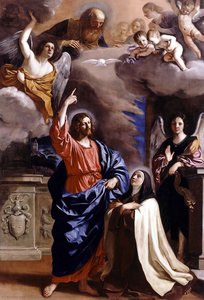
11Lot and His Daughters (1651) de GuercinoLot and His Daughters1651 · Toledo Museum of Art 12God the Father (1630) de GuercinoGod the Father1630 · Museu Nacional de Varsóvia 13Saint Francis with an angel playing violin (1620) de GuercinoSaint Francis with an angel playing violin1620 · Museu Nacional de Varsóvia 14Study of Saint Matthew turned to his right, reading a book de GuercinoStudy of Saint Matthew turned to his right, reading a book 15The Glory of All the Saints. Fragment (1613) de GuercinoThe Glory of All the Saints. Fragment1613 16The Glory of All the Saints. Fragment (1613) de GuercinoThe Glory of All the Saints. Fragment1613 17Jael and Sisera (1616) de GuercinoJael and Sisera1616 18Madonna and Child with Saint John The Baptist (1616) de GuercinoMadonna and Child with Saint John The Baptist1616 · Museum of Fine Arts 19Abraham and Hagar (1616) de GuercinoAbraham and Hagar1616 · Statens Museum For Kunst 20St. Francis in Ecstasy with St. Benedict and an Angel (1620) de GuercinoSt. Francis in Ecstasy with St. Benedict and an Angel1620 21The Persian Sybil (1628) de GuercinoThe Persian Sybil1628 · Bavarian State Painting Collections 22St Sebastian (1628) de GuercinoSt Sebastian1628 · Bavarian State Painting Collections 23Martyrdom of Saints John and Paul (1632) de GuercinoMartyrdom of Saints John and Paul1632 · Musée des Augustins 24Saint Joseph with the Christ Child (1637) de GuercinoSaint Joseph with the Christ Child1637 · National Gallery of Ireland 25Circé (1637) de GuercinoCircé1637 26Mary Magdalene (1645) de GuercinoMary Magdalene1645 27The Sick Child (1660) de GuercinoThe Sick Child1660 28St. Paul the Hermit Fed by the Raven (1660) de GuercinoSt. Paul the Hermit Fed by the Raven1660 · Instituto de Arte de Dayton 29Absalom and Tamar (1655) de GuercinoAbsalom and Tamar1655 30The Virgin and Child appearing to Saint Jerome (1650) de GuercinoThe Virgin and Child appearing to Saint Jerome1650 31Santa Palazia (1658) de GuercinoSanta Palazia1658 · Museo Civico 32Virtuous Love (1666) de GuercinoVirtuous Love1666 33Assumption of the Virgin (1650) de GuercinoAssumption of the Virgin1650 · Detroit Institute of Arts 34Saint Paul (1700) de GuercinoSaint Paul1700 · Slovak National Gallery 35Cleopatra (1621) de GuercinoCleopatra1621 · Galeria Nacional da Arménia 36La Madonna del Carmine con San Giuseppe e Santa Teresa e Gloria d' Angeli de GuercinoLa Madonna del Carmine con San Giuseppe e Santa Teresa e Gloria d' Angeli 37The Vocation of Saint Aloysius (Luigi) Gonzaga de GuercinoThe Vocation of Saint Aloysius (Luigi) GonzagaMetropolitan Museum of Art 38Saint Margaret of Cortona de GuercinoSaint Margaret of Cortona 39Apparition of Christ to Saint Therese de GuercinoApparition of Christ to Saint Therese 40The Holy Family (1620) de GuercinoThe Holy Family1620 41Fame, Honor and Virtue de GuercinoFame, Honor and Virtue 42Stilleben mit Melonen + Papagei (1616) de GuercinoStilleben mit Melonen + Papagei1616 43Amnon and Tamar de GuercinoAmnon and TamarNational Gallery of Art 44The Flagellation of Christ (1642) de GuercinoThe Flagellation of Christ1642 · Szépművészeti Múzeum 45Madonna and Child de GuercinoMadonna and ChildFinnish National Gallery 46Saint Paul de GuercinoSaint Paul 47Child seen from behind, standing between its mother's knees de GuercinoChild seen from behind, standing between its mother's knees 48BAPTISM OF CHRIST de GuercinoBAPTISM OF CHRIST 49St. Hieronymus de GuercinoSt. Hieronymus 50San Filippo Neri de GuercinoSan Filippo Neri 51Esther before Ahasuerus (1750) de GuercinoEsther before Ahasuerus1750 · University of Michigan Museum of Art 52The Pensive Muse de GuercinoThe Pensive MuseNational Gallery of Ireland 53Saint Agatha de GuercinoSaint AgathaNational Gallery of Ireland 54The Triumph of David de GuercinoThe Triumph of DavidNational Gallery of Ireland 55Study for St. William of Aquitaine de GuercinoStudy for St. William of AquitaineRhode Island School of Design Museum of Art 56Bust of a Soldier in Armor de GuercinoBust of a Soldier in ArmorRhode Island School of Design Museum of Art 57The Holy Family on the Flight meets the infant St John de GuercinoThe Holy Family on the Flight meets the infant St JohnFitzwilliam Museum 58Primavera de GuercinoPrimaveraMuseu de Belas Artes de Boston 59David with the head of Goliath de GuercinoDavid with the head of Goliath 60Saint Alexius in a brown wrap, holding a staff de GuercinoSaint Alexius in a brown wrap, holding a staff 61Man Kneeling de GuercinoMan Kneeling 62Landscape with a Fisherman de GuercinoLandscape with a Fisherman 63Landscape with Figures and a Wel de GuercinoLandscape with Figures and a Wel 64Landscape with Figures and Trees de GuercinoLandscape with Figures and Trees 65Landscape with Figures and a Tent de GuercinoLandscape with Figures and a Tent 66Landscape with Figures and a Bridge de GuercinoLandscape with Figures and a Bridge 67Landscape with Figures and a Bridge 1 de GuercinoLandscape with Figures and a Bridge 1 68Saint Francis in Adoration de GuercinoSaint Francis in Adoration 69St. John the Baptist in the Wilderness de GuercinoSt. John the Baptist in the Wilderness 70Portrait of a Man de GuercinoPortrait of a Man 71An Old Man de GuercinoAn Old Man 72A Woman Drinking from a Cup de GuercinoA Woman Drinking from a Cup 73St. John the Baptist in the Wilderness 1 de GuercinoSt. John the Baptist in the Wilderness 1 74A Woman Outstretched Arms de GuercinoA Woman Outstretched ArmsBavarian State Painting Collections 75The Flaying of Marsyas de GuercinoThe Flaying of Marsyas 76God the Father de GuercinoGod the Father 77Saint Jerome de GuercinoSaint Jerome 78Two Women and an Infant de GuercinoTwo Women and an Infant 79HEAD OF A GIRL, SEEN FROM BEHIND de GuercinoHEAD OF A GIRL, SEEN FROM BEHIND 80A seated man training a dog de GuercinoA seated man training a dog 81Cupid holding a vase of flowers de GuercinoCupid holding a vase of flowers 82Study of a woman holding a sieve de GuercinoStudy of a woman holding a sieve 83Susanna and the Elders 1 de GuercinoSusanna and the Elders 1 84The Martyrdom of St Peter de GuercinoThe Martyrdom of St Peter 85A study of Christ de GuercinoA study of Christ 86Madonna of the Swallow de GuercinoMadonna of the Swallow 87Landscape with tree in the foreground de GuercinoLandscape with tree in the foreground 88Annunciation de GuercinoAnnunciation 89Warrior Kneeling with Arms Outstretched de GuercinoWarrior Kneeling with Arms Outstretched 90Putto in the Clouds de GuercinoPutto in the Clouds 91Saint John the Evangelist in Meditation de GuercinoSaint John the Evangelist in Meditation 92The Resurrected Christ Appears to the Virgin de GuercinoThe Resurrected Christ Appears to the Virgin 93Saint Peter de GuercinoSaint Peter 94Nude figure of a woman, seen from the side de GuercinoNude figure of a woman, seen from the side 95STUDIES FOR THE VISION OF SAINT PHILIP NERI de GuercinoSTUDIES FOR THE VISION OF SAINT PHILIP NERI 96The Virgin and Child with the Infant Saint John the Baptist de GuercinoThe Virgin and Child with the Infant Saint John the BaptistScottish National Gallery 97David the violonist de GuercinoDavid the violonist 98Self-Portrait before a Painting of Amor Fedele de GuercinoSelf-Portrait before a Painting of Amor Fedele 99St Augustine de GuercinoSt Augustine 100Study of the God Almighty de GuercinoStudy of the God Almighty

Pinturas famosas de Guercino, período por período

Os temas que cativaram o olhar de Guercino

Os quatro temas que mais se repetem nestas obras originais, cada um com o seu melhor exemplo.

Os museus que guardam os originais de Guercino

Os 8 museus que detêm a maioria das pinturas desta página.

Museu Cidade Obras de Guercino Pinturas desta lista
Bavarian State Painting Collections, MuniqueBavarian State Painting Collections Munique 8 Portrait of a Woman, Christ and the Moneylender, The Persian Sybil
National Gallery of Ireland, DublinNational Gallery of Ireland Dublin 6 Saint Joseph with the Christ Child, The Pensive Muse, Saint Agatha
Museu Nacional de Varsóvia, VarsóviaMuseu Nacional de Varsóvia Varsóvia 2 God the Father, Saint Francis with an angel playing violin
Rhode Island School of Design Museum of Art, ProvidenceRhode Island School of Design Museum of Art Providence 2 Study for St. William of Aquitaine, Bust of a Soldier in Armor
National Gallery, LondresNational Gallery Londres 8 The Samian Sibyl with a Putto
Staatliche Kunstsammlungen Dresden, DresdenStaatliche Kunstsammlungen Dresden Dresden 4 Painting and Drawing
Fitzwilliam MuseumFitzwilliam Museum 3 The Holy Family on the Flight meets the infant St John
Scottish National Gallery, EdimburgoScottish National Gallery Edimburgo 3 The Virgin and Child with the Infant Saint John the Baptist

Guercino, uma pintura emblemática por década

Obras por década

Escolha uma década para ver a obra original que a define.

Pinturas de Guercino: a galeria responde

Qual pintura de Guercino é a mais famosa de todas?Revelar a resposta

Pietà (1638), Musée Condé, Chantilly. St Peter and the angel (1650) e David with the Head of Goliath (1657) vêm a seguir.

Qual era a idade de Guercino ao concluir Pietà?Revelar a resposta

47 anos: Pietà data de 1638, e Guercino nasceu em 1591.

Quais são as 10 principais pinturas de Guercino?Revelar a resposta

Pietà, St Peter and the angel, David with the Head of Goliath, The Samian Sibyl with a Putto, Saint-Jean-Baptiste, La Madonna del passero, Painting and Drawing, Portrait of a Woman, Christ and the Moneylender e St Anthony of Padua with the Infant Christ. O ranking acima apresenta o ano e o museu de cada uma.

Quantas obras Guercino criou?Revelar a resposta

Nosso catálogo contém 367 obras de Guercino, datadas de 1613 a 1666.

Onde estão expostos os originais mais famosos de Guercino?Revelar a resposta

Principalmente em Bavarian State Painting Collections (Munique), National Gallery of Ireland (Dublin) e Museu Nacional de Varsóvia (Varsóvia). A tabela de museus acima lista todos eles.

Quando é que Guercino criou as suas pinturas mais famosas?Revelar a resposta

Em 1650s: 9 das 100 obras nesta página foram feitas então, sendo St Peter and the angel delas.

Quais são as obras mais famosas de Guercino no início e no fim de sua carreira?Revelar a resposta

Nesta página, a mais antiga é The Glory of All the Saints. Fragment (1613) e a mais recente é Virtuous Love (1666).

Quais temas Guercino mais explorou?Revelar a resposta

Woman (11), Man (10) e Religious (9), entre as 100 obras nesta página.

Em qual técnica Guercino mais trabalhou?Revelar a resposta

Oil On Canvas, para 15 das 100 obras nesta página.

Com qual movimento Guercino está associado(a)?Revelar a resposta

Baroque, a julgar pelos originais nesta página.

Quais obras originais de Guercino o Bavarian State Painting Collections possui?Revelar a resposta

Portrait of a Woman, Christ and the Moneylender e The Persian Sybil: o Bavarian State Painting Collections, Munique detém 5 das obras desta página.

Posso ter uma pintura de Guercino reproduzida à mão?Revelar a resposta

Sim, como uma reprodução: a obra original permanece no seu museu, mas qualquer pintura desta página pode ser pintada à mão para você, feita sob encomenda uma a uma, a partir da própria página da pintura.

Guercino: o artista

A Vida Iluminada pela Sombra: O Mundo de Guercino

Giovanni Francesco Barbieri, conhecido mundialmente como Guercino – “o estrábico” – era um nome nascido de uma característica física, mas destinado a representar uma visão artística que remodelou dramaticamente a pintura barroca. Nascido em 1591 no pequeno vilarejo de Cento, aninhado entre Ferrara e Bolonha, a jornada de Guercino começou não nos salões consagrados das academias formais, mas através da autodescoberta e do aprendizado inicial com Ludovico Carracci. Este período formativo lançou as bases para um estilo que se tornaria sinônimo de intensidade emocional, chiaroscuro dramático e um profundo engajamento tanto com o realismo quanto com o idealismo. Ao contrário de muitos de seus contemporâneos que buscavam a perfeição clássica, a arte de Guercino pulsava com uma energia humana crua, refletindo o clima espiritual turbulento da Itália do século XVII. Sua vida inicial foi marcada por um talento natural que rapidamente ultrapassou o treinamento convencional; ele não estava simplesmente replicando estilos, mas forjando seu próprio caminho, um iluminado por uma compreensão intuitiva de luz e sombra.

Da Caravaggismo à Graça Clássica: Uma Paleta em Transformação

O desenvolvimento artístico de Guercino não foi uma progressão linear, mas sim um fascinante diálogo entre influências diferentes e explorações estilísticas. Suas primeiras obras estavam profundamente endividadas com o naturalismo revolucionário de Caravaggio, abraçando contrastes marcantes e um realismo áspero que chocava e cativava os públicos. Pinturas como *Amnon e Tamar* exemplificam este período inicial – uma representação pungente de um narrativo bíblico renderizada com honestidade implacável e profundidade psicológica. No entanto, Guercino não estava satisfeito em permanecer apenas na órbita do Caravaggismo. Um ponto de inflexão ocorreu em seu estilo durante a década de 1630, impulsionado pela curiosidade artística e pelas demandas dos mecenas exigentes. Ele começou a suavizar sua paleta, afastando-se do tenebrismo agressivo em direção a uma abordagem mais luminosa e equilibrada. Esta transição não foi simplesmente um capricho estilístico; refletiu um engajamento mais profundo com os ideais clássicos e um desejo de criar obras que fossem não apenas poderosas emocionalmente, mas também esteticamente refinadas. Este período viu-o abraçar uma maior profundidade espacial e uma composição mais harmoniosa, como evidenciado em obras-primas como *O Retorno do Filho Pródigo*. A influência de Carracci é evidente na busca por equilíbrio e proporção, elementos que ele incorporou gradualmente ao seu estilo.

Narrativas Bíblicas e Ressonância Emocional

Ao longo de sua carreira, Guercino consistentemente se voltou para as narrativas bíblicas como fonte de inspiração. No entanto, ele não simplesmente ilustrava essas histórias; ele imbui-las com um profundo senso de drama humano e ressonância emocional. Seus personagens não são santos idealizados, mas indivíduos falíveis confrontados com fé, dúvida, remorso e redenção. *O Retorno do Filho Pródigo* é um exemplo primário – uma representação poderosa de um momento crucial da Bíblia, renderizada com habilidade e sensibilidade impressionantes. Guercino compreendia que a verdadeira piedade não era sobre demonstrações externas de devoção, mas sobre as lutas internas e os sacrifícios que definiam uma vida dedicada à fé. Sua capacidade de capturar as vidas interiores de seus personagens o diferenciava de muitos de seus contemporâneos. Ele entendia que a arte podia ser um espelho da alma humana, refletindo suas esperanças, medos e anseios. A intensidade emocional em suas obras é inegável, transmitida através de expressões faciais sutis, gestos dramáticos e uma paleta de cores cuidadosamente selecionada.

O Desenvolvimento do Estilo: Da Sombra ao Clássico

A trajetória artística de Guercino foi marcada por uma evolução constante, influenciada por diversos estilos e mestres. Inicialmente, sua obra refletia a influência direta de Caravaggio, com o uso dramático da luz e sombra, figuras esqueléticas e um realismo cru. No entanto, ao longo dos anos, ele desenvolveu um estilo mais refinado, incorporando elementos do Maneirismo e do Classicismo. A década de 1630 marcou uma mudança significativa em sua paleta de cores, com a adoção de tons mais suaves e luminosos, influenciada por artistas como Guido Reni. Essa transição não foi apenas uma questão de estética; refletiu também uma mudança em seu estilo de pintura, com um foco maior na composição e no detalhe. A obra *A Flagelação de Cristo* (1657) demonstra essa evolução, combinando o realismo dramático de Caravaggio com a elegância e harmonia do Maneirismo. Guercino era um mestre em capturar a emoção e o drama em suas pinturas, mas também possuía uma habilidade notável para representar a beleza e a graça.

Legado Histórico: Reconhecimento e Influência

Embora seu nome não tenha alcançado a mesma fama que os de seus contemporâneos mais renomados, como Caravaggio ou Bernini, Guercino deixou um legado duradouro na história da arte. Suas pinturas são admiradas hoje por sua intensidade emocional, realismo dramático e beleza estética. Após um período de relativa obscuridade no século XIX, o trabalho de Guercino foi redescoberto no século XX, graças aos esforços do renomado historiador de arte Sir Denis Mahon. Mahon dedicou décadas à pesquisa sobre a vida e obra de Guercino, identificando seus estilos distintos e documentando sua produção artística com meticulosa precisão. Sua pesquisa ajudou a restaurar o reconhecimento merecido de Guercino como um dos principais pintores do Barroco italiano. Suas obras podem ser encontradas em importantes museus ao redor do mundo, incluindo a Pinacoteca Nacional de Ferrara, o Palazzo Brignole-Sale em Gênova e a Galleria Spada em Roma, testemunhando sua influência duradoura na arte europeia.

Todas as 367 obras de Guercino →