Retrato de Franz Kline

As 48 Pinturas Mais Famosas de Franz Kline, Cada Uma Única

Atualizado em Outubro 2026 · classificado pela nossa pontuação de popularidade (pesquisas, visitas e pedidos de cada obra) · 53 obras de Franz Kline em nosso catálogo

Em resumo

Mahoning (1956) é a pintura de Franz Kline que mais atrai olhares; a obra original pertence ao Whitney Museum of American Art, Nova Iorque. Depois disso, o olhar recai sobre Preto, Branco e Cinza (1959) e Untitled (1959). Entre as 53 obras de Franz Kline em nosso catálogo, estas 48 são as mais famosas, cada uma uma original única apresentada com o seu ano, o seu museu e a razão pela qual perdura.

1910 – 1962, Wilkes-Barre Abstract expressionism Mais obras: Smithsonian American Art Museum

As 10 principais pinturas de Franz Kline, sob o olhar da galeria

1
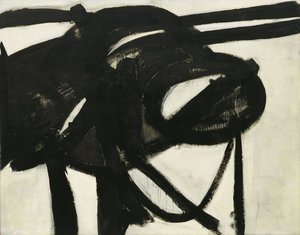
Mahoning (1956) de Franz Kline

Mahoning

1956 · Oil On Canvas · Whitney Museum of American Art, Nova Iorque

In the pantheon of Abstract Expressionism, few works command the room with such visceral authority as Franz Kline’s “Mahoning,” completed in 1956. To stand before this monumental canvas is to witness a profound dialogue between presence and absence, a struggle captured in the rhythmic collision of black enamel and stark white space. This is not merely a painting; it is an event. As a cornerstone of the New York School,…

2
Preto, Branco e Cinza (1959) de Franz Kline

Preto, Branco e Cinza

1959 · Acrílico sobre tela · Metropolitan Museum of Art, Nova York

Franz Kline: Uma Sinfonia de Linhas em Preto e Branco A obra "Black, White, and Gray" de Franz Kline é uma testemunha eloquente da força bruta e da beleza silenciosa do movimento Abstract Expressionismo americano. Pintada em 1959, esta tela monumental captura a essência da espontaneidade artística combinada com uma meticulosa atenção aos detalhes técnicos – um equilíbrio que reflete profundamente o espírito da época e permanece relevante para artistas…

3
Untitled (1959) de Franz Kline

Untitled

1959 · Oil · Smithsonian American Art Museum, Washington, D.C.

The canvas titled Untitled emerges from the hands of Franz Kline, a presence that commands the space it occupies. Created in 1959, this work exists as a significant expression of the Abstract Expressionism movement. It carries the weight of a specific moment in time, capturing a sense of raw, unmediated energy that defines the era. The piece arrives not as a window into a landscape, but as a direct encounter…

4
New York, N.Y. (1953) de Franz Kline

New York, N.Y.

1953 · Oil On Canvas · Albright-Knox Art Gallery, Nova York

The canvas holds New York, N.Y., an oil on canvas painting by Franz Kline. Created in 1953, this work belongs to the Abstract Expressionist movement. It exists as a collision of heavy, dark gestures against a pale ground.

5
Zinc Yellow (1959) de Franz Kline

Zinc Yellow

1959 · Oil On Canvas · Chrysler Museum of Art, Norfolk

In the pantheon of Abstract Expressionism, few works command the immediate, visceral attention of a room quite like Franz Kline’s Zinc Yellow. Completed in 1959, this monumental canvas serves as a breathtaking masterclass in reductive abstraction, where the boundaries between color and form dissolve into a singular, energetic event. At first glance, the viewer is met with an expansive, luminous field of yellow that seems to vibrate against the stark,…

6
Título Traduzido: Sem Título (1956) de Franz Kline

Título Traduzido: Sem Título

1956 · Acrílico sobre tela

Uma Explosão de Energia e Contraste: Uma Análise da Obra Não Título de Franz Kline A obra “Não Título” de Franz Kline, criada em 1956, representa um marco na história da arte abstrata expressionista americana. Mais do que apenas uma composição visualmente impactante, ela encapsula uma profunda reflexão sobre o processo artístico e a capacidade da pintura para transmitir emoções viscerais – elementos que continuam fascinando artistas e amantes da…

7
Untitled (1959) de Franz Kline

Untitled

1959 · Black and White Photography · Metropolitan Museum of Art, Nova York

This monochromatic photograph, dated 1959, captures a candid scene within a dense, wooded environment. The upper two-thirds of the frame are occupied by a heavy canopy of trees and foliage, creating a sense of enclosure through layered, organic lines. Natural daylight filters through the leaves, producing sharp highlights on certain surfaces while casting deep, dark shadows across the background. In the midground, several figures are positioned within a clearing. To…

Pinturas famosas de Franz Kline, números 11 a 48

Os temas que cativaram o olhar de Franz Kline

Os quatro temas que mais se repetem nestas obras originais, cada um com o seu melhor exemplo.

Os museus que guardam os originais de Franz Kline

Os 8 museus que detêm a maioria das pinturas desta página.

Museus Cidade Obras de Franz Kline Pinturas desta lista
Smithsonian American Art Museum, Washington, D.C.Smithsonian American Art Museum Washington, D.C. 3 Untitled, Palmerton, Pa., Blueberry Eyes
Metropolitan Museum of Art, Nova YorkMetropolitan Museum of Art Nova York 2 Preto, Branco e Cinza, Untitled
Museu de Belas Artes de Boston, BostonMuseu de Belas Artes de Boston Boston 2 Black on Green, Red, and Yellow, Probst I
Whitney Museum of American Art, Nova IorqueWhitney Museum of American Art Nova Iorque 1 Mahoning
Albright-Knox Art Gallery, Nova YorkAlbright-Knox Art Gallery Nova York 1 New York, N.Y.
Chrysler Museum of Art, NorfolkChrysler Museum of Art Norfolk 1 Zinc Yellow
Worcester Art Museum, WorcesterWorcester Art Museum Worcester 1 Untitled
Cleveland Museum of Art, ClevelandCleveland Museum of Art Cleveland 1 Accent Grave

Franz Kline ao longo das décadas: uma obra original única para cada uma

Obras por década

Escolha uma década para ver a obra original que a define.

Pinturas de Franz Kline: perguntas para a galeria

Qual é a obra mais famosa de Franz Kline?Revelar a resposta

Mahoning (1956), Whitney Museum of American Art, Nova Iorque. Preto, Branco e Cinza (1959) e Untitled (1959) vêm a seguir.

Com que idade Franz Kline criou Mahoning?Revelar a resposta

46 anos: Mahoning data de 1956, e Franz Kline nasceu em 1910.

Quais são as dez pinturas mais famosas de Franz Kline?Revelar a resposta

Mahoning, Preto, Branco e Cinza, Untitled, New York, N.Y., Zinc Yellow, Título Traduzido: Sem Título, Untitled, Study for "Flanders", Untitled e Frederick Blumenstein. O ranking acima apresenta o ano e o museu de cada uma.

Quantas obras de Franz Kline são conhecidas?Revelar a resposta

Nosso catálogo contém 53 obras de Franz Kline, datadas de 1938 a 1961.

Onde se pode ver os originais mais famosos de Franz Kline?Revelar a resposta

Principalmente em Smithsonian American Art Museum (Washington, D.C.), Metropolitan Museum of Art (Nova York) e Museu de Belas Artes de Boston (Boston). A tabela de museus acima lista todos eles.

Em que período Franz Kline criou as suas pinturas mais conhecidas?Revelar a resposta

Em 1950s: 17 das 48 obras nesta página foram feitas então, sendo Mahoning delas.

Qual pintura famosa de Franz Kline é a mais antiga e qual é a mais recente?Revelar a resposta

Nesta página, a mais antiga é Circus Scene (1938) e a mais recente é Study for "Flanders" (1961).

Quais temas Franz Kline preferia?Revelar a resposta

Black and white (4), Geometric forms (4) e Black and white art (4), entre as 48 obras nesta página.

Com quais materiais Franz Kline mais pintou?Revelar a resposta

Oil On Canvas, para 3 das 48 obras nesta página.

A qual movimento pertence a obra de Franz Kline?Revelar a resposta

Abstract expressionism, a julgar pelos originais nesta página.

Quais originais de Franz Kline posso ver no Smithsonian American Art Museum?Revelar a resposta

Untitled, Palmerton, Pa. e Blueberry Eyes: o Smithsonian American Art Museum, Washington, D.C. detém 3 das obras desta página.

Franz Kline: um retrato do artista

Franz Kline (1910-1962): Pioneer of Abstract Expressionism

Franz Kline, a pivotal figure in the Abstract Expressionist movement, remains an artist whose work resonates with raw power and emotional depth. Born in Wilkes-Barre, Pennsylvania, in 1910, his life was marked by early hardship – the suicide of his father when he was just seven years old cast a long shadow, influencing a sensibility that would later find expression in the stark contrasts defining his art. This formative experience led to a nomadic youth and eventual enrollment at Girard College, a Philadelphia boarding school for boys who had lost their fathers. It was here, amidst structured discipline, that Kline’s artistic inclinations began to surface, nurtured by traditional training in illustration and drafting. He continued his studies at Boston University and later honed his skills at the Heatherley School of Fine Art in London, immersing himself in the works of the Old Masters – Rembrandt, Velázquez, El Greco, Goya, Dürer – and absorbing the nuances of Japanese prints. These early influences, though seemingly distant from his eventual abstract style, laid a foundation for his understanding of composition, light, and the expressive potential of line.

Early Life and Influences: Shaping a Sensibility

Kline’s childhood was profoundly impacted by his father's tragic demise, an event that instilled in him a deep awareness of loss and vulnerability—sensibilities he would later translate into artistic exploration. He moved frequently as a young man, seeking solace and inspiration in diverse environments. His formal education began at Girard College, where he honed his drafting skills alongside fellow boys who had experienced similar familial tragedies. This environment fostered discipline and encouraged meticulous observation, shaping his approach to visual representation. Simultaneously, Kline’s fascination with European art blossomed during his time in London, where he studied at Heatherley's School of Fine Art. He was captivated by the dramatic chiaroscuro techniques employed by Rembrandt and Velázquez, immersing himself in the expressive power of tonal painting. Furthermore, his encounter with Japanese prints—particularly those of Hiroshige—introduced him to a radically different aesthetic tradition characterized by subtle gradations of color and meticulous detail—influences that would subtly permeate his later abstract compositions.

From Representation to Simplification: The Emergence of Abstract Expressionism

Kline’s artistic journey initially centered on figurative painting, producing landscapes, cityscapes, portraits, and murals that reflected the realities of his surroundings. However, a pivotal moment arrived in 1948 with an encounter with Willem de Kooning—a collaboration that would fundamentally alter his artistic trajectory. De Kooning suggested projecting Kline’s sketches onto a wall using a Bell-Opticon projector – an act that dramatically enlarged and transformed the image, reducing it to its essential strokes. This experience proved revelatory for Kline; he began experimenting with abstraction, driven by a desire to distill visual language down to its most fundamental elements. He abandoned meticulous realism in favor of bold, gestural marks—a stylistic decision that aligned him closely with the burgeoning Abstract Expressionist movement. The resulting canvases were characterized by expansive white backgrounds punctuated by sweeping black lines—a technique that would become Kline’s signature style and define his artistic legacy.

The Language of Black and White: Defining Kline's Aesthetic

Kline’s mature aesthetic is instantly recognizable for its monochromatic palette—primarily black on white. This wasn’t merely a stylistic preference but a deliberate strategy rooted in profound philosophical considerations. He believed that the absence of color allowed him to focus solely on the physicality of paint itself, emphasizing the interplay between positive and negative space—creating a visual tension that drew the viewer into the heart of the composition. His brushstrokes were fluid, dynamic, and often applied with house-painting brushes on large canvases, immersing the spectator within his abstract world. He meticulously crafted each mark, striving to convey not just visual information but also emotional resonance—a testament to his conviction that art could transcend rational thought and tap into primal instincts. Like Jackson Pollock and Mark Rothko, Kline embraced spontaneity as a means of capturing feelings and emotions—rejecting academic conventions in favor of an expressive idiom that prioritized gesture and materiality.

Legacy and Recognition: An Enduring Influence on Modern Art

Franz Kline achieved international acclaim during his lifetime, securing representation in prestigious galleries like Egan Gallery and Sidney Janis Gallery and participating prominently in significant artistic events such as the Venice Biennale in 1960—where he was awarded the Italian Ministry of Public Instruction Prize. His work profoundly impacted subsequent generations of artists—particularly Minimalists like Donald Judd and Richard Serra—who sought to reduce art to its essential forms, mirroring Kline’s own commitment to stripping away extraneous elements and prioritizing pure visual experience. Despite his tragically premature death from a heart attack in 1962 at the age of 51, Kline's legacy continues to inspire artists today—a testament to his unwavering dedication to artistic innovation and his enduring contribution to the history of modern art. His paintings remain powerful symbols of abstraction and gesture—capturing the essence of an era defined by experimentation and emotional intensity.