


1

Atualizado em Outubro 2026 · classificado pela nossa pontuação de popularidade (pesquisas, visitas e pedidos de cada obra) · 77 obras de Cliff Rowe em nosso catálogo
Em resumo
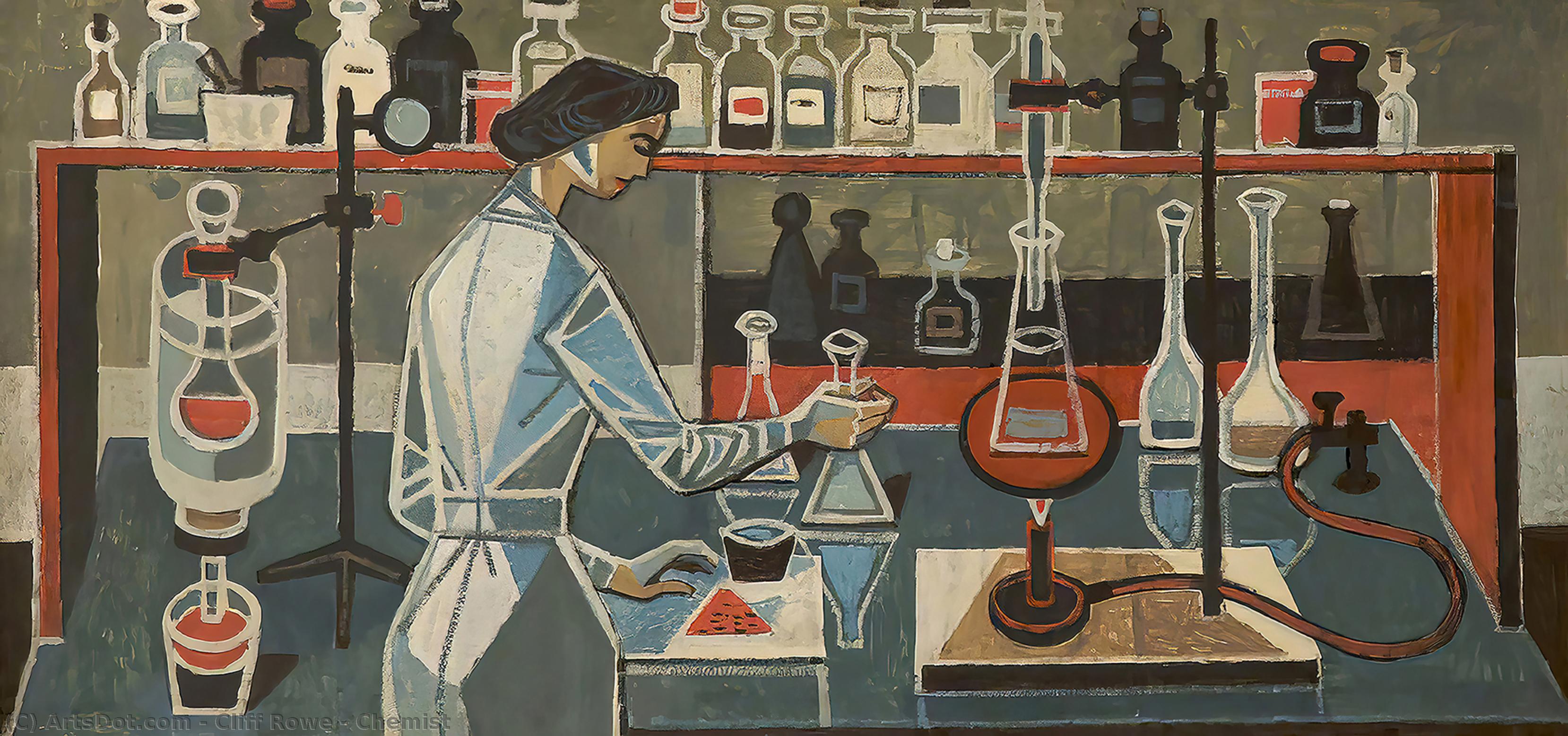
Chemist é a pintura de Cliff Rowe que mais atrai olhares. Depois disso, o olhar recai sobre Casting e The Fried Fish Shop (1936). Entre as 77 obras de Cliff Rowe em nosso catálogo, estas 77 são as mais famosas, cada uma uma original única apresentada com o seu ano, o seu museu e a razão pela qual perdura.


 The Three Graces
12
 Railway Wheeltapper
13
 Astronaut
14
 Drying Enamel Plates
15
 Man and Microscope
16
 Riveters
17
 Sorting Tobacco Leaves
18
 Woman Potter
19
 Man at Metal Press
20
 Engine Assembler
21
 Glass Blower
22
 Crane Operator
23
 Woman Reclining on Bed
24
 Street Scene Kentish Town1931
25
 Girl with Skipping Rope1931
26
 Woman Sitting on Doorstep1931
27
 Two Women and Pram1937
28
 Two Young Girls on Doorstep1937
29
 St Pancras, Cleaning Yard1945
30
 Man Pouring Liquid into Tank
31
 Buoys on Quay
32
 Three Toy Bears
33
 Woman Cleaning Loco Boiler
34
 Two Bicycle Makers
35
 Woman Sat at Machine Controls
36
 Men and Women in Doorway
37
 By Chance
38
 Pipe Cutter
39
 Woman Silkscreen Printer
40
 Bootmaking
41
 Baker
42
 Guitarist
43
 Woman Sunbathing in Park
44
 Women and Pram
45
 Village Harbour
46
 Bike Racers Cornering
47
 The Steps
48
 Bearded Scientist
49
 Street Scene (unfinished)
50
 Roofer
51
 Woman on Moped
52
 Woman in Bottling Plant
53
 Men Hoisting Machine Section
54
 Fruit Basket
55
 Female Glass Worker
56
 Removal Men
57
 Fireside
58
 Man Leaning Over Woman
59
 Woman Working
60
 Glassblower at Red Furnace
61
 Scientist at Lab Bench
62
 Child on Rocking Horse
63
 Textile Workers
64
 Sun Furnace
65
 Man at Boot Machine
66
 Fishing Boat on the Stocks
67
 Three Women Talking
68
 Mexican Guerrillas
69
 Operating Theatre Nurse
70
 Hospital Laundry Workers
71
 Fishing Boat
72
 Female Guitarist
73
 White Roses
74
 Human Pattern
75
 Loco Cleaners
76Woman with Birdcage in Window1931
77
 Cleaning Gas Retorts, St Pancras1942
Os quatro temas que mais se repetem nestas obras originais, cada um com o seu melhor exemplo.
Os 2 museus que detêm a maioria das pinturas desta página.
| Museu | Cidade | Obras de Cliff Rowe | Pinturas desta lista |
|---|---|---|---|
 New Walk Museum - Art Gallery |
Leicester | 1 | The Fried Fish Shop |
 Herbert Art Gallery - Museum |
Coventry | 1 | Woman with a Shopping Bag |
15 anos separam as primeiras e últimas obras originais datadas de Cliff Rowe exibidas aqui, 1931 e 1945: cada ano tem o seu lugar abaixo.
Escolha um ano para ver as obras originais.


The painting Cleaning Gas Retorts, St Pancras is a remarkable artwork created by Cliff Rowe in 1942. This oil on canvas piece measures 46 x 91 cm and is currently housed in the Science Museum in the United Kingdom. The painting depicts an industrial setting where a man is performing a task related to the storage of liquids in large containers. Artistic Style and Technique Cliff Rowe's artistic style is…

Chemist. Casting e The Fried Fish Shop (1936) vêm a seguir.
Chemist, Casting, The Fried Fish Shop, Woman with a Shopping Bag, Electrical Engineer, Industrial Plant, Three Men Building Frame, Plating Bicycle Frames, Man Shaping a Bottle e Man Drawing Out Molten Glass. O ranking acima apresenta o ano e o museu de cada uma.
Nosso catálogo contém 77 obras de Cliff Rowe, datadas de 1931 a 1945.
Principalmente em New Walk Museum - Art Gallery (Leicester) e Herbert Art Gallery - Museum (Coventry). A tabela de museus acima lista todos eles.
Em 1931: 4 das 77 obras nesta página foram feitas então, sendo Street Scene Kentish Town delas.
Nesta página, a mais antiga é Street Scene Kentish Town (1931) e a mais recente é St Pancras, Cleaning Yard (1945).
Social commentary (4), London life (3) e Abstract figures (2), entre as 77 obras nesta página.
Cubism, a julgar pelos originais nesta página.
Born in the heart of Wimbledon, South London, to working-class parents, Clifford Rowe’s life was a profound tapestry woven from threads of social conviction and artistic mastery. His early years were defined by a dual education: the formal training at the Wimbledon School of Art and the Royal College of Art, which sharpened his technical draughtsmanship, and the raw, lived experience of London’s streets, which forged his political soul. This unique intersection of modernist experimentation and Marxist ideology would become the hallmark of his career, allowing him to bridge the gap between avant-garde aesthetics and the urgent realities of the common man.
The 1920s served as a crucible for Rowe’s developing worldview. As he navigated the turbulent economic landscapes marked by hunger marches and the global tremors of the Wall Street Crash, his art began to find its political voice. A pivotal moment occurred in 1930 when he traveled to the Soviet Union. Staying for eighteen months, Rowe immersed himself in a society that viewed art as a vital instrument of the state and the people. While he eventually returned to England, driven by the realization that the class struggle was equally potent on home soil, his time abroad left an indelible mark on his technique, introducing him to a sense of scale and purpose that would define his later compositions.
Rowe’s artistic output was never merely decorative; it was deeply communicative. As a founding member of the Artists International Association (AIA) in 1933, he championed the idea that art should be accessible to the masses rather than sequestered in elite galleries. His work often blended the sharp, angular influences of Cubism with a gritty, grounded realism—a style some have described as a meeting point between Socialist Realism and New Realism. Whether through his evocative oil paintings or his prolific work as an illustrator, Rowe sought to capture the dignity of labor without falling into the trap of sentimentalism.
His versatility allowed him to move seamlessly between different mediums and commissions:
In his more introspective works, Rowe explored the psychological weight of modernity. Paintings such as Man and Microscope utilize Cubist-influenced forms to examine the detachment between humanity and advancing technology, using muted tones to evoke a sense of clinical isolation. Similarly, Operating Theatre Nurse presents an unsettling, geometric depiction of clinical detachment, showcasing his ability to use abstraction to convey profound emotional states. Even in his more representational scenes of London life—from the bustling atmosphere of fish shops to the industrial grit of factories—there is an underlying tension, a careful balance between the physical reality of the subject and the symbolic weight of their social position.
The historical significance of Cliff Rowe lies in his refusal to separate the artist from the citizen. His legacy is preserved not only in the prestigious collections of the Tate and The People’s History Museum but also in the very fabric of British social history. He remains a vital figure for those studying the intersection of art and politics, reminding us that the brush can be as powerful a tool for change as any political manifesto. Through his eyes, we see a London that is both a place of struggle and a landscape of immense, quiet beauty.
