Retrato de Chobunsai Eishi

As 68 Pinturas Mais Famosas de Chobunsai Eishi, Cada Uma Única

Atualizado em Novembro 2026 · classificado pela nossa pontuação de popularidade (pesquisas, visitas e pedidos de cada obra) · 69 obras de Chobunsai Eishi em nosso catálogo

Em resumo

Snow, Moon, and Cherry Blossoms (Yoshiwara in Three Seasons) (801) é a pintura de Chobunsai Eishi que mais atrai olhares; a obra original pertence ao Metropolitan Museum of Art, Nova York. Depois disso, o olhar recai sobre Three Gods of Good Fortune Visit the Yoshiwara; or “Scenes of Pleasure at the Height of Spring” (801) e The Salt Maidens, Murasame with Yukihira's Hat (1790). Entre as 69 obras de Chobunsai Eishi em nosso catálogo, estas 68 são as mais famosas, cada uma uma original única apresentada com o seu ano, o seu museu e a razão pela qual perdura.

1756 – 1829, Tóquio Ukiyo-e Mais obras: Metropolitan Museum of Art

As 10 principais pinturas de Chobunsai Eishi, sob o olhar da galeria

1
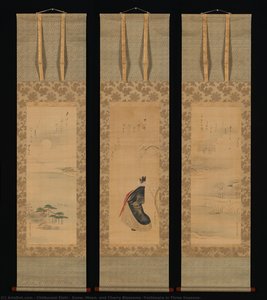
Snow, Moon, and Cherry Blossoms (Yoshiwara in Three Seasons) (801) de Chobunsai Eishi

Snow, Moon, and Cherry Blossoms (Yoshiwara in Three Seasons)

801 · Woodblock Print · Metropolitan Museum of Art, Nova York

Introduction Chōbunsai Eishi was a prominent Japanese artist of the Ukiyo-e school, which flourished during the Edo period (1603-1868). He is best known for his portraits of beautiful women and his innovative use of color. The Painting: Snow, Moon, and Cherry Blossoms "Snow, Moon, and Cherry Blossoms" is a masterpiece by Chōbunsai Eishi, which exemplifies his unique style and technique. The painting depicts a woman in traditional Japanese attire, standing…

2
Three Gods of Good Fortune Visit the Yoshiwara; or “Scenes of Pleasure at the Height of Spring” (801) de Chobunsai Eishi

Three Gods of Good Fortune Visit the Yoshiwara; or “Scenes of Pleasure at the Height of Spring”

801 · Silk · Metropolitan Museum of Art, Nova York

Introduction to Chōbunsai Eishi and Ukiyo-e Art Movement Chōbunsai Eishi was an artist of samurai descent who also created prints, illustrating several handscrolls showing patrons traveling to the pleasure quarters of Yoshiwara. The Ukiyo-e art movement, which flourished from the 17th through 19th centuries in Japan, produced woodblock prints and paintings depicting various subjects such as female beauties, kabuki actors, sumo wrestlers, scenes from history and folk tales, travel scenes…

3
The Salt Maidens, Murasame with Yukihira's Hat (1790) de Chobunsai Eishi

The Salt Maidens, Murasame with Yukihira's Hat

1790 · Woodblock Print · Art Institute of Chicago, Chicago

In this vertical hanging scroll, we find ourselves in a space of profound stillness. A single female figure, Murasame, is positioned in the lower half of the composition, her presence defined by a sense of calm contemplation. She is dressed in traditional attire, her kimono adorned with delicate red floral motifs that catch the eye against the more muted tones of her garments. In her hands, she holds a dark…

6
Beauty Replacing Her Hairpin (1798) de Chobunsai Eishi

Beauty Replacing Her Hairpin

1798 · Woodblock Print · Art Institute of Chicago, Chicago

Beauty Replacing Her Hairpin is a polychrome woodblock print created by the artist Chobunsai Eishi. This work dates to about 1798. The composition focuses on a single female figure captured in a moment of quiet movement. The subject is depicted in the act of adjusting her hair with a hairpin.

7
Moonlight [left of the pair Beauties in Spring] (1798) de Chobunsai Eishi

Moonlight [left of the pair Beauties in Spring]

1798 · Woodblock Print · Minneapolis Institute of Art, Minneapolis

We are looking at Moonlight [left of the pair Beauties in Spring], a work created by Chobunsai Eishi. This piece dates to about 1798, a period when the artist was deeply immersed in the development of his own distinct style within the ukiyo-e genre. The work reflects the refined sensibilities of the Edo period, capturing a specific moment of seasonal grace.

8
Rain [right of the pair Beauties in Spring] (1798) de Chobunsai Eishi

Rain [right of the pair Beauties in Spring]

1798 · Ink · Minneapolis Institute of Art, Minneapolis

The scene unfolds in Rain [right of the pair Beauties in Spring], a work that captures a fleeting moment of quietude. This piece, created by the artist Chobunsai Eishi, emerges from the atmosphere of the Edo period. It dates to about 1798, a time when the delicate nuances of Japanese ink and color painting were reaching a high level of refinement. The work exists as a singular vision of a…

9
Beauty in a Boat on Sumida River (1809) de Chobunsai Eishi

Beauty in a Boat on Sumida River

1809 · Woodblock Print · Cleveland Museum of Art, Cleveland

A single woman occupies the center of the frame, poised within a small boat upon the Sumida River. She is a study in stillness amidst the gentle movement of the water. Her blue kimono, heavy with intricate patterns, spills around her in voluminous folds, revealing a flash of red lining that catches the eye. She holds a white folding fan toward her face, a gesture that suggests a private moment…

10
A Courtesan Reading a Letter (1822) de Chobunsai Eishi

A Courtesan Reading a Letter

1822 · Woodblock Print · Art Institute of Chicago, Chicago

The scene unfolds in 1822, capturing a quiet moment in the life of a woman known as A Courtesan Reading a Letter. This work is the creation of Chobunsai Eishi, an artist who emerged from the bustling streets of Tokyo, Japan. Born in 1756, Eishi spent his life observing the delicate movements and private thoughts of the people around him. He lived until the seventh month of 1829, leaving behind…

Pinturas famosas de Chobunsai Eishi, números 11 a 68

11Courtesan with a Letter in Her Mouth (1815) de Chobunsai EishiCourtesan with a Letter in Her Mouth1815 · Metropolitan Museum of Art 12Courtesan with Fan and Koto (701) de Chobunsai EishiCourtesan with Fan and Koto701 13Beauty At Her Toilette Edo Period, Bunka Era de Chobunsai EishiBeauty At Her Toilette Edo Period, Bunka Era 14Concours De Plaisirs Des Quatre Saisons de Chobunsai EishiConcours De Plaisirs Des Quatre Saisons 15A girl representing a celestial musician playing the biwa de Chobunsai EishiA girl representing a celestial musician playing the biwa 16Beauty under Cherry Blossoms (1868) de Chobunsai EishiBeauty under Cherry Blossoms1868 · University of Michigan Museum of Art 17Prostitute at a Parade de Chobunsai EishiProstitute at a ParadeMinneapolis Institute of Art 18A Prostitute and her attendants under a cherry tree de Chobunsai EishiA Prostitute and her attendants under a cherry treeMinneapolis Institute of Art 19He Mountain Woman de Chobunsai EishiHe Mountain Woman 20Kokaidan Rokubu Goroshi de Chobunsai EishiKokaidan Rokubu Goroshi 21Kokaidan Heterogamy de Chobunsai EishiKokaidan Heterogamy 22Courtesan and Attendant de Chobunsai EishiCourtesan and AttendantMetropolitan Museum of Art 23Three Beauties Viewing Cherry Blossoms de Chobunsai EishiThree Beauties Viewing Cherry BlossomsMetropolitan Museum of Art 24Untitled de Chobunsai EishiUntitled 25A Parody Of The Well Curb From Tales Of Ise de Chobunsai EishiA Parody Of The Well Curb From Tales Of Ise 26A Beauty With A Sprig Of Cherry Blossom de Chobunsai EishiA Beauty With A Sprig Of Cherry Blossom 27From The Series Shokoku Meisho Hyakkei de Chobunsai EishiFrom The Series Shokoku Meisho Hyakkei 28Three Women and a Boy Along the Sumida River de Chobunsai EishiThree Women and a Boy Along the Sumida River 29A Group Of Courtesans And Kamuro In A Large Boat Playing On Drums And On The Shamisen de Chobunsai EishiA Group Of Courtesans And Kamuro In A Large Boat Playing On Drums And On The Shamisen 30The Courtesan Tokiwazu Of The Chojiya Strolling With Her Kamuro And Other Attendants On New Year's Day de Chobunsai EishiThe Courtesan Tokiwazu Of The Chojiya Strolling With Her Kamuro And Other Attendants On New Year's Day 31Courtesan Holding a Poetry Slip (1810) de Chobunsai EishiCourtesan Holding a Poetry Slip1810 32Hanging Scroll: Woman in a Dark Kimono de Chobunsai EishiHanging Scroll: Woman in a Dark KimonoCincinnati Art Museum 33River View in Snow de Chobunsai EishiRiver View in SnowMinneapolis Institute of Art 34A Bust Portrait Of A Young Girl de Chobunsai EishiA Bust Portrait Of A Young Girl 35A Group Of Five Japanese de Chobunsai EishiA Group Of Five Japanese 36Standing courtesan de Chobunsai EishiStanding courtesan 37Purple Flowers Of Edo de Chobunsai EishiPurple Flowers Of Edo 38A Group Of Five Oban Bijin de Chobunsai EishiA Group Of Five Oban Bijin 39Beauty Writing A Poem On A Fan de Chobunsai EishiBeauty Writing A Poem On A Fan 40Three Bijin de Chobunsai EishiThree Bijin 41Itsutomi, From The Series Seiro Geisha Erami de Chobunsai EishiItsutomi, From The Series Seiro Geisha Erami 42Matsuchiyama In Autumn; Mimeguri Shrine In Winter de Chobunsai EishiMatsuchiyama In Autumn; Mimeguri Shrine In Winter 43Portrait Of A Beauty Seated At A Desk de Chobunsai EishiPortrait Of A Beauty Seated At A Desk 44From The Series Imayo Irokue No Ito de Chobunsai EishiFrom The Series Imayo Irokue No Ito 45Portrait Of The Courtesan Mitsuhana Of The Ohishiya de Chobunsai EishiPortrait Of The Courtesan Mitsuhana Of The Ohishiya 46'hana No En' From 'eight Views Of Disguised Genji de Chobunsai Eishi'hana No En' From 'eight Views Of Disguised Genji 47A Beauty Playing With Her Hairpins de Chobunsai EishiA Beauty Playing With Her Hairpins 48Woodcut de Chobunsai EishiWoodcut 49Seated in an interior de Chobunsai EishiSeated in an interior 50A Beauty On A Yellow Background Holding The Cord Of A Model Of A Snapper de Chobunsai EishiA Beauty On A Yellow Background Holding The Cord Of A Model Of A Snapper 51Shiratsuyu of the ogiya de Chobunsai EishiShiratsuyu of the ogiya 52Daikoku, From The Series Fukujin Takara Awase de Chobunsai EishiDaikoku, From The Series Fukujin Takara Awase 53Courtesans From The Tamaya Yamazo Brothel de Chobunsai EishiCourtesans From The Tamaya Yamazo Brothel 54Portrait Of The Courtesan Seated By A Bookstand de Chobunsai EishiPortrait Of The Courtesan Seated By A Bookstand 55Praying for rain de Chobunsai EishiPraying for rain 56House cleaning de Chobunsai EishiHouse cleaning 57Two Young Girls And A Man Paddling In The River de Chobunsai EishiTwo Young Girls And A Man Paddling In The River 58Portrait Of The Courtesan Holding A Brush de Chobunsai EishiPortrait Of The Courtesan Holding A Brush 59Beauty dreaming of the tales of ise edo period de Chobunsai EishiBeauty dreaming of the tales of ise edo period 60Sumidagawa, From The Series Goshiki No Asobi de Chobunsai EishiSumidagawa, From The Series Goshiki No Asobi 61The Courtesan Segawa Of Matsubaya With Two Shinzo And Two Kamuro de Chobunsai EishiThe Courtesan Segawa Of Matsubaya With Two Shinzo And Two Kamuro 62Fujin Sogaku Juttai de Chobunsai EishiFujin Sogaku Juttai 63A Sheet From A Polyptych Depicting Young Girls Collecting Clams At The Seaside de Chobunsai EishiA Sheet From A Polyptych Depicting Young Girls Collecting Clams At The Seaside 64The Left-hand Sheet Of A Pentaptych Showing Two Young Girls And A Young Man In A Pleasure Boat de Chobunsai EishiThe Left-hand Sheet Of A Pentaptych Showing Two Young Girls And A Young Man In A Pleasure Boat 65Cherry Blossom Viewing At Gotenyama Hill de Chobunsai EishiCherry Blossom Viewing At Gotenyama Hill 66Nanamachi of the Yotsumeya walking with attendants Sumano and Akashi under a cherry tree de Chobunsai EishiNanamachi of the Yotsumeya walking with attendants Sumano and Akashi under a cherry tree 67Shellfish and Apparitions of the Yoshiwara Pleasure Quarter (1811) de Chobunsai EishiShellfish and Apparitions of the Yoshiwara Pleasure Quarter1811 68Beautiful Woman Enjoying Firefly Catching de Chobunsai EishiBeautiful Woman Enjoying Firefly CatchingFukuda Art Museum

Os temas que cativaram o olhar de Chobunsai Eishi

Os quatro temas que mais se repetem nestas obras originais, cada um com o seu melhor exemplo.

Os museus que guardam os originais de Chobunsai Eishi

Os 7 museus que detêm a maioria das pinturas desta página.

Museus Cidade Obras de Chobunsai Eishi Pinturas desta lista
Metropolitan Museum of Art, Nova YorkMetropolitan Museum of Art Nova York 5 Snow, Moon, and Cherry Blossoms (Yoshiwara in Three Seasons), Three Gods of Good Fortune Visit the Yoshiwara; or “Scenes of Pleasure at the Height of Spring”, Courtesan with a Letter in Her Mouth
Minneapolis Institute of Art, MinneapolisMinneapolis Institute of Art Minneapolis 5 Moonlight [left of the pair Beauties in Spring], Rain [right of the pair Beauties in Spring], Prostitute at a Parade
Art Institute of Chicago, ChicagoArt Institute of Chicago Chicago 4 The Salt Maidens, Murasame with Yukihira's Hat, The Salt Maidens, Matsukaze with Yukihira's Coat, Beauty Replacing Her Hairpin
Cleveland Museum of Art, ClevelandCleveland Museum of Art Cleveland 1 Beauty in a Boat on Sumida River
University of Michigan Museum of Art, Ann ArborUniversity of Michigan Museum of Art Ann Arbor 1 Beauty under Cherry Blossoms
Cincinnati Art Museum, CincinnatiCincinnati Art Museum Cincinnati 1 Hanging Scroll: Woman in a Dark Kimono
Fukuda Art Museum, KyotoFukuda Art Museum Kyoto 1 Beautiful Woman Enjoying Firefly Catching

Chobunsai Eishi ao longo das décadas: uma obra original única para cada uma

Obras por década

Escolha uma década para ver a obra original que a define.

Pinturas de Chobunsai Eishi: perguntas para a galeria

Qual é a obra mais famosa de Chobunsai Eishi?Revelar a resposta

Snow, Moon, and Cherry Blossoms (Yoshiwara in Three Seasons) (801), Metropolitan Museum of Art, Nova York. Three Gods of Good Fortune Visit the Yoshiwara; or “Scenes of Pleasure at the Height of Spring” (801) e The Salt Maidens, Murasame with Yukihira's Hat (1790) vêm a seguir.

Quais são as dez pinturas mais famosas de Chobunsai Eishi?Revelar a resposta

Snow, Moon, and Cherry Blossoms (Yoshiwara in Three Seasons), Three Gods of Good Fortune Visit the Yoshiwara; or “Scenes of Pleasure at the Height of Spring”, The Salt Maidens, Murasame with Yukihira's Hat, The Salt Maidens, Matsukaze with Yukihira's Coat, Mounted Archer and Courtesan with Bow, Beauty Replacing Her Hairpin, Moonlight [left of the pair Beauties in Spring], Rain [right of the pair Beauties in Spring], Beauty in a Boat on Sumida River e A Courtesan Reading a Letter. O ranking acima apresenta o ano e o museu de cada uma.

Quantas obras de Chobunsai Eishi são conhecidas?Revelar a resposta

Nosso catálogo contém 69 obras de Chobunsai Eishi, datadas de 1790 a 1822.

Onde se pode ver os originais mais famosos de Chobunsai Eishi?Revelar a resposta

Principalmente em Metropolitan Museum of Art (Nova York), Minneapolis Institute of Art (Minneapolis) e Art Institute of Chicago (Chicago). A tabela de museus acima lista todos eles.

Em que período Chobunsai Eishi criou as suas pinturas mais conhecidas?Revelar a resposta

Em 1790s: 6 das 68 obras nesta página foram feitas então, sendo The Salt Maidens, Murasame with Yukihira's Hat delas.

Qual pintura famosa de Chobunsai Eishi é a mais antiga e qual é a mais recente?Revelar a resposta

Nesta página, a mais antiga é The Salt Maidens, Murasame with Yukihira's Hat (1790) e a mais recente é A Courtesan Reading a Letter (1822).

Quais temas Chobunsai Eishi preferia?Revelar a resposta

Woman (13), Kimono (10) e Flowers (7), entre as 68 obras nesta página.

Com quais materiais Chobunsai Eishi mais pintou?Revelar a resposta

Woodblock Print, para 8 das 68 obras nesta página.

A qual movimento pertence a obra de Chobunsai Eishi?Revelar a resposta

Ukiyo-e, a julgar pelos originais nesta página.

Quais originais de Chobunsai Eishi posso ver no Metropolitan Museum of Art?Revelar a resposta

Snow, Moon, and Cherry Blossoms (Yoshiwara in Three Seasons), Three Gods of Good Fortune Visit the Yoshiwara; or “Scenes of Pleasure at the Height of Spring” e Courtesan with a Letter in Her Mouth: o Metropolitan Museum of Art, Nova York detém 5 das obras desta página.

Chobunsai Eishi: um retrato do artista

Chobunsai Eishi: O Poeta da Beleza

Chobunsai Eishi (1756-1829), também conhecido como Hosoda Tokitomi, destaca-se como uma figura fundamental no vibrante mundo da arte japonesa do período Edo. Nascido em uma distinta família samurai dentro do prestigiado clã Fujiwara – uma linhagem que remonta a papéis influentes no xogunato – a vida de Eishi foi marcada pelo privilégio e, em última análise, pela libertação artística. Seus primeiros anos foram definidos pelo serviço na corte Tokugawa, um cargo que ele renunciou em 1789 para se dedicar inteiramente à sua paixão: capturar a beleza requintada das mulheres e as narrativas evocativas da literatura clássica. O legado de Eishi repousa primordialmente em seus magistrais bijin-ga – retratos de mulheres belas – mas sua obra também abrange cenas extraídas de contos célebres como “O Conto de Genji”, demonstrando uma compreensão profunda tanto da técnica artística quanto da narrativa cultural.

Juventude e Fundamentos Artísticos

As origens de Chobunsai Eishi estavam profundamente imersas em tradição e influência. Seu avô, Hosoda Tokitoshi, serviu como Ministro do Tesouro para o xogunato, garantindo à sua família uma posição segura dentro do sistema imperial. Esse histórico instilou em Eishi um senso de decoro e uma apreciação pela estética refinada. Embora as circunstâncias exatas que cercam seu despertar artístico permaneçam um tanto envoltas em mistério, acredita-se que ele tenha recebido instrução precoce de Kanō Michinobu, um mestre proeminente da escola de pintura Kanō — renomada por seu detalhe meticuloso e representações estilizadas da natureza e de temas religiosos. A influência desse treinamento é evidente nas obras iniciais de Eishi, que compartilhavam certas semelhanças estilísticas com a tradição Kanō. No entanto, Eishi rapidamente forjou seu próprio caminho distintivo, estabelecendo-se como uma figura de liderança dentro do gênero ukiyo-e, conhecido por suas xilogravuras que capturam momentos fugazes de beleza e a vida cotidiana. O nome “Eishi”, que lhe foi concedido — fosse pelo Shogun Ieharu ou por tradição — marcou um passo significativo em sua jornada artística, significando seu reconhecimento como um artista habilidoso.

Uma Rivalidade de Estilos: Kiyonaga e Utamaro

A ascensão de Eishi ao prestígio coincidiu com o florescimento das carreiras de outros dois mestres do bijin-ga: Kitagawa Kiyonaga e Utamaro Nishimura. Inicialmente, Eishi viu-se em competição direta com Kiyonaga, cujas composições audaciosas e o uso dramático da cor estabeleciam um padrão elevado para a retratística. No entanto, a abordagem única de Eishi — caracterizada por uma ênfase na elegância, na sutileza e em um retrato matizado da beleza feminina — estabeleceu-o gradualmente como uma voz distinta dentro do campo. Ele capturou com maestria não apenas a aparência física, mas também a vida interior e as emoções de seus temas, criando retratos que ressoavam com os espectadores muito tempo após terem sido criados. Enquanto Kiyonaga favorecia a escala grandiosa e a apresentação teatral, Eishi excelia em transmitir intimidade e graça, frequentemente retratando mulheres em momentos silenciosos de contemplação ou em atividades delicadas. Essa sutil diferença de estilo acabou por consolidar o lugar de Eishi ao lado de Utamaro como um dos artistas de bijin-ga mais celebrados de sua época.

Técnica e Temática

A destreza técnica de Chobunsai Eishi era extraordinária, especialmente para um período em que a xilogravura ainda estava em constante evolução. Ele dominou a arte da sobreposição de cores — o nishiki-e — utilizando múltiplas tonalidades para criar efeitos ricos e luminosos. Suas gravuras frequentemente apresentavam tons suaves e contidos, refletindo as regulamentações da época que desencorajavam exibições ostensivas de riqueza e extravagância. No entanto, o talento de Eishi residia não apenas em sua execução técnica, mas também em sua capacidade de imbuir seus temas com uma sensação de vida e personalidade. Ele frequentemente retratava mulheres envolvidas em atividades literárias, como a leitura ou a escrita de poesia — buscando inspiração em contos clássicos como “O Conto de Genji”. Essas cenas ofereciam vislumbres da vida das mulheres durante o período Edo, revelando seus interesses intelectuais e papéis sociais. Notavelmente, as obras tardias de Eishi passaram a ser caracterizadas por figuras alongadas, com cabeças desproporcionalmente pequenas — uma escolha estilística que enfatizava a elegância e o refinamento.

Legado e Influência

Após 1801, Chobunsai Eishi abandonou o design de gravuras para se dedicar inteiramente à pintura, uma decisão que consolidou sua reputação como um mestre do pincel. Ele recebeu o título honorário Jibukyō (治部卿), em reconhecimento ao seu talento excepcional e suas contribuições às artes. Seus últimos anos foram marcados por contemplação silenciosa e refinamento artístico. A obra de Chobunsai Eishi continua a cativar o público nos dias de hoje, sendo admirada por sua beleza requintada, sua sutil profundidade emocional e sua execução técnica magistral. Sua influência pode ser observada nas gerações subsequentes de artistas de ukiyo-e, que buscaram inspiração em seu estilo elegante e em sua abordagem inovadora do retrato. Chobunsai Eishi permanece como um testemunho do poder da visão artística e do apelo duradouro de capturar a beleza da experiência humana através da arte. Suas gravuras estão presentes nos principais museus do mundo, garantindo que seu legado continue a inspirar e encantar por séculos.