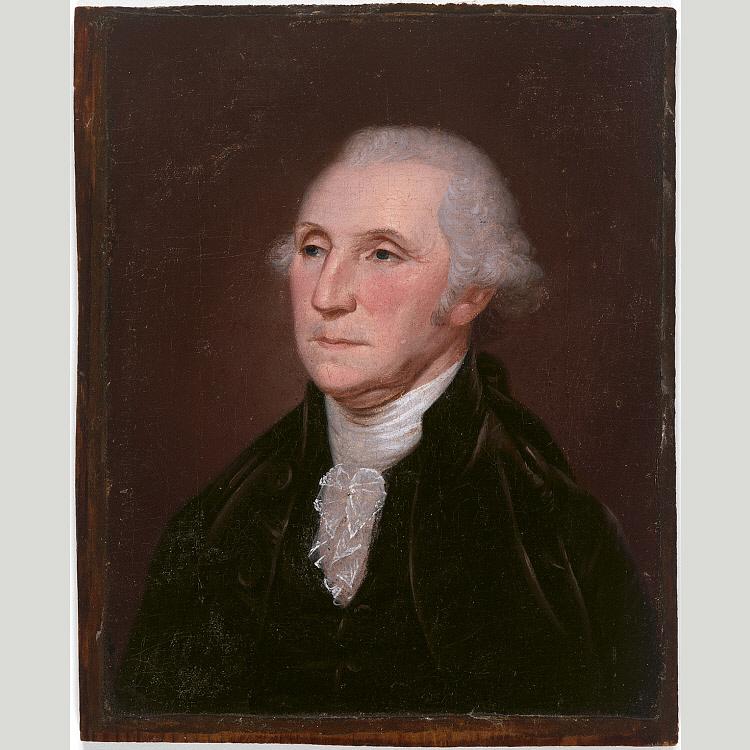
Retrato de Charles Willson Peale

As 100 Pinturas Mais Famosas de Charles Willson Peale, uma Seleção da Galeria

Atualizado em Novembro 2026 · classificado pela nossa pontuação de popularidade (pesquisas, visitas e pedidos de cada obra) · 302 obras de Charles Willson Peale em nosso catálogo

Em resumo

De todas as obras originais deixadas por Charles Willson Peale, a mais famosa é George Washington (1732-1799) (1784), da coleção do Harvard Art Museums, em Cambridge. Logo atrás vêm George Washington (1778) e George Washington (1732-1799), LL.D. 1781 (1788). Nosso catálogo contém 302 obras de Charles Willson Peale; a galeria preservou as 100 que o mundo mais admira, cada uma exibida com sua data, seu museu e sua história.

1741 – 1827, Chester Neoclassical style Mais obras: Metropolitan Museum of Art

As 10 principais pinturas de Charles Willson Peale: a escolha da galeria

1
George Washington (1732-1799) (1784) de Charles Willson Peale

George Washington (1732-1799)

1784 · Oil On Canvas · Harvard Art Museums, Cambridge

In this formal, full-length portrait, we encounter George Washington not merely as a man, but as the embodiment of a nascent nation's authority. The composition is vertical and classical, positioning him slightly off-center to create a sense of dynamic stability. He is dressed in the deep navy blue of the Continental Army uniform, a choice that anchors the viewer's eye against the dark, shadowy background. A yellow waistcoat and breeches…

2
George Washington (1778) de Charles Willson Peale

George Washington

1778 · Oil On Canvas · Metropolitan Museum of Art, Nova York

A full-length portrait captures George Washington in a moment of poised authority. He stands slightly off-center, one hand resting upon his hip while the other grips a cannon. The composition utilizes the diagonal line of the artillery piece to anchor the figure within a rugged landscape. His military attire consists of a dark navy blue coat accented by gold trim and a bright cerulean blue sash. A white cravat provides…

3
George Washington (1732-1799), LL.D. 1781 (1788) de Charles Willson Peale

George Washington (1732-1799), LL.D. 1781

1788 · Oil On Canvas · Yale University Art Gallery, New Haven

The air in the room feels heavy, thick with the quiet gravity of a man caught in the stillness of a momentous era. George Washington sits before us, his gaze fixed on a point just beyond the viewer's right shoulder, looking through the immediate moment toward an unseen horizon. He is a figure of profound composure, his presence defined by a steady, unyielding stare that suggests the immense burden of…

4
Portrait of George Washington (1779) de Charles Willson Peale

Portrait of George Washington

1779 · Watercolor · Detroit Institute of Arts, Detroit

The Portrait of George Washington by Charles Willson Peale is a small, intimate object of history. Created in 1779, this miniature is a quiet derivation of a sitting that took place in Philadelphia. It captures a moment of transition, born from the same likeness that would later inform larger, more public depictions of the commander.

5
George Washington (Last Bust Portrait type) (1795) de Charles Willson Peale

George Washington (Last Bust Portrait type)

1795 · Oil On Canvas

In the quiet, commanding presence of Charles Willson Peale’s 1795 portrait, George Washington, one finds far more than a mere likeness of a man; one encounters the very soul of a nascent republic. This particular rendition, belonging to the "Last Bust Portrait" type, captures the first President of the United States with a profound sense of Neoclassical grace. The composition is masterfully centered, focusing our gaze upon Washington’s head and…

6
Untitled (D2X63K) (1789) de Charles Willson Peale

Untitled (D2X63K)

1789 · Oil On Canvas · Metropolitan Museum of Art, Nova York

A Portrait of Dignity Amidst Revolution In the quiet gravity of Charles Willson Peale’s 1789 masterpiece, Untitled (D2X63K), we encounter more than just a painted figure; we witness the very soul of a nascent nation. Painted during the transformative years following George Washington’s inauguration, this work serves as a profound window into the Enlightenment-era American spirit. The central subject, a man seated with composed intellect in a formal chair, radiates…

7
Thomas and Henry Sergeant (1787) de Charles Willson Peale

Thomas and Henry Sergeant

1787 · Oil On Canvas · Museu de Belas Artes de Boston, Boston

In this 1787 oil on canvas, two young boys, Thomas and Henry Sergeant, are positioned side by side. They wear formal suits with satin linings and hats, their arms outstretched in a gesture of camaraderie. The boys are the central focus of the composition, set against a background that includes a chair and a clock hanging on the wall. To the right, a dog is situated near the subjects, while…

8
Exhumation of the Mastadon (1805) de Charles Willson Peale

Exhumation of the Mastadon

1805 · Oil On Canvas · Peale Museum, Baltimore

To stand before Charles Willson Peale's Exhumation of the Mastadon is not merely to observe a painting; it is to participate in a moment of profound human discovery. Dated to 1805, this oil on canvas transports us across the veil of millennia, placing us at the very threshold where scientific curiosity collided with artistic genius. The scene pulses with an almost palpable energy—the focused industry of a group of pioneering…

9
Mordecai Gist (1774) de Charles Willson Peale

Mordecai Gist

1774 · Oil On Canvas · Fine Arts Museums of San Francisco, São Francisco

In the quiet intensity of Charles Willson Peale’s 1774 portrait of Mordecai Gist, we encounter more than just a likeness of a prominent Maryland figure; we step into the very heart of the American colonial spirit. Painted on the precipice of revolution, this work captures a moment of profound historical tension and burgeoning identity. Peale, an artist whose life was inextricably woven into the fabric of the American struggle for…

10
Washington After the Battle of Princeton, New Jersey (1779) de Charles Willson Peale

Washington After the Battle of Princeton, New Jersey

1779 · Oil On Canvas

In the quiet intensity of 1779, Charles Willson Peale captured more than just a likeness; he immortalized the very heartbeat of a nascent nation. Washington After the Battle of Princeton, New Jersey serves as a profound window into the American Revolutionary War, offering a glimpse into the heavy atmosphere of victory and the weight of leadership. Through his masterful use of oil on canvas, Peale presents George Washington not merely…

A seleção de Charles Willson Peale continua, de 11 a 100

11Governor Thomas McKean and His Son, Thomas, Jr. (1787) de Charles Willson PealeGovernor Thomas McKean and His Son, Thomas, Jr.1787 · Philadelphia Museum of Art 12Retrato de um Gentilhomeníneo (1775) de Charles Willson PealeRetrato de um Gentilhomeníneo1775 · Metropolitan Museum of Art 13Mrs. Richard Tilghman (Mary Gibson) (1766 90) with Her Two Sons, William Gibson (1785 1844) John Lloyd (1785 1832), (painting) (1789) de Charles Willson PealeMrs. Richard Tilghman (Mary Gibson) (1766 90) with Her Two Sons, William Gibson (1785 1844) John Lloyd (1785 1832), (painting)1789 14Thomas McKean (1735-1817) (1781) de Charles Willson PealeThomas McKean (1735-1817)1781 · Harvard Art Museums 15Charles Willson Peale Self-Portrait (1791) de Charles Willson PealeCharles Willson Peale Self-Portrait1791 · National Portrait Gallery 16Walter Stewart (1756-1796) (1781) de Charles Willson PealeWalter Stewart (1756-1796)1781 · Yale University Art Gallery 17John Nicholson (1790) de Charles Willson PealeJohn Nicholson1790 · Art Institute of Chicago 18William Whetcroft (c.1735-1789) (1785) de Charles Willson PealeWilliam Whetcroft (c.1735-1789)1785 · Yale University Art Gallery 19Arthur St. Clair (1780) de Charles Willson PealeArthur St. Clair1780 · Metropolitan Museum of Art 20Portrait of a Woman (1775) de Charles Willson PealePortrait of a Woman1775 · Metropolitan Museum of Art 21Mrs. Elihu Hall (Catherine Orrick) (b. 1736), (painting) (1773) de Charles Willson PealeMrs. Elihu Hall (Catherine Orrick) (b. 1736), (painting)1773 22Mrs. James Maccubin Carroll (Sophia Gough) (1772-1816) (1790) de Charles Willson PealeMrs. James Maccubin Carroll (Sophia Gough) (1772-1816)1790 · Yale University Art Gallery 23Rebecca Bryan White (Mrs. John White) (1788) de Charles Willson PealeRebecca Bryan White (Mrs. John White)1788 · National Gallery of Art 24Mrs. Samuel Mifflin and Her Granddaughter Rebecca Mifflin Francis, (painting) (1780) de Charles Willson PealeMrs. Samuel Mifflin and Her Granddaughter Rebecca Mifflin Francis, (painting)1780 25The Staircase Group, (painting) (1795) de Charles Willson PealeThe Staircase Group, (painting)1795 26Susanna Steuart Tilghman (Mrs. James Tilghman) (1749-1774) (1775) de Charles Willson PealeSusanna Steuart Tilghman (Mrs. James Tilghman) (1749-1774)1775 · Harvard Art Museums 27Christopher Hughes (1789) de Charles Willson PealeChristopher Hughes1789 · Detroit Institute of Arts 28Portrait of Mrs. Thomas McKean (Sarah Armitage) and Her Daughter, Maria Louisa (1787) de Charles Willson PealePortrait of Mrs. Thomas McKean (Sarah Armitage) and Her Daughter, Maria Louisa1787 · Philadelphia Museum of Art 29John Philip de Haas (1772) de Charles Willson PealeJohn Philip de Haas1772 · National Gallery of Art 30Mary O'Donnell (1791) de Charles Willson PealeMary O'Donnell1791 31Mrs. Walter Stewart (Deborah McClenachan) (1763-1823) (1782) de Charles Willson PealeMrs. Walter Stewart (Deborah McClenachan) (1763-1823)1782 · Yale University Art Gallery 32Matthias and Thomas Bordley (1767) de Charles Willson PealeMatthias and Thomas Bordley1767 · Smithsonian American Art Museum 33John Paul Jones (1747 1792), (painting) (1781) de Charles Willson PealeJohn Paul Jones (1747 1792), (painting)1781 34Otto Louis-Guillaume, Comte de Mosloy (1822) de Charles Willson PealeOtto Louis-Guillaume, Comte de Mosloy1822 · Smithsonian American Art Museum 35Eleanor Miller (Mrs. Francis Bailey) (1791) de Charles Willson PealeEleanor Miller (Mrs. Francis Bailey)1791 · Cincinnati Art Museum 36Rachel Leeds Kerr (1790) de Charles Willson PealeRachel Leeds Kerr1790 · Dallas Museum of Art 37William Moultrie (1782) de Charles Willson PealeWilliam Moultrie1782 · National Portrait Gallery 38New England Merchant, (painting) (1765) de Charles Willson PealeNew England Merchant, (painting)1765 · New Britain Museum of American Art 39Dr. Thomas Cadwalader (1770) de Charles Willson PealeDr. Thomas Cadwalader1770 40William Paca (1740 1799), (painting) (1772) de Charles Willson PealeWilliam Paca (1740 1799), (painting)1772 41Samuel Chase (1741 1811), (painting) (1773) de Charles Willson PealeSamuel Chase (1741 1811), (painting)1773 42Richard Bennett Lloyd, Portrait Of, (painting) (1771) de Charles Willson PealeRichard Bennett Lloyd, Portrait Of, (painting)1771 43Portrait of a Woman, (painting) (1775) de Charles Willson PealePortrait of a Woman, (painting)1775 44John Philip de Haas, (painting) (1772) de Charles Willson PealeJohn Philip de Haas, (painting)1772 45Mrs. John Brice and Daughter, (painting) (1773) de Charles Willson PealeMrs. John Brice and Daughter, (painting)1773 46Mrs. John Dickinson and Her Daughter Sally (1740 1803), (painting) (1773) de Charles Willson PealeMrs. John Dickinson and Her Daughter Sally (1740 1803), (painting)1773 47Mrs. Michael Taney (Monica Brooke) (1770) de Charles Willson PealeMrs. Michael Taney (Monica Brooke)1770 · Metropolitan Museum of Art 48Mrs. Charles Carroll of Carrollton, (painting) (1771) de Charles Willson PealeMrs. Charles Carroll of Carrollton, (painting)1771 49Henrietta Maria Bordley, Portrait Of, (painting) (1773) de Charles Willson PealeHenrietta Maria Bordley, Portrait Of, (painting)1773 50Sarah Turner, Portrait Of, (painting) (1770) de Charles Willson PealeSarah Turner, Portrait Of, (painting)1770 51Margaret Strachan (Mrs. Thomas Harwood) (1747 1821), (painting) (1771) de Charles Willson PealeMargaret Strachan (Mrs. Thomas Harwood) (1747 1821), (painting)1771 52Portrait of a Lady in Blue (probably Mary Phillips, 1743 75), (painting) (1775) de Charles Willson PealePortrait of a Lady in Blue (probably Mary Phillips, 1743 75), (painting)1775 53William Stone (1739 1821), (painting) (1775) de Charles Willson PealeWilliam Stone (1739 1821), (painting)1775 54Portrait of a Maryland Gentleman (1775) de Charles Willson PealePortrait of a Maryland Gentleman1775 55Anne Catharine Hoof Green (1769) de Charles Willson PealeAnne Catharine Hoof Green1769 · National Portrait Gallery 56Portrait of Arthur St. Clair (1737-1818) (1782) de Charles Willson PealePortrait of Arthur St. Clair (1737-1818)1782 57Portrait of Lydia Henchman Hancock (1777) de Charles Willson PealePortrait of Lydia Henchman Hancock1777 · Rhode Island School of Design Museum of Art 58Portrait of John Hancock (1776) de Charles Willson PealePortrait of John Hancock1776 · Rhode Island School of Design Museum of Art 59George Washington at the Battle of Princeton (1784) de Charles Willson PealeGeorge Washington at the Battle of Princeton1784 60Caldwell Sister (1782) de Charles Willson PealeCaldwell Sister1782 · Smithsonian American Art Museum 61Pieter Johan van Berckel (1725–1800) (1783) de Charles Willson PealePieter Johan van Berckel (1725–1800)1783 · New York Historical Society 62Elias Boudinot IV (1784) de Charles Willson PealeElias Boudinot IV1784 63James Crawford, and Daughter, (painting) (1785) de Charles Willson PealeJames Crawford, and Daughter, (painting)1785 · Instituto de Arte de Dayton 64Henry Lee (1756 1818), (painting) (1782) de Charles Willson PealeHenry Lee (1756 1818), (painting)1782 65Joseph Dean (1738 93), (painting) (1785) de Charles Willson PealeJoseph Dean (1738 93), (painting)1785 66Benjamin Rush, (painting) (1783) de Charles Willson PealeBenjamin Rush, (painting)1783 · Nationalmuseum 67Robert Hazelhurst, (painting) (1782) de Charles Willson PealeRobert Hazelhurst, (painting)1782 68Benjamin Lincoln (1733 1810), (painting) (1782) de Charles Willson PealeBenjamin Lincoln (1733 1810), (painting)1782 69Nathanael Greene (1742 1786), (painting) (1783) de Charles Willson PealeNathanael Greene (1742 1786), (painting)1783 70George Washington (1732 1799), (painting) (1780) de Charles Willson PealeGeorge Washington (1732 1799), (painting)1780 71Portrait of Gen. Lafayette, (painting) (1781) de Charles Willson PealePortrait of Gen. Lafayette, (painting)1781 72Peyton Randolph (1721 1775), (painting) (1782) de Charles Willson PealePeyton Randolph (1721 1775), (painting)1782 73Thomas McKean (1735 1817), (painting) (1782) de Charles Willson PealeThomas McKean (1735 1817), (painting)1782 74Jean Baptiste Donatien de Vimeur Rochambeau, Comte de (1725 1807), (painting) (1782) de Charles Willson PealeJean Baptiste Donatien de Vimeur Rochambeau, Comte de (1725 1807), (painting)1782 75Portrait of a Lady (1778) de Charles Willson PealePortrait of a Lady1778 · Metropolitan Museum of Art 76Mrs. John Cox (Esther Bowes) (1778) de Charles Willson PealeMrs. John Cox (Esther Bowes)1778 · Metropolitan Museum of Art 77Nathanael Greene (1778) de Charles Willson PealeNathanael Greene1778 · Metropolitan Museum of Art 78Anthony Butler (1782) de Charles Willson PealeAnthony Butler1782 · Metropolitan Museum of Art 79Samuel B. Webb, (painting) (1779) de Charles Willson PealeSamuel B. Webb, (painting)1779 80John Laurens (1780) de Charles Willson PealeJohn Laurens1780 81Thomas McKean, Portrait Of, (painting) (1776) de Charles Willson PealeThomas McKean, Portrait Of, (painting)1776 82General George Washington, (painting) (1783) de Charles Willson PealeGeneral George Washington, (painting)1783 83John Dickinson (1732 1808), (painting) (1782) de Charles Willson PealeJohn Dickinson (1732 1808), (painting)1782 84Portrait of Eleazer McComb, (painting) (1784) de Charles Willson PealePortrait of Eleazer McComb, (painting)1784 85Catherine and Elizabeth Hall, (painting) (1776) de Charles Willson PealeCatherine and Elizabeth Hall, (painting)1776 86Joseph Hewes (1730 79), (painting) (1776) de Charles Willson PealeJoseph Hewes (1730 79), (painting)1776 87General Nathanael Greene, (painting) (1783) de Charles Willson PealeGeneral Nathanael Greene, (painting)1783 88Portrait of Mrs. Benjamin Rush, (painting) (1776) de Charles Willson PealePortrait of Mrs. Benjamin Rush, (painting)1776 89Joseph Donaldson (1776) de Charles Willson PealeJoseph Donaldson1776 · Metropolitan Museum of Art 90William Moultrie (1730 1805), (painting) (1782) de Charles Willson PealeWilliam Moultrie (1730 1805), (painting)1782 91Mrs. Richard Gibbs (Margery Harrison) (d. 1790), (painting) (1778) de Charles Willson PealeMrs. Richard Gibbs (Margery Harrison) (d. 1790), (painting)1778 92George Washington (1777) de Charles Willson PealeGeorge Washington1777 · Metropolitan Museum of Art 93Robert Ralston (age 21) (1781 1836), (painting) (1782) de Charles Willson PealeRobert Ralston (age 21) (1781 1836), (painting)1782 94Frederick William Von Steuben, Baron (1730 1794), (painting) (1780) de Charles Willson PealeFrederick William Von Steuben, Baron (1730 1794), (painting)1780 · Pennsylvania Academy of Fine Arts 95Benjamin Harrison, Jr (1783) de Charles Willson PealeBenjamin Harrison, Jr1783 · National Portrait Gallery 96Portrait of a Gentleman, possibly Judge John Berrien (1789) de Charles Willson PealePortrait of a Gentleman, possibly Judge John Berrien1789 97Francis Bailey (1791) de Charles Willson PealeFrancis Bailey1791 · Cincinnati Art Museum 98George Washington at Princeton (1788) de Charles Willson PealeGeorge Washington at Princeton1788 · Indianapolis Museum of Art 99Timothy Matlack (1790) de Charles Willson PealeTimothy Matlack1790 · Museu de Belas Artes de Boston 100Nathaniel Gorham (1793) de Charles Willson PealeNathaniel Gorham1793 · Museu de Belas Artes de Boston

Pinturas famosas de Charles Willson Peale, período por período

Os temas que cativaram o olhar de Charles Willson Peale

Os quatro temas que mais se repetem nestas obras originais, cada um com o seu melhor exemplo.

Os museus que guardam os originais de Charles Willson Peale

Os 8 museus que detêm a maioria das pinturas desta página.

Museus Cidade Obras de Charles Willson Peale Pinturas desta lista
Metropolitan Museum of Art, Nova YorkMetropolitan Museum of Art Nova York 24 George Washington, Untitled (D2X63K), Retrato de um Gentilhomeníneo
Yale University Art Gallery, New HavenYale University Art Gallery New Haven 6 George Washington (1732-1799), LL.D. 1781, Walter Stewart (1756-1796), William Whetcroft (c.1735-1789)
National Portrait Gallery, Washington, D.C.National Portrait Gallery Washington, D.C. 12 William Moultrie, Anne Catharine Hoof Green, Benjamin Harrison, Jr
Smithsonian American Art Museum, Washington, D.C.Smithsonian American Art Museum Washington, D.C. 7 Matthias and Thomas Bordley, Otto Louis-Guillaume, Comte de Mosloy, Caldwell Sister
Museu de Belas Artes de Boston, BostonMuseu de Belas Artes de Boston Boston 5 Thomas and Henry Sergeant, Timothy Matlack, Nathaniel Gorham
Harvard Art Museums, CambridgeHarvard Art Museums Cambridge 3 George Washington (1732-1799), Thomas McKean (1735-1817), Susanna Steuart Tilghman (Mrs. James Tilghman) (1749-1774)
Philadelphia Museum of Art, FiladélfiaPhiladelphia Museum of Art Filadélfia 6 Governor Thomas McKean and His Son, Thomas, Jr., Portrait of Mrs. Thomas McKean (Sarah Armitage) and Her Daughter, Maria Louisa
Detroit Institute of Arts, DetroitDetroit Institute of Arts Detroit 5 Portrait of George Washington, Christopher Hughes

Charles Willson Peale década a década: a obra original que define cada uma

Obras por década

Escolha uma década para ver a obra original que a define.

Perguntas de colecionadores sobre as pinturas de Charles Willson Peale

Por qual obra Charles Willson Peale é mais conhecido(a)?Revelar a resposta

George Washington (1732-1799) (1784), Harvard Art Museums, Cambridge. George Washington (1778) e George Washington (1732-1799), LL.D. 1781 (1788) vêm a seguir.

Qual era a idade de Charles Willson Peale quando George Washington (1732-1799) foi feita?Revelar a resposta

43 anos: George Washington (1732-1799) data de 1784, e Charles Willson Peale nasceu em 1741.

Quais são as dez pinturas mais famosas de Charles Willson Peale?Revelar a resposta

George Washington (1732-1799), George Washington, George Washington (1732-1799), LL.D. 1781, Portrait of George Washington, George Washington (Last Bust Portrait type), Untitled (D2X63K), Thomas and Henry Sergeant, Exhumation of the Mastadon, Mordecai Gist e Washington After the Battle of Princeton, New Jersey. O ranking acima apresenta o ano e o museu de cada uma.

Quantas pinturas Charles Willson Peale deixou?Revelar a resposta

Nosso catálogo contém 302 obras de Charles Willson Peale, datadas de 1765 a 1822.

Em quais museus estão expostas as obras-primas de Charles Willson Peale?Revelar a resposta

Principalmente em Metropolitan Museum of Art (Nova York), Yale University Art Gallery (New Haven) e National Portrait Gallery (Washington, D.C.). A tabela de museus acima lista todos eles.

Em que anos Charles Willson Peale pintou as suas obras mais famosas?Revelar a resposta

Em 1780s: 46 das 100 obras nesta página foram feitas então, sendo George Washington (1732-1799) delas.

Quais são as primeiras e as últimas obras originais famosas de Charles Willson Peale?Revelar a resposta

Nesta página, a mais antiga é New England Merchant, (painting) (1765) e a mais recente é Otto Louis-Guillaume, Comte de Mosloy (1822).

Quais temas Charles Willson Peale escolheu com mais frequência?Revelar a resposta

Man (52), Portrait (34) e Woman (20), entre as 100 obras nesta página.

Qual técnica Charles Willson Peale mais utilizou?Revelar a resposta

Oil On Canvas, para 68 das 100 obras nesta página.

A qual movimento artístico pertence Charles Willson Peale?Revelar a resposta

Neoclassical style, a julgar pelos originais nesta página.

Quais obras de Charles Willson Peale estão expostas no Metropolitan Museum of Art?Revelar a resposta

George Washington, Untitled (D2X63K) e Retrato de um Gentilhomeníneo: o Metropolitan Museum of Art, Nova York detém 12 das obras desta página.

Charles Willson Peale: vida e obra

Charles Willson Peale: Um Pintor Revolucionário, Cientista e Ídolo da Primeira América

Charles Willson Peale (1741-1827) foi um artista americano cuja vida transcendeu a pintura tradicional para abraçar uma paixão pela ciência e uma profunda conexão com o espírito da época revolucionária americana. Sua obra permanece como um testemunho único do período, combinando beleza estética com rigor intelectual e um desejo de registrar o mundo ao seu redor com precisão e emoção.

Infância Difícil e Primeiros Passos na Arte

A vida inicial de Peale foi marcada por dificuldades financeiras após a morte prematura de seu pai. Após uma breve carreira como sapateador, ele descobriu um talento nato pela arte durante seus estudos iniciais com John Hesselius e posteriormente com o renomado pintor John Singleton Copley em Boston. Essas experiências proporcionaram uma compreensão fundamental das técnicas tradicionais da pintura inglesa e americana, estabelecendo as bases para seu estilo artístico futuro. Uma influência particularmente significativa foi sua estadia em Londres entre 1767 e 1770, onde estudou sob Benjamin West, um artista que defendia o neoclassicismo e buscava inspiração na arte greco-romana. Esta exposição a estilos europeus moldou profundamente sua visão estética e seu desejo de criar obras que refletissem os valores da razão e da ordem.

Carreira Artística e Obras Emblemáticas

Peale alcançou reconhecimento internacional como pintor retratista, especialmente por suas imagens de figuras importantes da Revolução Americana. Sua obra mais famosa é a série de pinturas de George Washington, que compreende quase sessenta obras distintas. Essas pinturas não apenas celebram o líder revolucionário americano, mas também são documentos históricos preciosos que capturam os aspectos psicológicos e físicos do primeiro presidente dos Estados Unidos. Peale empregou uma abordagem meticulosa na criação dessas imagens, buscando reproduzir com fidelidade a aparência física de Washington e transmitir sua personalidade através da composição e da expressão facial. Além das pinturas de Washington, Peale criou obras significativas como "O Grupo Escadaria" (c. 1795), um exemplo impressionante de trompe l'oeil que desafia os limites entre pintura e arquitetura, criando uma ilusão espacial que envolve o espectador e reforça a sensação de presença artística. Essas obras demonstram sua habilidade técnica excepcional e seu domínio das técnicas inovadoras da época.

Além da Pintura: Uma Mente Científica Pioneira

Embora Peale seja celebrado principalmente como pintor, ele também foi um cientista dedicado que desempenhou um papel fundamental na formação do pensamento científico americano. Sua paixão pela natureza o levou a organizar expedições científicas para estudar animais e plantas em diversas regiões dos Estados Unidos, coletando amostras e realizando desenhos detalhados que enriqueceram o conhecimento científico da época. Em 1784, Peale fundou o Museu Americano em Filadélfia, uma instituição inovadora que se tornou um dos primeiros museus públicos nos Estados Unidos. O museu abrigava uma coleção extraordinária de objetos naturais e arqueológicos, incluindo esqueletos de animais pré-históricos como mastodonte, que atraíram visitantes de todo o mundo e estimularam o interesse pela ciência e pela educação. Além disso, Peale desempenhou um papel importante na divulgação do conhecimento científico através da publicação de livros ilustrados e da organização de palestras públicas, contribuindo para a formação de uma cultura científica nas camadas mais altas da sociedade americana. Sua iniciativa inspirou outros cientistas e artistas a promover o estudo da natureza e a compartilhar suas descobertas com o público em geral.

Legado Histórico e Influência Duradoura

O legado artístico e científico de Charles Willson Peale permanece relevante até hoje, refletindo os valores do Iluminismo e o espírito crítico que caracterizaram o período revolucionário americano. Sua obra é considerada um marco da pintura neoclássica americana e influenciou gerações de artistas posteriores, que buscaram inspiração em seu estilo elegante e preciso. Além disso, Peale é reconhecido como um pioneiro na criação do museu público nos Estados Unidos, estabelecendo um modelo para instituições culturais que celebram o conhecimento científico e a beleza artística. Sua vida e obra são exemplos de como a arte e a ciência podem se complementar para promover o desenvolvimento intelectual e cultural de uma sociedade.