Retrato de Andrea Di Bartolo

Pinturas de Andrea Di Bartolo: As 28 mais famosas, sob o olhar de uma galeria

Atualizado em Novembro 2026 · classificado pela nossa pontuação de popularidade (pesquisas, visitas e pedidos de cada obra) · 30 obras de Andrea Di Bartolo em nosso catálogo

Em resumo

Aos olhos da galeria, a pintura mais famosa de Andrea Di Bartolo é Coronation of the Virgin (1410), cuja obra original está exposta no Pinacoteca di Brera, em Milão. St. Jerome in the Wildrness (1515) e The Presentation of the Virgin in the Temple (1400) completam o trio que todos reconhecem. Dos 30 trabalhos de Andrea Di Bartolo em nosso catálogo, a galeria apresenta abaixo as 28 obras mais famosas, cada uma original, com seu ano, seu museu e o que a torna única.

1360 – 1428, Siena Sienese school Mais obras: National Gallery of Art

As 10 principais pinturas de Andrea Di Bartolo na galeria

1
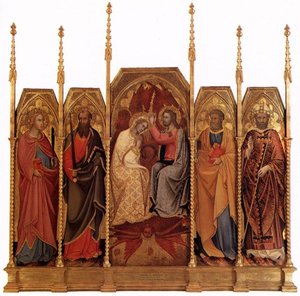
Coronation of the Virgin (1410) de Andrea Di Bartolo

Coronation of the Virgin

1410 · Oil On Canvas · Pinacoteca di Brera, Milão

To stand before this depiction of the Coronation of the Virgin is to be transported across the veil of time, into a realm where earthly grandeur meets divine glory. The scene unfolds with breathtaking solemnity and vibrant energy, capturing that singular moment when Mary, the Mother of God, is elevated to her heavenly throne. Andrea di Bartolo’s masterful hand guides our gaze through this sacred gathering, presenting not merely an…

2
St. Jerome in the Wildrness (1515) de Andrea Di Bartolo

St. Jerome in the Wildrness

1515 · Oil On Panel · The Bowes Museum, Barnard Castle

In the quiet, rugged expanse of a landscape that feels more European than Syrian, we encounter a moment of profound spiritual intensity. St. Jerome in the Wilderness is not merely a depiction of a saint; it is an immersive experience of penance and prayer. As the viewer’s eye meets the kneeling figure of St. Jerome, there is an immediate sense of the weight of devotion. The artist captures the saint…

3
The Presentation of the Virgin in the Temple (1400) de Andrea Di Bartolo

The Presentation of the Virgin in the Temple

1400 · Tempera On Panel · National Gallery of Art, Washington

The Presentation of the Virgin in the Temple by Andrea Di Bartolo captures a pivotal moment from the life of the Madonna. Created about 1400/1405, the work illustrates the young Virgin Mary taking leave of her parents, Anna and Joachim. This narrative is drawn from an apocryphal account attributed to the evangelist Matthew, rather than the canonical Gospels.

4
Madonna of Humility, The Blessing Christ, Two Angels, and a Donor [obverse] (1380) de Andrea Di Bartolo

Madonna of Humility, The Blessing Christ, Two Angels, and a Donor [obverse]

1380 · Tempera On Panel · National Gallery of Art, Washington

The late 14th-century Sienese School finds a profound expression in this tempera and gold leaf panel. Seated upon a patterned cushion, the Virgin Mary nurtures the infant Christ, a composition that emphasizes maternal intimacy within a rigid, hierarchical structure. The gold ground provides a non-naturalistic, divine backdrop, reflecting an omnipresent light that transcends earthly space. This portable altarpiece, dated to approximately 1380, utilizes a vertical arrangement to guide the viewer…

5
Christ on the Cross [reverse] (1380) de Andrea Di Bartolo

Christ on the Cross [reverse]

1380 · Tempera On Panel · National Gallery of Art, Washington

The viewer encounters Christ on the Cross [reverse], a work by Andrea Di Bartolo that dates to about 1380/1390. This panel functions as a simplified version of a portable diptych, a small and intimate object designed for private contemplation. While the obverse of such an icon typically presents a Madonna and Child, this specific side focuses entirely on the central figure of the Crucifixion. It is a quiet, solitary scene…

6
The Crucifixion (1400) de Andrea Di Bartolo

The Crucifixion

1400 · Tempera On Panel · Metropolitan Museum of Art, Nova York

In this panoramic composition, we find ourselves witnessing a profound moment of religious tragedy. The scene is crowded, filled with a dense assembly of mourners and soldiers that presses against the foreground, creating a sense of immediate, heavy presence. At the center, the figure of Christ is suspended on the cross, flanked by two thieves, while angels hover within the sky above. The composition is characteristic of the Sienese Gothic…

7
The Assumption of the Virgin with St. Thomas and Two Donors (Ser Palamedes and his Son Matthew) (1390) de Andrea Di Bartolo

The Assumption of the Virgin with St. Thomas and Two Donors (Ser Palamedes and his Son Matthew)

1390 · Tempera On Panel · Virginia Museum of Fine Arts, Richmond

The composition ascends vertically, guiding the eye from the earthly realm toward a divine summit. At the center of this spiritual movement, the Virgin Mary rises through layers of angelic figures, her presence framed by a background of gold leaf that eliminates earthly shadows. This Sienese Gothic approach creates a flattened, sacred space where light is even and pervasive. The figures are defined by rhythmic, organic shapes and the precise,…

8
Den hellige Blasius (1395) de Andrea Di Bartolo

Den hellige Blasius

1395 · Tempera On Panel · National Museum of Art, Architecture and Design, Oslo

The gaze meets Den hellige Blasius, a painting that holds a steady, sacred presence. This work by Andrea Di Bartolo brings a singular figure into view, presenting a religious scene or person through the lens of late medieval devotion. The subject, Saint Blasius, emerges from a background of gold, appearing as a quiet pillar of faith. Every line of the figure seems to carry the weight of a prayer, frozen…

9
The Crucifixion (1390) de Andrea Di Bartolo

The Crucifixion

1390 · Tempera On Panel · Museu Nacional de Varsóvia, Varsóvia

The Crucifixion by Andrea Di Bartolo emerges from the shadows of the late fourteenth century, a solemn vision captured around 1400. This work places the viewer directly before the central event of Christian history, presenting the Crucifixion of Jesus Christ with a profound sense of spiritual weight. Every line and color choice works to anchor this sacred moment in a space that feels both otherworldly and deeply felt.

10
Saint Stephen (panel from the right pilaster of an altarpiece) (1397) de Andrea Di Bartolo

Saint Stephen (panel from the right pilaster of an altarpiece)

1397 · Tempera On Panel · Victoria and Albert Museum, Londres

Saint Stephen (panel from the right pilaster of an altarpiece) is a work by Andrea Di Bartolo. This fragmentary panel originated as part of a series of superimposed figures from the right pilaster of an unidentified Italian altarpiece. The wood panel captures the first Christian martyr, Saint Stephen, in a moment of quiet, heavy presence. He is depicted with the symbols of his devotion and his end: a book held…

Pinturas de Andrea Di Bartolo, classificadas de 11 a 28

Os temas que cativaram o olhar de Andrea Di Bartolo

Os quatro temas que mais se repetem nestas obras originais, cada um com o seu melhor exemplo.

Os museus que guardam os originais de Andrea Di Bartolo

Os 8 museus que detêm a maioria das pinturas desta página.

Museus Cidade Obras de Andrea Di Bartolo Pinturas desta lista
National Gallery of Art, WashingtonNational Gallery of Art Washington 5 The Presentation of the Virgin in the Temple, Madonna of Humility, The Blessing Christ, Two Angels, and a Donor [obverse], Christ on the Cross [reverse]
Musée du Petit Palais, AvignonMusée du Petit Palais Avignon 3 Saint Bishop, Saint Anthony Abbot, Saint Costanzo
Detroit Institute of Arts, DetroitDetroit Institute of Arts Detroit 2 Christ in Benediction, Madonna and Child
Pinacoteca di Brera, MilãoPinacoteca di Brera Milão 1 Coronation of the Virgin
The Bowes Museum, Barnard CastleThe Bowes Museum Barnard Castle 1 St. Jerome in the Wildrness
Metropolitan Museum of Art, Nova YorkMetropolitan Museum of Art Nova York 1 The Crucifixion
Virginia Museum of Fine Arts, RichmondVirginia Museum of Fine Arts Richmond 1 The Assumption of the Virgin with St. Thomas and Two Donors (Ser Palamedes and his Son Matthew)
National Museum of Art, Architecture and Design, OsloNational Museum of Art, Architecture and Design Oslo 1 Den hellige Blasius

Andrea Di Bartolo, uma pintura emblemática por década

Obras por década

Escolha uma década para ver a obra original que a define.

Pinturas de Andrea Di Bartolo: a galeria responde

Qual pintura de Andrea Di Bartolo é a mais famosa de todas?Revelar a resposta

Coronation of the Virgin (1410), Pinacoteca di Brera, Milão. St. Jerome in the Wildrness (1515) e The Presentation of the Virgin in the Temple (1400) vêm a seguir.

Qual era a idade de Andrea Di Bartolo ao concluir Coronation of the Virgin?Revelar a resposta

50 anos: Coronation of the Virgin data de 1410, e Andrea Di Bartolo nasceu em 1360.

Quais são as 10 principais pinturas de Andrea Di Bartolo?Revelar a resposta

Coronation of the Virgin, St. Jerome in the Wildrness, The Presentation of the Virgin in the Temple, Madonna of Humility, The Blessing Christ, Two Angels, and a Donor [obverse], Christ on the Cross [reverse], The Crucifixion, The Assumption of the Virgin with St. Thomas and Two Donors (Ser Palamedes and his Son Matthew), Den hellige Blasius, The Crucifixion e Saint Stephen (panel from the right pilaster of an altarpiece). O ranking acima apresenta o ano e o museu de cada uma.

Quantas obras Andrea Di Bartolo criou?Revelar a resposta

Nosso catálogo contém 30 obras de Andrea Di Bartolo, datadas de 1380 a 1424.

Onde estão expostos os originais mais famosos de Andrea Di Bartolo?Revelar a resposta

Principalmente em National Gallery of Art (Washington), Musée du Petit Palais (Avignon) e Detroit Institute of Arts (Detroit). A tabela de museus acima lista todos eles.

Quando é que Andrea Di Bartolo criou as suas pinturas mais famosas?Revelar a resposta

Em 1400s: 8 das 28 obras nesta página foram feitas então, sendo The Presentation of the Virgin in the Temple delas.

Quais são as obras mais famosas de Andrea Di Bartolo no início e no fim de sua carreira?Revelar a resposta

Nesta página, a mais antiga é Madonna of Humility, The Blessing Christ, Two Angels, and a Donor [obverse] (1380) e a mais recente é Madonna and Child (1424).

Quais temas Andrea Di Bartolo mais explorou?Revelar a resposta

Gold background (14), Woman (7) e Child (6), entre as 28 obras nesta página.

Em qual técnica Andrea Di Bartolo mais trabalhou?Revelar a resposta

Tempera On Panel, para 19 das 28 obras nesta página.

Com qual movimento Andrea Di Bartolo está associado(a)?Revelar a resposta

Sienese school, a julgar pelos originais nesta página.

Quais obras originais de Andrea Di Bartolo o National Gallery of Art possui?Revelar a resposta

The Presentation of the Virgin in the Temple, Madonna of Humility, The Blessing Christ, Two Angels, and a Donor [obverse] e Christ on the Cross [reverse]: o National Gallery of Art, Washington detém 5 das obras desta página.

Andrea Di Bartolo: o artista

Um Legado de Devoção Sienense

No coração vibrante da Escola de Siena, Andrea Di Bartolo emergiu como um mestre cujo pincel capturou a profunda intensidade espiritual de sua era. Como filho e pupilo do proeminente pintor Bartolo di Fredi, a jornada artística de Andrea estava profundamente enraizada nas tradições do atelier de seu pai. Seus primeiros anos foram passados imerso nas prestigiadas encomendas que fluíam pelo estúdio de sua família, um período de aprendizado que lançou as bases para uma carreira definida pela devoção religiosa e maestria técnica. Trabalhando ao lado de luminares como Luca di Tommè, ele contribuiu para obras comunitárias significativas, incluindo um retábulo para a guilda dos sapateiros na catedral de Siena, marcando sua primeira presença documentada nos anais da história da arte.

A arte de Andrea Di Bartolo não se limitava apenas à tela; ele era um criador versátil, atuando como pintor, designer de vitrais e iluminador de manuscritos. Sua obra frequentemente estabelecia uma ponte entre a graça etérea da tradição Gótica e o humanismo emergente que eventualmente definiria o Renascimento. Em seus temas religiosos, encontra-se uma atenção meticulosa aos detalhes e uma capacidade de profundidade narrativa. Seja retratando a quietude solitária de São Jerônimo no Deserto ou a tensão dramática de uma Crucifixão, Andrea possuía a habilidade de ancorar suas composições com estruturas poderosas que conduzem o espectador a um estado de contemplação.

Maestria de Luz e Narrativa

A destreza técnica de Andrea Di Bartolo é mais evidente em sua capacidade de manipular a luz e a textura para evocar emoção. Suas obras frequentemente apresentam uma qualidade luminosa, onde o jogo entre sombra e brilho espelha as lutas espirituais internas de seus temas. Em suas representações de figuras sagradas, há uma sensação palpável de peso e presença; as dobras pesadas e rítmicas das vestes de um cardeal ou a delicada translucidez de um véu são renderizadas com uma precisão que torna o divino tangivelmente humano. Essa maestria permitiu-lhe criar obras que serviam como sermões silenciosos, ricos em um vocabulário simbólico destinado a inspirar piedade nos fiéis.

Além de sua habilidade individual, a importância histórica de Andrea reside em seu papel dentro da paisagem em evolução da Itália central e do norte. Ativo durante o final do século XIV e início do século XV, ele ajudou a manter o prestígio da Escola de Siena durante um período de grande transição. Suas contribuições para retábulos, vitrais e manuscritos iluminados garantiram que sua visão artística permeasse vários aspectos da vida religiosa em Siena e suas cidades vizinhas. Através de sua dedicação tanto à complexidade decorativa de seu ofício quanto à beleza solene de seus temas, Andrea Di Bartolo deixou uma marca indelével no patrimônio visual da Itália.