1


Atualizado em Novembro 2026 · classificado pela nossa pontuação de popularidade (pesquisas, visitas e pedidos de cada obra) · 18 obras de Allen Jones em nosso catálogo
Em resumo
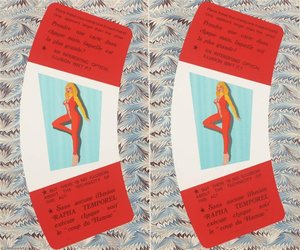
De todas as obras originais que Allen Jones deixou, a mais famosa é Untitled (2). Logo atrás vêm Hermaphrodite (1963) e Hatstand. Nosso catálogo contém 18 obras de Allen Jones; a galeria preservou as 18 que o mundo mais admira, cada uma exibida com sua data, seu museu e sua história.

Allen Jones’s 1963 painting, "Hermaphrodite," is not merely a depiction of figures; it is an eloquent meditation on the very nature of identity, connection, and the boundaries we impose upon ourselves. The canvas captures a moment steeped in intimacy—a central couple locked in a tender embrace amidst what appears to be a lively gathering. Yet, the true focus remains on the merging forms at the heart of the composition. Jones…


Os quatro temas que mais se repetem nestas obras originais, cada um com o seu melhor exemplo.
O museu que detém a maioria das pinturas desta página.
| Museus | Cidade | Obras de Allen Jones | Pinturas desta lista |
|---|---|---|---|
 National Museums Liverpool |
Liverpool | 1 | Hermaphrodite |
1963 é o ano de cada obra datada de Allen Jones nesta seleção: aqui estão elas, classificadas por fama.
Escolha um ano para ver as obras originais.
Allen Jones’s 1963 painting, "Hermaphrodite," is not merely a depiction of figures; it is an eloquent meditation on the very nature of identity, connection, and the boundaries we impose upon ourselves. The canvas captures a moment steeped in intimacy—a central couple locked in a tender embrace amidst what appears to be a lively gathering. Yet, the true focus remains on the merging forms at the heart of the composition. Jones…
Untitled (2). Hermaphrodite (1963) e Hatstand vêm a seguir.
Untitled (2), Hermaphrodite, Hatstand, Untitled, One way traffic, Chair, Right hand lady, Diva, Wet seal e Nudo ombra. O ranking acima apresenta o ano e o museu de cada uma.
Nosso catálogo contém 18 obras de Allen Jones.
Principalmente em National Museums Liverpool (Liverpool). A tabela de museus acima lista todos eles.
Pop art, a julgar pelos originais nesta página.
Born in the coastal city of Southampton in 1937, Allen Jones emerged as one of the most striking and controversial voices within the British Pop Art movement. His artistic journey was forged in the rigorous studios of the Hornsey College of Art and later the Royal College of Art, though his path was marked by a rebellious spirit that famously led to his expulsion from the latter institution. This early friction with authority did not stifle his creativity; rather, it acted as a catalyst, pushing him toward an aesthetic that challenged the very foundations of mid-century societal norms. As he transitioned from student to educator, teaching at institutions such as Croydon College of Art and later in Hamburg and California, Jones refined a visual language that would forever link the glossy allure of mass media with the unsettling depths of human psychology.
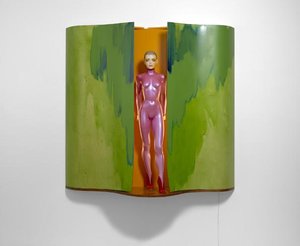
The essence of Jones’s work lies in its masterful, often jarring, juxtaposition of the organic and the artificial. He became renowned for a sculptural style that utilized smooth, hyper-realistic mannequins to explore the complexities of femininity and objectification. By placing these glossy, idealized figures within textured, geometric panels or alongside utilitarian objects like chairs and tables, he created a profound tension between the natural human form and the cold precision of industrial design. This technique allowed him to critique the pervasive influence of advertising and the way mass media constructs beauty standards, turning the viewer into an observer of both desire and artifice.
While his roots are firmly planted in the vibrant energy of Pop Art, Jones’s intellectual depth is heavily indebted to the traditions of Surrealism. He drew significant inspiration from the dreamlike, destabilizing works of René Magritte, seeking to use imagery that could bypass rational thought and strike directly at the subconscious. This influence is palpable in masterpieces such as “Diva,” where a mannequin is encased within an abstract, textured panel, creating a sense of beautiful decay and existential anxiety. His ability to blend the bright, commercial colors of the 1960s with the unsettling, irrational logic of dreams allowed him to create works that were simultaneously eye-catching and deeply disconcerting.
His explorations often delved into themes of identity and the fragmentation of the self. Through various mediums—including painting, lithography, and sculpture—Jones presented a world where figures are often disconnected from their surroundings or integrated into strange, mechanical structures. This is evident in works like “One Way Traffic,” a provocative collage that utilizes a surreal grid to present female figures, and “Untitled (2),” which uses dramatic lighting and bold lines to evoke the glamour of 1970s fashion photography. In doing so, he forced his audience to confront the thin line between the human subject and the commercial object.
The historical significance of Allen Jones extends far beyond the initial shock value of his mid-century provocations. He has been recognized as a pivotal figure in the evolution of contemporary British art, earning prestigious accolades such as the Prix des Jeunes Artistes at the 1963 Paris Biennale and becoming a Senior Academician at the Royal Academy of Arts. His career is marked by a relentless pursuit of new forms, moving from the bold, graphic statements of his early years to more complex, hyperrealistic sculptural explorations in later decades.
Today, the works of Allen Jones reside in some of the world's most esteemed institutions, ensuring his influence continues to resonate with new generations of artists and scholars. His legacy is defined by several key contributions:
Through his uncompromising vision, Jones transformed the medium of Pop Art into a powerful tool for social commentary, leaving behind a body of work that remains as challenging and vital today as it was during its inception.