Retrato de Alexander Calder

As 98 Pinturas Mais Famosas de Alexander Calder, uma Seleção da Galeria

Atualizado em Outubro 2026 · classificado pela nossa pontuação de popularidade (pesquisas, visitas e pedidos de cada obra) · 98 obras de Alexander Calder em nosso catálogo

Em resumo

De todas as obras originais deixadas por Alexander Calder, a mais famosa é Untitled, da coleção do Biennale Internazionale dell'Antiquariato di Firenze, em Florença. Logo atrás vêm Mobile (1932) e Romulus and Remus (1928). Nosso catálogo contém 98 obras de Alexander Calder; a galeria preservou as 98 que o mundo mais admira, cada uma exibida com sua data, seu museu e sua história.

1898 – 1976, Lawnton Abstract expressionism Mais obras: Biennale Internazionale dell'Antiquariato di Firenze

As 10 principais pinturas de Alexander Calder: a escolha da galeria

3
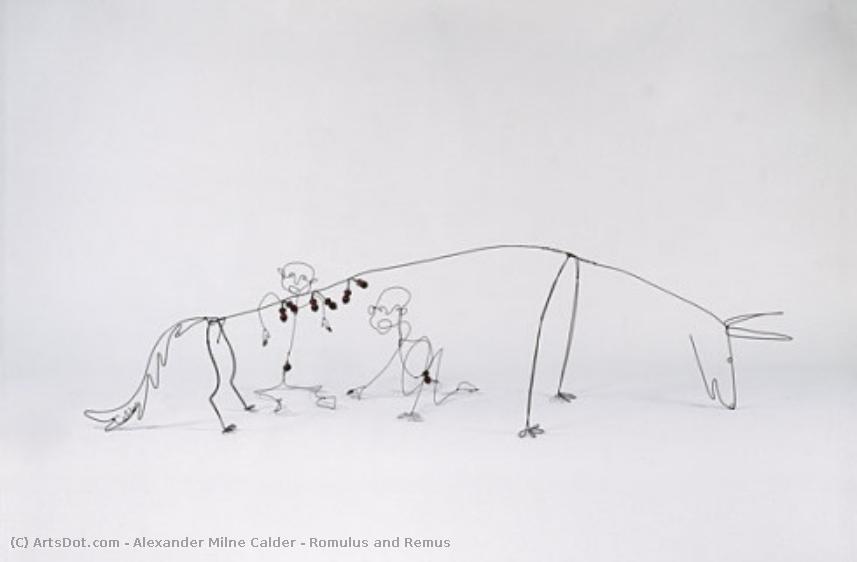
Romulus and Remus (1928) de Alexander Calder

Romulus and Remus

1928 · Solomon R. Guggenheim Museum, Nova York

Alexander Milne Calder's "Romulus and Remus," crafted in 1928, isn’t merely a sculpture; it’s a distilled essence of myth rendered in delicate wire. This piece, a testament to the artist’s pioneering approach to three-dimensional form, transcends its subject matter – the legendary founders of Rome – to become a profound meditation on beginnings, brotherhood, and the very act of creation itself. Calder, deeply influenced by Constructivism and early Modernism, sought…

5
Red Lily Pads (Nénuphars rouges) (1956) de Alexander Calder

Red Lily Pads (Nénuphars rouges)

1956 · Acrylic · Solomon R. Guggenheim Museum, Nova York

Alexander Milne Calder's "Red Lily Pads (Nénuphars rouges)" isn’t merely a depiction of a serene pond; it’s an invitation to lose oneself in the delicate balance of form, color, and movement. Created in 1956, this captivating sculpture – captured through a masterful photograph – embodies Calder's signature approach: embracing chance and celebrating the ephemeral beauty of nature within a distinctly modern aesthetic. The piece resides within a contemporary architectural space,…

9
Black Sun (1953) de Alexander Calder

Black Sun

1953 · Acrylic On Canvas · Tate Britain, Londres

Alexander Milne Calder's "Black Sun," painted in 1953, isn’t merely a depiction of abstract forms; it’s an invitation to contemplate the interplay between chaos and order, darkness and light. Born in Aberdeen, Scotland, and later establishing himself as a pivotal figure in American sculpture alongside his son Alexander Stirling Calder and grandson Alexander ‘Sandy’ Calder, Milne Calder possessed a singular vision – one that sought to capture dynamic movement and…

10
Colored Spots (1970) de Alexander Calder

Colored Spots

1970 · Gouache

In Colored Spots, created in 1970, we encounter a moment of pure rhythmic energy. This gouache work moves away from the heavy permanence of sculpture to explore the lightness of color and shape. The composition is defined by a series of circles, varying in scale, that appear to drift across the surface. There is a specific tension in how these forms are placed; they do not sit static but seem…

A seleção de Alexander Calder continua, de 11 a 98

11Calder's Circus (1931) de Alexander CalderCalder's Circus1931 · Whitney Museum of American Art 12Red Sun (1968) de Alexander CalderRed Sun1968 · Des Moines Art Center 13Lobster Trap and Fish Tail (1939) de Alexander CalderLobster Trap and Fish Tail1939 · MoMA - Museu de Arte Moderna 14Violin (1960) de Alexander CalderViolin1960 15Untitled (400) de Alexander CalderUntitled (400) 16Untitled (2) de Alexander CalderUntitled (2) 17Untitled (362) de Alexander CalderUntitled (362) 18Sculpture in montreal de Alexander CalderSculpture in montreal 19Untitled (1937) de Alexander CalderUntitled1937 20Untitled (1948) de Alexander CalderUntitled1948 · The Phillips Collection 21Three Fingers (1944) de Alexander CalderThree Fingers1944 22The Antlers (1944) de Alexander CalderThe Antlers1944 23The Vine (1944) de Alexander CalderThe Vine1944 24The Fawn (1944) de Alexander CalderThe Fawn1944 25The Racket (1944) de Alexander CalderThe Racket1944 26The Flower (1944) de Alexander CalderThe Flower1944 27Yellow Tights (1945) de Alexander CalderYellow Tights1945 28Spiral Composition (1946) de Alexander CalderSpiral Composition1946 29Four Fish in Water (1947) de Alexander CalderFour Fish in Water1947 30The Acrobats (1944) de Alexander CalderThe Acrobats1944 31"Calder #1" Textile (Model No. 1-145) (1949) de Alexander Calder"Calder #1" Textile (Model No. 1-145)1949 · Metropolitan Museum of Art 32Antennae with Red and Blue Dots (1953) de Alexander CalderAntennae with Red and Blue Dots1953 33Reef Fringe (1953) de Alexander CalderReef Fringe1953 34Black Widow (1959) de Alexander CalderBlack Widow1959 35Chevrons Noir sur Rouge et Jaune (1960) de Alexander CalderChevrons Noir sur Rouge et Jaune1960 36Saucers (1965) de Alexander CalderSaucers1965 377 Circles Abstract (1966) de Alexander Calder7 Circles Abstract1966 38Grid with Symbols (1966) de Alexander CalderGrid with Symbols1966 39Like Two Discs Sculpture (1962) de Alexander CalderLike Two Discs Sculpture1962 40A R de Alexander CalderA R 41Red, Blue and Black Balls on a Yellow Ground (1967) de Alexander CalderRed, Blue and Black Balls on a Yellow Ground1967 · Dallas Museum of Art 42Untitled (1968) de Alexander CalderUntitled1968 · Buffalo AKG Art Museum 43Across the Orange Moons (1967) de Alexander CalderAcross the Orange Moons1967 · Smithsonian American Art Museum 44Model for Nenuphar (1968) de Alexander CalderModel for Nenuphar1968 45Nenuphar (1968) de Alexander CalderNenuphar1968 46Gwenfritz (1968) de Alexander CalderGwenfritz1968 47Across the Orange Moons (1967) de Alexander CalderAcross the Orange Moons1967 48Pryamids and Clouds (1970) de Alexander CalderPryamids and Clouds1970 49Maquette for Flamingo (1972) de Alexander CalderMaquette for Flamingo1972 50Spiral (1970) de Alexander CalderSpiral1970 51The Big Wheel (1970) de Alexander CalderThe Big Wheel1970 52Yellow, Red, Blue Flowers (1970) de Alexander CalderYellow, Red, Blue Flowers1970 53Tableau Noir (1970) de Alexander CalderTableau Noir1970 54Pyramids (1975) de Alexander CalderPyramids1975 55Crosshatch de Alexander CalderCrosshatch 56Fish at Sunrise (1974) de Alexander CalderFish at Sunrise1974 57Red Polygons de Alexander CalderRed PolygonsThe Phillips Collection 58Untitled (665) de Alexander CalderUntitled (665) 59Untitled (226) de Alexander CalderUntitled (226) 60Untitled (728) de Alexander CalderUntitled (728) 61Untitled (3) de Alexander CalderUntitled (3)New York Historical Society 62Untitled (227) de Alexander CalderUntitled (227) 63Untitled (230) de Alexander CalderUntitled (230) 64Untitled (391) de Alexander CalderUntitled (391) 65Untitled (208) de Alexander CalderUntitled (208) 66Untitled (121) de Alexander CalderUntitled (121) 67Untitled (778) de Alexander CalderUntitled (778) 68Untitled (527) de Alexander CalderUntitled (527) 69Untitled (4) de Alexander CalderUntitled (4) 70Untitled (890) de Alexander CalderUntitled (890) 71Untitled (647) de Alexander CalderUntitled (647) 72Untitled (282) de Alexander CalderUntitled (282) 73Untitled (318) de Alexander CalderUntitled (318) 74Flamingo de Alexander CalderFlamingo 75Untitled, (1976) de Alexander CalderUntitled, (1976) 76Untitled (5) de Alexander CalderUntitled (5) 77Hair Comb de Alexander CalderHair Comb 78Untitled (210) de Alexander CalderUntitled (210) 79Untitled (937) de Alexander CalderUntitled (937) 80Untitled (571) de Alexander CalderUntitled (571) 81Winter Landscape de Alexander CalderWinter Landscape 82Untitled de Alexander CalderUntitled 83The Boston Society of Architects de Alexander CalderThe Boston Society of Architects 84Red, Yellow, Blue de Alexander CalderRed, Yellow, Blue 85Baluster de Alexander CalderBaluster 86Pin de Alexander CalderPin 87Boney de Alexander CalderBoney 88Four wings, (1972) de Alexander CalderFour wings, (1972) 89Necklace de Alexander CalderNecklace 90Smoke Rings de Alexander CalderSmoke Rings 91Untitled (6) de Alexander CalderUntitled (6) 92Bracelet de Alexander CalderBracelet 93Trois Spirales de Alexander CalderTrois Spirales 94On Yellow de Alexander CalderOn Yellow 95Nemo de Alexander CalderNemoBiennale Internazionale dell'Antiquariato di Firenze 96Red, Yelloe and Blue Gongs de Alexander CalderRed, Yelloe and Blue GongsCa' Pesaro - International Gallery of Modern Art 97Tache Bleu de Alexander CalderTache Bleu 98Red Mobile de Alexander CalderRed MobileGalleria Civica di Arte Moderna e Contemporanea Torino

Pinturas famosas de Alexander Calder, período por período

Os temas que cativaram o olhar de Alexander Calder

Os quatro temas que mais se repetem nestas obras originais, cada um com o seu melhor exemplo.

Os museus que guardam os originais de Alexander Calder

Os 8 museus que detêm a maioria das pinturas desta página.

Museus Cidade Obras de Alexander Calder Pinturas desta lista
Biennale Internazionale dell'Antiquariato di Firenze, FlorençaBiennale Internazionale dell'Antiquariato di Firenze Florença 2 Untitled, Nemo
Solomon R. Guggenheim Museum, Nova YorkSolomon R. Guggenheim Museum Nova York 2 Romulus and Remus, Red Lily Pads (Nénuphars rouges)
The Phillips Collection, Washington, D.C.The Phillips Collection Washington, D.C. 2 Untitled, Red Polygons
Tate Britain, LondresTate Britain Londres 1 Black Sun
Whitney Museum of American Art, Nova IorqueWhitney Museum of American Art Nova Iorque 1 Calder's Circus
Des Moines Art Center, Des MoinesDes Moines Art Center Des Moines 1 Red Sun
MoMA - Museu de Arte Moderna, Nova YorkMoMA - Museu de Arte Moderna Nova York 1 Lobster Trap and Fish Tail
Metropolitan Museum of Art, Nova YorkMetropolitan Museum of Art Nova York 1 "Calder #1" Textile (Model No. 1-145)

Alexander Calder década a década: a obra original que define cada uma

Obras por década

Escolha uma década para ver a obra original que a define.

Perguntas de colecionadores sobre as pinturas de Alexander Calder

Por qual obra Alexander Calder é mais conhecido(a)?Revelar a resposta

Untitled, Biennale Internazionale dell'Antiquariato di Firenze, Florença. Mobile (1932) e Romulus and Remus (1928) vêm a seguir.

Quais são as dez pinturas mais famosas de Alexander Calder?Revelar a resposta

Untitled, Mobile, Romulus and Remus, Abstraction, Red Lily Pads (Nénuphars rouges), Orange and Black Composition, Puppet Man, Slanting Red Nose, Black Sun e Colored Spots. O ranking acima apresenta o ano e o museu de cada uma.

Quantas pinturas Alexander Calder deixou?Revelar a resposta

Nosso catálogo contém 98 obras de Alexander Calder, datadas de 1928 a 1975.

Em quais museus estão expostas as obras-primas de Alexander Calder?Revelar a resposta

Principalmente em Biennale Internazionale dell'Antiquariato di Firenze (Florença), Solomon R. Guggenheim Museum (Nova York) e The Phillips Collection (Washington, D.C.). A tabela de museus acima lista todos eles.

Em que anos Alexander Calder pintou as suas obras mais famosas?Revelar a resposta

Em 1960s: 17 das 98 obras nesta página foram feitas então, sendo Abstraction delas.

Quais são as primeiras e as últimas obras originais famosas de Alexander Calder?Revelar a resposta

Nesta página, a mais antiga é Romulus and Remus (1928) e a mais recente é Pyramids (1975).

Quais temas Alexander Calder escolheu com mais frequência?Revelar a resposta

Sculpture (6), Geometric (5) e Geometric design (5), entre as 98 obras nesta página.

Qual técnica Alexander Calder mais utilizou?Revelar a resposta

Acrylic On Canvas, para 4 das 98 obras nesta página.

A qual movimento artístico pertence Alexander Calder?Revelar a resposta

Abstract expressionism, a julgar pelos originais nesta página.

Quais obras de Alexander Calder estão expostas no Biennale Internazionale dell'Antiquariato di Firenze?Revelar a resposta

Untitled e Nemo: o Biennale Internazionale dell'Antiquariato di Firenze, Florença detém 2 das obras desta página.

Alexander Calder: vida e obra

Introduction to Alexander Milne Calder

Alexander Milne Calder (MILL-nee) was a Scottish-American sculptor born in Aberdeen, Scotland, on August 23, 1846. He is best known for his architectural sculpture of Philadelphia City Hall and both his son, Alexander Stirling Calder, and grandson, Alexander ‘sandy’ Calder, became significant sculptors in the 20th century. Calder's artistic journey began with a formative influence from his father, sculptor John Rhind, who instilled in him an appreciation for meticulous craftsmanship while attending the Royal Academy in Edinburgh. Seeking broader horizons, he moved to London and honed his skills at the South Kensington School alongside Thomas Eakins at the Pennsylvania Academy of Fine Arts.

Early Life and Education

Calder’s upbringing was marked by a profound connection to art from a young age. At three years old, he posed nude for his father's sculpture *Man Cub*, a cast of which resides in the Metropolitan Museum of Art in New York City—a testament to Calder’s early engagement with sculptural representation. His fascination continued as he studied at Stevens Institute of Technology, Hoboken, New Jersey, where he pursued a degree in mechanical engineering alongside foundational artistic disciplines like chemistry and drawing. Notably, his mother, Nanette Lederer Calder, was herself a painter who had honed her technique at the Académie Julian and the Sorbonne in Paris. This familial artistic heritage undoubtedly shaped Calder’s worldview and nurtured his innate talent for visual expression.

Career Highlights

Calder's professional life unfolded with remarkable achievements, beginning with his pivotal role in designing the sculptures adorning Philadelphia City Hall—a monumental undertaking that spanned over two decades and involved crafting more than 250 pieces of marble and bronze. This ambitious project solidified his reputation as a visionary architect and sculptor. Furthermore, he captivated audiences with his creation of William Penn, a colossal bronze statue commemorating Pennsylvania’s founding father, which stands proudly atop City Hall's tower—a symbol of civic pride and artistic grandeur. Calder’s dedication to innovation extended beyond monumental sculptures; he pioneered the development of kinetic art, specifically mobiles—suspended sculptures propelled by air currents or motors—that embrace chance and spontaneity as core aesthetic principles.

Legacy and Influence

Alexander Milne Calder’s impact on the art world transcends his own creations, resonating through generations of sculptors and artists who have drawn inspiration from his pioneering approach to form and movement. His son, Alexander Stirling Calder, followed in his father's footsteps, establishing himself as a celebrated sculptor known for his distinctive stabiles—stationary sculptures that defy gravity with elegant balance. Similarly, Alexander ‘sandy’ Calder continued the family tradition of artistic excellence, producing captivating works that cemented Calder’s place among the most influential sculptors of the 20th century. His enduring legacy serves as a reminder of the transformative power of creativity and the lasting impact of artistic vision.