


1


Atualizado em Outubro 2026 · classificado pela nossa pontuação de popularidade (pesquisas, visitas e pedidos de cada obra) · 36 obras de Alan Davie em nosso catálogo
Em resumo
Aos olhos da galeria, a pintura mais famosa de Alan Davie é Woman Arranging Flowers (1945). Untitled Abstract e Self Portrait with Brushes (1937) completam o trio que todos reconhecem. Dos 36 trabalhos de Alan Davie em nosso catálogo, a galeria apresenta abaixo as 36 obras mais famosas, cada uma original, com seu ano, seu museu e o que a torna única.


 Joe's Magic Lantern1961
12
 Joe's Lucky Dip1961
13
 Keep Your Fingers Crossed1961
14
 Hopi Studies No.32, Opus 0.11731991 · University of Hertfordshire
15
 Hopi Studies No.30 (Big Blue) (Opus O.1171)1991
16
 Homage to an Earth Goddess No.61992
17
 Symbols in a Landscape1994 · The Pier Arts Centre
18
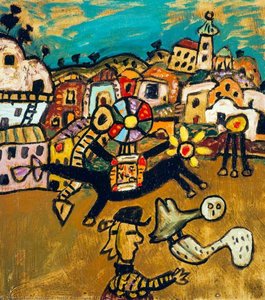 Village Witch (Opus O.1263)1994
19
 Magic Casket1997 · Scottish National Gallery of Modern Art
20
 Celtic Landscape (Dreamscape)1996 · The Pier Arts Centre
21
 Magic Landscape (Opus O.1337)1996
22
 The Alchemist's Mirror No.1 (Opus 1357)1997
23
 Cosmic Signals I2000
24
 Cosmic Signals No.72000
25
 The Golden Palace1999
26
 Magician's Mirror No.22000 · The Mercer Art Gallery
27
 Serpent's Idea of a Horse2000
28
 The Magician's Mirror No.3 (Opus 1450)2000
29
 Without Devices2004 · Pembroke College Oxford Jcr Art Collection
30
 Around and Around in the PinkGaleria Nacional do Canadá
31
 Kaleidoscope for a Parrot
32
 Prize for a Serpent
33
 Flowers on a TableThe Fleming Collection
34Prophet in a Tree, 1963Museu Fitzwilliam
35
 Double MonumentRobinson College
36
 Hallucination with Monster and Cock
Os 8 museus que detêm a maioria das pinturas desta página.
| Museu | Cidade | Obras de Alan Davie | Pinturas desta lista |
|---|---|---|---|
 The Pier Arts Centre |
Stromness | 2 | Symbols in a Landscape, Celtic Landscape (Dreamscape) |
 University of Hertfordshire |
North Hatley | 1 | Hopi Studies No.32, Opus 0.1173 |
 Scottish National Gallery of Modern Art |
Edimburgo | 1 | Magic Casket |
 The Mercer Art Gallery |
Harrogate | 1 | Magician's Mirror No.2 |
 Pembroke College Oxford Jcr Art Collection |
Oxford | 1 | Without Devices |
 Galeria Nacional do Canadá |
Ottawa | 1 | Around and Around in the Pink |
 The Fleming Collection |
London | 1 | Flowers on a Table |
 Museu Fitzwilliam |
Cambridge | 1 | Prophet in a Tree, 1963 |
Escolha uma década para ver a obra original que a define.
Woman Arranging Flowers (1945). Untitled Abstract e Self Portrait with Brushes (1937) vêm a seguir.
25 anos: Woman Arranging Flowers data de 1945, e Alan Davie nasceu em 1920.
Woman Arranging Flowers, Untitled Abstract, Self Portrait with Brushes, The Saint, Entrance to a Paradise, Jingling Space, Ram Grip, Piggy Chain, Joy Bag No. 1 e Entrance For A Red Temple No. 4. O ranking acima apresenta o ano e o museu de cada uma.
Nosso catálogo contém 36 obras de Alan Davie, datadas de 1937 a 2004.
Principalmente em The Pier Arts Centre (Stromness), University of Hertfordshire (North Hatley) e Scottish National Gallery of Modern Art (Edimburgo). A tabela de museus acima lista todos eles.
Em 1990s: 10 das 36 obras nesta página foram feitas então, sendo Hopi Studies No.32, Opus 0.1173 delas.
Nesta página, a mais antiga é Self Portrait with Brushes (1937) e a mais recente é Without Devices (2004).
Abstract expressionism, a julgar pelos originais nesta página.
Symbols in a Landscape e Celtic Landscape (Dreamscape): o The Pier Arts Centre, Stromness detém 2 das obras desta página.

