Retrato de Sol Lewitt

As 40 Pinturas Mais Famosas de Sol Lewitt, uma Seleção da Galeria

Atualizado em Outubro 2026 · classificado pela nossa pontuação de popularidade (pesquisas, visitas e pedidos de cada obra) · 42 obras de Sol Lewitt em nosso catálogo

Em resumo

De todas as obras originais deixadas por Sol Lewitt, a mais famosa é Serial Project #1 ABCD (1966), da coleção do MoMA - Museu de Arte Moderna, em Nova York. Logo atrás vêm Wall drawing #1091: arcs, circles and bands (room) (2003) e Distorted Cubes Bozuk Küpler. Nosso catálogo contém 42 obras de Sol Lewitt; a galeria preservou as 40 que o mundo mais admira, cada uma exibida com sua data, seu museu e sua história.

1928 – 2007, Hartford Minimalism Mais obras: MASS MoCA

As 10 principais pinturas de Sol Lewitt: a escolha da galeria

1
Serial Project #1 ABCD (1966) de Sol Lewitt

Serial Project #1 ABCD

1966 · Sculpture · MoMA - Museu de Arte Moderna, Nova York

A systematic arrangement of white cubes and rectangular prisms occupies a grid-like base, set against a stark black void. This geometric composition, titled Serial Project #1 ABCD, functions as an architectural exploration of structure and seriality. Rather than representing a specific building, the work investigates the permutations of simple shapes. The arrangement follows a predetermined algorithm, where the placement of each element is dictated by a logical sequence rather than…

2
Wall drawing #1091: arcs, circles and bands (room) (2003) de Sol Lewitt

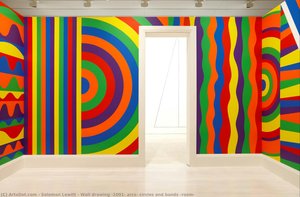
Wall drawing #1091: arcs, circles and bands (room)

2003 · Installation Art · Art Gallery of New South Wales, Sydney

To stand before Wall drawing #1091: arcs, circles and bands (room) is to witness not merely an arrangement of pigment on a surface, but the vibrant echo of artistic reinvention. This monumental piece by Solomon Lewitt captures a moment of profound resurgence in his later career. Where earlier works might have favored a more restrained palette, this drawing explodes with exuberant color—a joyous chromatic symphony applied across the architectural expanse…

3
Distorted Cubes Bozuk Küpler de Sol Lewitt

Distorted Cubes Bozuk Küpler

Painting · Borusan Contemporary, Istanbul

In the realm of conceptual mastery, few works capture the rhythmic pulse of modern abstraction as vibrantly as Sol LeWitt’s Distorted Cubes Bozuk Küpler. This captivating piece serves as a brilliant testament to the artist's ability to transform rigid mathematical precision into a dance of visual delight. At first glance, the viewer is greeted by an intricate mosaic of fourteen distinct colored squares, each meticulously arranged to create a sense…

4
Wall Drawing #391 (1983) de Sol Lewitt

Wall Drawing #391

1983 · Indian Ink · MASS MoCA, Adams

Wall Drawing #391 is an artwork by Solomon Lewitt. Created in April 1983, this two-part drawing occupies a specific space within the MASS MoCA in Adams. The work exists as a structural dialogue between two adjacent surfaces, mapping out a logic that relies on the intersection of planes and the direction of the line.

5
Wall Drawing #831 (1997) de Sol Lewitt

Wall Drawing #831

1997 · Drawing · Museu Guggenheim Bilbao, Bilbao

In the vast landscape of twentieth-century modernism, few names resonate with as much intellectual rigor as Solomon Lewitt. His Wall Drawing #831, created in 1997, serves as a breathtaking testament to the power of the idea over the hand. As a pioneer of both Minimalism and Conceptual Art, Lewitt famously posited that the concept itself is the machine that makes the art. This particular work is not merely a painting…

6
Wall Drawing #915 (1999) de Sol Lewitt

Wall Drawing #915

1999 · Installation Art · MASS MoCA, Adams

Wall Drawing #915 exists as an installation of mathematical precision. Created in 1999, the work utilizes a palette of pastels, anchored by a primary tone of steel blue. The composition relies on geometric patterns and interlocking shapes that transform architectural surfaces into active participants in the art. Through the use of arcs and circles, the piece establishes a rhythmic movement across the wall.

7
Incomplete open cube 5/6 (1974) de Sol Lewitt

Incomplete open cube 5/6

1974 · Metal · Art Gallery of New South Wales, Sydney

Incomplete Open Cube No.5-6 – A Testament to Minimalist Geometry The ‘Incomplete open cubes’ represent a pivotal moment in Sol LeWitt's artistic trajectory, encapsulating the core tenets of his conceptual approach and solidifying his position as one of the pioneers of Minimalism. Created in 1974, this sculpture—a precisely crafted aluminum structure—isn’t merely an object; it’s an embodiment of intellectual rigor distilled into a deceptively simple form. LeWitt himself famously articulated…

8
Kaldor Public Art Project 06: Sol LeWitt 1977 (1977) de Sol Lewitt

Kaldor Public Art Project 06: Sol LeWitt 1977

1977 · Drawing · Kaldor Public Art Projects, Sydney

In the quiet, transformative moment captured in this 1977 photograph, we witness more than just the documentation of a mural; we see the physical manifestation of an idea. Part of the prestigious Kaldor Public Art Project, this work by Solomon LeWitt serves as a profound testament to the power of Conceptualism. The image presents a stark, monochromatic dialogue between two observers and a monumental wall drawing that consumes the architectural…

9
Wall Drawing #146A (2000) de Sol Lewitt

Wall Drawing #146A

2000 · Crayon · MASS MoCA, Adams

In the realm of contemporary minimalism, few names resonate with as much intellectual authority as Solomon LeWitt. His work, particularly the mesmerizing Wall Drawing #14 6A, serves as a profound testament to the power of the concept over the physical object. This particular piece, captured in its striking blue crayon medium, transcends the boundaries of traditional painting to become an immersive environment. As one gazes upon the composition, the distinction…

A seleção de Sol Lewitt continua, de 11 a 40

11Pyramid (2005) de Sol LewittPyramid2005 · Art Gallery of New South Wales 12Black with White Lines, Vertical Not Touching (1970) de Sol LewittBlack with White Lines, Vertical Not Touching1970 · MoMA - Museu de Arte Moderna 13Cubo de Sol LewittCuboCAMUSAC Cassino Museum of Contemporary Art 14Vertical Lines, Not Touching (1970) de Sol LewittVertical Lines, Not Touching1970 · MoMA - Museu de Arte Moderna 15Objectivity (1962) de Sol LewittObjectivity1962 16Irregular Grid de Sol LewittIrregular GridElgiz Museum of Contemporary Art 17Wall Drawing #822 (1997) de Sol LewittWall Drawing #8221997 · MASS MoCA 18Four Color Woodcuts-Curvy Bands I-IV (1996) de Sol LewittFour Color Woodcuts-Curvy Bands I-IV1996 · Borusan Contemporary 19Kaldor Public Art Project 11: Sol LeWitt 1998 (1998) de Sol LewittKaldor Public Art Project 11: Sol LeWitt 19981998 · Kaldor Public Art Projects 20Blue Vertical (2000) de Sol LewittBlue Vertical2000 21Wal Drawing #999 (2001) de Sol LewittWal Drawing #9992001 · MASS MoCA 22Isometric Figures in Five and Six Colors (2002) de Sol LewittIsometric Figures in Five and Six Colors2002 · Borusan Contemporary 23Wall Drawing #1171 (2005) de Sol LewittWall Drawing #11712005 · MASS MoCA 24Wall Drawing #1185 (2005) de Sol LewittWall Drawing #11852005 · MASS MoCA 25brushstrokes 2 de Sol Lewittbrushstrokes 2CAMUSAC Cassino Museum of Contemporary Art 26Lincoln Center Print de Sol LewittLincoln Center PrintBorusan Contemporary 27brushstrokes de Sol LewittbrushstrokesCAMUSAC Cassino Museum of Contemporary Art 28Wall drawing #338: Two part drawing. The wall is divided vertically into two parts. Each part is divided horizontally and vertically into four equal parts. 1st part: Lines in four directions, one direction in each quarter. 2nd part: Lines in four dir.... (1971) de Sol LewittWall drawing #338: Two part drawing. The wall is divided vertically into two parts. Each part is divided horizontally and vertically into four equal parts. 1st part: Lines in four directions, one direction in each quarter. 2nd part: Lines in four dir....1971 · Art Gallery of New South Wales 29Wall Drawing #340 (1980) de Sol LewittWall Drawing #3401980 · MASS MoCA 30Untitled de Sol LewittUntitled 31Untitled from Squares with a Different Line Direction in Each Half Square (3) de Sol LewittUntitled from Squares with a Different Line Direction in Each Half Square (3) 32Untitled from Squares with a Different Line Direction in Each Half Square de Sol LewittUntitled from Squares with a Different Line Direction in Each Half Square 33Untitled from Squares with a Different Line Direction in Each Half Square (2) de Sol LewittUntitled from Squares with a Different Line Direction in Each Half Square (2) 34Wall Drawing #154, #155, #162, #163, #157, #158 de Sol LewittWall Drawing #154, #155, #162, #163, #157, #158Modern Art Oxford 35Distorted Cubes from Distorted Cubes de Sol LewittDistorted Cubes from Distorted Cubes 36Distorted Cubes from Distorted Cubes (2) de Sol LewittDistorted Cubes from Distorted Cubes (2) 37Irregular tower de Sol LewittIrregular towerCAMUSAC Cassino Museum of Contemporary Art 38Irregular tower de Sol LewittIrregular towerCAMUSAC Cassino Museum of Contemporary Art 39Irregular Arcs, Bands and Loops de Sol LewittIrregular Arcs, Bands and LoopsBorusan Contemporary 40Eight-Pointed Stars de Sol LewittEight-Pointed StarsChrysler Museum of Art

Pinturas famosas de Sol Lewitt, período por período

Os temas que cativaram o olhar de Sol Lewitt

Os quatro temas que mais se repetem nestas obras originais, cada um com o seu melhor exemplo.

Os museus que guardam os originais de Sol Lewitt

Os 8 museus que detêm a maioria das pinturas desta página.

Museus Cidade Obras de Sol Lewitt Pinturas desta lista
MASS MoCA, AdamsMASS MoCA Adams 9 Wall Drawing #391, Wall Drawing #915, Wall Drawing #146A
Borusan Contemporary, IstanbulBorusan Contemporary Istanbul 5 Distorted Cubes Bozuk Küpler, Four Color Woodcuts-Curvy Bands I-IV, Isometric Figures in Five and Six Colors
CAMUSAC Cassino Museum of Contemporary Art, CassinoCAMUSAC Cassino Museum of Contemporary Art Cassino 5 Cubo, brushstrokes 2, brushstrokes
Art Gallery of New South Wales, SydneyArt Gallery of New South Wales Sydney 4 Wall drawing #1091: arcs, circles and bands (room), Incomplete open cube 5/6, Pyramid
MoMA - Museu de Arte Moderna, Nova YorkMoMA - Museu de Arte Moderna Nova York 3 Serial Project #1 ABCD, Black with White Lines, Vertical Not Touching, Vertical Lines, Not Touching
Kaldor Public Art Projects, SydneyKaldor Public Art Projects Sydney 2 Kaldor Public Art Project 06: Sol LeWitt 1977, Kaldor Public Art Project 11: Sol LeWitt 1998
Museu Guggenheim Bilbao, BilbaoMuseu Guggenheim Bilbao Bilbao 1 Wall Drawing #831
Elgiz Museum of Contemporary Art, İstanbulElgiz Museum of Contemporary Art İstanbul 1 Irregular Grid

Sol Lewitt década a década: a obra original que define cada uma

Obras por década

Escolha uma década para ver a obra original que a define.

Perguntas de colecionadores sobre as pinturas de Sol Lewitt

Por qual obra Sol Lewitt é mais conhecido(a)?Revelar a resposta

Serial Project #1 ABCD (1966), MoMA - Museu de Arte Moderna, Nova York. Wall drawing #1091: arcs, circles and bands (room) (2003) e Distorted Cubes Bozuk Küpler vêm a seguir.

Qual era a idade de Sol Lewitt quando Serial Project #1 ABCD foi feita?Revelar a resposta

38 anos: Serial Project #1 ABCD data de 1966, e Sol Lewitt nasceu em 1928.

Quais são as dez pinturas mais famosas de Sol Lewitt?Revelar a resposta

Serial Project #1 ABCD, Wall drawing #1091: arcs, circles and bands (room), Distorted Cubes Bozuk Küpler, Wall Drawing #391, Wall Drawing #831, Wall Drawing #915, Incomplete open cube 5/6, Kaldor Public Art Project 06: Sol LeWitt 1977, Wall Drawing #146A e Wall Drawing #793B Certificate. O ranking acima apresenta o ano e o museu de cada uma.

Quantas pinturas Sol Lewitt deixou?Revelar a resposta

Nosso catálogo contém 42 obras de Sol Lewitt, datadas de 1962 a 2005.

Em quais museus estão expostas as obras-primas de Sol Lewitt?Revelar a resposta

Principalmente em MASS MoCA (Adams), Borusan Contemporary (Istanbul) e CAMUSAC Cassino Museum of Contemporary Art (Cassino). A tabela de museus acima lista todos eles.

Em que anos Sol Lewitt pintou as suas obras mais famosas?Revelar a resposta

Em 2000s: 8 das 40 obras nesta página foram feitas então, sendo Wall drawing #1091: arcs, circles and bands (room) delas.

Quais são as primeiras e as últimas obras originais famosas de Sol Lewitt?Revelar a resposta

Nesta página, a mais antiga é Objectivity (1962) e a mais recente é Pyramid (2005).

Quais temas Sol Lewitt escolheu com mais frequência?Revelar a resposta

Geometric abstraction (8), Conceptual art (7) e Wall drawing (5), entre as 40 obras nesta página.

Qual técnica Sol Lewitt mais utilizou?Revelar a resposta

Sculpture, para 2 das 40 obras nesta página.

A qual movimento artístico pertence Sol Lewitt?Revelar a resposta

Minimalism, a julgar pelos originais nesta página.

Quais obras de Sol Lewitt estão expostas no MASS MoCA?Revelar a resposta

Wall Drawing #391, Wall Drawing #915 e Wall Drawing #146A: o MASS MoCA, Adams detém 9 das obras desta página.

Sol Lewitt: vida e obra

O Arquiteto de Ideias: A Vida e o Legado de Sol LeWitt

Na vasta paisagem do modernismo do século XX, poucas figuras projetam uma sombra tão longa ou intelectualmente profunda quanto Solomon LeWitt. Nascido em 9 de setembro de 1928, em Hartford, Connecticut, em uma família de imigrantes judeus da Rússia, a jornada de LeWitt foi definida pela busca do pensamento puro em detrimento da mera execução física. Seus primeiros anos foram moldados por uma rigorosa curiosidade analítica, um traço nutrido por seus estudos na Universidade de Syracuse entre 1945 e 1949. Esta base acadêmica em matemática e geometria tornaria-se, mais tarde, o próprio pulsar de sua linguagem artística, permitindo-lhe despojar a arte tradicional de seus excessos decorativos para revelar a beleza esquelética da lógica e da estrutura.

A evolução de LeWitt como artista não foi uma ruptura súbita, mas uma migração deliberada do tangível para o conceitual. Embora suas explorações iniciais envolvessem a natureza tátil da pintura e do desenho, ele logo se viu cada vez mais atraído pela ideia por trás do traço, em vez do próprio traço. Essa mudança marcou o nascimento de um pioneiro que uniria a lacuna entre o Minimalismo e a Arte Conceitual. Ele passou a ver o artista não como um artesão limitado pela mão, mas como um arquiteto de instruções. Ao priorizar o projeto mental sobre o objeto acabado, LeWitt desafiou a própria definição de autoria, sugerindo que, uma vez concebida uma ideia, sua manifestação física é apenas uma consequência secundária.

A Revolução dos Desenhos de Parede

O final da década de 1960 testemunhou uma das transformações mais radicais na arte contemporânea com o surgimento dos icônções desenhos de parede de LeWitt. Rejeitando a permanência e o preciosismo da escultura tradicional, ele introduziu as "estruturas" — um termo que preferia a "esculturas" para enfatizar sua essência matemática — e uma série de instruções que poderiam ser executadas por qualquer pessoa treinada para segui-las. Estas obras não eram meras decorações, mas experiências vividas, frequentemente compostas por padrões geométricos precisos, arcos e formas interconectadas que sopravam vida nos espaços arquitetônicos que habitavam.

Presenciar um desenho de parede de LeWitt é ver a lógica transformada em poesia. Fosse a repetição austera e rítmica encontrada em Black with White Lines, Vertical Not Touching ou a energia vibrante e exuberante de Wall Drawing #1091: arcs, circles and bands, seu trabalho utilizava o poder da linha para comandar o espaço. Estas peças frequentemente dependiam de um sistema de instruções lógicas, muitas vezes matemáticas, que guiavam assistentes ou instaladores de museus em sua produção. Este método democratizou o ato da criação e, simultaneamente, elevou a importância do conceito, garantindo que a obra de arte existisse fundamentalmente como uma centelha intelectual antes mesmo de tocar uma parede.

Uma Impressão Duradoura na Modernidade

Ao longo de sua carreira prolífica, que abrangeu décadas e incluiu o domínio da gravura, fotografia e instalação, LeWitt permaneceu inabalável em seu compromisso com a clareza e a precisão. Sua habilidade de encontrar uma beleza profunda nas formas mais simples — como a impactante Pirâmide branca ou os ritmos complexos e coloridos de seus trabalhos de parede feitos com giz de cera — redefiniu as fronteiras estéticas do final do século XX. Ele provou que a arte poderia ser despojada de seu ego e de seu ornamento, mas ainda assim reter uma alma que ressoa profundamente com o desejo humano por ordem e descoberta.

A importância histórica de Sol LeWitt não pode ser subestimada. Ele forneceu o vocabulário para que gerações de artistas explorassem as fronteiras entre o pensamento e a matéria. Seu legado vive em cada museu e galeria onde a linha entre o criador e o executor se torna tênue, e onde a força de uma ideia é reconhecida como o meio supremo. Ao olharmos para trás em sua vida, desde seus começos em Hartford até seus dias finais na cidade de Nova York em 2007, vemos um homem que não apenas fez arte, mas que nos ensinou a enxergar a profunda arquitetura do próprio pensamento.