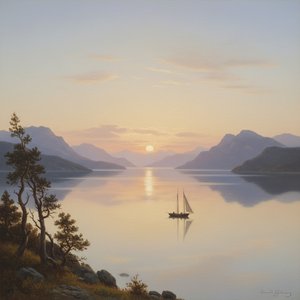
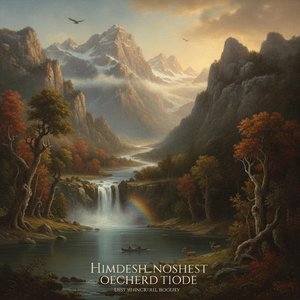
Early Life and Artistic Beginnings
Sanford Robinson Gifford, a name synonymous with the serene beauty of American landscapes, was born on July 10, 1823, in Greenfield, New York – a small town nestled amidst the rolling hills of Saratoga County. His early life unfolded within the familiar embrace of Hudson, his childhood spent immersed in the natural splendor of the Catskill Mountains. This formative environment would profoundly shape his artistic vision, instilling a deep reverence for the region’s delicate light and atmospheric nuances. Initially guided by John Rubens Smith, a distinguished British watercolorist and drawing master, Gifford embarked on his artistic journey, honing his skills in perspective, anatomy, and the fundamental techniques of draughtsmanship. He further refined his craft at the National Academy of Design in New York City, absorbing the teachings of established artists and developing his own distinctive style.The Luminism Style and European Influences
Gifford’s artistic trajectory took a decisive turn when he embraced the burgeoning movement known as Luminism – a subgenre of the Hudson River School characterized by its emphasis on capturing the subtle effects of light and atmosphere. Unlike many of his contemporaries who favored dramatic, heroic landscapes, Gifford sought to depict nature in its most delicate and ephemeral states. His paintings are imbued with a sense of quiet contemplation, inviting viewers to lose themselves in the tranquil beauty of the natural world. Crucially, Gifford’s artistic development was significantly influenced by his extensive travels throughout Europe between 1855 and 1857. He immersed himself in the art of masters such as J.M.W. Turner, absorbing their innovative techniques for rendering light and color. His journey also exposed him to the Barbizon School painters in France, whose loose brushwork and focus on capturing the essence of nature resonated deeply with his own artistic sensibilities.Notable Works and Artistic Achievements
Throughout his prolific career, Gifford produced a remarkable body of work that continues to captivate audiences today. Among his most celebrated paintings are *Tivoli* (1868), now housed in the Metropolitan Museum of Art, and *Mount Mansfield* (1858), which was exhibited at the National Academy of Design. These works exemplify Gifford’s mastery of light, color, and composition, showcasing his ability to evoke a profound sense of peace and serenity. His paintings frequently depict scenes from the Catskill Mountains, the Adirondack wilderness, and the Rocky Mountains – landscapes that held a particular fascination for him. He also undertook an expedition to Wyoming in 1870 as part of F.V. Hayden’s geological survey, capturing the rugged beauty of the American West. Gifford's dedication to his craft resulted in over 700 paintings documented in a catalog published posthumously, a testament to his extraordinary productivity and artistic vision.Legacy and Historical Significance
Sanford Robinson Gifford’s contributions to American landscape painting are undeniable. He stands as a pivotal figure within the Hudson River School, representing a shift towards a more subtle and contemplative approach to depicting nature. His Luminist style—characterized by its delicate light, atmospheric effects, and understated beauty—has had a lasting influence on generations of artists. Gifford’s work is now recognized for its emotional resonance and technical brilliance, and it continues to be exhibited in prestigious museums around the world. His legacy endures as a reminder of the power of art to capture the sublime beauty of the natural world and evoke a sense of wonder within the human spirit.Perguntas e Respostas
Onde posso ver as obras de Sanford Robinson Gifford em ordem cronológica?
Existe uma linha do tempo das obras de Sanford Robinson Gifford: a página Linha do tempo das obras do artista organiza as obras por data de criação.
De onde é Sanford Robinson Gifford?
Sanford Robinson Gifford nasceu em Estados Unidos da América.
A qual período histórico pertence a obra de Sanford Robinson Gifford?
Sanford Robinson Gifford atuou no período Século XIX. Este período situa a atividade do artista na história.