Retrato de Richard Brakenburgh

As 45 Pinturas Mais Famosas de Richard Brakenburgh, uma Seleção da Galeria

Atualizado em Novembro 2026 · classificado pela nossa pontuação de popularidade (pesquisas, visitas e pedidos de cada obra) · 46 obras de Richard Brakenburgh em nosso catálogo

Em resumo

De todas as obras originais deixadas por Richard Brakenburgh, a mais famosa é Tavern Scene (1692), da coleção do Nationalmuseum, em Estocolmo. Logo atrás vêm Tavern interior with dancing peasants, (1690) e Interior with a company celebrating Twelfth Night, the Feast of Epiphany (1690). Nosso catálogo contém 46 obras de Richard Brakenburgh; a galeria preservou as 45 que o mundo mais admira, cada uma exibida com sua data, seu museu e sua história.

1650 – 1702, Haarlem Dutch golden age Mais obras: Bavarian State Painting Collections

As 10 principais pinturas de Richard Brakenburgh: a escolha da galeria

1
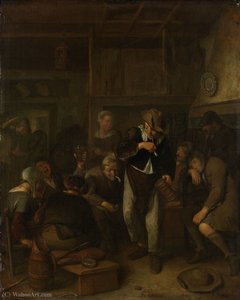
Tavern Scene (1692) de Richard Brakenburgh

Tavern Scene

1692 · Oil On Canvas · Nationalmuseum, Estocolmo

A single light source, perhaps a guttering candle, strikes the scene from the left. It catches the white fabric of a woman’s garment in the foreground, turning her into a bright anchor amidst a sea of ochre and deep brown. Around her, the tavern breathes with a heavy, crowded energy. Figures lean into one another, their postures shaped by the weight of conversation and the pull of drink. The air…

2
Tavern interior with dancing peasants, (1690) de Richard Brakenburgh

Tavern interior with dancing peasants,

1690 · Oil On Canvas · Kunsthistorisches Museum, Viena

Step into the warmth of this 1690 tavern scene, where the air seems thick with the scent of spilled ale and the sound of rhythmic footsteps. Richard Brakenburgh has captured a fleeting moment of celebration among the peasantry, drawing us into a crowded, lively interior. The composition pulls the viewer through a deep perspective, moving from the immediate, tactile details of the foreground into a shadowy, bustling crowd that recedes…

3
Interior with a company celebrating Twelfth Night, the Feast of Epiphany (1690) de Richard Brakenburgh

Interior with a company celebrating Twelfth Night, the Feast of Epiphany

1690 · Oil On Canvas · Kunsthistorisches Museum, Viena

In this work, titled Interior with a company celebrating Twelfth Night, the Feast of Epiphany, we find ourselves observing a quiet moment of communal gathering. Painted by Richard Brakenburgh in 1690, the scene captures a specific social ritual. It is a fine example of genre art, focusing on the everyday interactions and festivities of the period. The subject matter centers on a group of people gathered for the Twelfth Night…

4
Réunion dans un cabaret de Richard Brakenburgh

Réunion dans un cabaret

Oil On Canvas

The air inside the cabaret feels thick, heavy with the scent of spilled ale and the warmth of too many bodies gathered in a single room. Light flickers from candles, casting long, dancing shadows that stretch across the floor and climb the walls. In the center of this swirling chaos, a group of figures moves in a rhythmic dance, their forms blurring slightly as they spin. Around them, the tavern…

5
Merry Company (1676) de Richard Brakenburgh

Merry Company

1676 · Oil · Bavarian State Painting Collections, Munique

Richard Brakenburgh's Merry Company captures a lively social gathering, likely situated within a tavern or a domestic setting. The scene focuses on a group of people engaged in conversation and leisure, embodying the 'Merry Company' theme prevalent in Dutch Golden Age painting. This subject matter reflects the communal spirit and social interactions of the seventeenth century.

6
The Resurrection of Christ and the Visit of the Women to the Tomb (1676) de Richard Brakenburgh

The Resurrection of Christ and the Visit of the Women to the Tomb

1676 · Oil · Bavarian State Painting Collections, Munique

In The Resurrection of Christ and the Visit of the Women to the Tomb, Richard Brakenburgh orchestrates a scene of intense, sudden movement. The composition follows a dynamic pyramidal structure that draws the eye upward toward a burst of light in the upper center. From this celestial radiance, a luminous, winged angelic figure descends, gesturing toward the earthly events unfolding below. The perspective is set slightly from below, which lends…

8
Monk's Entertainment in a Roman Cloister (1680) de Richard Brakenburgh

Monk's Entertainment in a Roman Cloister

1680 · Oil On Canvas · Slovak National Gallery, Bratislava

In Monk's Entertainment in a Roman Cloister, Richard Brakenburgh employs a sophisticated chiaroscuro technique to define the cavernous interior. A single, unseen light source from the left casts strong highlights onto faces and hands, allowing them to emerge from deep, atmospheric shadows. This dramatic interplay of light and dark creates a sense of depth and bustling activity within the crowded space. Through precise perspective, the artist organizes the overlapping clusters…

9
Portrait of a young woman (1683) de Richard Brakenburgh

Portrait of a young woman

1683 · Oil

In "Portrait of a young woman" by Richard Brakenburgh, the subject is captured in a three-quarter length pose. She sits centrally, anchored against a dark and atmospheric background that recedes into shadow. The color palette relies on deep blacks and browns, creating a somber foundation for the figure. This darkness pushes the subject forward, making her presence feel immediate and singular.

10
merry party (1686) de Richard Brakenburgh

merry party

1686 · Oil · Museum Gouda, Gouda

The air in the room feels heavy with the scent of spilled ale and uninhibited laughter. A dense crowd of figures presses together in a crowded interior, their bodies caught in a moment of boisterous social indulgence. To the right, a large, heavy curtain hangs in deep folds, framing the scene like a stage set for a play that has already reached its climax. Light spills from the upper left,…

A seleção de Richard Brakenburgh continua, de 11 a 45

11A Game of Cards at an Inn (1683) de Richard BrakenburghA Game of Cards at an Inn1683 · Statens Museum For Kunst 12Tavern Interior with a Maidservant and Drinkers (1680) de Richard BrakenburghTavern Interior with a Maidservant and Drinkers1680 · Hallwyl Museum 13Adoration of the Shepherds (1694) de Richard BrakenburghAdoration of the Shepherds1694 · Bavarian State Painting Collections 14An Interior with Figures (1689) de Richard BrakenburghAn Interior with Figures1689 · National Gallery of Ireland 15The Eve of Saint Nicholas (1690) de Richard BrakenburghThe Eve of Saint Nicholas1690 · Museu Frans Hals 16Dance in a Cottage (1699) de Richard BrakenburghDance in a Cottage1699 · Nationalmuseum 17merry party (1691) de Richard Brakenburghmerry party1691 · Museu Frans Hals 18A family on a terrace. (1691) de Richard BrakenburghA family on a terrace.1691 19The Feast of St. Nicholas (1698) de Richard BrakenburghThe Feast of St. Nicholas1698 20Family Scene (1680) de Richard BrakenburghFamily Scene1680 · Museu Fitzwilliam 21May Queen Festival (1700) de Richard BrakenburghMay Queen Festival1700 · Szépművészeti Múzeum 22Dutch Merchants Trading in a Chinese Harbor (1683) de Richard BrakenburghDutch Merchants Trading in a Chinese Harbor1683 · Groninger Museum 23Celebration of a Birth (1683) de Richard BrakenburghCelebration of a Birth1683 24Interior of a Farmhouse (1699) de Richard BrakenburghInterior of a Farmhouse1699 · Museu Fitzwilliam 25Intérieur d'auberge de Richard BrakenburghIntérieur d'aubergeMuseu do Louvre 26Cabaret Interior de Richard BrakenburghCabaret InteriorPetit Palais 27Jolly Company de Richard BrakenburghJolly CompanyRoyal Museum of Fine Arts Antwerp 28Figural scene against architecture de Richard BrakenburghFigural scene against architectureMuseu Nacional de Varsóvia 29INTERIEUR D'UN ESTAMINET de Richard BrakenburghINTERIEUR D'UN ESTAMINET 30SCENE GALANTE de Richard BrakenburghSCENE GALANTE 31LE LEVER DE LA MARIEE de Richard BrakenburghLE LEVER DE LA MARIEE 32Feast of St Nicholas de Richard BrakenburghFeast of St NicholasSzépművészeti Múzeum 33Family Portrait (1670) de Richard BrakenburghFamily Portrait1670 · Art Museum Riga Bourse 34St Nicholas Eve (1685) de Richard BrakenburghSt Nicholas Eve1685 · Amstelkring Museum 35The doctor's visit. de Richard BrakenburghThe doctor's visit.Museum Boijmans Van Beuningen 36Moines et religieuses en goguette de Richard BrakenburghMoines et religieuses en goguette 37In the tavern. de Richard BrakenburghIn the tavern. 38Family Having Breakfast de Richard BrakenburghFamily Having Breakfast 39Merry company. de Richard BrakenburghMerry company.Museum Boijmans Van Beuningen 40Gallant scene at Palais des Beaux-Arts de Lille. de Richard BrakenburghGallant scene at Palais des Beaux-Arts de Lille. 41Celebration of a Birth de Richard BrakenburghCelebration of a BirthDulwich Picture Gallery 42Merry company de Richard BrakenburghMerry companySzépművészeti Múzeum 43The Feast of St. Nicholas de Richard BrakenburghThe Feast of St. NicholasRijksmuseum 44A Medical Practitioner Taking a Girl's Pulse and Holding a Flask of Her Urine de Richard BrakenburghA Medical Practitioner Taking a Girl's Pulse and Holding a Flask of Her Urine 45Peasant's inn de Richard BrakenburghPeasant's innRijksmuseum

Os temas que cativaram o olhar de Richard Brakenburgh

Os quatro temas que mais se repetem nestas obras originais, cada um com o seu melhor exemplo.

Os museus que guardam os originais de Richard Brakenburgh

Os 8 museus que detêm a maioria das pinturas desta página.

Museus Cidade Obras de Richard Brakenburgh Pinturas desta lista
Bavarian State Painting Collections, MuniqueBavarian State Painting Collections Munique 3 Merry Company, The Resurrection of Christ and the Visit of the Women to the Tomb, Adoration of the Shepherds
Szépművészeti Múzeum, BudapesteSzépművészeti Múzeum Budapeste 3 May Queen Festival, Feast of St Nicholas, Merry company
Nationalmuseum, EstocolmoNationalmuseum Estocolmo 2 Tavern Scene, Dance in a Cottage
Kunsthistorisches Museum, VienaKunsthistorisches Museum Viena 2 Tavern interior with dancing peasants,, Interior with a company celebrating Twelfth Night, the Feast of Epiphany
Museu Frans Hals, HarenMuseu Frans Hals Haren 2 The Eve of Saint Nicholas, merry party
Museu Fitzwilliam, CambridgeMuseu Fitzwilliam Cambridge 2 Family Scene, Interior of a Farmhouse
Museum Boijmans Van Beuningen, RoterdãMuseum Boijmans Van Beuningen Roterdã 2 The doctor's visit., Merry company.
Rijksmuseum, AmsterdãRijksmuseum Amsterdã 2 The Feast of St. Nicholas, Peasant's inn

Richard Brakenburgh década a década: a obra original que define cada uma

Obras por década

Escolha uma década para ver a obra original que a define.

Perguntas de colecionadores sobre as pinturas de Richard Brakenburgh

Por qual obra Richard Brakenburgh é mais conhecido(a)?Revelar a resposta

Tavern Scene (1692), Nationalmuseum, Estocolmo. Tavern interior with dancing peasants, (1690) e Interior with a company celebrating Twelfth Night, the Feast of Epiphany (1690) vêm a seguir.

Qual era a idade de Richard Brakenburgh quando Tavern Scene foi feita?Revelar a resposta

42 anos: Tavern Scene data de 1692, e Richard Brakenburgh nasceu em 1650.

Quais são as dez pinturas mais famosas de Richard Brakenburgh?Revelar a resposta

Tavern Scene, Tavern interior with dancing peasants,, Interior with a company celebrating Twelfth Night, the Feast of Epiphany, Réunion dans un cabaret, Merry Company, The Resurrection of Christ and the Visit of the Women to the Tomb, Drinkers and Musicians in a Cabaret, with Child with a Hoop, Monk's Entertainment in a Roman Cloister, Portrait of a young woman e merry party. O ranking acima apresenta o ano e o museu de cada uma.

Quantas pinturas Richard Brakenburgh deixou?Revelar a resposta

Nosso catálogo contém 46 obras de Richard Brakenburgh, datadas de 1670 a 1700.

Em quais museus estão expostas as obras-primas de Richard Brakenburgh?Revelar a resposta

Principalmente em Bavarian State Painting Collections (Munique), Szépművészeti Múzeum (Budapeste) e Nationalmuseum (Estocolmo). A tabela de museus acima lista todos eles.

Em que anos Richard Brakenburgh pintou as suas obras mais famosas?Revelar a resposta

Em 1680s: 10 das 45 obras nesta página foram feitas então, sendo Monk's Entertainment in a Roman Cloister delas.

Quais são as primeiras e as últimas obras originais famosas de Richard Brakenburgh?Revelar a resposta

Nesta página, a mais antiga é Family Portrait (1670) e a mais recente é May Queen Festival (1700).

Quais temas Richard Brakenburgh escolheu com mais frequência?Revelar a resposta

People (19), Figures (10) e Table (9), entre as 45 obras nesta página.

Qual técnica Richard Brakenburgh mais utilizou?Revelar a resposta

Oil On Canvas, para 12 das 45 obras nesta página.

A qual movimento artístico pertence Richard Brakenburgh?Revelar a resposta

Dutch golden age, a julgar pelos originais nesta página.

Quais obras de Richard Brakenburgh estão expostas no Bavarian State Painting Collections?Revelar a resposta

Merry Company, The Resurrection of Christ and the Visit of the Women to the Tomb e Adoration of the Shepherds: o Bavarian State Painting Collections, Munique detém 3 das obras desta página.

Richard Brakenburgh: vida e obra

Uma Vida Capturada na Era de Ouro

Nascido na histórica cidade de Haarlem, nos Países Baixos, Richard Brakenburgh emergiu como uma figura notável dentro da vibrante tapeçaria da Era de Ouro Holandesa. Sua vida e seu fazer artístico estavam profundamente enraizados no solo cultural de Haarlem, onde desenvolveu uma sensibilidade única para capturar os momentos íntimos, e muitas vezes barulhentos, da vida no século XVII. Enquanto alguns relatos históricos sugerem que ele possuía a alma de um poeta descontraído, seu verdadeiro legado reside nas pinceladas que deram vida ao pulsar social de sua era. Sua jornada pelo mundo da arte foi marcada por uma conexão profunda com as tradições locais de sua terra natal, e sua presença em Leeuwarden durante as últimas décadas do século XVII sugere uma mobilidade que permitiu que sua influência alcançasse horizontes além de seu local de nascimento.

Linhagem Artística e Influências

O desenvolvimento do estilo de Richard Brakenburgh foi moldado pelos mestres que o precederam e o acompanharam em sua jornada criativa. Ele é reconhecido como um pupilo de Hendrik Mommers, um instrutor cuja habilidade em pintar cenas de gênero astutas forneceu o plano fundamental para as próprias explorações de Richard Brakenburgh sobre a interação humana. No entanto, as sombras de mestres ainda maiores pairavam sobre sua obra; a influência de Jan Steen foi profunda, guiando-o em direção à criação de composições complexas e movidas pela narrativa. Existe também um diálogo estilístico significativo entre Richard Brakenburgh e Bernard Schendel, uma vez que ambos os artistas compartilhavam uma era e uma abordagem semelhantes em relação aos seus temas. Grande parte de sua estética pode ser rastreada até a tradição de Adriaen van Ostade, particularmente em sua capacidade de retratar celebrações festivas e assembleias animadas com um senso de energia espontânea.

Maestria de Gênero e Técnica

A obra de Richard Brakenburgh é celebrada pela sua capacidade de transformar cenas cotidianas em janelas extraordinárias para o passado. Ele especializou-se em pinturas de gênero que capturavam a convivialidade da vida nas tavernas, onde o tilintar de copos e o murmúrio das conversas parecem quase audíveis através da tela. Sua destreza técnica é evidente no uso do chiaroscuro, empregando um jogo dramático de luz e sombra para esculpir figuras e imbuir seus interiores com um sentido de mistério acolhedor. Seja retratando uma estalagem movimentada ou uma celebração festiva sazonal, suas composições são caracterizadas por:

  • Perspectiva Precisa: Uma habilidade notável de utilizar a perspectiva linear para criar profundidade dentro de espaços lotados e mal iluminados.
  • Detalhe Luminoso: A aplicação magistral da luz para capturar as bordas de vidrarias, as texturas de roupas rústicas e as superfícies desgastadas de móveis de madeira.
  • Profundidade Narrativa: Um arranjo ingênuo de figuras que conduz o olhar do espectador através de uma cena harmoniosa, porém energética.

Legado e Significado Histórico

Embora sua obra seja frequentemente notada por sua fluidez e acabamento primoroso, o verdadeiro significado de Richard Brakenburgh reside em seu papel como um cronista do tecido social holandês. Suas pinturas servem como instantâneos perenes de uma era próspera, capturando tanto a dignidade dos retratos de família quanto a alegria desenfreada dos festivais comunitários. Seu sucesso foi de tal magnitude que proporcionou estabilidade para sua família, garantindo que sua viúva pudesse manter uma anuidade em Frísia após seu falecimento. Hoje, suas contribuições para a Era de Ouro Holandesa permanecem vitais, oferecendo aos espectadores modernos uma experiência imersiva em um mundo onde as fronteiras entre o passado histórico e o momento presente se dissolvem de forma magnífica.