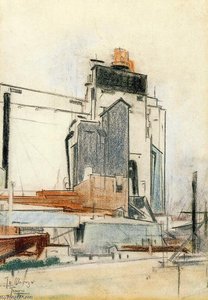
Retrato de Preston Dickinson

As 35 Pinturas Mais Famosas de Preston Dickinson, Cada Uma Única

Atualizado em Novembro 2026 · classificado pela nossa pontuação de popularidade (pesquisas, visitas e pedidos de cada obra) · 37 obras de Preston Dickinson em nosso catálogo

Em resumo

The World I Live In (1920) é a pintura de Preston Dickinson que mais atrai olhares. Depois disso, o olhar recai sobre Still Life in Interior (1920) e Still Life (1924). Entre as 37 obras de Preston Dickinson em nosso catálogo, estas 35 são as mais famosas, cada uma uma original única apresentada com o seu ano, o seu museu e a razão pela qual perdura.

1889 – 1930, New York City Precisionism Mais obras: Smithsonian American Art Museum

As 10 principais pinturas de Preston Dickinson, sob o olhar da galeria

1
The World I Live In (1920) de Preston Dickinson

The World I Live In

1920 · Oil On Canvas

A white house with red trim anchors the scene, its geometric lines cutting through a soft, diffused light. It sits under a pale sky, framed by the dark, stylized branches of a tree that reaches from the left. The structure is a collection of sharp angles and clean planes, a study in the stability of domestic life. Two figures linger near the front door, their presence small against the architectural…

2
Still Life in Interior (1920) de Preston Dickinson

Still Life in Interior

1920 · Oil On Canvas · Art Institute of Chicago, Chicago

In this composition, we find ourselves observing a quiet, domestic scene that has been dismantled and reassembled through a modern lens. The work presents a collection of everyday objects—a sake bottle, a tea canister adorned with Japanese figures, a cup and saucer, and various pieces of fruit like lemons—all arranged within an interior that feels both intimate and structurally complex. Rather than a traditional, singular viewpoint, the perspective is exaggerated…

3
Still Life (1924) de Preston Dickinson

Still Life

1924 · Oil On Paper · Metropolitan Museum of Art, Nova York

This 1924 oil painting on paper, mounted on composition board, presents a monochromatic arrangement of fragmented shapes. The composition is dense, utilizing a grayscale palette that ranges from deep blacks to bright whites. Sharp angles, overlapping planes, and curved segments create a rhythmic movement across the surface. Lines function as both structural boundaries for the shapes and as expressive elements that guide the eye through the fractured space. The perspective…

4
Vase of Flowers (1926) de Preston Dickinson

Vase of Flowers

1926 · Oil On Canvas · Metropolitan Museum of Art, Nova York

The composition is vertically oriented, centered on a tall, translucent blue glass vase. Inside the vessel, several lilies and long green leaves extend upward. The vase rests upon a wooden table that occupies the foreground. To the left, a heavy blue drapery with a white vertical stripe creates a structural border for the scene. The tabletop is tilted at a sharp angle, creating a sense of geometric tension against the…

6
Untitled Landscape (1918) de Preston Dickinson

Untitled Landscape

1918 · Smithsonian American Art Museum, Washington, D.C.

The Untitled Landscape painting by William Preston Dickinson is a stunning example of American modern art, created in 1918. This oil on canvas piece measures 36 x 50 cm and is currently housed at the Hirshhorn Museum and Sculpture Garden in the United States. Artist Background William Preston Dickinson was an American artist known for his contributions to the Precisionist style, which emphasized industrial subjects. His work often featured geometric…

Pinturas famosas de Preston Dickinson, números 11 a 35

Pinturas famosas de Preston Dickinson, período por período

Os temas que cativaram o olhar de Preston Dickinson

Os quatro temas que mais se repetem nestas obras originais, cada um com o seu melhor exemplo.

Os museus que guardam os originais de Preston Dickinson

Os 7 museus que detêm a maioria das pinturas desta página.

Museus Cidade Obras de Preston Dickinson Pinturas desta lista
Smithsonian American Art Museum, Washington, D.C.Smithsonian American Art Museum Washington, D.C. 5 Untitled Landscape, The Hills, Houses and Landscape
Metropolitan Museum of Art, Nova YorkMetropolitan Museum of Art Nova York 3 Still Life, Vase of Flowers, Interior
Columbus Museum of Art, ColumbusColumbus Museum of Art Columbus 2 Factory, Outskirts of the City
The Phillips Collection, Washington, D.C.The Phillips Collection Washington, D.C. 2 Street in Quebec, Winter, Harlem River
Art Institute of Chicago, ChicagoArt Institute of Chicago Chicago 1 Still Life in Interior
Cleveland Museum of Art, ClevelandCleveland Museum of Art Cleveland 1 Still Life
Museu de Belas Artes de Boston, BostonMuseu de Belas Artes de Boston Boston 1 Quebec

Preston Dickinson ao longo das décadas: uma obra original única para cada uma

Obras por década

Escolha uma década para ver a obra original que a define.

Pinturas de Preston Dickinson: perguntas para a galeria

Qual é a obra mais famosa de Preston Dickinson?Revelar a resposta

The World I Live In (1920). Still Life in Interior (1920) e Still Life (1924) vêm a seguir.

Com que idade Preston Dickinson criou The World I Live In?Revelar a resposta

31 anos: The World I Live In data de 1920, e Preston Dickinson nasceu em 1889.

Quais são as dez pinturas mais famosas de Preston Dickinson?Revelar a resposta

The World I Live In, Still Life in Interior, Still Life, Vase of Flowers, Tower of Gold, Untitled Landscape, Harlem River, Still LIfe with Pipe and Letters, Harlem River Bridge e Village by the Sea. O ranking acima apresenta o ano e o museu de cada uma.

Quantas obras de Preston Dickinson são conhecidas?Revelar a resposta

Nosso catálogo contém 37 obras de Preston Dickinson, datadas de 1915 a 1930.

Onde se pode ver os originais mais famosos de Preston Dickinson?Revelar a resposta

Principalmente em Smithsonian American Art Museum (Washington, D.C.), Metropolitan Museum of Art (Nova York) e Columbus Museum of Art (Columbus). A tabela de museus acima lista todos eles.

Em que período Preston Dickinson criou as suas pinturas mais conhecidas?Revelar a resposta

Em 1920s: 21 das 35 obras nesta página foram feitas então, sendo The World I Live In delas.

Qual pintura famosa de Preston Dickinson é a mais antiga e qual é a mais recente?Revelar a resposta

Nesta página, a mais antiga é Tower of Gold (1915) e a mais recente é The Siphon (1930).

Quais temas Preston Dickinson preferia?Revelar a resposta

Life (4), Flowers (3) e American landscape (2), entre as 35 obras nesta página.

Com quais materiais Preston Dickinson mais pintou?Revelar a resposta

Oil On Canvas, para 3 das 35 obras nesta página.

A qual movimento pertence a obra de Preston Dickinson?Revelar a resposta

Precisionism, a julgar pelos originais nesta página.

Quais originais de Preston Dickinson posso ver no Smithsonian American Art Museum?Revelar a resposta

Untitled Landscape, The Hills e Houses and Landscape: o Smithsonian American Art Museum, Washington, D.C. detém 5 das obras desta página.

Preston Dickinson: um retrato do artista

The Industrial Visionary: The Life and Legacy of William Preston Dickinson

In the grand tapestry of American Modernism, few threads are as intricately woven yet as tragically short-lived as those left by William Preston Dickinson. Born in New York City in 1889, Dickinson emerged from a working-class background, shaped by the early loss of his father and the quiet resilience of a family that moved to Suffern, New York. His journey into the heart of the avant-garde was fueled by an innate talent and the generous patronage of figures like Henry Barbey, which allowed him to traverse the artistic epicenters of the early twentieth century. From the rigorous training at the Art Students League under William Merritt Chase to the transformative years spent in Paris studying at the Académie Julian, Dickinson’s eye was constantly being refined by the shifting currents of European modernism.

Dickinson's artistic evolution was a sophisticated dance between tradition and the radical new languages of his time. While his early training provided a foundation in classical technique, his exposure to Cubism and Futurism in Europe fundamentally altered his perception of form and motion. He did not merely observe the world; he reconstructed it through a lens of geometric precision. This stylistic maturation eventually led him to become a pivotal figure in the Precisionist movement. His work began to capture the rhythmic, structural beauty of the industrial age—a period defined by steel, steam, and the monumental scale of human engineering. Through his brush, the grit of factories and the stark lines of granaries were elevated to the status of high art, imbued with a sense of order and architectural majesty.

A Journey Through Landscapes and Industry

The breadth of Dickinson's oeuvre reflects a restless spirit that sought beauty in both the mechanical and the natural. His travels played a crucial role in defining his visual vocabulary. During his time in Quebec, he captured the quiet dignity of landscapes and street scenes, applying his modernist sensibilities to the rugged textures of the North American terrain. Later, his summer in Omaha, Nebraska, provided him with some of his most iconic subject matter; his series of drawings depicting the Peters Mills granaries and factory complexes stands as a testament to his ability to find poetic structure within industrial landscapes. These works are characterized by a sharp clarity and a deliberate reduction of detail, focusing instead on the interplay of light, shadow, and geometric volume.

Beyond the monumental scale of industry, Dickinson possessed a profound sensitivity for more intimate subjects. His mastery extended to:

  • Still Life Paintings: Where he explored the tension between organic forms and structured compositions.
  • Urban Landscapes: Capturing the evolving skyline and the rhythmic pulse of the city.
  • Geometric Abstraction: Utilizing the principles of Cubism to deconstruct and reassemble his surroundings.

The Final Act and Enduring Significance

Despite his rising reputation and the successful solo exhibitions at the Daniel Gallery, Dickinson's life was marked by a persistent struggle with ill health. His final chapter unfolded in Spain, a move intended to find both creative inspiration and economic stability. However, the shadows of tragedy followed him to Irún, where a bout of double pneumonia claimed his life in November 1930, at the tender age of forty-one. He left behind a body of work that serves as a vital bridge between the representational traditions of the nineteenth century and the abstract explorations of the twentieth.

Today, the historical significance of William Preston Dickinson lies in his ability to have synthesized the chaotic energy of the industrial revolution into a disciplined, aesthetic language. He remains a cornerstone of American Modernism, reminding us that even within the cold steel of a factory or the stark lines of a granary, there exists a profound and enduring beauty. His legacy continues to resonate through the collections of major museums, where his paintings stand as silent, powerful witnesses to an era of unprecedented transformation.