


1


Atualizado em Novembro 2026 · classificado pela nossa pontuação de popularidade (pesquisas, visitas e pedidos de cada obra) · 35 obras de Pieter Wouwerman em nosso catálogo
Em resumo
De todas as obras originais deixadas por Pieter Wouwerman, a mais famosa é Forest with staffage figures (1642), da coleção do Villa Vauban, em Luxembourg. Logo atrás vêm Dice-Playing Soldiers in Front of an Inn (1652) e Officer on Horseback (1660). Nosso catálogo contém 35 obras de Pieter Wouwerman; a galeria preservou as 31 que o mundo mais admira, cada uma exibida com sua data, seu museu e sua história.


 View of Paris seen from the Place Dauphine1660 · Statens Museum For Kunst
12
 Frederik Hendrik at the surrender of Maastricht, 22 August 16321650 · Rijksmuseum
13
 Hunting party on horseback with servants and dogs1661 · Staatliche Kunsthalle Karlsruhe
14
 Beach Scene with Fisher Woman1668 · Gemäldegalerie Alte Meister im Schloss Wilhelmshöhe
15
 View of Paris with the tower and porch of Nesle, in the backgroud the Pont Neuf and la Place Dauphine1664
16
 Landscape with a dapple grey horse1667 · Museum Boijmans Van Beuningen
17
 The storming of Coevorden, December 30, 16721672 · Rijksmuseum
18
 Horsemarket in Delft1670 · Het Prinsenhof
19
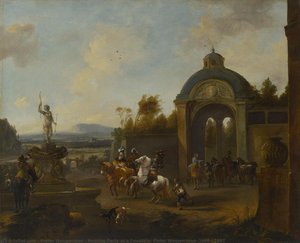 Hunting Party at a Fountain, Pieter Wouwerman, 1660 - 16821682 · Rijksmuseum
20
 Cavalry Skirmish with Foot SoldiersRoyal Museum of Fine Arts Antwerp
21
 Departure for huntingMuseu Nacional de Varsóvia
22
 The watering place
23
 Landscape with a genre sceneMuseu Nacional de Varsóvia
24
 Setting Off On A Falcon Hunt
25
 The stableFitzwilliam Museum
26
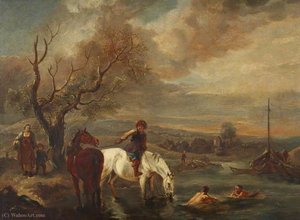 Country Scene with a Man on Horseback and Bathers
27
 Landscape with resting travellers
28
 Cavalry Men by a Suttler's Tent
29
 Dune landscape with figuresCleveland Museum of Art
30
 Encampment beside an Ale HouseFitzwilliam Museum
31
 Caçada aos CervosMuseu Hermitage
Os quatro temas que mais se repetem nestas obras originais, cada um com o seu melhor exemplo.
Os 8 museus que detêm a maioria das pinturas desta página.
| Museus | Cidade | Obras de Pieter Wouwerman | Pinturas desta lista |
|---|---|---|---|
 Museu Nacional de Varsóvia |
Varsóvia | 3 | Groom and horses, Departure for hunting, Landscape with a genre scene |
 Rijksmuseum |
Amsterdã | 3 | Frederik Hendrik at the surrender of Maastricht, 22 August 1632, The storming of Coevorden, December 30, 1672, Hunting Party at a Fountain, Pieter Wouwerman, 1660 - 1682 |
 Staatliche Kunsthalle Karlsruhe |
Karlsruhe | 2 | The Collision, Hunting party on horseback with servants and dogs |
 Museu Hermitage |
São Petersburgo | 2 | Horses in the Pasture, Caçada aos Cervos |
 Gemäldegalerie Alte Meister im Schloss Wilhelmshöhe |
Kassel | 2 | Landscape with horsemen at a blacksmith, Beach Scene with Fisher Woman |
 Fitzwilliam Museum |
2 | The stable, Encampment beside an Ale House | |
 Villa Vauban |
Luxembourg | 1 | Forest with staffage figures |
 Bavarian State Painting Collections |
Munique | 1 | Dice-Playing Soldiers in Front of an Inn |
Escolha uma década para ver a obra original que a define.

Forest with staffage figures (1642), Villa Vauban, Luxembourg. Dice-Playing Soldiers in Front of an Inn (1652) e Officer on Horseback (1660) vêm a seguir.
19 anos: Forest with staffage figures data de 1642, e Pieter Wouwerman nasceu em 1623.
Forest with staffage figures, Dice-Playing Soldiers in Front of an Inn, Officer on Horseback, The Combat, The Collision, Groom and horses, Army Camp, Horses in the Pasture, Landscape with horsemen at a blacksmith e Sandhills with Figure. O ranking acima apresenta o ano e o museu de cada uma.
Nosso catálogo contém 35 obras de Pieter Wouwerman, datadas de 1642 a 1682.
Principalmente em Museu Nacional de Varsóvia (Varsóvia), Rijksmuseum (Amsterdã) e Staatliche Kunsthalle Karlsruhe (Karlsruhe). A tabela de museus acima lista todos eles.
Em 1660s: 7 das 31 obras nesta página foram feitas então, sendo Officer on Horseback delas.
Nesta página, a mais antiga é Forest with staffage figures (1642) e a mais recente é Hunting Party at a Fountain, Pieter Wouwerman, 1660 - 1682 (1682).
Groom and horses, Departure for hunting e Landscape with a genre scene: o Museu Nacional de Varsóvia, Varsóvia detém 3 das obras desta página.