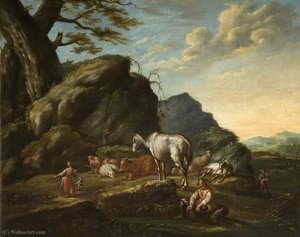
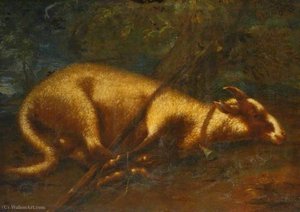
Goats and Flock of Sheep
Goats and Flock of Sheep is an oil painting by Philipp Peter Roos. The artist, who was also known by the moniker Rosa di Tivoli, produced this work about 1681. He was a German Baroque painter born in Sankt Goar, Germany.
Em resumo
De todas as obras originais deixadas por Philipp Peter Roos, a mais famosa é Goats and Flock of Sheep (1681), da coleção do Bavarian State Painting Collections, em Munique. Logo atrás vêm Piece of Livestock (1681) e Landscape with Cattle and Shepherd (1681). Nosso catálogo contém 93 obras de Philipp Peter Roos; a galeria preservou as 92 que o mundo mais admira, cada uma exibida com sua data, seu museu e sua história.
Goats and Flock of Sheep is an oil painting by Philipp Peter Roos. The artist, who was also known by the moniker Rosa di Tivoli, produced this work about 1681. He was a German Baroque painter born in Sankt Goar, Germany.
Piece of Livestock is an oil painting by Philipp Peter Roos, executed in 1681. The work originates from the Baroque period, a time when the artist was establishing his presence within the Italianate landscape tradition.
Landscape with Cattle and Shepherd is a work by the German Baroque painter Philipp Peter Roos. Created about 1681, the painting reflects the artist's specialized focus on pastoral scenes and animal subjects. Roos was a significant figure in the development of Italianate landscapes, often characterized by his intimate study of livestock and the natural environment.
In Piece of Livestock, Philipp Peter Roos organizes a pastoral scene through a close-up, ground-level perspective that establishes an immediate intimacy with the subjects. The composition is dominated by a large, seated cow positioned slightly to the right of the center. To the left, a smaller lamb or calf provides a sense of scale, while a woman interacts with a dog in the space behind the primary subject. This arrangement…
Resting Flock with Shepherds is an oil painting by the German Baroque artist Philipp Peter Roos. Created about 1681, this work captures a quiet moment within a rugged landscape. The composition focuses on a group of livestock and a shepherd, rendered with a sense of immediate presence that draws the viewer into the scene.
Resting Flock with Shepherds is an oil painting by Philipp Peter Roos. The canvas captures a heavy stillness among livestock and their guardian. This work was created about 1681. It presents a scene of animals and men gathered in a quiet, layered space under a turbulent sky.
In this Baroque-style oil painting, the mythological drama of the Liberation of Io unfolds with a sudden, heavy intensity. Created by Philipp Peter Roos about 1681, the scene captures a moment of profound tension between the divine and the mortal. A massive, powerful bull dominates the foreground, its muscular form rendered with a weight that feels almost tangible. This central figure looms over the landscape, its presence commanding the space…
This oil on canvas painting, dated 1681, presents a monochromatic scene rendered in various shades of gray. In the foreground, a young woman is positioned amidst a group of livestock, including sheep or goats. The composition is a medium shot, placing the human subject and the animals in the immediate front and middle ground. The terrain is undulating, forming rolling hills that recede into a background of hazy mountains and…
Returning Flock with Shepherds is an oil painting by Philipp Peter Roos. Created about 1681, the work captures a quiet moment of pastoral movement. The artist, a German Baroque painter, was born in Sankt Goar. He would later become known by the moniker Rosa di Tivoli.
The scene unfolds in Shepherd with Cow, Sheep and Goats in Italian Mountain Landscape, a work that captures a quiet moment of pastoral life. This painting, created about 1680, brings together a shepherd and his diverse herd amidst a rugged, mountainous setting. The figures and animals exist within a landscape that feels both immediate and deeply rooted in the natural world.
Os quatro temas que mais se repetem nestas obras originais, cada um com o seu melhor exemplo.
Os 8 museus que detêm a maioria das pinturas desta página.
| Museus | Cidade | Obras de Philipp Peter Roos | Pinturas desta lista |
|---|---|---|---|
| Munique | 15 | Goats and Flock of Sheep, Piece of Livestock, Landscape with Cattle and Shepherd | |
| Copenhague | 5 | Cattle Piece, Landscape with a Bull, Sheep and Goats, A Shepherd with his Herd | |
| Buenos Aires | 4 | Landscape with shepherd and animals, Landscape with figures and animals, Shepherd and animals in a landscape | |
| Bratislava | 3 | Goat Herd with a Goatherd, Shepherd's Idyl in a Romantic Landscape with Ruins, Herd by an Ancient Well | |
| Praga | 3 | Ravine with a Stream, a Shepherd and His Herd, Horse and Goats Grazing, Shepherd with a Herd of Sheep and Goats | |
| Viena | 3 | Herd with Sleeping Shepherds, Rider Meeting, Landscape with Flock of Sheep | |
| São Petersburgo | 3 | Landscape with a Grotto, Landscape with a Waterfall, Landscape with a Herd | |
| Estocolmo | 3 | Dead Hare, Landskap med hjord, A Goat Resting |
Escolha uma década para ver a obra original que a define.
This large-scale oil painting, dated 1669, presents a crowded, maximalist composition of diverse animal species. The arrangement is packed, with various animals overlapping to create a sense of density and movement. The color palette relies on deep, earthy tones, including rich browns, blacks, and dark ochres. These dark shades are interrupted by specific highlights of white and cream, alongside splashes of red from a rooster and parrots. The lighting follows…
Goats and Flock of Sheep is an oil painting by Philipp Peter Roos. The artist, who was also known by the moniker Rosa di Tivoli, produced this work about 1681. He was a German Baroque painter born in Sankt Goar, Germany.
A heavy, dark-colored cow anchors the center of this scene, its presence felt in the weight of its silhouette. To the left, two goats rest upon the ground, one a pale contrast of white and light tan against the shadows. A man sits nearby, leaning back in a moment of stillness, his gaze directed toward the animals or perhaps the viewer. The air in the enclosure feels thick and dim,…
In this work, titled Shepherd's Idyl in a Romantic Landscape with Ruins, the artist Philipp Peter Roos presents a quiet moment of rural existence. Created about 1700, the painting captures a shepherd tending to his flock amidst a landscape of rolling hills and weathered stone structures. There is a sense of stillness in the way the figures and animals occupy the space, suggesting a life governed by the rhythms of…
Goats and Flock of Sheep (1681), Bavarian State Painting Collections, Munique. Piece of Livestock (1681) e Landscape with Cattle and Shepherd (1681) vêm a seguir.
24 anos: Goats and Flock of Sheep data de 1681, e Philipp Peter Roos nasceu em 1657.
Goats and Flock of Sheep, Piece of Livestock, Landscape with Cattle and Shepherd, Piece of Livestock, Resting Flock with Shepherds, Resting Flock with Shepherds, Liberation of Io, Piece of Cattle, Returning Flock with Shepherds e Shepherd with Cow, Sheep and Goats in Italian Mountain Landscape. O ranking acima apresenta o ano e o museu de cada uma.
Nosso catálogo contém 93 obras de Philipp Peter Roos, datadas de 1669 a 1700.
Principalmente em Bavarian State Painting Collections (Munique), Statens Museum For Kunst (Copenhague) e Museu Nacional de Belas Artes (Buenos Aires). A tabela de museus acima lista todos eles.
Em 1680s: 21 das 92 obras nesta página foram feitas então, sendo Goats and Flock of Sheep delas.
Nesta página, a mais antiga é Various animals gathered before Noah's Ark (1669) e a mais recente é Shepherd's Idyl in a Romantic Landscape with Ruins (1700).
Landscape (33), Animals (29) e Goats (19), entre as 92 obras nesta página.
Oil On Canvas, para 18 das 92 obras nesta página.
Baroque, a julgar pelos originais nesta página.
Goats and Flock of Sheep, Piece of Livestock e Landscape with Cattle and Shepherd: o Bavarian State Painting Collections, Munique detém 15 das obras desta página.
Sob a luz dourada do Barroco italiano, poucos nomes evocam a serenidade pastoral do campo como Philipp Peter Roos. Conhecido pela história pelo seu evocativo apelido, Rosa di Tivoli, este mestre nascido na Alemanha transformou o género da paisagem através de uma ligação profunda, quase visceral, ao mundo natural. Nascido em 1655 na região da Renânia — especificamente perto de Sankt Goar — Roos estava destinado ao pincel desde os seus primeiros anos. Era filho de Johann Heinrich Roos, um respeitado pintor de paisagens que forneceu as lições fundamentais de harmonia tonal e equilíbrio composicional que mais tarde definiriam o estilo maduro do artista. Este aprendizagem precoce não se tratava apenas de técnica; era uma imersão numa forma de ver o mundo através da lente da luz, da sombra e da dignidade silenciosa da terra.
A trajetória da vida de Roos mudou drasticamente em 1677, num momento precipitado pela generosidade de Carlos I, Landgrave de Hesse-Kassel. Reconhecendo o talento emergente do jovem pintor, o Landgrave forneceu os meios financeiros para que Roos embarcasse numa jornada transformadora rumo a Roma. Esta migração das tradições germânicas para o coração do Barroco italiano permitiu que Roos absorvesse a energia vibrante da arte romana. Foi aqui que procurou mentoria sob o célebre Giacinto Brandi, cuja influência ajudou a refinar a capacidade de Roos de fundir a estrutura clássica com um realismo mais espontâneo e atmosférico. Este período em Roma foi também profundamente pessoal; foi durante estes anos que Roos se apaixonou por Isabella Brandi, a filha do seu mentor. A união deles levaria eventualmente o artista a estabelecer-se em Tivoli, um movimento que ligaria para sempre a sua identidade à paisagem que tanto amava.
O que distingue verdadeiramente a obra de Rosa di Tivoli é a autenticidade inigualável dos seus temas animais. Ao contrário de muitos dos seus contemporâneos, que utilizavam animais como meros detalhes decorativos numa paisagem, Roos tratava cada criatura — desde o touro robusto até à cabra ágil — com a reverência de um retratista. A sua residência em Tivoli foi famosamente concebida em torno de um conceito semelhante a um estúdio vivo; ele mantinha uma vasta coleção de animais exóticos e domésticos, transformando efetivamente o seu entorno num estudo contínuo de movimento, anatomia e temperamento. Esta proximidade íntima permitiu-lhe capturar o subtil espasmo de uma orelha ou a tensão muscular de uma fera sob pressão, conferindo às suas telas uma vitalidade arrebatadora.
A sua mestria técnica é evidente na forma como navegou pelas complexidades da estética barroca. Embora as suas composições recorram frequentemente às qualidades serenas e atmosféricas da Era de Ouro Holandesa, estão infundidas com a intensidade dramática característica da escola italiana. As suas obras apresentam frequentemente:
A importância histórica de Philipp Peter Roos reside na sua capacidade de construir uma ponte entre as tradições estruturadas da paisagem da Europa do Norte e o drama emotivo e luminoso da Itália. Ele surgiu num momento em que a investigação científica da época começava a exigir observações mais precisas do mundo natural, mesmo quando os temas religiosos e mitológicos ainda dominavam a consciência artística. Nas suas pinturas, encontra-se tanto o detalhe meticuloso de um naturalista como a alma poética de um romântico. Ao documentar a flora e a fauna da zona rural romana com tamanha devoção, criou um registo visual que fala tanto do espírito da época quanto dos próprios temas retratados.
Embora tenha falecido em 1706, deixando um legado gravado no próprio solo de Tivoli, a sua influência perdurou. Ele permanece uma figura fundamental para qualquer estudioso da evolução da pintura animalista e do desenvolvimento da paisagem italianizante. Através dos seus olhos, não vemos apenas uma coleção de gado; testemunhamos uma celebração profunda da vida nas suas formas mais fundamentais e despojadas. A sua obra continua a ressoar como um testemunho do poder da observação e da beleza duradoura do ideal pastoral.