Retrato de Peter de Wint

Pinturas de Peter de Wint: As 100 mais famosas, sob o olhar de uma galeria

Atualizado em Novembro 2026 · classificado pela nossa pontuação de popularidade (pesquisas, visitas e pedidos de cada obra) · 224 obras de Peter de Wint em nosso catálogo

Em resumo

Aos olhos da galeria, a pintura mais famosa de Peter de Wint é Bamburgh Castle. A View Of Lincoln From The South At Little Bargate e The Old Bridge completam o trio que todos reconhecem. Dos 224 trabalhos de Peter de Wint em nosso catálogo, a galeria apresenta abaixo as 100 obras mais famosas, cada uma original, com seu ano, seu museu e o que a torna única.

1784 – 1849, Stone Romanticism Mais obras: Yale Center for British Art

As 10 principais pinturas de Peter de Wint na galeria

1
Bamburgh Castle de Peter de Wint

Bamburgh Castle

Oil

This painting presents Bamburgh Castle, a formidable structure situated in Northumberland, England. The British painter Peter De Wint has captured the fortification as it sits perched atop a rugged rocky outcrop. From this elevated vantage point, the castle commands the surrounding landscape, which is characterized by hilly and uneven terrain. The composition places the stone architecture in direct dialogue with the natural elements of the coast.

2
A View Of Lincoln From The South At Little Bargate de Peter de Wint

A View Of Lincoln From The South At Little Bargate

Oil

We are looking at A View Of Lincoln From The South At Little Bargate, a work by the English painter Peter De Wint. This piece reflects the artist's deep connection to the landscape, a pursuit that defined much of his career. De Wint was a versatile practitioner, working with proficiency in both oils and watercolour to capture the nuances of the natural world.

3
The Old Bridge de Peter de Wint

The Old Bridge

Oil

In "The Old Bridge" by Peter De Wint, the eye is immediately drawn to the weathered wooden structure that spans a calm, slow-moving stream. This central bridge anchors the scene, acting as a quiet connection between the riverbanks. On the left side of the timber crossing, two figures pause in mid-conversation. One wears a hat while the other is adorned in a bonnet, their period clothing suggesting a quiet moment…

4
The Harvesters de Peter de Wint

The Harvesters

Watercolor

The Harvesters is a work by the English painter Peter De Wint. Born in 1784 in Stone, Staffordshire, England, De Wint established himself as a significant figure in the tradition of British landscape painting. His practice often focused on the rural topography of the English countryside, capturing the rhythms of agricultural life through both oil and watercolor.

5
The Farmyard (1815) de Peter de Wint

The Farmyard

1815 · Watercolor · Birmingham Museum and Art Gallery, Birmingham

We find ourselves before The Farmyard, a work by Peter De Wint. This piece dates to 1815, a period when the artist was establishing his presence within the British art scene. It is currently held in the collection of the Birmingham Museum and Art Gallery.

6
Caernarvon Castle (1836) de Peter de Wint

Caernarvon Castle

1836 · Watercolor · Birmingham Museum and Art Gallery, Birmingham

There is a certain stillness in this 1836 watercolor that invites a quiet contemplation of the passage of time. The scene presents Caernarvon Castle, a massive, vertical presence that anchors the composition on the left. It sits along a waterfront, its rugged masonry rendered with a sense of weathered permanence. Above, an expansive, overcast sky dominates the upper half of the work, casting a diffused light that softens the edges…

7
Harvest Scene (1834) de Peter de Wint

Harvest Scene

1834 · Watercolor · Birmingham Museum and Art Gallery, Birmingham

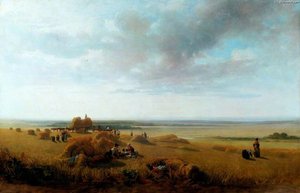
is a watercolor painting by the English painter Peter De Wint. Created in 1834, the work captures a quiet moment of rural life. It presents a vast, open landscape where the earth meets an expansive sky. The scene focuses on the stillness of a pastoral setting, where the light of a late afternoon or an overcast day settles over the fields.

8
Sheltering from the Sun (1835) de Peter de Wint

Sheltering from the Sun

1835 · Watercolor · Birmingham Museum and Art Gallery, Birmingham

The landscape unfolds in Sheltering from the Sun, a watercolor that captures a quiet moment of rest within the natural world. Created by Peter De Wint in 1835, this work presents a scene of pastoral stillness. The artist focuses on the simple, heavy presence of cattle seeking refuge, grounding the viewer in a specific, tranquil instance of rural life.

9
Lynmouth (1844) de Peter de Wint

Lynmouth

1844 · Watercolor · Birmingham Museum and Art Gallery, Birmingham

In Lynmouth, Peter De Wint captures a rugged, rocky gorge where the raw power of nature takes center stage. The scene unfolds around a cascading waterfall that surges through the heart of the landscape. Water rushes downward, its movement driving the eye through a deep perspective that pulls the viewer into the very depths of the ravine. Large, dark boulders sit heavy in the foreground, anchoring the scene before the…

Pinturas de Peter de Wint, classificadas de 11 a 100

11A Meet In The Grounds Of Raby Castle de Peter de WintA Meet In The Grounds Of Raby Castle 12Figures Loading A Haycart, Beneath A Tree de Peter de WintFigures Loading A Haycart, Beneath A Tree 13Harvesting scene, cheddington de Peter de WintHarvesting scene, cheddington 14The Glebe Farm de Peter de WintThe Glebe Farm 15The Lake At Burghley House de Peter de WintThe Lake At Burghley House 16Coast Scene de Peter de WintCoast SceneYale Center for British Art 17Threshing Corn de Peter de WintThreshing Corn 18Llansantffraid-glan-conway, denbighshire de Peter de WintLlansantffraid-glan-conway, denbighshire 19Near Matlock de Peter de WintNear MatlockYale Center for British Art 20Moored Barges Near Lambeth Palace de Peter de WintMoored Barges Near Lambeth Palace 21Cornfield With A Windmill de Peter de WintCornfield With A Windmill 22Two Rustic Figures de Peter de WintTwo Rustic Figures 23Study For 'elijah' - de Peter de WintStudy For 'elijah' - 24Shepherd and flock on a bridge, near newark de Peter de WintShepherd and flock on a bridge, near newark 25Head Of A Girl- Probably A Study Of Mrs. De Wint de Peter de WintHead Of A Girl- Probably A Study Of Mrs. De Wint 26John Keats de Peter de WintJohn Keats 27Castle on a Hill with a Bridge below de Peter de WintCastle on a Hill with a Bridge belowBirmingham Museum and Art Gallery 28Study of Burdocks de Peter de WintStudy of BurdocksYale Center for British Art 29Barges on a River de Peter de WintBarges on a RiverMuseu de Belas Artes de Boston 30Sea Study de Peter de WintSea Study 31A Lake View, Possibly Buttermere From Crummock Water de Peter de WintA Lake View, Possibly Buttermere From Crummock Water 32Pond With Willow Tree And Ducks de Peter de WintPond With Willow Tree And Ducks 33Cattle Beneath A Tree de Peter de WintCattle Beneath A Tree 34A Cottage In A Wooded Landscpe de Peter de WintA Cottage In A Wooded Landscpe 35Landscape Study- A Haystack Near A Church de Peter de WintLandscape Study- A Haystack Near A ChurchYale Center for British Art 36Two Studies Of A Watermill de Peter de WintTwo Studies Of A Watermill 37Cattle Before Ludlow Castle, Shropshire de Peter de WintCattle Before Ludlow Castle, Shropshire 38Cattle On The Edge Of A Lane, A Church Beyond de Peter de WintCattle On The Edge Of A Lane, A Church Beyond 39A coastal landscape de Peter de WintA coastal landscape 40A Barge Near Mooring Posts de Peter de WintA Barge Near Mooring Posts 41Near Penrith de Peter de WintNear Penrith 42A Landscape With Harvesters In The Foreground de Peter de WintA Landscape With Harvesters In The Foreground 43Study of a timber wagon; loading the barge de Peter de WintStudy of a timber wagon; loading the barge 44Still Life With Broom de Peter de WintStill Life With Broom 45Plough Horses de Peter de WintPlough Horses 46Harvest Time- Cumberland de Peter de WintHarvest Time- CumberlandYale Center for British Art 47Cookham-on-thames, Berkshire de Peter de WintCookham-on-thames, Berkshire 48Ash Tree In Ashstead Park de Peter de WintAsh Tree In Ashstead ParkSlovak National Gallery 49Greenwich de Peter de WintGreenwich 50A Barn In A Wooded Landscape de Peter de WintA Barn In A Wooded Landscape 51Bardon Hill, Charnwood Forest, Leicestershire de Peter de WintBardon Hill, Charnwood Forest, Leicestershire 52Middleham, Yorkshire de Peter de WintMiddleham, Yorkshire 53Manor House And Church, Lytes Cary, Somerset de Peter de WintManor House And Church, Lytes Cary, Somerset 54Malmesbury Abbey de Peter de WintMalmesbury Abbey 55Borough Cathedral de Peter de WintBorough Cathedral 56Dunster, Somerset de Peter de WintDunster, SomersetFitzwilliam Museum 57A Yorkshire Road de Peter de WintA Yorkshire RoadYale Center for British Art 58A Mill In France de Peter de WintA Mill In France 59Bristol cathedral from the south de Peter de WintBristol cathedral from the south 60Harvest Time - de Peter de WintHarvest Time -Yale Center for British Art 61Gloucester de Peter de WintGloucester 62Chelsea Old Bridge, London de Peter de WintChelsea Old Bridge, London 63Achilles Statue, Hyde Park, London de Peter de WintAchilles Statue, Hyde Park, London 64Landscape With Willow Tree de Peter de WintLandscape With Willow Tree 65Haymaking On The Banks Of A Lincolnshire River de Peter de WintHaymaking On The Banks Of A Lincolnshire River 66Chester de Peter de WintChester 67A Study For 'the Ferry' - Snowdon From Llyn Padarn, North Wales de Peter de WintA Study For 'the Ferry' - Snowdon From Llyn Padarn, North Wales 68Woodland Scene de Peter de WintWoodland Scene 69Hay Wagons de Peter de WintHay Wagons 70Figures And A Horse And Cart On A Country Track de Peter de WintFigures And A Horse And Cart On A Country Track 71Extensive Landscape de Peter de WintExtensive LandscapeBirmingham Museum and Art Gallery 72A View Of Richmond, Yorkshire With A Footbridge In The Foreground de Peter de WintA View Of Richmond, Yorkshire With A Footbridge In The Foreground 73A Country Road With Traveller On Horseback de Peter de WintA Country Road With Traveller On Horseback 74A Cornfield de Peter de WintA Cornfield 75Landscape with haystacks de Peter de WintLandscape with haystacks 76The Ferry de Peter de WintThe Ferry 77Lincolnshire Cornfield Near Horncastle de Peter de WintLincolnshire Cornfield Near Horncastle 78A Wooded Track de Peter de WintA Wooded Track 79A Wooded Landscape With A Rainbow de Peter de WintA Wooded Landscape With A Rainbow 80A Country Road; And A Companion Work de Peter de WintA Country Road; And A Companion Work 81View Of Ludlow Castle de Peter de WintView Of Ludlow Castle 82Still Life With Rake de Peter de WintStill Life With Rake 83Building A Hayrick - de Peter de WintBuilding A Hayrick - 84Barden Tower, Yorkshire de Peter de WintBarden Tower, Yorkshire 85View Over Flat Country de Peter de WintView Over Flat Country 86A Haywagon In An Open Landscape de Peter de WintA Haywagon In An Open Landscape 87View Of Exeter de Peter de WintView Of Exeter 88The Farm Pond de Peter de WintThe Farm Pond 89Great Mitton, Lancashire, From The Ribble, With Longridge Fell Beyond de Peter de WintGreat Mitton, Lancashire, From The Ribble, With Longridge Fell Beyond 90Shipbuilding On The Yorkshire Coast de Peter de WintShipbuilding On The Yorkshire Coast 91Men Working On The Lincolnshire Heathland de Peter de WintMen Working On The Lincolnshire Heathland 92Harvesters In The Fields Above The Valley Of The Lune, Cumbria de Peter de WintHarvesters In The Fields Above The Valley Of The Lune, Cumbria 93Grasmere And Helm Crag, Cumbria de Peter de WintGrasmere And Helm Crag, Cumbria 94Loading a Haywain de Peter de WintLoading a Haywain 95Harvesting scene de Peter de WintHarvesting scene 96View Of Elizabeth Castle, St Helier, Jersey de Peter de WintView Of Elizabeth Castle, St Helier, Jersey 97Three Cart-horses In Traces de Peter de WintThree Cart-horses In Traces 98Harvesting, Probably On The Lincolnshire Cliff de Peter de WintHarvesting, Probably On The Lincolnshire Cliff 99Landscape With Cows And Barn de Peter de WintLandscape With Cows And Barn 100Two Men In Punts de Peter de WintTwo Men In Punts

Pinturas famosas de Peter de Wint, período por período

Os temas que cativaram o olhar de Peter de Wint

Os quatro temas que mais se repetem nestas obras originais, cada um com o seu melhor exemplo.

Os museus que guardam os originais de Peter de Wint

Os 5 museus que detêm a maioria das pinturas desta página.

Museus Cidade Obras de Peter de Wint Pinturas desta lista
Yale Center for British Art, New HavenYale Center for British Art New Haven 22 Coast Scene, Near Matlock, Study of Burdocks
Birmingham Museum and Art Gallery, BirminghamBirmingham Museum and Art Gallery Birmingham 8 The Farmyard, Caernarvon Castle, Harvest Scene
Fitzwilliam MuseumFitzwilliam Museum 2 Dunster, Somerset
Museu de Belas Artes de Boston, BostonMuseu de Belas Artes de Boston Boston 1 Barges on a River
Slovak National Gallery, BratislavaSlovak National Gallery Bratislava 1 Ash Tree In Ashstead Park

Peter de Wint, uma pintura emblemática por década

Obras por década

Escolha uma década para ver a obra original que a define.

Pinturas de Peter de Wint: a galeria responde

Qual pintura de Peter de Wint é a mais famosa de todas?Revelar a resposta

Bamburgh Castle. A View Of Lincoln From The South At Little Bargate e The Old Bridge vêm a seguir.

Quais são as 10 principais pinturas de Peter de Wint?Revelar a resposta

Bamburgh Castle, A View Of Lincoln From The South At Little Bargate, The Old Bridge, The Harvesters, The Farmyard, Caernarvon Castle, Harvest Scene, Sheltering from the Sun, Lynmouth e A Woman Sorting Washing. O ranking acima apresenta o ano e o museu de cada uma.

Quantas obras Peter de Wint criou?Revelar a resposta

Nosso catálogo contém 224 obras de Peter de Wint, datadas de 1815 a 1844.

Onde estão expostos os originais mais famosos de Peter de Wint?Revelar a resposta

Principalmente em Yale Center for British Art (New Haven), Birmingham Museum and Art Gallery (Birmingham) e Fitzwilliam Museum. A tabela de museus acima lista todos eles.

Quando é que Peter de Wint criou as suas pinturas mais famosas?Revelar a resposta

Em 1830s: 3 das 100 obras nesta página foram feitas então, sendo Caernarvon Castle delas.

Quais são as obras mais famosas de Peter de Wint no início e no fim de sua carreira?Revelar a resposta

Nesta página, a mais antiga é The Farmyard (1815) e a mais recente é Lynmouth (1844).

Quais temas Peter de Wint mais explorou?Revelar a resposta

Landscape (18), Scenes (7) e Atmospheric light (7), entre as 100 obras nesta página.

Em qual técnica Peter de Wint mais trabalhou?Revelar a resposta

Watercolor, para 6 das 100 obras nesta página.

Com qual movimento Peter de Wint está associado(a)?Revelar a resposta

Romanticism, a julgar pelos originais nesta página.

Quais obras originais de Peter de Wint o Yale Center for British Art possui?Revelar a resposta

Coast Scene, Near Matlock e Study of Burdocks: o Yale Center for British Art, New Haven detém 7 das obras desta página.

Peter de Wint: o artista

Early Life and Training

Peter de Wint’s artistic journey began in Stone, Staffordshire, England, on January 21, 1784. Born to a Dutch physician father who had emigrated from New York—a lineage that instilled within him an appreciation for European artistic traditions—his formative years were marked by exposure to intellectual pursuits and a burgeoning fascination with visual arts. Initially slated for the medical profession like his father, De Wint’s innate talent swiftly steered him towards London in 1802, where he embarked on a path of artistic exploration. A pivotal moment arrived when he secured an apprenticeship with John Raphael Smith, a celebrated mezzotint engraver and portrait painter. This invaluable experience honed his drawing skills and introduced him to the meticulous craft of engraving—techniques that would prove foundational to his subsequent artistic endeavors. Recognizing the importance of formal instruction, De Wint diligently pursued studies under John Varley, a prominent watercolorist who championed Dr. Monro’s informal academy for young artists. Within this stimulating environment, he encountered luminaries such as Turner and Girtin, absorbing their stylistic innovations and broadening his artistic horizons.

Artistic Style and Development

De Wint quickly established himself as one of England's foremost watercolorists, distinguished by an unparalleled ability to capture the ethereal beauty of light and atmosphere using a remarkably restrained palette—typically consisting of just ten pigments. This deliberate limitation demanded exceptional sensitivity and precision, resulting in paintings characterized by breathtaking subtlety and nuance. He championed ivory-tinted Creswick paper, a material that perfectly complemented his artistic vision and contributed significantly to the delicate luminescence of his masterpieces. While predominantly recognized for watercolor landscapes, De Wint also ventured into oil painting, demonstrating versatility and expanding his expressive repertoire. His canvases often conveyed a profound emotional resonance—a hallmark of Romanticism—reflecting an artist’s deep engagement with the sublime grandeur of nature and the complexities of human experience.

Key Themes and Subjects

A significant portion of De Wint's oeuvre revolved around Lincolnshire landscapes, which served as recurring subjects of inspiration throughout his career. These paintings depicted idyllic scenes of haymaking, charming rural cottages nestled amidst rolling hills, and expansive vistas capturing the majesty of the English countryside—images imbued with a palpable sense of tranquility and nostalgia. His artistic vision sought to convey not merely visual representations but also emotional responses to the natural world. Furthermore, De Wint produced portraits that showcased his meticulous attention to detail and his ability to capture the essence of his subjects’ personalities. Notably, he created an evocative oil painting of John Keats—a testament to his skill in portraying human emotion and capturing the spirit of a literary figure.

Legacy and Historical Significance

Alfred William Rich eloquently summarized De Wint's artistic achievement by stating that “ever came nearer painting a perfect picture than did Peter de Wint,” underscoring his exceptional talent and unwavering dedication to craft—a judgment that continues to resonate with art historians today. His influence extended far beyond his own lifetime, shaping the aesthetic sensibilities of subsequent generations of British artists and contributing decisively to the evolution of English landscape painting. Today, De Wint’s artworks reside in prestigious collections across the globe—including Tate Britain, the Victoria and Albert Museum, and The Collection (Lincoln)—affirming their enduring artistic merit and cementing his place as a pivotal figure in nineteenth-century art history. His legacy persists as an exemplar of Romantic idealism and technical mastery—a testament to the transformative power of artistic vision.