Retrato de Nicolas Lancret

As 100 Pinturas Mais Famosas de Nicolas Lancret, Cada Uma Única

Atualizado em Novembro 2026 · classificado pela nossa pontuação de popularidade (pesquisas, visitas e pedidos de cada obra) · 185 obras de Nicolas Lancret em nosso catálogo

Em resumo

Picnic after the Hunt (1735) é a pintura de Nicolas Lancret que mais atrai olhares; a obra original pertence ao National Gallery of Art, Washington. Depois disso, o olhar recai sobre LES PLAISIRS DU BAIN e Spring (1738). Entre as 185 obras de Nicolas Lancret em nosso catálogo, estas 100 são as mais famosas, cada uma uma original única apresentada com o seu ano, o seu museu e a razão pela qual perdura.

1689 – 1743, Paris Rococo elegance Mais obras: Wallace Collection

As 10 principais pinturas de Nicolas Lancret, sob o olhar da galeria

1
Picnic after the Hunt (1735) de Nicolas Lancret

Picnic after the Hunt

1735 · Oil On Canvas · National Gallery of Art, Washington

The canvas titled Picnic after the Hunt captures a quiet pause in the rhythm of the day. Painted in 1735, this work belongs to the hand of Nicolas Lancret. The scene rests upon the surface of the oil, a moment of stillness held within the frame. It is a fragment of a social afternoon, frozen in the light of the eighteenth century.

2
LES PLAISIRS DU BAIN de Nicolas Lancret

LES PLAISIRS DU BAIN

Oil On Canvas · Museu do Louvre, Paris

In the soft, luminous glow of 18th-century French artistry, few works capture the essence of aristocratic leisure as tenderly as Nicolas Lancret’s Les Plaisirs du bain. This exquisite oil on canvas serves as a window into a bygone era, transporting the viewer to a sun-drenched afternoon where the boundaries between nature and high society dissolve into a dreamlike state. Painted circa 1725, the work is a quintessential masterpiece of the…

3
Spring (1738) de Nicolas Lancret

Spring

1738 · Oil On Canvas · Museu do Louvre, Paris

In the delicate dance of light and shadow that defines Nicolas Lancret’s 1738 masterpiece, “Spring,” we are transported to an era of unparalleled grace and aristocratic leisure. This oil on canvas, a jewel within the Louvre Museum's collection, serves as a breathtaking window into the mid-18th century, capturing the very essence of the Rococo spirit. Through his masterful brushwork, Lancret does more than merely depict a scene; he orchestrates a…

4
Lady and Gentleman with two Girls and a Servant (1742) de Nicolas Lancret

Lady and Gentleman with two Girls and a Servant

1742 · Oil On Canvas · National Gallery, Londres

Nicolas Lancret’s “Lady and Gentleman with Two Girls and a Servant,” painted in 1742, isn't merely a portrait; it’s a meticulously crafted window into the refined pleasures of late Baroque and early Rococo France. The scene unfolds within a secluded garden, a carefully constructed haven of beauty and leisure—a space deliberately removed from the bustling realities of Parisian society. Lancret masterfully captures a moment of domestic tranquility, a tableau vivant…

5
Luncheon Party in a Park (1735) de Nicolas Lancret

Luncheon Party in a Park

1735 · Oil On Canvas · Museu de Belas Artes de Boston, Boston

In the soft, dappled light of an idealized Parisian afternoon, Nicolas Lancret’s "Luncheon Party in a Park" invites the viewer into a world of effortless grace and aristocratic leisure. Painted around 1735, this masterpiece serves as a quintessential window into the Rococo era, a period defined by its pursuit of pleasure, charm, and the celebration of refined social rituals. The scene unfolds within a lush, verdant park, where a group…

6
The Swing (1729) de Nicolas Lancret

The Swing

1729 · Oil On Canvas · Nationalmuseum, Estocolmo

A woman in a blue gown sways through the air, her silk skirts catching the light. She is suspended by ropes, a pale pink headdress fluttering against the green shadows of the forest. Below her, the world is a tangle of leaves and dappled sunlight. To her side, a man in brown leans into the shade, his gaze fixed upon the rhythmic arc of the swing. The air feels heavy…

7
Fastening the Skate (1743) de Nicolas Lancret

Fastening the Skate

1743 · Oil · Nationalmuseum, Estocolmo

Fastening the Skate is an oil painting by the French artist Nicolas Lancret. The artist, who was born in 1690 and died in 1743, produced this work in 1743. The piece was commissioned by Carl Gustaf Tessin, a man who shared a passion for skating with his wife. This specific commission reflects the personal interests of the patron through its wintry subject matter.

8
The Watering Party (L'eau) (1716) de Nicolas Lancret

The Watering Party (L'eau)

1716 · Oil · Scottish National Gallery, Edimburgo

A group of peasants gathers along a riverbank, their attention fixed on a communal catch. One man leans over the water with a long pole, while others tend to the fish on the ground. The scene is framed by a large, textured tree on the left, its sweeping branches guiding the eye toward a sunlit background. In the distance, a watermill and various buildings emerge through a soft, atmospheric haze.…

9
Open Air Dance (1724) de Nicolas Lancret

Open Air Dance

1724 · Oil On Canvas · Statens Museum For Kunst, Copenhague

The forest breathes in muted greens and ochres, a soft canopy filtering light onto a sudden clearing. Here, the air holds a quiet tension of movement. A man lunges forward in a bow, his patterned fabrics catching the light, while a woman responds in mid-dance. Her gown is a flash of luminous white and silver against the earthy shadows of the woods. The scene is a delicate arrangement of curves…

10
The Beautiful Greek (La belle grecque) (1732) de Nicolas Lancret

The Beautiful Greek (La belle grecque)

1732 · Oil On Canvas · Wallace Collection, Londres

A young woman emerges from a hazy, sun-drenched landscape, her presence commanding a quiet stillness. She is bathed in a diffused, warm light that softens the edges of the world around her. Her gaze is contemplative, drawing the viewer into a moment of serene tranquility. She wears a gown of deep crimson, trimmed with luxurious fur that catches the light, contrasting against the darker fabric of her bodice. This attire…

Pinturas famosas de Nicolas Lancret, números 11 a 100

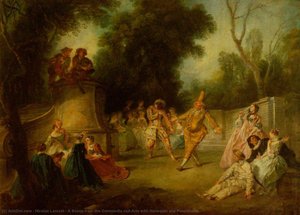
11La Camargo Dancing (1730) de Nicolas LancretLa Camargo Dancing1730 · National Gallery of Art 12Mademoiselle de Camargo Dancing (1730) de Nicolas LancretMademoiselle de Camargo Dancing1730 · Wallace Collection 13Pastoral Dance (1725) de Nicolas LancretPastoral Dance1725 · Museum Boijmans Van Beuningen 14The Beautiful Greek Woman (1733) de Nicolas LancretThe Beautiful Greek Woman1733 · Art Institute of Chicago 15The Seat of Justice in the Parliament of Paris in 1723 (1724) de Nicolas LancretThe Seat of Justice in the Parliament of Paris in 17231724 · Museu do Louvre 16Earth de Nicolas LancretEarth 17LE REPAS AU RETOUR DE LA CHASSE de Nicolas LancretLE REPAS AU RETOUR DE LA CHASSEMuseu do Louvre 18The Enchanted Pear Tree (tale of La Fontaine) (1721) de Nicolas LancretThe Enchanted Pear Tree (tale of La Fontaine)1721 19A Gallant Conversation (1719) de Nicolas LancretA Gallant Conversation1719 · Wallace Collection 20An elegant couple singing by candlelight ('The Duet') (1720) de Nicolas LancretAn elegant couple singing by candlelight ('The Duet')1720 21Concert in the Oval Salon of Pierre Crozat's Chateau at Montmorency (1720) de Nicolas LancretConcert in the Oval Salon of Pierre Crozat's Chateau at Montmorency1720 · Dallas Museum of Art 22The Pleasures of Winter (1720) de Nicolas LancretThe Pleasures of Winter1720 23Concert in the Paris Home of Pierre Crozat (1720) de Nicolas LancretConcert in the Paris Home of Pierre Crozat1720 · Bavarian State Painting Collections 24Pierrot with Three Women in a Park (1721) de Nicolas LancretPierrot with Three Women in a Park1721 25young people dancing in a park (1715) de Nicolas Lancretyoung people dancing in a park1715 26The Turtledoves (1725) de Nicolas LancretThe Turtledoves1725 · Musée des Beaux-Arts de Valenciennes 27The Bird's Nest (1725) de Nicolas LancretThe Bird's Nest1725 · Musée des Beaux-Arts de Valenciennes 28Gallant feast representing a lady dancing with Pulcinella (1725) de Nicolas LancretGallant feast representing a lady dancing with Pulcinella1725 · Collection Bemberg 29A Man Playing a Hurdy-Gurdy (1725) de Nicolas LancretA Man Playing a Hurdy-Gurdy1725 · Barber Institute of Fine Arts 30The Repast of the Hunting Party (1725) de Nicolas LancretThe Repast of the Hunting Party1725 · Detroit Institute of Arts 31Fête Galante (1725) de Nicolas LancretFête Galante1725 32The Swing (1725) de Nicolas LancretThe Swing1725 · Cleveland Museum of Art 33The See-Saw (1723) de Nicolas LancretThe See-Saw1723 · Cleveland Museum of Art 34The Vineyard (1723) de Nicolas LancretThe Vineyard1723 · Cleveland Museum of Art 35Horticulture (1723) de Nicolas LancretHorticulture1723 · Cleveland Museum of Art 36The Gardener (1723) de Nicolas LancretThe Gardener1723 · Cleveland Museum of Art 37The Swing (1730) de Nicolas LancretThe Swing1730 · Cincinnati Art Museum 38The Cage (1725) de Nicolas LancretThe Cage1725 39The Swing (1724) de Nicolas LancretThe Swing1724 · Indianapolis Museum of Art 40Blind Man's Buff (1729) de Nicolas LancretBlind Man's Buff1729 · Nationalmuseum 41Le Menuet (1732) de Nicolas LancretLe Menuet1732 42The Toy Windmill (1732) de Nicolas LancretThe Toy Windmill1732 · Scottish National Gallery 43Sleeping Bergame or The Indiscreet Shepherd (1743) de Nicolas LancretSleeping Bergame or The Indiscreet Shepherd1743 · Musée Des Beaux 44Crowned Bergère (1743) de Nicolas LancretCrowned Bergère1743 · Musée Des Beaux 45The Bird Catchers (1738) de Nicolas LancretThe Bird Catchers1738 · Wallace Collection 46An Italian Comedy Scene (1734) de Nicolas LancretAn Italian Comedy Scene1734 · Wallace Collection 47Group Portrait in a Landscape with Amorous Couple (1737) de Nicolas LancretGroup Portrait in a Landscape with Amorous Couple1737 · Krannert Art Museum 48La Malice (Mischief) (1735) de Nicolas LancretLa Malice (Mischief)1735 · National Gallery of Ireland 49Portrait of the Actor Grandval (1742) de Nicolas LancretPortrait of the Actor Grandval1742 · Indianapolis Museum of Art 50Portrait of a Dancer (Mademoiselle Marie Sallé?) (1735) de Nicolas LancretPortrait of a Dancer (Mademoiselle Marie Sallé?)1735 · Museu de Belas Artes de Boston 51Fall (1738) de Nicolas LancretFall1738 52Nicaise (1738) de Nicolas LancretNicaise1738 53Two Friends (1738) de Nicolas LancretTwo Friends1738 54The Four Ages of Man Old Age (1735) de Nicolas LancretThe Four Ages of Man Old Age1735 · National Gallery 55Fête Champêtre (1750) de Nicolas LancretFête Champêtre1750 56'Les oies du frère Philippe' (1749) de Nicolas Lancret'Les oies du frère Philippe'1749 · Amsterdam Museum 57L'Innocence de Nicolas LancretL'InnocenceMuseu do Louvre 58Study for Picnic after the Hunt (1735) de Nicolas LancretStudy for Picnic after the Hunt1735 · Musée des Beaux-Arts de Rouen 59The Four Times of Day Afternoon (1739) de Nicolas LancretThe Four Times of Day Afternoon1739 60LE GASCON PUNI de Nicolas LancretLE GASCON PUNIMuseu do Louvre 61The Four Times of Day - Morning de Nicolas LancretThe Four Times of Day - Morning 62Dance in a Pavilion (1730) de Nicolas LancretDance in a Pavilion1730 · Schloss Charlottenburg 63Dance before a Fountain (1724) de Nicolas LancretDance before a Fountain1724 · J. Paul Getty Museum 64The flirtation of the servant de Nicolas LancretThe flirtation of the servant 65A Girl in a Kitchen (1730) de Nicolas LancretA Girl in a Kitchen1730 · Wallace Collection 66A Scene from the Commedia dell'Arte with Harlequin and Punchinello (1734) de Nicolas LancretA Scene from the Commedia dell'Arte with Harlequin and Punchinello1734 · National Trust 67Les Tourterelles de Nicolas LancretLes TourterellesMuseu do Louvre 68Lady Seated by a Fountain, Attended by a Gallant de Nicolas LancretLady Seated by a Fountain, Attended by a GallantVictoria and Albert Museum 69Air (1732) de Nicolas LancretAir1732 · National Trust 70Water (1732) de Nicolas LancretWater1732 · National Trust 71The Swing (1735) de Nicolas LancretThe Swing1735 · Victoria and Albert Museum 72The Village Wedding (1737) de Nicolas LancretThe Village Wedding1737 · National Trust 73The Wedding Breakfast (1740) de Nicolas LancretThe Wedding Breakfast1740 · National Trust 74The Four Times of Day Evening (1739) de Nicolas LancretThe Four Times of Day Evening1739 · National Gallery 75The Four Times of Day Midday (1739) de Nicolas LancretThe Four Times of Day Midday1739 · National Gallery 76The Four Times of Day Morning (1739) de Nicolas LancretThe Four Times of Day Morning1739 · National Gallery 77Lovers in a Landscape (1736) de Nicolas LancretLovers in a Landscape1736 · The Barber Institute of Fine Arts 78The Four Ages of Man Childhood (1735) de Nicolas LancretThe Four Ages of Man Childhood1735 · National Gallery 79The Four Ages of Man Maturity (1735) de Nicolas LancretThe Four Ages of Man Maturity1735 · National Gallery 80Fete in a Wood (1720) de Nicolas LancretFete in a Wood1720 · Wallace Collection 81Women Bathing (1720) de Nicolas LancretWomen Bathing1720 · Wallace Collection 82The Servant Justified de Nicolas LancretThe Servant Justified 83Winter (1738) de Nicolas LancretWinter1738 · Museu do Louvre 84Pastoral Revels (1738) de Nicolas LancretPastoral Revels1738 · Wallace Collection 85The italian actors de Nicolas LancretThe italian actorsGaleria Nacional da Arménia 86The Earth (1730) de Nicolas LancretThe Earth1730 · Museu Thyssen-Bornemisza 87A Tale from La Fontaine (Le petit chien qui secue de l'argent et des pierreries) (1738) de Nicolas LancretA Tale from La Fontaine (Le petit chien qui secue de l'argent et des pierreries)1738 · Wallace Collection 88The Servant Justified (1740) de Nicolas LancretThe Servant Justified1740 · Metropolitan Museum of Art 89Le lit de justice tenu au parlement à la majorité de Louis XV (22 février 1723) de Nicolas LancretLe lit de justice tenu au parlement à la majorité de Louis XV (22 février 1723)Museu do Louvre 90The Spectacles de Nicolas LancretThe SpectaclesMusée Des Beaux 91The Unfaithful Woman. Les Rémois. de Nicolas LancretThe Unfaithful Woman. Les Rémois.Musée Des Beaux 92The Duo de Nicolas LancretThe Duo 93Cavalier and Two Ladies de Nicolas LancretCavalier and Two LadiesVictoria and Albert Museum 94Conversation Piece de Nicolas LancretConversation Piece 95Fête Galante de Nicolas LancretFête GalanteRhode Island School of Design Museum of Art 96Music party in a landscape de Nicolas LancretMusic party in a landscapeFitzwilliam Museum 97The Seesaw de Nicolas LancretThe SeesawMuseum of Fine Arts 98Blind Man's Bluff de Nicolas LancretBlind Man's BluffMuseum of Fine Arts 99The Amorous Turk de Nicolas LancretThe Amorous TurkMuseum of Fine Arts 100The Captive Bird de Nicolas LancretThe Captive BirdMuseum of Fine Arts

Pinturas famosas de Nicolas Lancret, período por período

Os temas que cativaram o olhar de Nicolas Lancret

Os quatro temas que mais se repetem nestas obras originais, cada um com o seu melhor exemplo.

Os museus que guardam os originais de Nicolas Lancret

Os 8 museus que detêm a maioria das pinturas desta página.

Museus Cidade Obras de Nicolas Lancret Pinturas desta lista
Wallace Collection, LondresWallace Collection Londres 11 The Beautiful Greek (La belle grecque), Mademoiselle de Camargo Dancing, A Gallant Conversation
Museu do Louvre, ParisMuseu do Louvre Paris 19 LES PLAISIRS DU BAIN, Spring, The Seat of Justice in the Parliament of Paris in 1723
National Gallery, LondresNational Gallery Londres 8 Lady and Gentleman with two Girls and a Servant, The Four Ages of Man Old Age, The Four Times of Day Evening
Cleveland Museum of Art, ClevelandCleveland Museum of Art Cleveland 6 The Swing, The See-Saw, The Vineyard
National Trust, AylesburyNational Trust Aylesbury 5 A Scene from the Commedia dell'Arte with Harlequin and Punchinello, Air, Water
Musée Des Beaux, ToursMusée Des Beaux Tours 4 Sleeping Bergame or The Indiscreet Shepherd, Crowned Bergère, The Spectacles
Museum of Fine Arts, HoustonMuseum of Fine Arts Houston 4 The Seesaw, Blind Man's Bluff, The Amorous Turk
Nationalmuseum, EstocolmoNationalmuseum Estocolmo 3 The Swing, Fastening the Skate, Blind Man's Buff

Nicolas Lancret ao longo das décadas: uma obra original única para cada uma

Obras por década

Escolha uma década para ver a obra original que a define.

Pinturas de Nicolas Lancret: perguntas para a galeria

Qual é a obra mais famosa de Nicolas Lancret?Revelar a resposta

Picnic after the Hunt (1735), National Gallery of Art, Washington. LES PLAISIRS DU BAIN e Spring (1738) vêm a seguir.

Com que idade Nicolas Lancret criou Picnic after the Hunt?Revelar a resposta

46 anos: Picnic after the Hunt data de 1735, e Nicolas Lancret nasceu em 1689.

Quais são as dez pinturas mais famosas de Nicolas Lancret?Revelar a resposta

Picnic after the Hunt, LES PLAISIRS DU BAIN, Spring, Lady and Gentleman with two Girls and a Servant, Luncheon Party in a Park, The Swing, Fastening the Skate, The Watering Party (L'eau), Open Air Dance e The Beautiful Greek (La belle grecque). O ranking acima apresenta o ano e o museu de cada uma.

Quantas obras de Nicolas Lancret são conhecidas?Revelar a resposta

Nosso catálogo contém 185 obras de Nicolas Lancret, datadas de 1715 a 1743.

Onde se pode ver os originais mais famosos de Nicolas Lancret?Revelar a resposta

Principalmente em Wallace Collection (Londres), Museu do Louvre (Paris) e National Gallery (Londres). A tabela de museus acima lista todos eles.

Em que período Nicolas Lancret criou as suas pinturas mais conhecidas?Revelar a resposta

Em 1730s: 38 das 100 obras nesta página foram feitas então, sendo Picnic after the Hunt delas.

Qual pintura famosa de Nicolas Lancret é a mais antiga e qual é a mais recente?Revelar a resposta

Nesta página, a mais antiga é young people dancing in a park (1715) e a mais recente é Fastening the Skate (1743).

Quais temas Nicolas Lancret preferia?Revelar a resposta

Trees (41), Woman (36) e People (31), entre as 100 obras nesta página.

Com quais materiais Nicolas Lancret mais pintou?Revelar a resposta

Oil On Canvas, para 52 das 100 obras nesta página.

A qual movimento pertence a obra de Nicolas Lancret?Revelar a resposta

Rococo elegance, a julgar pelos originais nesta página.

Quais originais de Nicolas Lancret posso ver no Wallace Collection?Revelar a resposta

The Beautiful Greek (La belle grecque), Mademoiselle de Camargo Dancing e A Gallant Conversation: o Wallace Collection, Londres detém 10 das obras desta página.

Nicolas Lancret: um retrato do artista

Nicolas Lancret: Um Olhar Encantador sobre a Elegância do Rococó

Nicolas Lancret, nascido em Paris em 1690 e falecido na mesma cidade em 1743, personifica o espírito jovial e refinado da arte rococó francesa. Sua trajetória artística floresceu durante um período de grande transformação social e cultural, a Regência do Duque de Orléans e os primeiros anos do reinado de Luís XV, capturando com maestria a essência da vida cotidiana parisiense e as celebrações elegantes que marcavam a época. Embora detalhes precisos sobre sua infância sejam escassos, sabemos que Lancret iniciou sua formação sob a tutela de Pierre d’Ulin, um pintor de história respeitado, mas foi o encontro com a obra de Antoine Watteau que moldou profundamente seu caminho artístico. Posteriormente, estudou com Jean-Baptiste Gillot, discípulo direto de Watteau, solidificando ainda mais sua ligação com essa linhagem artística influente. Essa base sólida preparou Lancret para desenvolver um estilo único, caracterizado por representações alegres e vibrantes da sociedade parisiense e suas festividades.

A Arte como Espelho da Sociedade Francesa

Lancret rapidamente se destacou como um retratista brilhante do cotidiano francês, imortalizando em tela cenas de bailes deslumbrantes, feiras animadas, casamentos campestres e outros encontros sociais que refletiam os gostos e os costumes de sua época. Sua habilidade em capturar a leveza e a frivolidade da estética rococó é inegável, traduzindo-se em obras repletas de charme e elegância. *Le Déjeuner de Jambon*, datado de 1735 e exposto no Musée Condé em Chantilly, exemplifica perfeitamente sua maestria na representação de cenas de gênero, retratando um animado almoço com presunto, onde figuras vibrantes interagem em um ambiente de convivialidade. *La Servante Justifiée*, criada entre 1735 e 1740, demonstra a capacidade de Lancret em retratar cenas domésticas com sagacidade e encanto, enquanto *Le Jeu des Quatre-Coins* captura a energia e o divertimento da interação social através da representação de um popular jogo. A delicadeza e o refinamento também se manifestam em seus retratos, como *Marie-Anne de Camargo*, datado de 1730, onde Lancret exibe sua habilidade em retratar figuras da moda com precisão e elegância.

Influências Artísticas e a Sombra de Watteau

A semelhança entre o estilo de Lancret e o de Watteau é inegável, levando historiadores da arte a frequentemente compararem os dois artistas. Ambos compartilham uma sensibilidade pela representação de cenas galantes e um apreço pela beleza do cotidiano. No entanto, enquanto Watteau é frequentemente considerado o mestre supremo do gênero *fête galante*, Lancret desenvolveu uma abordagem mais acessível e direta, com cores mais vibrantes e composições mais harmoniosas. Embora alguns críticos tenham argumentado que a obra de Lancret carece da profundidade emocional presente na pintura de Watteau, sua capacidade de capturar a essência da sociedade francesa do século XVIII lhe garantiu um lugar significativo na história da arte. A influência de artistas como François Boucher pode ser observada em suas obras posteriores, demonstrando a continuidade e o desenvolvimento do estilo rococó.

Evolução Artística e Legado Duradouro

Ao longo de sua carreira, Lancret demonstrou uma evolução gradual em sua abordagem artística. Inicialmente fortemente influenciado por Watteau, ele desenvolveu um estilo mais distinto, caracterizado por cores mais vivas e uma maior harmonia entre as figuras e seus arredores. Suas obras posteriores, como *Montreir de lanterne magique* e *Family in a Garden*, são consideradas o auge de sua realização artística, demonstrando uma crescente capacidade de criar profundidade e intimidade em suas composições. Sua importância histórica reside em sua contribuição para o movimento rococó e em sua habilidade de documentar a vida social e os valores culturais da França do século XVIII através de suas pinturas encantadoras e acessíveis. Suas obras, hoje presentes em coleções prestigiosas como a Galeria Nacional e o Musée d'Orsay, continuam a inspirar admiração pela arte rococó francesa, perpetuando o legado de um artista que soube capturar a beleza efêmera da vida cotidiana com graça e elegância.