


1


Atualizado em Outubro 2026 · classificado pela nossa pontuação de popularidade (pesquisas, visitas e pedidos de cada obra) · 32 obras de Morris Graves em nosso catálogo
Em resumo
Aos olhos da galeria, a pintura mais famosa de Morris Graves é Bird Singing in the Moonlight (1938). Crow, Surf and Moon (1943) e Logged Mountains (1943) completam o trio que todos reconhecem. Dos 32 trabalhos de Morris Graves em nosso catálogo, a galeria apresenta abaixo as 30 obras mais famosas, cada uma original, com seu ano, seu museu e o que a torna única.


The Logged Mountains painting by Morris Graves is a thought-provoking artwork that showcases the artist's skill in combining natural elements with artistic expression. Created in 1943, this oil on canvas painting measures 66 x 92 cm and is currently housed at the Smithsonian American Art Museum in the United States. Artist Background Morris Graves was an American artist known for his delicate and contemplative drawings that capture the essence of…


 Woodpeckers1941
12
 Bird And Chalice1939
13
 Folded Wings Memory the Moon Weeping1943
14
 Night Sky No. 21944 · Art Museum
15
 South American Brush Bird1944
16
 Oregon, from the United States Series1948
17
 Young Gander Ready for Flight1952 · The Phillips Collection
18
 August Still Life1952 · The Phillips Collection
19
 Young Gander1952
20
 Bird Masking1953
21
 Marsh Orchids1955 · Art Museum
22
 Spirit Bird1956
23
 Bouquet1954
24
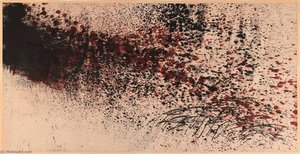 Spring with Machine Age Noise V1957
25
 Flowers1954
26
 Poverty Winter - Still Life1982 · Art Museum
27
 Summer Still Life1988
28
 Hibernation1954
29
 State of the World (Double Necked Vessel)
30
 Winter Flower (Ireland)
Os 3 museus que detêm a maioria das pinturas desta página.
| Museus | Cidade | Obras de Morris Graves | Pinturas desta lista |
|---|---|---|---|
 Art Museum |
Seattle | 6 | Crow, Surf and Moon, Bird in the Night, Sea, Fish and Constellation |
 The Phillips Collection |
Washington, D.C. | 3 | Surf and Bird, Young Gander Ready for Flight, August Still Life |
 Smithsonian American Art Museum |
Washington, D.C. | 1 | Logged Mountains |
Escolha uma década para ver a obra original que a define.


Bird Singing in the Moonlight (1938). Crow, Surf and Moon (1943) e Logged Mountains (1943) vêm a seguir.
28 anos: Bird Singing in the Moonlight data de 1938, e Morris Graves nasceu em 1910.
Bird Singing in the Moonlight, Crow, Surf and Moon, Logged Mountains, Surf and Bird, Snake and Moon, Wheelbarrow, Bird in the Night, Sea, Fish and Constellation, Bird in the Spirit e Nestling. O ranking acima apresenta o ano e o museu de cada uma.
Nosso catálogo contém 32 obras de Morris Graves, datadas de 1934 a 1988.
Principalmente em Art Museum (Seattle), The Phillips Collection (Washington, D.C.) e Smithsonian American Art Museum (Washington, D.C.). A tabela de museus acima lista todos eles.
Em 1940s: 11 das 30 obras nesta página foram feitas então, sendo Crow, Surf and Moon delas.
Nesta página, a mais antiga é Wheelbarrow (1934) e a mais recente é Summer Still Life (1988).
Crow, Surf and Moon, Bird in the Night e Sea, Fish and Constellation: o Art Museum, Seattle detém 6 das obras desta página.