Retrato de Miné Okubo

Pinturas de Miné Okubo: As 72 mais famosas, sob o olhar de uma galeria

Atualizado em Novembro 2026 · classificado pela nossa pontuação de popularidade (pesquisas, visitas e pedidos de cada obra) · 72 obras de Miné Okubo em nosso catálogo

Em resumo

Aos olhos da galeria, a pintura mais famosa de Miné Okubo é (3 Women Going to Church) (1948), cuja obra original está exposta no Japanese American National Museum, em Los Angeles. Walking over muddy ground, Central Utah Relocation Project, Topaz, Utah, 1942-1944 (1944) e Teaching art classes, Tanforan Assembly Center, San Bruno, California, 1942 (1944) completam o trio que todos reconhecem. Dos 72 trabalhos de Miné Okubo em nosso catálogo, a galeria apresenta abaixo as 72 obras mais famosas, cada uma original, com seu ano, seu museu e o que a torna única.

1912 – 2001, Riverside Social realism Mais obras: Japanese American National Museum

As 10 principais pinturas de Miné Okubo na galeria

1
(3 Women Going to Church) (1948) de Miné Okubo

(3 Women Going to Church)

1948 · Gouache · Japanese American National Museum, Los Angeles

Three women move toward the viewer, their bodies rendered as simplified, rectangular forms. They walk in a somber line, heads bowed under the weight of a quiet gravity. In their hands, they hold books, small anchors of faith against the surrounding bleakness. The figures are heavy with a sense of shared purpose, their rounded features catching subtle highlights amidst a landscape of muted blues and browns.

2
Walking over muddy ground, Central Utah Relocation Project, Topaz, Utah, 1942-1944 (1944) de Miné Okubo

Walking over muddy ground, Central Utah Relocation Project, Topaz, Utah, 1942-1944

1944 · Drawing · Japanese American National Museum, Los Angeles

Miné Okubo’s “Walking Over Muddy Ground, Central Utah Relocation Project, Topaz, Utah, 1942-1944” isn't merely a depiction of a landscape; it’s a distilled essence of hardship, determination, and the quiet dignity of a people displaced. Rendered in stark black and white, the drawing captures a pivotal moment within the Topaz War Relocation Center—a microcosm of the larger narrative of Japanese American internment during World War II. The image immediately draws…

3
Teaching art classes, Tanforan Assembly Center, San Bruno, California, 1942 (1944) de Miné Okubo

Teaching art classes, Tanforan Assembly Center, San Bruno, California, 1942

1944 · Ink On Paper · Japanese American National Museum, Los Angeles

In this work, titled Teaching art classes, Tanforan Assembly Center, San Bruno, California, 1942, the artist Miné Okubo captures a quiet, instructional moment within the confines of a relocation center. Created in 1944, the piece offers a view into the daily life of Japanese Americans during the wartime era. It is a document of a specific time and place, recorded through the eyes of someone who lived through the experience…

4
Posting of Civilian Exclusion Order/Evacuation Order No. 19, Berkeley, California, 1942 (1944) de Miné Okubo

Posting of Civilian Exclusion Order/Evacuation Order No. 19, Berkeley, California, 1942

1944 · Acrylic On Canvas · Japanese American National Museum, Los Angeles

Miné Okubo's "Posting of Civilian Exclusion Order/Evacuation Order No. 19, Berkeley, California, 1942" isn’t merely a historical document rendered in ink and paper; it’s a visceral embodiment of fear, uncertainty, and the profound disruption inflicted upon Japanese Americans during World War II. Created in 1942, amidst the escalating anxieties of wartime America, this powerful black-and-white drawing captures a pivotal moment – the public announcement of an evacuation order that would…

5
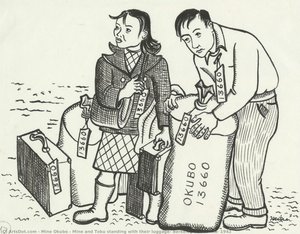
Mine and Toku standing with their luggage, Berkeley, California, 1942 (1944) de Miné Okubo

Mine and Toku standing with their luggage, Berkeley, California, 1942

1944 · Acrylic On Paper · Japanese American National Museum, Los Angeles

Miné Okubo's "Mine and Toku Standing with Their Luggage, Berkeley, California, 1942" isn’t merely a photograph; it’s a distilled essence of experience, a poignant snapshot frozen in time during a profoundly unsettling chapter of American history. Created in 1944, shortly after the internment of Japanese Americans following Pearl Harbor, this deceptively simple drawing offers an intimate and deeply affecting glimpse into the lives of two individuals – Miné and her…

6
Community toilets, Tanforan Assembly Center, San Bruno, California, 1942 (1944) de Miné Okubo

Community toilets, Tanforan Assembly Center, San Bruno, California, 1942

1944 · Ink On Paper · Japanese American National Museum, Los Angeles

Miné Okubo's "Community Toilets, Tanforan Assembly Center, San Bruno, California, 1942" is far more than a simple depiction of a utilitarian space. It’s a poignant and profoundly moving testament to the everyday realities faced by Japanese Americans unjustly incarcerated during World War II. Rendered in stark black ink on white paper, the artwork transcends its subject matter to become a powerful symbol of loss, dignity, and quiet resilience within a…

7
Mine and Toku arrive in their barrack, Central Utah Relocation Project, Topaz, Utah, 1942 (1944) de Miné Okubo

Mine and Toku arrive in their barrack, Central Utah Relocation Project, Topaz, Utah, 1942

1944 · Acrylic On Canvas · Japanese American National Museum, Los Angeles

Miné Okubo's "Mine and Toku arrive in their barrack, Central Utah Relocation Project, Topaz, Utah, 1942" isn’t merely a drawing; it’s a distilled essence of trauma, displacement, and the quiet dignity of survival. Created during her forced incarceration at the Topaz War Relocation Center in 1942, this stark black-and-white image offers an intimate glimpse into a profoundly unsettling chapter of American history – the unjust internment of Japanese Americans during…

8
Eating lunch while awaiting departure inside the Civil Control Station, Berkeley, California, 1942 (1944) de Miné Okubo

Eating lunch while awaiting departure inside the Civil Control Station, Berkeley, California, 1942

1944 · Acrylic On Canvas · Japanese American National Museum, Los Angeles

Miné Okubo's "Eating Lunch while awaiting departure inside the Civil Control Station, Berkeley, California, 1942" isn't merely a depiction of a scene; it’s a distilled essence of wartime anxiety and the profound human cost of forced displacement. Created during a period of immense upheaval – the incarceration of Japanese Americans following Pearl Harbor – this black-and-white pen and ink drawing transcends its documentary origins to become a poignant meditation on…

9
Medical exam in laundry building, Central Utah Relocation Project, Topaz, Utah, 1942 (1944) de Miné Okubo

Medical exam in laundry building, Central Utah Relocation Project, Topaz, Utah, 1942

1944 · Ink · Japanese American National Museum, Los Angeles

The scene unfolds within the stark confines of a laundry building at the Topaz War Relocation Center. Here, in "Medical exam in laundry building, Central Utah Relocation Project, Topaz, Utah, 1942," the artist Miné Okubo captures a moment of quiet, clinical scrutiny. The air feels heavy with the weight of the surrounding enclosure, a space where the routine of a medical examination meets the lived reality of the Topaz camp.…

10
New bachelor dorms at Barrack 14, Tanforan Assembly Center, San Bruno, California, 1942 (1944) de Miné Okubo

New bachelor dorms at Barrack 14, Tanforan Assembly Center, San Bruno, California, 1942

1944 · Acrylic On Canvas · Japanese American National Museum, Los Angeles

Within the stark, geometric confines of the Tanforan Assembly Center during World War II, Miné Okubo captured a poignant and enduring moment – “New Bachelor Dorms at Barrack 14.” This deceptively simple ink-on-paper illustration transcends mere documentation; it’s a testament to human dignity amidst displacement, a quiet observation of daily life within the shadow of internment. Created in 1942-1944, during a period of immense upheaval for Japanese Americans, Okubo's work…

Pinturas de Miné Okubo, classificadas de 11 a 72

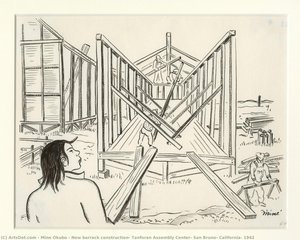
11Army blanket distribution, Central Utah Relocation Project, Topaz, Utah, 1942 (1944) de Miné OkuboArmy blanket distribution, Central Utah Relocation Project, Topaz, Utah, 19421944 · Japanese American National Museum 12Obtaining drinking water, Central Utah Relocation Project, Topaz, Utah, 1942-1944 (1944) de Miné OkuboObtaining drinking water, Central Utah Relocation Project, Topaz, Utah, 1942-19441944 · Japanese American National Museum 13Working at the Topaz Times, Central Utah Relocation Project, Topaz, Utah, 1942 (1944) de Miné OkuboWorking at the Topaz Times, Central Utah Relocation Project, Topaz, Utah, 19421944 · Japanese American National Museum 14Teacher and students in classroom, Central Utah Relocation Project, Topaz, Utah, 1942-1944 (1944) de Miné OkuboTeacher and students in classroom, Central Utah Relocation Project, Topaz, Utah, 1942-19441944 · Japanese American National Museum 15Waiting in line to receive vaccinations, Tanforan Assembly Center, San Bruno, California, 1942 (1944) de Miné OkuboWaiting in line to receive vaccinations, Tanforan Assembly Center, San Bruno, California, 19421944 · Japanese American National Museum 16Mosquitos and flies in the barracks, Central Utah Relocation Project, Topaz, Utah, 1942-1944 (1944) de Miné OkuboMosquitos and flies in the barracks, Central Utah Relocation Project, Topaz, Utah, 1942-19441944 · Japanese American National Museum 17Observing camp activities from a rooftop, Tanforan Assembly Center, San Bruno, California, 1942 (1944) de Miné OkuboObserving camp activities from a rooftop, Tanforan Assembly Center, San Bruno, California, 19421944 · Japanese American National Museum 18Bus ride to Central Utah Relocation Project, Topaz, Utah, 1942 (1944) de Miné OkuboBus ride to Central Utah Relocation Project, Topaz, Utah, 19421944 · Japanese American National Museum 19Listening to radio announcement of bombing of Pearl Harbor, with brother Toku, Berkeley, California, 1941 (1944) de Miné OkuboListening to radio announcement of bombing of Pearl Harbor, with brother Toku, Berkeley, California, 19411944 · Japanese American National Museum 20Registering at the Civil Control Station at Pilgrim Hall of the First Congregational Church, Berkeley, California, 1942 (1944) de Miné OkuboRegistering at the Civil Control Station at Pilgrim Hall of the First Congregational Church, Berkeley, California, 19421944 · Japanese American National Museum 21Arrival at Tanforan Assembly Center, San Bruno, California, 1942 (1944) de Miné OkuboArrival at Tanforan Assembly Center, San Bruno, California, 19421944 · Japanese American National Museum 22Waiting in line for supper, Tanforan Assembly Center, San Bruno, California, 1942 (1944) de Miné OkuboWaiting in line for supper, Tanforan Assembly Center, San Bruno, California, 19421944 · Japanese American National Museum 23Induction at Central Utah Relocation Project, Topaz, Utah, 1942 (1944) de Miné OkuboInduction at Central Utah Relocation Project, Topaz, Utah, 19421944 · Japanese American National Museum 24[Untitled] (1977) de Miné Okubo[Untitled]1977 · Japanese American National Museum 25New barrack construction, Tanforan Assembly Center, San Bruno, California, 1942 (1944) de Miné OkuboNew barrack construction, Tanforan Assembly Center, San Bruno, California, 19421944 · Japanese American National Museum 26Arrival of evacuees from Hawaii, Central Utah Relocation Project, Topaz, Utah, 1942-1944 (1944) de Miné OkuboArrival of evacuees from Hawaii, Central Utah Relocation Project, Topaz, Utah, 1942-19441944 · Japanese American National Museum 27Carrying mattresses to the barrack, Central Utah Relocation Project, Topaz, Utah, 1942 (1944) de Miné OkuboCarrying mattresses to the barrack, Central Utah Relocation Project, Topaz, Utah, 19421944 · Japanese American National Museum 28Eating in the mess hall, Central Utah Relocation Project, Topaz, Utah, 1942-1944 (1944) de Miné OkuboEating in the mess hall, Central Utah Relocation Project, Topaz, Utah, 1942-19441944 · Japanese American National Museum 29Mine with open newspaper, surrounded by anti-Japanese slogans, Berkeley, California, 1941 (1944) de Miné OkuboMine with open newspaper, surrounded by anti-Japanese slogans, Berkeley, California, 19411944 · Japanese American National Museum 30Scavenging lumber to build furniture, Central Utah Relocation Project, Topaz, Utah, 1942 (1944) de Miné OkuboScavenging lumber to build furniture, Central Utah Relocation Project, Topaz, Utah, 19421944 · Japanese American National Museum 31Landscaping with trees, Central Utah Relocation Project, Topaz, Utah, 1942-1944 (1944) de Miné OkuboLandscaping with trees, Central Utah Relocation Project, Topaz, Utah, 1942-19441944 · Japanese American National Museum 32Snowball fight, Central Utah Relocation Project, Topaz, Utah, 1942-1944 (1944) de Miné OkuboSnowball fight, Central Utah Relocation Project, Topaz, Utah, 1942-19441944 · Japanese American National Museum 33Families preparing for evacuation, Berkeley, California, 1942 (1944) de Miné OkuboFamilies preparing for evacuation, Berkeley, California, 19421944 · Japanese American National Museum 34First night at Tanforan Assembly Center, San Bruno, California, 1942 (1944) de Miné OkuboFirst night at Tanforan Assembly Center, San Bruno, California, 19421944 · Japanese American National Museum 35Mine and Toku assemble cots, Tanforan Assembly Center, San Bruno, California, 1942 (1944) de Miné OkuboMine and Toku assemble cots, Tanforan Assembly Center, San Bruno, California, 19421944 · Japanese American National Museum 36Awaiting registration at the Civil Control Station at Pilgrim Hall of the First Congregational Church, Berkeley, California, 1942 (1944) de Miné OkuboAwaiting registration at the Civil Control Station at Pilgrim Hall of the First Congregational Church, Berkeley, California, 19421944 · Japanese American National Museum 37Waiting to disembark from the bus at Tanforan Assembly Center, San Bruno, California, 1942 (1944) de Miné OkuboWaiting to disembark from the bus at Tanforan Assembly Center, San Bruno, California, 19421944 · Japanese American National Museum 38Dining with friends in Berkeley, California, ca.1939-1941 (1944) de Miné OkuboDining with friends in Berkeley, California, ca.1939-19411944 · Japanese American National Museum 39Mine at train station in Berne, Switzerland, 1939 (1944) de Miné OkuboMine at train station in Berne, Switzerland, 19391944 · Japanese American National Museum 40Arrival at Central Utah Relocation Project, Topaz, Utah, 1942 (1944) de Miné OkuboArrival at Central Utah Relocation Project, Topaz, Utah, 19421944 · Japanese American National Museum 41[Untitled] (1978) de Miné Okubo[Untitled]1978 · Japanese American National Museum 42Interior view of Mine and Toku (1944) de Miné OkuboInterior view of Mine and Toku1944 · Japanese American National Museum 43Luggage delivery truck, Tanforan Assembly Center, San Bruno, California, 1942 (1944) de Miné OkuboLuggage delivery truck, Tanforan Assembly Center, San Bruno, California, 19421944 · Japanese American National Museum 44Mine and Toku are shown to their barrack, Tanforan Assembly Center, San Bruno, California, 1942 (1944) de Miné OkuboMine and Toku are shown to their barrack, Tanforan Assembly Center, San Bruno, California, 19421944 · Japanese American National Museum 45Unfinished camp construction, Central Utah Relocation Project, Topaz, Utah, 1942 (1944) de Miné OkuboUnfinished camp construction, Central Utah Relocation Project, Topaz, Utah, 19421944 · Japanese American National Museum 46Mine reads newspaper announcing war declaration against Japan, Berkeley, California, 1941 (1944) de Miné OkuboMine reads newspaper announcing war declaration against Japan, Berkeley, California, 19411944 · Japanese American National Museum 47Walking with guide to Barrack 16, Room 50, Tanforan Assembly Center, San Bruno, California, 1942 (1944) de Miné OkuboWalking with guide to Barrack 16, Room 50, Tanforan Assembly Center, San Bruno, California, 19421944 · Japanese American National Museum 48[Untitled] (1978) de Miné Okubo[Untitled]1978 · Japanese American National Museum 49Interior of Mine and Toku (1944) de Miné OkuboInterior of Mine and Toku1944 · Japanese American National Museum 50[Untitled] (1970) de Miné Okubo[Untitled]1970 · Japanese American National Museum 51Receiving hostile looks while traveling by bus, Berkeley, California, 1941-42 (1944) de Miné OkuboReceiving hostile looks while traveling by bus, Berkeley, California, 1941-421944 · Japanese American National Museum 52Mine and Toku preparing for departure, Berkeley, California, 1942 (1944) de Miné OkuboMine and Toku preparing for departure, Berkeley, California, 19421944 · Japanese American National Museum 53Returning home for curfew, Berkeley, California, 1942 (1944) de Miné OkuboReturning home for curfew, Berkeley, California, 19421944 · Japanese American National Museum 54Mail-order clothing from Sears Roebuck, Central Utah Relocation Project, Topaz, Utah, 1942-1944 (1944) de Miné OkuboMail-order clothing from Sears Roebuck, Central Utah Relocation Project, Topaz, Utah, 1942-19441944 · Japanese American National Museum 55[Untitled] (1969) de Miné Okubo[Untitled]1969 · Japanese American National Museum 56[Untitled] (1968) de Miné Okubo[Untitled]1968 · Japanese American National Museum 57Rocky Ladies ? (1977) de Miné OkuboRocky Ladies ?1977 · Japanese American National Museum 58Bachelor (1944) de Miné OkuboBachelor1944 · Japanese American National Museum 59[Untitled] (1969) de Miné Okubo[Untitled]1969 · Japanese American National Museum 60[Untitled] (1974) de Miné Okubo[Untitled]1974 · Japanese American National Museum 61Victory gardens, Central Utah Relocation Project, Topaz, Utah, 1942-1944 (1944) de Miné OkuboVictory gardens, Central Utah Relocation Project, Topaz, Utah, 1942-19441944 · Japanese American National Museum 62Trimming grass inside living quarters, Tanforan Assembly Center, San Bruno, California, 1942 (1944) de Miné OkuboTrimming grass inside living quarters, Tanforan Assembly Center, San Bruno, California, 19421944 · Japanese American National Museum 63Departure postings at the Civil Control Station, Berkeley, California, 1942 (1944) de Miné OkuboDeparture postings at the Civil Control Station, Berkeley, California, 19421944 · Japanese American National Museum 64Medical exam at Tanforan Assembly Center, San Bruno, California, 1942 (1944) de Miné OkuboMedical exam at Tanforan Assembly Center, San Bruno, California, 19421944 · Japanese American National Museum 65Mine and Toku sweep the stall, Tanforan Assembly Center, San Bruno, California, 1942 (1944) de Miné OkuboMine and Toku sweep the stall, Tanforan Assembly Center, San Bruno, California, 19421944 · Japanese American National Museum 66Inspection of evacuees for contraband, Tanforan Assembly Center, San Bruno, California, 1942 (1944) de Miné OkuboInspection of evacuees for contraband, Tanforan Assembly Center, San Bruno, California, 19421944 · Japanese American National Museum 67Relocation notification, Tanforan Assembly Center, San Bruno, California, 1942 (1944) de Miné OkuboRelocation notification, Tanforan Assembly Center, San Bruno, California, 19421944 · Japanese American National Museum 68Receiving room assignments at Tanforan Assembly Center, San Bruno, California, 1942 (1944) de Miné OkuboReceiving room assignments at Tanforan Assembly Center, San Bruno, California, 19421944 · Japanese American National Museum 69Waiting to use the washrooms, Central Utah Relocation Project, Topaz, Utah, 1942-1944 (1944) de Miné OkuboWaiting to use the washrooms, Central Utah Relocation Project, Topaz, Utah, 1942-19441944 · Japanese American National Museum 70Rest stop with military police, Nevada, 1942 (1944) de Miné OkuboRest stop with military police, Nevada, 19421944 · Japanese American National Museum 71Sem título (1978) de Miné OkuboSem título1978 · Japanese American National Museum 72Shopping at the canteen, Tanforan Assembly Center, San Bruno, California, 1942 (1944) de Miné OkuboShopping at the canteen, Tanforan Assembly Center, San Bruno, California, 19421944 · Japanese American National Museum

Pinturas famosas de Miné Okubo, período por período

Os temas que cativaram o olhar de Miné Okubo

Os quatro temas que mais se repetem nestas obras originais, cada um com o seu melhor exemplo.

Os museus que guardam os originais de Miné Okubo

O museu que detém a maioria das pinturas desta página.

Museus Cidade Obras de Miné Okubo Pinturas desta lista
Japanese American National Museum, Los AngelesJapanese American National Museum Los Angeles 72 (3 Women Going to Church), Walking over muddy ground, Central Utah Relocation Project, Topaz, Utah, 1942-1944, Teaching art classes, Tanforan Assembly Center, San Bruno, California, 1942

Miné Okubo, uma pintura emblemática por década

Obras por década

Escolha uma década para ver a obra original que a define.

Pinturas de Miné Okubo: a galeria responde

Qual pintura de Miné Okubo é a mais famosa de todas?Revelar a resposta

(3 Women Going to Church) (1948), Japanese American National Museum, Los Angeles. Walking over muddy ground, Central Utah Relocation Project, Topaz, Utah, 1942-1944 (1944) e Teaching art classes, Tanforan Assembly Center, San Bruno, California, 1942 (1944) vêm a seguir.

Qual era a idade de Miné Okubo ao concluir (3 Women Going to Church)?Revelar a resposta

36 anos: (3 Women Going to Church) data de 1948, e Miné Okubo nasceu em 1912.

Quais são as 10 principais pinturas de Miné Okubo?Revelar a resposta

(3 Women Going to Church), Walking over muddy ground, Central Utah Relocation Project, Topaz, Utah, 1942-1944, Teaching art classes, Tanforan Assembly Center, San Bruno, California, 1942, Posting of Civilian Exclusion Order/Evacuation Order No. 19, Berkeley, California, 1942, Mine and Toku standing with their luggage, Berkeley, California, 1942, Community toilets, Tanforan Assembly Center, San Bruno, California, 1942, Mine and Toku arrive in their barrack, Central Utah Relocation Project, Topaz, Utah, 1942, Eating lunch while awaiting departure inside the Civil Control Station, Berkeley, California, 1942, Medical exam in laundry building, Central Utah Relocation Project, Topaz, Utah, 1942 e New bachelor dorms at Barrack 14, Tanforan Assembly Center, San Bruno, California, 1942. O ranking acima apresenta o ano e o museu de cada uma.

Quantas obras Miné Okubo criou?Revelar a resposta

Nosso catálogo contém 72 obras de Miné Okubo, datadas de 1944 a 1978.

Onde estão expostos os originais mais famosos de Miné Okubo?Revelar a resposta

Principalmente em Japanese American National Museum (Los Angeles). A tabela de museus acima lista todos eles.

Quando é que Miné Okubo criou as suas pinturas mais famosas?Revelar a resposta

Em 1940s: 62 das 72 obras nesta página foram feitas então, sendo (3 Women Going to Church) delas.

Quais são as obras mais famosas de Miné Okubo no início e no fim de sua carreira?Revelar a resposta

Nesta página, a mais antiga é Walking over muddy ground, Central Utah Relocation Project, Topaz, Utah, 1942-1944 (1944) e a mais recente é [Untitled] (1978).

Quais temas Miné Okubo mais explorou?Revelar a resposta

Resilience (37), Observation (21) e Japanese american (16), entre as 72 obras nesta página.

Em qual técnica Miné Okubo mais trabalhou?Revelar a resposta

Acrylic On Canvas, para 34 das 72 obras nesta página.

Com qual movimento Miné Okubo está associado(a)?Revelar a resposta

Social realism, a julgar pelos originais nesta página.

Quais obras originais de Miné Okubo o Japanese American National Museum possui?Revelar a resposta

(3 Women Going to Church), Walking over muddy ground, Central Utah Relocation Project, Topaz, Utah, 1942-1944 e Teaching art classes, Tanforan Assembly Center, San Bruno, California, 1942: o Japanese American National Museum, Los Angeles detém 72 das obras desta página.

Miné Okubo: o artista

A Vida Escrita na Resiliência: A Arte de Miné Okubo

Miné Okubo, nascida em Riverside, Califórnia, em 1912, foi uma artista cuja vida se entrelaçou inextricavelmente com um capítulo crucial e doloroso da história americana. Sua trajetória não é apenas a de um talento artístico, mas sim de uma coragem profunda, uma observação inabalável e o poder da arte como testemunho. Desde os primeiros incentivos dentro de uma família que valorizava a criatividade – sua mãe, uma habilidosa calígrafa, seu pai, um estudioso – Okubo embarcou em um caminho rumo ao treinamento formal, estudando na Universidade da Califórnia, Berkeley, e posteriormente aventurando-se na Europa em 1938 para ampliar seus horizontes artísticos. Este período de estudo foi abruptamente interrompido pela sombra sinistra da Segunda Guerra Mundial, forçando seu retorno aos Estados Unidos pouco antes que as tensões globais atingissem o ápice. Mal sabia ela que essa chegada trará não apenas a continuidade de sua jornada artística, mas também a injusta prisão e uma experiência que definiria tanto sua vida quanto sua arte.

Testemunho Artístico em Tempos de Adversidade

O ataque a Pearl Harbor alterou drasticamente o curso da vida de Okubo, assim como para inúmeros outros americanos de origem japonesa. Em 1942, ela e seu irmão Benji foram arrancados de suas casas e injustamente confinados no Tanforan Assembly Center, um antigo estádio de corrida transformado em um centro temporário de detenção antes de serem transferidos para o mais permanente Topaz War Relocation Center, em Utah. É dentro dessas paredes de arame farpado, em meio à poeira e ao desespero, que Okubo embarcou em seu empreendimento artístico mais significativo. Impulsionada por uma necessidade quase compulsiva de documentar a realidade ao seu redor, ela começou a criar um notável registro visual da vida no campo – mais de 2.000 desenhos e esboços meticulosamente renderizados em grafite, aquarela e carvão. Estes não eram grandes quadros históricos ou retratos idealizados; eram representações cruas e honestas da existência cotidiana: alojamentos superlotados, processos burocráticos, rostos marcados pela preocupação e resignação, momentos de dignidade silenciosa em meio à profunda angústia. Sua arte não era apenas uma resposta pessoal; era um ato de desafio, uma recusa em ser silenciado ou apagado.

Citizen 13660: Um Testemunho de Desumanização e Esperança

Após sua libertação de Topaz em 1944, Okubo canalizou suas experiências em uma obra-prima artística e literária: *Citizen 13660*. Publicada em 1946, o livro compreendia 198 de seus desenhos acompanhados por textos pungentes. O próprio título é profundamente simbólico, referindo-se ao número atribuído a ela no sistema de detenção – um lembrete impactante do processo desumanizador que ela e tantos outros sofreram. *Citizen 13660* não era apenas um relato da dor; era uma representação sutil da força humana diante da adversidade. Okubo não hesitou em retratar as injustiças e a humilhação, mas também capturou momentos de comunidade, humor e força silenciosa. Os desenhos são caracterizados por sua direta, profundidade emocional e uso magistral da linha e sombra. O livro rapidamente se tornou uma obra seminal que documentava a experiência dos americanos japoneses internados, oferecendo um olhar implacável sobre um capítulo obscuro da história americana que muitos preferiram ignorar.

Influências Artísticas e Evolução Estilística

Okubo foi influenciada por uma variedade de artistas e movimentos artísticos. Sua formação na Universidade da Califórnia, Berkeley, expôs-a ao modernismo europeu, enquanto seu trabalho durante a Grande Depressão a aproximou do Social Realismo – um movimento que enfatizava a representação de questões sociais e da vida cotidiana com precisão implacável. A influência de sua mãe, uma calígrafa talentosa, e de seu irmão Benji, um pintor pioneiro, moldaram sua visão artística. Após a guerra, Okubo se mudou para Nova York e continuou sua carreira artística, trabalhando como ilustradora para revistas e livros, e realizando projetos de murais. Embora nunca abandonasse os temas de justiça social e dignidade humana que haviam definido seu trabalho durante a guerra, seu estilo evoluiu ao longo do tempo. Ela explorou diferentes mídias e técnicas, mas sempre manteve um compromisso com o realismo e a observação honesta.

Legado Duradouro: A Arte como Testemunho Social

Miné Okubo faleceu em 2001 aos 88 anos. Sua obra permanece um poderoso lembrete da fragilidade das liberdades civis, da importância da vigilância contra o preconceito e a discriminação e do poder duradouro da arte para testemunhar, desafiar a injustiça e inspirar esperança. Seus desenhos não são apenas documentos históricos; são histórias humanas profundamente gravadas em grafite e aquarela, nos forçando a lembrar, aprender com e nunca repetir os erros do passado.