A Quiet Revolution in Color: The Life and Art of Milton Avery
Milton Clark Avery, born March 7, 1885, in the small hamlet of Altmar, New York, wasn’t a painter who stormed the art world with manifestos or radical pronouncements. Instead, his revolution unfolded quietly, through a subtle yet profound exploration of color and form that would deeply influence generations of American artists. His early life was steeped in practicality; as the son of a tanner, Avery began working at sixteen to support his family after his father’s untimely death, taking on various blue-collar jobs while nurturing a burgeoning passion for art. This period instilled in him a grounded sensibility, a connection to everyday life that would permeate his work.
Early Life and Artistic Beginnings
Raised in rural New York State amidst the hardships of working-class existence, Avery’s formative years shaped his artistic vision profoundly. The death of his brother-in-law in 1915 left him responsible for caring for nine female relatives—a circumstance that instilled a deep sense of responsibility and fostered an unwavering dedication to providing for his family. Recognizing his innate talent for visual representation, he pursued formal training at the Connecticut League of Art Students and later at the Art Students League of New York, honing his skills through disciplined observation and experimentation.
Influences from European Modernism
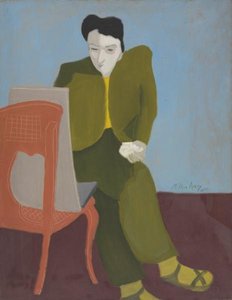
Avery’s artistic journey wasn't defined by immediate acclaim but rather by a gradual assimilation of influential movements. He absorbed the bold color palettes of French Fauvism—artists like Henri Matisse served as pivotal mentors—and the expressive distortions characteristic of German Expressionism, particularly the work of Ernst Ludwig Kirchner. However, Avery skillfully synthesized these lessons into something uniquely his own; he didn’t merely imitate stylistic conventions but rather interrogated their underlying principles, seeking to distill essence and convey emotion.
The Rise of Color Field Painting & Recognition by Roy Neuberger
Avery's breakthrough came in the 1930s with the patronage of Roy Neuberger, a New York art dealer who recognized the exceptional quality and originality of his paintings. Neuberger’s astute judgment propelled Avery into the spotlight, initiating an ambitious campaign to disseminate his work internationally—a pivotal moment that secured his place as a cornerstone of American Modernism. Among Neuberger's most notable acquisitions was *Gaspé Landscape*, which became emblematic of Avery’s distinctive style: luminous color fields juxtaposed with simplified geometric forms.
A Legacy of Serenity and Influence
Milton Avery’s enduring legacy resides in his unwavering commitment to exploring the expressive potential of color—a pursuit that profoundly impacted subsequent generations of artists. Artists like Mark Rothko and Adolph Gottlieb acknowledged Avery's influence, recognizing his pioneering role in establishing Color Field painting as a dominant aesthetic trend. His paintings continue to captivate audiences today with their serene beauty, understated elegance, and profound emotional resonance—a testament to an artist who dared to redefine the boundaries of artistic expression.