Retrato de Marj Bond

As 12 Pinturas Mais Famosas de Marj Bond, Cada Uma Única

Atualizado em Novembro 2026 · classificado pela nossa pontuação de popularidade (pesquisas, visitas e pedidos de cada obra) · 12 obras de Marj Bond em nosso catálogo

Em resumo

Eagle and Jaguar Warriors (Green Faces) (1993) é a pintura de Marj Bond que mais atrai olhares; a obra original pertence ao Nhs Lothian, Edimburgo. Depois disso, o olhar recai sobre Votive Queen (1997) e Oasis (1997). Entre as 12 obras de Marj Bond em nosso catálogo, estas 12 são as mais famosas, cada uma uma original única apresentada com o seu ano, o seu museu e a razão pela qual perdura.

nascido em 1939 Mais obras: Nhs Lothian

As 10 principais pinturas de Marj Bond, sob o olhar da galeria

1
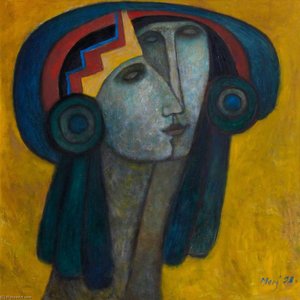
Eagle and Jaguar Warriors (Green Faces) (1993) de Marj Bond

Eagle and Jaguar Warriors (Green Faces)

1993 · Oil On Canvas · Nhs Lothian, Edimburgo

A woman stares out from a field of intense yellow, her gaze steady and heavy with a quiet, internal gravity. She occupies the center of the frame, her form defined by bold, angular lines that carve her presence out of the space. Her features carry the weight of ancient lineages, framed by an elaborate headdress and large earrings that suggest a status far beyond the ordinary. The light falls evenly…

2
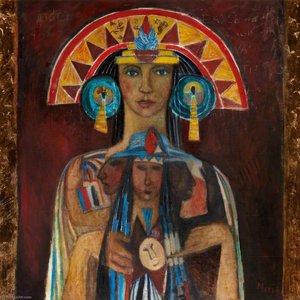
Votive Queen (1997) de Marj Bond

Votive Queen

1997 · Oil On Canvas

The artwork presents a stylized portrait of a woman, viewed from a frontal perspective. Her face is elongated, characterized by angular, geometric planes that define the nose, cheekbones, and jawline. A large, stylized archway frames the upper portion of the composition, enclosing the subject's head and upper torso. The background consists of a textured square featuring vertical stripes in varying shades of brown and beige. The figure is adorned with…

3
Oasis (1997) de Marj Bond

Oasis

1997 · Watercolor · Scottish National Gallery of Modern Art, Edimburgo

In the vast, sun-drenched expanse of Oasis, created in 1997, the viewer is immediately transported into a realm where the boundaries between reality and dreamscape dissolve. Marj Bond, an artist renowned for her ability to weave together the tangible textures of landscape with the ethereal whispers of the inner spirit, presents us with a scene that transcends mere desert scenery. This large-scale masterpiece, measuring 106 x 106 cm, serves as…

Pinturas famosas de Marj Bond, números 11 a 12

Os museus que guardam os originais de Marj Bond

Os 2 museus que detêm a maioria das pinturas desta página.

Museus Cidade Obras de Marj Bond Pinturas desta lista
Nhs Lothian, EdimburgoNhs Lothian Edimburgo 7 Eagle and Jaguar Warriors (Green Faces), Eagle and Jaguar (Sun Goddess), Eagle and Jaguar
Scottish National Gallery of Modern Art, EdimburgoScottish National Gallery of Modern Art Edimburgo 1 Oasis

Marj Bond ao longo dos anos: os originais únicos de cada um

Entre 1993 e 1997, totalizando 5 anos, Marj Bond criou cada original datado aqui exibido: um curto período, ano após ano.

Obras por ano

Escolha um ano para ver as obras originais.

Pinturas de Marj Bond: perguntas para a galeria

Qual é a obra mais famosa de Marj Bond?Revelar a resposta

Eagle and Jaguar Warriors (Green Faces) (1993), Nhs Lothian, Edimburgo. Votive Queen (1997) e Oasis (1997) vêm a seguir.

Com que idade Marj Bond criou Eagle and Jaguar Warriors (Green Faces)?Revelar a resposta

54 anos: Eagle and Jaguar Warriors (Green Faces) data de 1993, e Marj Bond nasceu em 1939.

Quais são as dez pinturas mais famosas de Marj Bond?Revelar a resposta

Eagle and Jaguar Warriors (Green Faces), Votive Queen, Oasis, Eagle and Jaguar (Sun Goddess), Eagle and Jaguar, Three Figures in a Landscape, Undulating Perthshire, Sun and Moon, Aztec Head e Eagle and Jaguar Warriors (Heart). O ranking acima apresenta o ano e o museu de cada uma.

Quantas obras de Marj Bond são conhecidas?Revelar a resposta

Nosso catálogo contém 12 obras de Marj Bond, datadas de 1993 a 1997.

Onde se pode ver os originais mais famosos de Marj Bond?Revelar a resposta

Principalmente em Nhs Lothian (Edimburgo) e Scottish National Gallery of Modern Art (Edimburgo). A tabela de museus acima lista todos eles.

Em que período Marj Bond criou as suas pinturas mais conhecidas?Revelar a resposta

Em 1993: 3 das 12 obras nesta página foram feitas então, sendo Eagle and Jaguar Warriors (Green Faces) delas.

Qual pintura famosa de Marj Bond é a mais antiga e qual é a mais recente?Revelar a resposta

Nesta página, a mais antiga é Eagle and Jaguar Warriors (Green Faces) (1993) e a mais recente é Votive Queen (1997).

Com quais materiais Marj Bond mais pintou?Revelar a resposta

Oil On Canvas, para 2 das 12 obras nesta página.

Quais originais de Marj Bond posso ver no Nhs Lothian?Revelar a resposta

Eagle and Jaguar Warriors (Green Faces), Eagle and Jaguar (Sun Goddess) e Eagle and Jaguar: o Nhs Lothian, Edimburgo detém 7 das obras desta página.

Marj Bond: um retrato do artista

Marj Bond: A Weaver of Scottish Landscapes and Inner Worlds

Marjorie “Marj” Brasch, a name now synonymous with the vibrant heart of Scottish watercolour, wasn’t simply an artist; she was a conduit, channeling the raw beauty of her homeland – its rugged landscapes, ancient myths, and deeply felt spirituality – onto canvas. Born in Paisley, Scotland, in 1936, into a family steeped in music and tradition, Marj's artistic journey began not with formal training but with an innate compulsion to capture the world around her. This early drive, coupled with a restless spirit of exploration and a profound connection to nature, would ultimately define her distinctive style and enduring legacy. Her life was one of constant movement – a deliberate rejection of settled routines in favor of immersing herself in diverse cultures and landscapes, experiences that profoundly shaped her artistic vision. She wasn’t merely painting what she saw; she was translating the *feeling* of Scotland into colour and form.

Early Influences and Artistic Development

Marj's formal training at Glasgow School of Art in the mid-1950s provided a crucial foundation, exposing her to the techniques and philosophies of established masters like Alex Dick, David Donaldson, Mary Armour, and Benno Schotz. However, it was the influence of the Scottish Colourists – figures like George Leslie Pearce and Francis Cadell – that truly resonated with her. Their bold use of colour, expressive brushwork, and ability to imbue landscapes with a sense of emotional intensity became a guiding light for Marj’s own work. Crucially, she moved away from the tonal realism prevalent at the time, embracing a brighter palette and a more intuitive approach to composition. This shift was dramatically influenced by her travels, particularly her 1988 sabbatical in India, where she experienced a transformative awakening to colour and texture. The vibrant hues of Indian textiles, the intricate patterns, and the sheer abundance of light ignited within her a desire to break free from the constraints of traditional painting techniques. She began experimenting with handmade paper, incorporating its unique textures and imperfections into her work – a deliberate act of embracing imperfection and celebrating the beauty of the hand-crafted.

A Journey Through Cultures: Landscapes as Mirrors

Marj’s artistic evolution wasn't confined to Scotland; it was fueled by an insatiable curiosity and a willingness to engage with diverse cultures. Her travels to Mexico, Morocco, Cuba, and Italy weren’t simply vacations; they were immersive experiences that profoundly impacted her artistic sensibilities. Each journey yielded new visual vocabulary – the geometric patterns of Mayan architecture in Yucatan, the rich ochre tones of Moroccan landscapes, the vibrant colours of Cuban textiles, the subtle hues of Italian light. These influences manifested in her work through a layering of motifs and symbols, creating complex narratives that spoke to universal themes of spirituality, mythology, and the interconnectedness of all things. Her paintings became visual diaries, documenting not just places but also the emotional resonance she felt within them. The recurring presence of animals – eagles, jaguars, wolves – often symbolized strength, wisdom, and a connection to the wild.

Key Works and Recognition

Marj’s distinctive style quickly garnered recognition within the Scottish art world. She was awarded the Anne Redpath Award in 1984, a prestigious honor recognizing her talent and originality. The Crawford Arts Centre Special Award in St Andrews in 1987 further cemented her position as a leading contemporary watercolourist. Her work has been exhibited extensively throughout the UK and internationally, including Sweden, France, America, London, and Dublin. Notable works such as “Eagle and Jaguar Warriors (Green Faces)” (1993), a powerful expressionistic portrait blending indigenous motifs with bold colours, exemplify her unique approach. Her paintings are now held in private and public collections across the globe, including Perth Museum & Art Gallery and Edinburgh University, testament to their enduring appeal.

Legacy and Continuing Influence

Marj Bond’s death in 2023 marked the loss of a truly original voice in Scottish art. Her legacy extends beyond her individual paintings; she demonstrated the transformative power of travel and cultural exchange, inspiring countless artists to embrace new perspectives and push the boundaries of their creative practice. Her willingness to experiment with texture, colour, and symbolism continues to resonate today, reminding us that art can be a powerful tool for exploring our inner worlds and connecting with the beauty and complexity of the world around us. Her work stands as a vibrant celebration of Scottish heritage, infused with a global perspective and an unwavering commitment to artistic innovation.