Retrato de Ludwig Meidner

As 19 Pinturas Mais Famosas de Ludwig Meidner, Cada Uma Única

Atualizado em Novembro 2026 · classificado pela nossa pontuação de popularidade (pesquisas, visitas e pedidos de cada obra) · 22 obras de Ludwig Meidner em nosso catálogo

Em resumo

Max Herrmann-Neisse (1913) é a pintura de Ludwig Meidner que mais atrai olhares; a obra original pertence ao Art Institute of Chicago, Chicago. Depois disso, o olhar recai sobre Despair (III) (1914) e Blowing the Shofar (1937). Entre as 22 obras de Ludwig Meidner em nosso catálogo, estas 19 são as mais famosas, cada uma uma original única apresentada com o seu ano, o seu museu e a razão pela qual perdura.

1884 – 1966 Expressionism Mais obras: Jewish Museum Frankfurt

As 10 principais pinturas de Ludwig Meidner, sob o olhar da galeria

1
Max Herrmann-Neisse (1913) de Ludwig Meidner

Max Herrmann-Neisse

1913 · Oil On Canvas · Art Institute of Chicago, Chicago

The gaze of the subject meets us in this 1913 portrait, a moment frozen in oil by the hand of Ludwig Meidner. This work captures Max Herrmann-Neisse, a figure who moved through the intellectual circles of Berlin as a poet and theater critic. The artist, Ludwig Meidner, finds his way into the inner lives of the city's literati, and here he settles upon the face of this specific writer. There…

2
Despair (III) (1914) de Ludwig Meidner

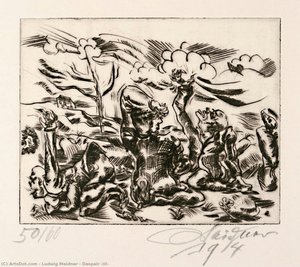
Despair (III)

1914 · Woodcut · Jewish Museum Frankfurt, Frankfurt

Despair (III) by Ludwig Meidner is a monochromatic woodcut print created about 1914. The composition is tightly cropped, focusing the viewer's attention on a central group of figures situated within a desolate landscape. These figures are depicted in a state of distress, their forms conveying a sense of suffering or abandonment. In the background, a small building is visible, providing a solitary point of reference within the empty surroundings. The…

3
Blowing the Shofar (1937) de Ludwig Meidner

Blowing the Shofar

1937 · Drawing · Jewish Museum Frankfurt, Frankfurt

In the evocative depths of Ludwig Meidner’s 1937 work, Blowing the Shofar, we are transported to a moment of profound spiritual and auditory intensity. This striking black and white drawing captures more than just a ritualistic act; it captures the very breath of a culture. The subject, a man draped in a heavy, hooded robe, is caught in the visceral moment of exhaling into the shofar—a ram’s horn instrument central…

4
Gas Chamber (1945) de Ludwig Meidner

Gas Chamber

1945 · Jewish Museum Frankfurt, Frankfurt

Meidner’s charcoal drawing of a gas chamber was probably produced prior to the spring of 1945. Following the liberation of the extermination camps, numerous photos and eyewitness accounts circulated documenting the fact that in the majority of the death camps the gas chambers were disguised as shower blocks, complete with shower heads, in order to prevent panic among those being sent to their deaths. This detail, intriguing in its perfidy,…

Pinturas famosas de Ludwig Meidner, números 11 a 19

Os temas que cativaram o olhar de Ludwig Meidner

Os quatro temas que mais se repetem nestas obras originais, cada um com o seu melhor exemplo.

Os museus que guardam os originais de Ludwig Meidner

Os 2 museus que detêm a maioria das pinturas desta página.

Museus Cidade Obras de Ludwig Meidner Pinturas desta lista
Jewish Museum Frankfurt, FrankfurtJewish Museum Frankfurt Frankfurt 13 Despair (III), Blowing the Shofar, Gas Chamber
Art Institute of Chicago, ChicagoArt Institute of Chicago Chicago 1 Max Herrmann-Neisse

Ludwig Meidner ao longo das décadas: uma obra original única para cada uma

Obras por década

Escolha uma década para ver a obra original que a define.

Pinturas de Ludwig Meidner: perguntas para a galeria

Qual é a obra mais famosa de Ludwig Meidner?Revelar a resposta

Max Herrmann-Neisse (1913), Art Institute of Chicago, Chicago. Despair (III) (1914) e Blowing the Shofar (1937) vêm a seguir.

Com que idade Ludwig Meidner criou Max Herrmann-Neisse?Revelar a resposta

29 anos: Max Herrmann-Neisse data de 1913, e Ludwig Meidner nasceu em 1884.

Quais são as dez pinturas mais famosas de Ludwig Meidner?Revelar a resposta

Max Herrmann-Neisse, Despair (III), Blowing the Shofar, Gas Chamber, Untitled (327), Ecstatic Figure, Male Head, Male Head with Kippah and Tallit, Male Portrait with Kippah e Two Praying Jews. O ranking acima apresenta o ano e o museu de cada uma.

Quantas obras de Ludwig Meidner são conhecidas?Revelar a resposta

Nosso catálogo contém 22 obras de Ludwig Meidner, datadas de 1913 a 1950.

Onde se pode ver os originais mais famosos de Ludwig Meidner?Revelar a resposta

Principalmente em Jewish Museum Frankfurt (Frankfurt) e Art Institute of Chicago (Chicago). A tabela de museus acima lista todos eles.

Em que período Ludwig Meidner criou as suas pinturas mais conhecidas?Revelar a resposta

Em 1930s: 5 das 19 obras nesta página foram feitas então, sendo Blowing the Shofar delas.

Qual pintura famosa de Ludwig Meidner é a mais antiga e qual é a mais recente?Revelar a resposta

Nesta página, a mais antiga é Max Herrmann-Neisse (1913) e a mais recente é The Sacrifice of Manoah (1950).

Quais temas Ludwig Meidner preferia?Revelar a resposta

Portrait (3), Man (2) e Tallit (2), entre as 19 obras nesta página.

Com quais materiais Ludwig Meidner mais pintou?Revelar a resposta

Drawing, para 5 das 19 obras nesta página.

A qual movimento pertence a obra de Ludwig Meidner?Revelar a resposta

Expressionism, a julgar pelos originais nesta página.

Quais originais de Ludwig Meidner posso ver no Jewish Museum Frankfurt?Revelar a resposta

Despair (III), Blowing the Shofar e Gas Chamber: o Jewish Museum Frankfurt, Frankfurt detém 13 das obras desta página.

Ludwig Meidner: um retrato do artista

A Life Shaped by Change

Born in Bernstadt, Germany, in 1884, Ludwig Meidner began his adult life far from the canvas. He first followed his parents' wishes by taking up an apprenticeship as a stonemason, though he did not complete this training. His path eventually led him to the Royal School of Art in Breslau and later to Paris, where he studied at the Académie Julian and Cormon Academies. During these years in Paris, he met Amedeo Modigliani, a connection that placed him at the center of a changing artistic landscape. After returning to Berlin, he worked as a fashion illustrator and draftsman, finding his footing within the city's growing avant-garde circles.

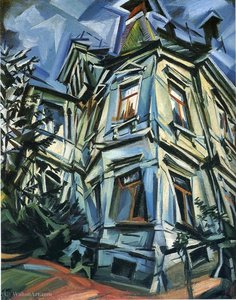
The years leading up to the First World War brought a profound shift in his vision. In 1912, he began creating what are often called his apocalyptic landscapes. These works featured chaotic scenes of urban life, with comets crossing skies like shells and buildings appearing on the verge of collapse. While some saw these images as predictions of the coming war, they were also reflections of the intense energy and social unrest present in the modern metropolis. His involvement with the Die Pathetiker group further solidified his place in the German expressionist movement.

Faith and Displacement

The devastation of the First World War changed Meidner deeply. Having served in the German military as an infantry soldier and a French interpreter, he emerged from the conflict with a different perspective on life and art. He turned toward Orthodox Judaism, finding a new source of meaning through religious themes. His work began to include portraits of prophets and scenes of Jewish ritual, such as his 1937 drawing, Blowing the Shofar. This period saw him moving away from pure expressionist chaos toward more structured, religious imagery that explored the inner experience of faith.

The rise of the Nazi party forced another period of movement and hardship. In 1935, Meidner moved to Cologne to teach at a Jewish school, but the increasing pressure in Germany became impossible to ignore. His work was included in the 1937 Degenerate Art exhibition in Munich, an event that marked him as a target of the regime. In August 1939, he and his wife, Else Meidner, fled to England. Life in London was difficult; he was interned at Huyton Camp and later on the Isle of Man. During these years of exile, he lived in near poverty, often relying on the support of the local Jewish community while continuing to draw and paint from his observations of the world around him.

A Return to Germany

After many years in England, Meidner chose to return to Germany in 1953. He settled in Frankfurt, a city that offered him both a sense of stability and a connection to his heritage. This later period of his life was marked by a renewed recognition within the German art scene. In 1964, he received the Order of Merit of the Federal Republic of Germany and became a member of the Berlin Academy of Fine Arts. His late works continued to reflect his lifelong engagement with both the physical world and the spiritual realm.

Meidner passed away in Darmstadt in 1966. His legacy remains visible in major institutions such as the Jewish Museum Frankfurt, the Museum of Modern Art in New York, and the Metropolitan Museum of Art. Through his varied roles as a painter, printmaker, and writer, he left behind a body of work that documented the turbulent transitions of the twentieth century.