Retrato de Ludwig Knaus

As 47 Pinturas Mais Famosas de Ludwig Knaus, Cada Uma Única

Atualizado em Novembro 2026 · classificado pela nossa pontuação de popularidade (pesquisas, visitas e pedidos de cada obra) · 51 obras de Ludwig Knaus em nosso catálogo

Em resumo

Portrait of Mrs. Müller (1848) é a pintura de Ludwig Knaus que mais atrai olhares; a obra original pertence ao Alte Nationalgalerie, Berlim. Depois disso, o olhar recai sobre Head of a Peasant Woman (1872) e Solomonic Wisdom (1878). Entre as 51 obras de Ludwig Knaus em nosso catálogo, estas 47 são as mais famosas, cada uma uma original única apresentada com o seu ano, o seu museu e a razão pela qual perdura.

1829 – 1910, Wiesbaden Realism Mais obras: Alte Nationalgalerie

As 10 principais pinturas de Ludwig Knaus, sob o olhar da galeria

1
Portrait of Mrs. Müller (1848) de Ludwig Knaus

Portrait of Mrs. Müller

1848 · Oil On Canvas · Alte Nationalgalerie, Berlim

The room feels still, held in a heavy, respectful silence. Mrs. Müller sits before us, her presence steady and unmoving against a dark, indistinct background that offers no distractions from her character. The light enters from the upper left, a soft, singular glow that brushes against her forehead and the curve of her cheek, leaving the other side of her face in a gentle, thoughtful shadow. There is a profound…

2
Head of a Peasant Woman (1872) de Ludwig Knaus

Head of a Peasant Woman

1872 · Oil On Canvas · Museu Hermitage, São Petersburgo

In this 1872 oil portrait, we find ourselves in a moment of profound stillness. The subject, a young peasant woman, is presented in a close-up bust view, her head turned slightly toward us as if caught in a fleeting thought. There is a certain gravity to her expression, a quiet melancholy that draws the viewer into her private world. The lighting, appearing to descend from the upper left, casts soft…

3
Solomonic Wisdom (1878) de Ludwig Knaus

Solomonic Wisdom

1878 · Oil On Canvas · Alte Nationalgalerie, Berlim

Solomonic Wisdom is an oil on canvas painting executed by Ludwig Knaus in 1878. The work belongs to the tradition of German genre painting, focusing on a specific moment of domestic instruction. The scene captures an elderly Jewish man initiating his grandchild into the secrets of the second-hand trade.

4
Portrait of the Physicist Hermann von Helmholtz (1881) de Ludwig Knaus

Portrait of the Physicist Hermann von Helmholtz

1881 · Oil On Panel · Alte Nationalgalerie, Berlim

In this 1881 oil on wood portrait, Ludwig Knaus captures the likeness of the German physicist and physiologist Hermann von Helmholtz. The work was originally commissioned for the National Gallery's portrait collection, a purpose that underscores the significance of the sitter during this period. Knaus, a prominent figure in nineteenth-century German art, brings a sense of quiet dignity to the subject, presenting him not merely as a scientist, but as…

5
The Hunter (1845) de Ludwig Knaus

The Hunter

1845 · Oil On Canvas · Alte Nationalgalerie, Berlim

In "The Hunter" by Ludwig Knaus, a solitary man occupies a vast, breathing landscape. The composition is vertically oriented, drawing the eye upward through a rugged terrain toward a distant horizon. Positioned slightly off-center to the left, the full-length figure of the hunter commands the space, his presence felt through the weight of his gear and his sudden, alert movement. He carries a long rifle and a shoulder bag, tools…

6
Walk in the Tuileries (1855) de Ludwig Knaus

Walk in the Tuileries

1855 · Oil On Canvas · Bavarian State Painting Collections, Munique

In "Walk in the Tuileries" by Ludwig Knaus, a quiet afternoon unfolds within the confines of a park, likely the Tuileries Garden. The composition centers on a trio of figures moving through the space. A woman leads the way, her long, light-colored dress contrasted by the weight of a dark shawl. Beside her, a small child in a white frock moves in rhythm with the group, accompanied by a young…

7
August Cappelen (1850) de Ludwig Knaus

August Cappelen

1850 · Oil On Canvas

The composition focuses entirely on the upper shoulders and the head, removing any sense of place or time. This isolation forces a direct connection between the viewer and the subject. There is a sense of dignity in the simplicity of the presentation. The darkness surrounding him does not feel empty; it feels like a quiet room where the only thing that matters is the breath of the sitter. The portrait…

8
Peasant in Hessian costume (1852) de Ludwig Knaus

Peasant in Hessian costume

1852 · Oil On Canvas · New Gallery, Kassel

In "Peasant in Hessian costume" by Ludwig Knaus, a single figure occupies the center of a vertical, full-length portrait. The man sits in a moment of stillness, dressed in the traditional attire of a Hessian peasant. His clothing is a study in muted, naturalistic tones; creams and whites define the fabric of his garments, while deep blacks and blues anchor the waistcoat and stockings. The subject is positioned at eye-level,…

9
Portrait of a young girl (1852) de Ludwig Knaus

Portrait of a young girl

1852 · Oil · Moravian Gallery in Brno, Brno

Ludwig Knaus presents a bust-length portrait in Portrait of a young girl, dating from about 1852. The subject is positioned slightly off-center, facing the viewer with a gentle, contemplative expression. Her dark hair is parted in the middle, framing a face characterized by luminous skin tones. This central focus is emphasized by a dark, indistinct background that lacks specific detail, ensuring the viewer's attention remains fixed upon the sitter.

10
The cheater (1851) de Ludwig Knaus

The cheater

1851 · Oil · Alte Nationalgalerie, Berlim

Step into the dim, amber-lit atmosphere of this 1851 oil painting. We find ourselves in a rustic interior, perhaps a tavern, where the air feels heavy with unspoken tension. A group of men is gathered around a wooden table, their bodies leaning inward, caught in a singular moment of intense concentration. The light, striking from the upper left, carves their features out of the darkness, casting deep shadows that swallow…

Pinturas famosas de Ludwig Knaus, números 11 a 47

Pinturas famosas de Ludwig Knaus, período por período

Os temas que cativaram o olhar de Ludwig Knaus

Os quatro temas que mais se repetem nestas obras originais, cada um com o seu melhor exemplo.

Os museus que guardam os originais de Ludwig Knaus

Os 8 museus que detêm a maioria das pinturas desta página.

Museus Cidade Obras de Ludwig Knaus Pinturas desta lista
Alte Nationalgalerie, BerlimAlte Nationalgalerie Berlim 7 Portrait of Mrs. Müller, Solomonic Wisdom, Portrait of the Physicist Hermann von Helmholtz
Museu Hermitage, São PetersburgoMuseu Hermitage São Petersburgo 3 Head of a Peasant Woman, First Earnings, A Young Girl In A Field
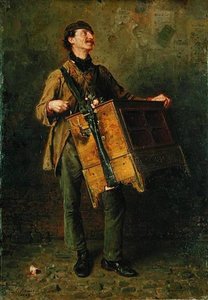
Bavarian State Painting Collections, MuniqueBavarian State Painting Collections Munique 2 Walk in the Tuileries, The Hurdy-Gurdy Man
New Gallery, KasselNew Gallery Kassel 2 Peasant in Hessian costume, Interior with green ceramic stove
Walters Art Museum, BaltimoreWalters Art Museum Baltimore 2 The Truant, Mud Pies
Grohmann Museum, MilwaukeeGrohmann Museum Milwaukee 2 Potato Harvest, The Magician in the Barn
Moravian Gallery in Brno, BrnoMoravian Gallery in Brno Brno 1 Portrait of a young girl
Staatliche Kunstsammlungen Dresden, DresdenStaatliche Kunstsammlungen Dresden Dresden 1 Behind the curtain

Ludwig Knaus ao longo das décadas: uma obra original única para cada uma

Obras por década

Escolha uma década para ver a obra original que a define.

Pinturas de Ludwig Knaus: perguntas para a galeria

Qual é a obra mais famosa de Ludwig Knaus?Revelar a resposta

Portrait of Mrs. Müller (1848), Alte Nationalgalerie, Berlim. Head of a Peasant Woman (1872) e Solomonic Wisdom (1878) vêm a seguir.

Com que idade Ludwig Knaus criou Portrait of Mrs. Müller?Revelar a resposta

19 anos: Portrait of Mrs. Müller data de 1848, e Ludwig Knaus nasceu em 1829.

Quais são as dez pinturas mais famosas de Ludwig Knaus?Revelar a resposta

Portrait of Mrs. Müller, Head of a Peasant Woman, Solomonic Wisdom, Portrait of the Physicist Hermann von Helmholtz, The Hunter, Walk in the Tuileries, August Cappelen, Peasant in Hessian costume, Portrait of a young girl e The cheater. O ranking acima apresenta o ano e o museu de cada uma.

Quantas obras de Ludwig Knaus são conhecidas?Revelar a resposta

Nosso catálogo contém 51 obras de Ludwig Knaus, datadas de 1845 a 1897.

Onde se pode ver os originais mais famosos de Ludwig Knaus?Revelar a resposta

Principalmente em Alte Nationalgalerie (Berlim), Museu Hermitage (São Petersburgo) e Bavarian State Painting Collections (Munique). A tabela de museus acima lista todos eles.

Em que período Ludwig Knaus criou as suas pinturas mais conhecidas?Revelar a resposta

Em 1850s: 8 das 47 obras nesta página foram feitas então, sendo Walk in the Tuileries delas.

Qual pintura famosa de Ludwig Knaus é a mais antiga e qual é a mais recente?Revelar a resposta

Nesta página, a mais antiga é The Hunter (1845) e a mais recente é Tyrolean Farm Boy (1897).

Quais temas Ludwig Knaus preferia?Revelar a resposta

Man (9), Children (8) e Woman (7), entre as 47 obras nesta página.

Com quais materiais Ludwig Knaus mais pintou?Revelar a resposta

Oil On Canvas, para 19 das 47 obras nesta página.

A qual movimento pertence a obra de Ludwig Knaus?Revelar a resposta

Realism, a julgar pelos originais nesta página.

Quais originais de Ludwig Knaus posso ver no Alte Nationalgalerie?Revelar a resposta

Portrait of Mrs. Müller, Solomonic Wisdom e Portrait of the Physicist Hermann von Helmholtz: o Alte Nationalgalerie, Berlim detém 7 das obras desta página.

Ludwig Knaus: um retrato do artista

O Mestre da Pintura de Género Alemã

Ludwig Knaus destaca-se como uma figura preeminente na história da arte alemã do século XIX, um pintor cujo pincel capturou o próprio pulsar da vida rural e doméstica. Nascido em Wiesbaden, na Alemanha, Knaus emergiu da prestigiada e jovem Escola de Düsseldorf, um ambiente que inicialmente moldou a sua estética primordial. Os seus anos de formação foram passados sob a tutela de mestres como Sohn e Schadow, onde desenvolveu uma base caracterizada por uma certa gravidade e um uso denso da cor. No entanto, a verdadeira evolução da sua alma artística ocorreu quando se aventurou por Paris em 1852. Ao tornar-se discípulo de Thomas Couture, Knaus passou por uma transformação profunda, refinando a sua técnica e afastando-se dos tons mais escuros e sombrios da sua juventude em direção a uma abordagem mais luminosa e matizada da luz e do caráter.

Este período de estudos parisienses foi fundamental para a sua ascensão ao reconhecimento internacional. Por volta de 1853, a sua obra Morning after the Kermess rendeu-lhe a segunda Medalha de Ouro do Salão, sinalizando a sua chegada como um talento celebrado no cenário europeu. A sua capacidade de fundir a precisão do treino académico com uma profundidade narrativa e emotiva permitiu-lhe tornar-se um mestre da pintura de género — um estilo dedicado a retratar cenas quotidianas com precisão inabalável e ressonância emocional. Quer estivesse a retratar a companhia silenciosa de um caçador em Ein Försterheim ou o encantamento comunitário encontrado em The Magician in the Barn, Knaus possuía uma habilidade rara de transformar o mundano no monumental.

Uma Tapeçaria de Conexão Humana e Tradição

A essência da obra de Knaus reside na sua profunda empatia pelos seus temas. Ele não se limitou a observar o campesinato ou as classes trabalhadoras; ele imortalizou a sua dignidade, o seu labor e as suas alegrias partilhadas. As suas obras funcionam frequentemente como janelas para uma era passada, capturando a vida rítmica e comunitária da paisagem alemã do século XIX. Em obras-primas como Potato Harvest, vê-se uma sinfonia de trabalho onde as fronteiras entre o esforço individual e a unidade familiar se dissolvem num propósito único e partilhado. Ele possuía um dom extraordinário para tecer figuras diversas num único momento de respiração suspensa, criando composições que parecem menos imagens estáticas e mais tapeçarias vivas de conexão humana.

Para além das grandes cenas comunitárias, Knaus destacou-se ao capturar o íntimo e o sombrio. A sua capacidade de retratar a pobreza com dignidade é evidente em obras como The Hurdy-gurdy Man, onde o detalhe cativante e os tons ponderados evocam um sentido de respeito pelas lutas do músico de rua. Este domínio da atmosfera — utilizando uma paleta rica em castanhos, ocres e vermelhos — permitiu-lhe criar interiores que parecem quentes, convidativos e profundamente habitados. Os seus trabalhos tardios também exploraram temas clássicos, incluindo uma série de "Idílios" com nus num estilo clássico, demonstrando a amplitude do seu alcance técnico e a sua capacidade de navegar entre o realismo cru da vida contemporânea e a beleza idealizada da tradição clássica.

Legado e Eminência Académica

À medida que a sua carreira progredia, a influência de Knaus estendeu-se muito além da tela, alcançando as próprias instituições que moldaram as futuras gerações de artistas. A sua jornada profissional levou-o a Berlim, onde exerceu durante vários anos, culminando na sua nomeação como professor na Real Academia Prussiana de Berlim. Este cargo consolidou o seu estatuto não apenas como um criador de imagens belas, mas como um pilar do mundo da arte académica. O seu período tardio produziu algumas das suas obras mais duradouras, incluindo The Holy Family e The Road to Ruin, ambas preservadas hoje em coleções prestigiadas como o Metropolitan Museum of Art, em Nova Iorque.

A importância histórica de Ludwig Knaus reside no seu papel como uma ponte entre eras. Embora tenha emergido das tradições da Escola de Düsseldorf, a sua obra ressoou com a maré crescente do Realismo e do Naturalismo — movimentos que procuravam rejeitar a névoa onírica do Romantismo em favor da verdade nua e crua. Através da sua atenção meticulosa ao detalhe e do seu profundo respeito pelo tema, Knaus proporcionou um registo visual dos valores culturais do seu tempo: a dignidade do trabalho, o calor da domesticidade e uma ligação duradoura ao mundo natural. O seu legado permanece gravado na qualidade vibrante e realista das suas pinturas, que continuam a oferecer aos espectadores um vislumbre pungente da alma da Europa do século XIX.