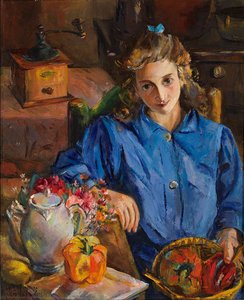
Lois Mailou Jones

1905 - 1998

Lois Mailou Jones (1905–1998) é conhecido sobretudo por Les Fétiches; o catálogo contém 37 obras do artista.

Destaques

  • Copyright status: Under copyright
  • Died: 1998
  • Mediums: acrílico sobre tela
  • Works on this site: 37
  • Best occasions: herança cultural
  • Corpus themes: african motifs
  • Top 3 works:
    • Les Fétiches
    • Self Portrait
    • Initiation, Liberia
  • Born: 1905, Boston, Estados Unidos

Por qual obra Lois Mailou Jones é mais conhecido(a)?

Acima de tudo Les Fétiches; depois Initiation, Liberia.

A Life Immersed in Color and Culture

Lois Mailou Jones, a name synonymous with groundbreaking artistry and unwavering dedication to African American representation, was born in Boston, Massachusetts, on November 3, 1905. From her earliest years, she was nurtured in an environment that valued creativity; her parents, Thomas Vreeland Jones, a lawyer, and Carolyn Adams Jones, a cosmetologist, encouraged her innate talent for drawing and painting, particularly with the fluid grace of watercolors. Summers spent on Martha's Vineyard proved formative, introducing young Lois to a constellation of influential figures – sculptor Meta Warrick Fuller, composer Harry T. Burleigh, and novelist Dorothy West – who would subtly shape her artistic sensibilities. This early exposure instilled in her not only an appreciation for art but also a sense of cultural pride and the importance of mentorship, values she would carry throughout her life. Her formal education began at the High School of Practical Arts in Boston (1919-1923), followed by night classes at the Boston Museum of Fine Arts, secured through a hard-earned scholarship. A pivotal apprenticeship with costume designer Grace Ripley further broadened her artistic horizons, sparking an early fascination with African masks and their potential for symbolic expression. Even as a teenager, Jones demonstrated remarkable ambition, holding her first solo exhibition on Martha’s Vineyard at the age of seventeen. She continued to hone her skills at the School of the Museum of Fine Arts in Boston (1923-1927), consistently winning the Susan Minot Lane Scholarship, and supplemented her studies with courses at the Boston Normal Art School, culminating in a graduate degree in design from the Design Art School of Boston in 1928.

From Textile Design to Artistic Independence

Jones’s initial professional path led her into the world of textile design, working for both F. A. Foster Company in Boston and Schumacher Company in New York City. However, a transformative summer at Harvard University in 1928 ignited a deeper desire – to fully dedicate herself to painting. This decision coincided with the burgeoning Harlem Renaissance, an intellectual and artistic movement that profoundly impacted her work. The influence of artist Aaron Douglas became particularly significant; his stylized depictions of African American life and incorporation of African motifs resonated deeply with Jones’s own emerging aesthetic vision. Her seminal work, The Ascent of Ethiopia, stands as a testament to this period, reflecting both Douglas's stylistic influence and her growing commitment to celebrating African heritage. She explored the interplay between geometric abstraction and organic forms, mirroring the dynamism of Caribbean culture and drawing inspiration from the vibrant patterns of Haitian art—a passion fueled by her marriage to Louis Vergniaud Pierre-Noël in 1953. Her artistic evolution wasn’t merely about stylistic experimentation; it was driven by a profound conviction that art could serve as a vehicle for social commentary and cultural affirmation.

A Pioneer's Enduring Impact

Throughout her prolific career, Jones consistently championed the recognition of African American artists and their contributions to the broader art world. She faced considerable obstacles due to gender bias and racial prejudice—challenges she confronted with unwavering resilience and determination. Despite these difficulties, she persevered in pursuing her artistic ambitions, establishing herself as a respected educator and mentor who nurtured the talents of countless aspiring artists. Notably, she founded the art department at Palmer Memorial Institute in North Carolina in 1928, demonstrating versatility beyond painting by coaching basketball, teaching folk dancing, and providing musical accompaniment for church services. Her appointment to Howard University’s faculty in 1930 under James Vernon Herring marked a pivotal moment—a partnership that would endure for over forty years and solidify her role as a beacon of artistic excellence within the Black community. At Howard, Jones instilled in her students a commitment to social justice and encouraged them to explore themes of identity, heritage, and empowerment. Her legacy extends far beyond her own artwork; it resides in the countless individuals she inspired to pursue their creative passions and advocate for inclusivity within the arts. Jones’s artistic style evolved over time—beginning with Impressionistic tendencies and progressing toward a more expressive blend of Cubist elements and abstraction. She skillfully combined geometric precision with organic textures, creating canvases that pulsed with color and conveyed profound emotional depth. Her distinctive approach to composition and technique distinguished her from many of her contemporaries, establishing her as a singular voice within the American art landscape. Her paintings—including iconic works like Jeune Fille Française, Les Fétiches, and Initiation, Liberia—continue to captivate audiences with their vibrant hues, intricate patterns, and evocative symbolism. These pieces serve as powerful reminders of Jones’s unwavering dedication to portraying the beauty and complexity of African American experience. Her work is now housed in prominent museums across the United States and internationally, ensuring that her artistic vision will endure for generations to come. Lois Mailou Jones passed away peacefully in Washington, D.C., on June 9, 1998, leaving behind an indelible mark on art history—a testament to a life devoted to creativity, scholarship, and unwavering advocacy for cultural understanding.

Quiz

Cada pergunta possui apenas uma resposta correta.

Pergunta 1:
Qual movimento artístico ou estilo é frequentemente associado à Lois Mailou Jones?
Pergunta 2:
O que foi o trabalho inicial de Lois Mailou Jones após concluir seus estudos?
Pergunta 3:
Em qual país influenciou significativamente a arte de Jones através de suas cores vibrantes e padrões após seu casamento?
Pergunta 4:
Além de artista, qual papel importante Lois Mailou Jones desempenhou na Howard University por mais de quarenta anos?
Pergunta 5:
O que Lois Mailou Jones afirmava ser sua maior contribuição para o mundo da arte?

Perguntas e Respostas

Onde posso encontrar estatísticas sobre as obras de Lois Mailou Jones?

Veja as pinturas mais populares de Lois Mailou Jones, classificadas pelo número de visitas que recebem neste site.

A qual período histórico pertence a obra de Lois Mailou Jones?

Lois Mailou Jones atuou no período Modernismo. Este período situa a atividade do artista na história.

A qual movimento artístico Lois Mailou Jones pertencia?

Lois Mailou Jones está associado ao movimento Harlem Renaissance.

A obra de Lois Mailou Jones está em domínio público?

Não. As obras de Lois Mailou Jones ainda estão protegidas por direitos autorais.

Quanto tempo durou a carreira de Lois Mailou Jones?

As obras datadas de Lois Mailou Jones listadas aqui abrangem o período de 1928 a 1988, totalizando 22 obras. Veja a trajetória de Lois Mailou Jones período a período.

Quando Lois Mailou Jones faleceu?

Lois Mailou Jones faleceu em 1998, aos aproximadamente 93 anos.

Onde e quando nasceu Lois Mailou Jones?

Lois Mailou Jones nasceu em Boston, em 1905.

Por quais pinturas Lois Mailou Jones é conhecido(a)?

Lois Mailou Jones é conhecido pelas obras listadas em as pinturas mais famosas de Lois Mailou Jones.

Onde posso ver as pinturas de Lois Mailou Jones?

As pinturas de Lois Mailou Jones podem ser vistas em Smithsonian American Art Museum e National Museum of Women in the Arts.