


1


Atualizado em Novembro 2026 · classificado pela nossa pontuação de popularidade (pesquisas, visitas e pedidos de cada obra) · 14 obras de Keith Vaughan em nosso catálogo
Em resumo
Green Jug (1950) é a pintura de Keith Vaughan que mais atrai olhares; a obra original pertence ao Jerwood Gallery, Hastings. Depois disso, o olhar recai sobre The Barn (1935) e Lane in Shere (1935). Entre as 14 obras de Keith Vaughan em nosso catálogo, estas 13 são as mais famosas, cada uma uma original única apresentada com o seu ano, o seu museu e a razão pela qual perdura.


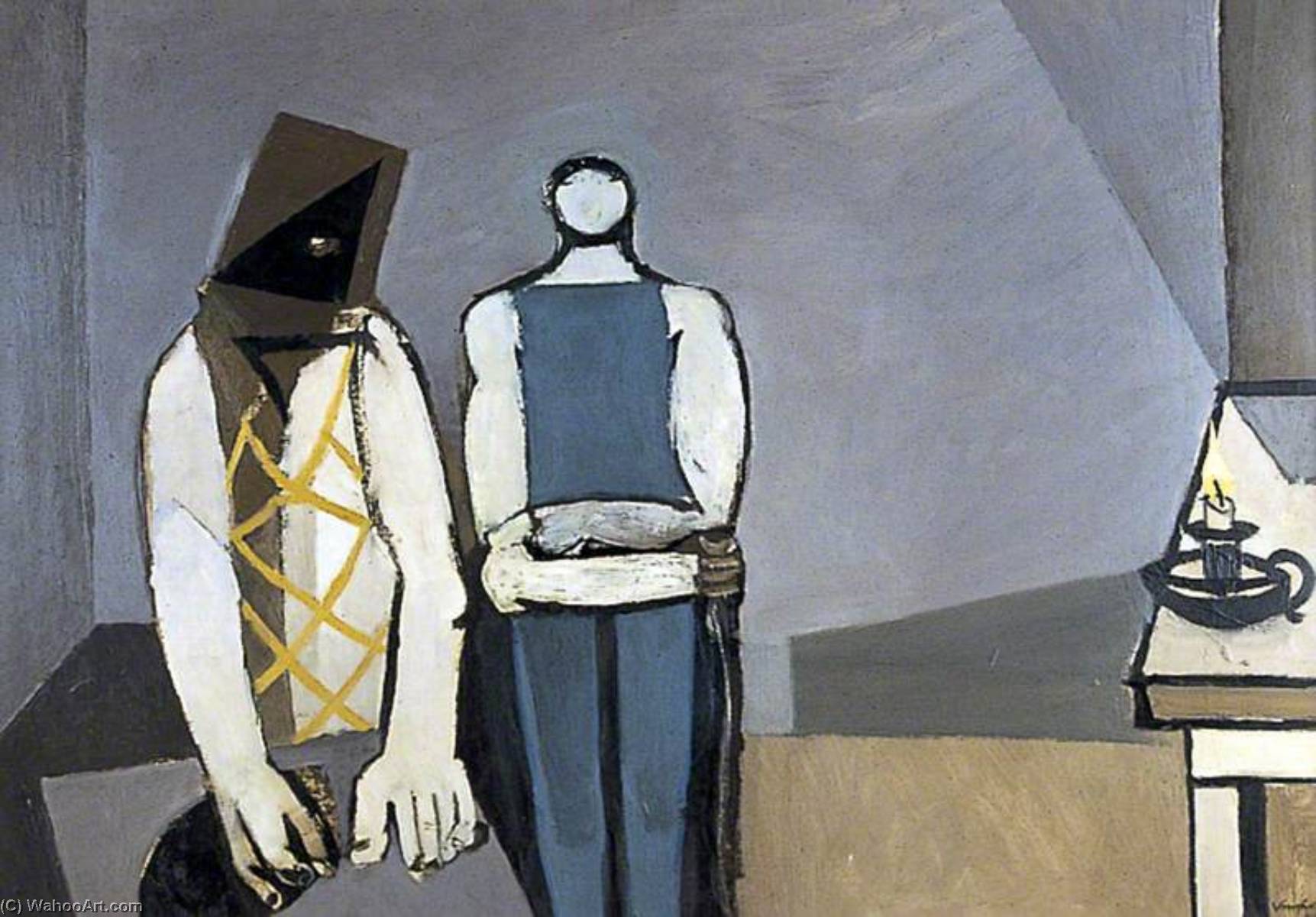

In this oil on canvas, titled Water, Trees and Figures II, the artist Keith Vaughan explores a complex intersection of the natural and the human. Created between 1948 and 1959, the work captures a specific moment in the artist's development, moving through a period of significant formal experimentation. The piece measures 63.5 x 83.7 cm, offering a scale that feels both intimate and substantial when viewed in person.
Os 7 museus que detêm a maioria das pinturas desta página.
| Museus | Cidade | Obras de Keith Vaughan | Pinturas desta lista |
|---|---|---|---|
 Jerwood Gallery |
Hastings | 2 | Green Jug, Two Figures |
 Government Art Collection |
Londres | 1 | Lane in Shere |
 Leeds Art Gallery |
Leeds | 1 | Figure Undressing |
 Queens' College |
Cambridge | 1 | Quarrymen by an Entrenchment |
 Middlesbrough Institute of Modern Art |
Middlesbrough | 1 | Climbing Figures |
 The Ingram Collection of Modern British And Contemporary Art |
London | 1 | Theseus (final study for the 'Dome of Discovery' at The Festival of Britain) |
 Coleção do Conselho Britânico |
Londres | 1 | Water, Trees and Figures II |
Escolha uma década para ver a obra original que a define.
Green Jug (1950), Jerwood Gallery, Hastings. The Barn (1935) e Lane in Shere (1935) vêm a seguir.
38 anos: Green Jug data de 1950, e Keith Vaughan nasceu em 1912.
Green Jug, The Barn, Lane in Shere, Figure Undressing, Two Figures, Quarrymen by an Entrenchment, Climbing Figures, Theseus (final study for the 'Dome of Discovery' at The Festival of Britain), The Trial e Water, Trees and Figures II. O ranking acima apresenta o ano e o museu de cada uma.
Nosso catálogo contém 14 obras de Keith Vaughan, datadas de 1935 a 1959.
Principalmente em Jerwood Gallery (Hastings), Government Art Collection (Londres) e Leeds Art Gallery (Leeds). A tabela de museus acima lista todos eles.
Em 1940s: 4 das 13 obras nesta página foram feitas então, sendo Figure Undressing delas.
Nesta página, a mais antiga é The Barn (1935) e a mais recente é The Trial (1959).
Green Jug e Two Figures: o Jerwood Gallery, Hastings detém 2 das obras desta página.
The story of John Keith Vaughan is one of profound resilience and an unyielding pursuit of visual truth. Born in 1912 in the coastal serenity of Selsey Bill, Sussex, Vaughan’s early years were marked by a certain turbulence that would later inform the emotional depth of his work. His time as a boarder at Christ’s Hospital School was shadowed by the hardships of bullying, yet it was within these challenging corridors that an art master first recognized his latent talent. This early spark ignited a lifelong devotion to the canvas, a journey that began far from formal academies and instead blossomed through a self-taught, independent spirit. Before he became a pillar of British modernism, Vaughan navigated the structured world of the Lintas advertising agency, where he honed a keen eye for composition and the power of visual storytelling—skills that would eventually breathe life into his evocative landscapes and symbolic figures.
As his career matured, Vaughan’s artistic language became a sophisticated tapestry woven from the threads of European modernism. He did not merely observe nature; he reinterpreted it through the lens of masters like Cézanne, Picasso, Matisse, and Nicolas de Staël. This confluence of influences allowed him to move beyond mere representation, seeking instead the spiritual and emotional resonance hidden within the terrain. His work became a bridge between the tangible world and a more abstract, symbolic realm. Whether capturing the rugged textures of Essex landscapes or the delicate tension of his Assembly of Figures series, Vaughan utilized color and form to explore themes of human existence, mortality, and the sublime. His mastery extended across mediums, as he was celebrated not only for his commanding oil paintings but also as one of Britain’s most exquisite exponents of gouache.
To encounter a Vaughan painting is to enter a space where the boundaries between the physical and the metaphysical blur. His oeuvre is characterized by a remarkable ability to imbue even the simplest subject with profound meaning. In his still lifes, such as the whimsical Green Jug, one finds a sense of joyful, almost naive vitality expressed through vibrant colors and impasto textures. Conversely, his larger-scale works often grapple with much heavier themes. In pieces like Water, Trees and Figures II, the artist employs bold blues and yellows to create a sense of dramatic tension, using suspended figures and symbolic elements like clocks to meditate on the relentless passage of time.
This duality—the ability to oscillate between lightheartedness and deep, existential inquiry—is what defines his historical significance. His contributions to the Neo-Romantic movement of the 1940s placed him alongside luminaries such as John Minton and Graham Sutherland. Together, they sought to capture the psychological landscape of a nation navigating the complexities of war and reconstruction. Vaughan’s work was not merely decorative; it was an intellectual and emotional endeavor that challenged viewers to decipher the layers of symbolism embedded within his compositions.
The breadth of Vaughan's impact is reflected in the diverse range of his roles: he was a painter, graphic artist, illustrator, photographer, teacher, and even a journal writer. His dedication to the craft led him to prestigious teaching positions at the Camberwell School of Art, Central School of Art and Design, and the Slade, where he mentored a new generation of artists in the nuances of visual expression. His monumental 22-meter-long mural for the Festival of Britain in 1951 remains a testament to his ability to engage with the grand scale of public art, even if much of that specific work was lost to time.
Today, the legacy of John Keith Vaughan is preserved in prestigious collections across the United Kingdom, the United States, and Australia. His work continues to resonate because it speaks to a universal human experience—the search for meaning within the natural world and the struggle to find beauty amidst hardship. Through his meticulous use of color, his mastery of texture, and his unwavering commitment to symbolic depth, Vaughan remains a singular and vital voice in the history of 20th-century British art.


