Retrato de Karl Blechen

As 94 Pinturas Mais Famosas de Karl Blechen, Cada Uma Única

Atualizado em Novembro 2026 · classificado pela nossa pontuação de popularidade (pesquisas, visitas e pedidos de cada obra) · 97 obras de Karl Blechen em nosso catálogo

Em resumo

Sanssouci Palace (1830) é a pintura de Karl Blechen que mais atrai olhares; a obra original pertence ao Nationalgalerie, Berlim. Depois disso, o olhar recai sobre The Interior of the Palm House on the Pfaueninsel Near Potsdam (1834) e Afternoon on Capri (1829). Entre as 97 obras de Karl Blechen em nosso catálogo, estas 94 são as mais famosas, cada uma uma original única apresentada com o seu ano, o seu museu e a razão pela qual perdura.

1798 – 1840, Cottbus Romantic industrialization Mais obras: Alte Nationalgalerie

As 10 principais pinturas de Karl Blechen, sob o olhar da galeria

1
Sanssouci Palace (1830) de Karl Blechen

Sanssouci Palace

1830 · Oil On Canvas · Nationalgalerie, Berlim

Subject Carl Blechen’s 1830 canvas invites the viewer into a dramatic yet serene tableau of Sanssouci Palace, its stately gardens framed by a storm‑laden sky that breathes both tension and awe. The central fountain glistens beneath swirling clouds, while a lone horse stands poised in the midst of the park, an emblem of grace amid turmoil. Figures—families, couples, solitary wanderers—are scattered across the scene, their silhouettes hinting at stories untold.…

2
The Interior of the Palm House on the Pfaueninsel Near Potsdam (1834) de Karl Blechen

The Interior of the Palm House on the Pfaueninsel Near Potsdam

1834 · Oil On Canvas · Art Institute of Chicago, Chicago

The work before us is titled The Interior of the Palm House on the Pfaueninsel Near Potsdam, a significant oil on canvas by the German artist Carl Blechen. Created in 1834, this painting captures a specific moment of architectural and botanical splendor within the Prussian royal grounds. It offers a view into a space where the structured lines of design meet the untamed growth of tropical flora.

3
Afternoon on Capri (1829) de Karl Blechen

Afternoon on Capri

1829 · Oil On Canvas

The oil painting depicts a coastal scene on the island of Capri, captured from an elevated perspective. In the upper right, massive cliffs of ochre and sienna rise toward the center-left, their jagged surfaces textured by light and shadow. These geological formations descend toward a calm, blue sea that occupies the middle ground. A solitary figure sits upon a rocky outcrop in the lower left, positioned against the scale of…

4
Napoleon on Horseback, Surrounded by Generals and Troops (1823) de Karl Blechen

Napoleon on Horseback, Surrounded by Generals and Troops

1823 · Watercolor

In Napoleon on Horseback, Surrounded by Generals and Troops, Carl Blechen organizes a scene of profound historical and heroic weight. The composition is centered upon a prominent figure on horseback, presumably Napoleon, who commands the viewer's immediate attention. This central figure is encircled by a dense gathering of military personnel and troops, creating a sense of crowded, purposeful movement. Whether the scene depicts a moment of intense military engagement or…

5
Tarantella (1830) de Karl Blechen

Tarantella

1830 · Oil On Canvas · Städel Museum, Frankfurt

In this 1830 oil on canvas, we find ourselves drawn into a lively scene of folk celebration. A group of people has gathered for a traditional dance, the Tarantella, set against a picturesque coastal landscape. The composition is built around a central dancing figure, whose movement acts as a focal point for the seated observers and the figures drifting in the background. There is a sense of rhythm here, captured…

6
Two monks in the park of Terni (1830) de Karl Blechen

Two monks in the park of Terni

1830 · Oil On Canvas · Alte Nationalgalerie, Berlim

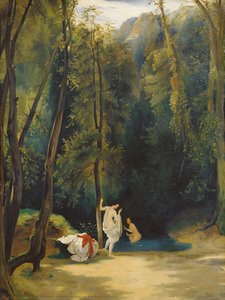
The painting, titled Two monks in the park of Terni, was executed by the German artist Carl Blechen in 1830. It is also known by the alternative title Parthie aus dem Park des Grafen Graziani bei Terni. This work captures a quiet moment within the Park of Count Graziani, situated in the Nera river valley at Terni. The scene focuses on two monks engaged in conversation, positioned beneath a leafy…

7
Two Ladies in the Park (1830) de Karl Blechen

Two Ladies in the Park

1830 · Oil · Bavarian State Painting Collections, Munique

This romanticized landscape painting, dating from 1830, captures a tranquil scene of two women enjoying a moment of quiet companionship within an elegant park. The composition is carefully balanced, featuring the two figures positioned slightly off-center. They are framed by lush greenery on the right, while the left side of the work offers a receding view of trees and water. The women are dressed in soft white and cream garments,…

8
"Tarantella" Merry-society at Italian shore (1823) de Karl Blechen

"Tarantella" Merry-society at Italian shore

1823 · Oil

"Tarantella" Merry-society at Italian shore is an oil painting by the German artist Carl Blechen. Executed about 1823, the work captures a lively social gathering set against a coastal landscape. The scene focuses on human interaction within a picturesque environment, featuring figures engaged in various activities, including dance and seated observation.

9
Pifferaro and Girls in Rome (1834) de Karl Blechen

Pifferaro and Girls in Rome

1834 · Oil · Alte Nationalgalerie, Berlim

Pifferaro and Girls in Rome is an oil painting by the German artist Carl Blechen, executed in 1834. The work presents a genre scene set within the urban landscape of Rome, capturing a specific moment of social interaction amidst the city's architectural remnants.

10
Fishermen on Capri (1834) de Karl Blechen

Fishermen on Capri

1834 · Oil On Canvas · Alte Nationalgalerie, Berlim

In Fishermen on Capri, Carl Blechen captures a quiet moment on a pebbled shore. The scene is a serene and atmospheric coastal landscape set against the dramatic natural backdrop of the Italian coast. A woman in a flowing white dress sits upon the rocks, leaning toward a man kneeling before her. Nearby, a second man stands with his back to the viewer, his red cap a sharp point of color…

Pinturas famosas de Karl Blechen, números 11 a 94

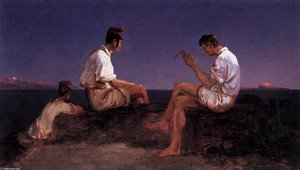
11Shepherd boy (1832) de Karl BlechenShepherd boy1832 12Forest path near Spandau (1835) de Karl BlechenForest path near Spandau1835 · Alte Nationalgalerie 13Weathered Tree Trunks in a Park (recto), c. 1834 (1834) de Karl BlechenWeathered Tree Trunks in a Park (recto), c. 18341834 · Albertina 14Stormy Weather over the Roman Campagna (1829) de Karl BlechenStormy Weather over the Roman Campagna1829 · Nationalgalerie 15Galgenberg (1833) de Karl BlechenGalgenberg1833 · Galerie Neue Meister 16Italian Monastery Building on the Water's Edge (1832) de Karl BlechenItalian Monastery Building on the Water's Edge1832 · Alte Nationalgalerie 17Memorial Column in the Forest (1837) de Karl BlechenMemorial Column in the Forest1837 · Alte Nationalgalerie 18Sleeping Faun in the Reeds (1827) de Karl BlechenSleeping Faun in the Reeds1827 · Alte Nationalgalerie 19Gothic Church Ruins (1826) de Karl BlechenGothic Church Ruins1826 · Staatliche Kunstsammlungen Dresden 20Rocky Landscape with Monk (1825) de Karl BlechenRocky Landscape with Monk1825 · Alte Nationalgalerie 21View of Rooftops and Gardens (1835) de Karl BlechenView of Rooftops and Gardens1835 · Nationalgalerie 22The Woods near Spandau (1834) de Karl BlechenThe Woods near Spandau1834 · Nationalgalerie 23Grotto in the Gulf of Naples (1829) de Karl BlechenGrotto in the Gulf of Naples1829 · Wallraf-Richartz-Museum 24Woman Bathing in the Park of Terni (1829) de Karl BlechenWoman Bathing in the Park of Terni1829 · Städel Museum 25Italian Landscape (1829) de Karl BlechenItalian Landscape1829 · Alte Nationalgalerie 26Sleeping Faun (1820) de Karl BlechenSleeping Faun1820 27Romantic Painting with Ruins (1820) de Karl BlechenRomantic Painting with Ruins1820 · Westfälisches Landesmuseum 28Landscape with Hermit (1822) de Karl BlechenLandscape with Hermit1822 29Friedrich Wilhelm III's Palm Court (1832) de Karl BlechenFriedrich Wilhelm III's Palm Court1832 · Nationalgalerie 30In the Berliner Tiergarten / Forest Path with Water (1825) de Karl BlechenIn the Berliner Tiergarten / Forest Path with Water1825 31The Roman Forum (1829) de Karl BlechenThe Roman Forum1829 32Forest Gorge with Red Deer (1828) de Karl BlechenForest Gorge with Red Deer1828 · Niedersächsisches Landesmuseum 33View of Monte Castiglione in Capri (1829) de Karl BlechenView of Monte Castiglione in Capri1829 · Staatliche Kunsthalle Karlsruhe 34Young Oak Tree (1828) de Karl BlechenYoung Oak Tree1828 · Galeria Nacional do Canadá 35Fantasy Mountain Scene (1823) de Karl BlechenFantasy Mountain Scene1823 · Alte Nationalgalerie 36Ruins of Oybin Monastery (1823) de Karl BlechenRuins of Oybin Monastery1823 · Alte Nationalgalerie 37Track to Castle Gandolfo (1830) de Karl BlechenTrack to Castle Gandolfo1830 · Alte Nationalgalerie 38The Shattered Tower of Heidelberg Castle (1829) de Karl BlechenThe Shattered Tower of Heidelberg Castle1829 · Alte Nationalgalerie 39Trees at Sunrise in Autumn (1823) de Karl BlechenTrees at Sunrise in Autumn1823 · Alte Nationalgalerie 40Knight's castle at the fir pond (1823) de Karl BlechenKnight's castle at the fir pond1823 · Alte Nationalgalerie 41Campagna landscape (1830) de Karl BlechenCampagna landscape1830 · Berlinische Galerie 42Stormy sea with Lighthouse (1826) de Karl BlechenStormy sea with Lighthouse1826 · Hamburger Kunsthalle 43The Capuchin Convent at Amalfi (1829) de Karl BlechenThe Capuchin Convent at Amalfi1829 · National Gallery 44The Valley of Mills near Amalfi (1830) de Karl BlechenThe Valley of Mills near Amalfi1830 45boat at the coast (1823) de Karl Blechenboat at the coast1823 46Winterlandscape + wanderer (1823) de Karl BlechenWinterlandscape + wanderer1823 47landscape with figures (1823) de Karl Blechenlandscape with figures1823 48Winter- Landscape (1823) de Karl BlechenWinter- Landscape1823 49Mill Valley at Amalfi with Capuchin monk and farmer (1823) de Karl BlechenMill Valley at Amalfi with Capuchin monk and farmer1823 50Landscape with ruin, with motives of Webers "Freischütz" (1823) de Karl BlechenLandscape with ruin, with motives of Webers "Freischütz"1823 51Sleeping satyr in landscape (1823) de Karl BlechenSleeping satyr in landscape1823 52forest with pond + deers (1826) de Karl Blechenforest with pond + deers1826 53Gravestone (1823) de Karl BlechenGravestone1823 · Alte Nationalgalerie 54Mountain Gorge in Winter (1825) de Karl BlechenMountain Gorge in Winter1825 · Alte Nationalgalerie 55Mill in the valley near Amalfi (1829) de Karl BlechenMill in the valley near Amalfi1829 · Hamburger Kunsthalle 56Monastery of Saint Scholastica (1830) de Karl BlechenMonastery of Saint Scholastica1830 · Von der Heydt Museum 57Landscape (1823) de Karl BlechenLandscape1823 · Schloss Weimar 58Estudo para um Monumento Funebre (1824) de Karl BlechenEstudo para um Monumento Funebre1824 · Nationalgalerie 59Gorge at Amalfi (1831) de Karl BlechenGorge at Amalfi1831 · Alte Nationalgalerie 60Forest Path in the Harz (1833) de Karl BlechenForest Path in the Harz1833 61Waterfalls near Tivoli (1832) de Karl BlechenWaterfalls near Tivoli1832 · Alte Nationalgalerie 62In the park of Villa Borghese (1837) de Karl BlechenIn the park of Villa Borghese1837 · Alte Nationalgalerie 63Schloss Sanssouci (1833) de Karl BlechenSchloss Sanssouci1833 · Alte Nationalgalerie 64Forest Landscape at Dawn (1835) de Karl BlechenForest Landscape at Dawn1835 · Bavarian State Painting Collections 65Spinning women in Cervara (1835) de Karl BlechenSpinning women in Cervara1835 · Alte Nationalgalerie 66Monk on Terrace (1835) de Karl BlechenMonk on Terrace1835 · Alte Nationalgalerie 67Mill in a valley (1833) de Karl BlechenMill in a valley1833 68Landscape in Winter at Moonlight (1836) de Karl BlechenLandscape in Winter at Moonlight1836 · Museum Behnhaus Drägerhaus 69In the Palm House in Potsdam (1832) de Karl BlechenIn the Palm House in Potsdam1832 · Hamburger Kunsthalle 70Girls on a Hill at the Beach (1840) de Karl BlechenGirls on a Hill at the Beach1840 71Fisherman (1839) de Karl BlechenFisherman1839 · Staatliche Kunsthalle Karlsruhe 72View of the Santa Scolastica Monastery near Subiaco (1832) de Karl BlechenView of the Santa Scolastica Monastery near Subiaco1832 · Staatliche Kunsthalle Karlsruhe 73In the Park at Terni de Karl BlechenIn the Park at TerniStaatsgalerie Stuttgart 74Passagem Alpina no Inverno com Monges (1833) de Karl BlechenPassagem Alpina no Inverno com Monges1833 · Staatliche Graphische Sammlung 75Bathers in Terni Park (1836) de Karl BlechenBathers in Terni Park1836 · Nationalgalerie 76Tivoli Gardens at the Villa d'Este (1831) de Karl BlechenTivoli Gardens at the Villa d'Este1831 · Nationalgalerie 77View of Assisi (1832) de Karl BlechenView of Assisi1832 · Neue Pinakothek 78Self-Portrait (1823) de Karl BlechenSelf-Portrait1823 · Nationalgalerie 79Scaffold in Storm (1833) de Karl BlechenScaffold in Storm1833 · Gemäldegalerie 80Forest landscape with flowing water and two hunters de Karl BlechenForest landscape with flowing water and two huntersKupferstichkabinett 81Hermit in a rocky landscape de Karl BlechenHermit in a rocky landscape 82The studio of the sculptor Rudolf Schadow de Karl BlechenThe studio of the sculptor Rudolf SchadowKunsthalle Bremen 83Resting Pilgrim in a Church's ruin de Karl BlechenResting Pilgrim in a Church's ruin 84Wooded landscape with castle de Karl BlechenWooded landscape with castle 85Tiberius rocks at Capri de Karl BlechenTiberius rocks at CapriNiedersächsisches Landesmuseum 86Rest in the Forest de Karl BlechenRest in the Forest 87Heidelberg Ruins de Karl BlechenHeidelberg RuinsKunsthalle Bremen 88The Waterfall de Karl BlechenThe WaterfallDetroit Institute of Arts 89Fishermen at the Gulf of Naples (1829) de Karl BlechenFishermen at the Gulf of Naples1829 · Nationalgalerie 90The Bay of Rapallo (1829) de Karl BlechenThe Bay of Rapallo1829 · Nationalgalerie 91Grotte im Park der Villa d’Este (1828) de Karl BlechenGrotte im Park der Villa d’Este1828 92Tower Ruins with Dragon (1827) de Karl BlechenTower Ruins with Dragon1827 · Alte Nationalgalerie 93Building the Devil's Bridge (1833) de Karl BlechenBuilding the Devil's Bridge1833 · Neue Pinakothek 94Rolling Mill (1834) de Karl BlechenRolling Mill1834 · Nationalgalerie

Pinturas famosas de Karl Blechen, período por período

Os temas que cativaram o olhar de Karl Blechen

Os quatro temas que mais se repetem nestas obras originais, cada um com o seu melhor exemplo.

Os museus que guardam os originais de Karl Blechen

Os 8 museus que detêm a maioria das pinturas desta página.

Museus Cidade Obras de Karl Blechen Pinturas desta lista
Alte Nationalgalerie, BerlimAlte Nationalgalerie Berlim 24 Two monks in the park of Terni, Pifferaro and Girls in Rome, Fishermen on Capri
Nationalgalerie, BerlimNationalgalerie Berlim 12 Sanssouci Palace, Stormy Weather over the Roman Campagna, View of Rooftops and Gardens
Staatliche Kunsthalle Karlsruhe, KarlsruheStaatliche Kunsthalle Karlsruhe Karlsruhe 3 View of Monte Castiglione in Capri, Fisherman, View of the Santa Scolastica Monastery near Subiaco
Hamburger Kunsthalle, HamburgoHamburger Kunsthalle Hamburgo 3 Stormy sea with Lighthouse, Mill in the valley near Amalfi, In the Palm House in Potsdam
Städel Museum, FrankfurtStädel Museum Frankfurt 2 Tarantella, Woman Bathing in the Park of Terni
Bavarian State Painting Collections, MuniqueBavarian State Painting Collections Munique 2 Two Ladies in the Park, Forest Landscape at Dawn
Niedersächsisches Landesmuseum, HanoverNiedersächsisches Landesmuseum Hanover 2 Forest Gorge with Red Deer, Tiberius rocks at Capri
Neue Pinakothek, MuniqueNeue Pinakothek Munique 2 View of Assisi, Building the Devil's Bridge

Karl Blechen ao longo das décadas: uma obra original única para cada uma

Obras por década

Escolha uma década para ver a obra original que a define.

Pinturas de Karl Blechen: perguntas para a galeria

Qual é a obra mais famosa de Karl Blechen?Revelar a resposta

Sanssouci Palace (1830), Nationalgalerie, Berlim. The Interior of the Palm House on the Pfaueninsel Near Potsdam (1834) e Afternoon on Capri (1829) vêm a seguir.

Com que idade Karl Blechen criou Sanssouci Palace?Revelar a resposta

32 anos: Sanssouci Palace data de 1830, e Karl Blechen nasceu em 1798.

Quais são as dez pinturas mais famosas de Karl Blechen?Revelar a resposta

Sanssouci Palace, The Interior of the Palm House on the Pfaueninsel Near Potsdam, Afternoon on Capri, Napoleon on Horseback, Surrounded by Generals and Troops, Tarantella, Two monks in the park of Terni, Two Ladies in the Park, "Tarantella" Merry-society at Italian shore, Pifferaro and Girls in Rome e Fishermen on Capri. O ranking acima apresenta o ano e o museu de cada uma.

Quantas obras de Karl Blechen são conhecidas?Revelar a resposta

Nosso catálogo contém 97 obras de Karl Blechen, datadas de 1820 a 1840.

Onde se pode ver os originais mais famosos de Karl Blechen?Revelar a resposta

Principalmente em Alte Nationalgalerie (Berlim), Nationalgalerie (Berlim) e Staatliche Kunsthalle Karlsruhe (Karlsruhe). A tabela de museus acima lista todos eles.

Em que período Karl Blechen criou as suas pinturas mais conhecidas?Revelar a resposta

Em 1820s: 43 das 94 obras nesta página foram feitas então, sendo Afternoon on Capri delas.

Qual pintura famosa de Karl Blechen é a mais antiga e qual é a mais recente?Revelar a resposta

Nesta página, a mais antiga é Sleeping Faun (1820) e a mais recente é Girls on a Hill at the Beach (1840).

Quais temas Karl Blechen preferia?Revelar a resposta

Landscape (31), Sky (30) e Trees (26), entre as 94 obras nesta página.

Com quais materiais Karl Blechen mais pintou?Revelar a resposta

Oil On Canvas, para 46 das 94 obras nesta página.

A qual movimento pertence a obra de Karl Blechen?Revelar a resposta

Romantic industrialization e Romanticism, a julgar pelos originais nesta página.

Quais originais de Karl Blechen posso ver no Alte Nationalgalerie?Revelar a resposta

Two monks in the park of Terni, Pifferaro and Girls in Rome e Fishermen on Capri: o Alte Nationalgalerie, Berlim detém 24 das obras desta página.

Karl Blechen: um retrato do artista

Um Pioneiro da Industrialização Romântica: A Vida e a Arte de Carl Blechen

Carl Eduard Ferdinand Blechen, nascido em Cottbus, Alemanha, em 1798, ocupa uma posição singular e frequentemente negligenciada na tradição da pintura paisagística. Sua vida foi marcada tanto por brilhantismo artístico quanto por turbulências pessoais, uma dualidade que moldou profundamente seu trabalho evocativo e inovador. Inicialmente destinado a uma carreira pragmática no setor bancário devido às restrições financeiras familiares, as inclinações artísticas inerentes de Blechen acabaram prevalecendo. Ele buscou estudos na Academia de Artes de Berlim em 1822, embarcando em um caminho que o levaria a se tornar um dos primeiros artistas a enfrentar os desafios estéticos – e as possibilidades – apresentados pela industrialização inicial.

Os anos formativos de Blechen foram imersos nos ideais Românticos que varriam a Europa. No entanto, ao contrário de muitos de seus contemporâneos que se concentravam exclusivamente na beleza natural idealizada ou na grandeza histórica, o olhar de Blechen foi atraído por um mundo em transformação. Uma jornada crucial para a Itália em 1828-1829 provou ser transformadora. Imerso na luz e na atmosfera do campo italiano, ele aprimorou suas habilidades no esboço ao ar livre, capturando momentos fugazes e efeitos dramáticos com notável sensibilidade. Esses esboços não eram meros estudos preparatórios; eles foram imbuídos de uma energia vibrante que caracterizaria seu estilo maduro. Ele retornou a Berlim não apenas como um pintor tecnicamente proficiente, mas como um artista com uma visão distinta – uma que buscava reconciliar a beleza sublime da natureza com as realidades crescentes da modernidade.

Navegando entre Tradição e Transformação

A produção artística de Blechen é caracterizada por uma tensão convincente entre sensibilidade Romântica e um nascente Realismo. Ele não evitou retratar a paisagem industrial em expansão, mas também não a celebrou criticamente. Obras como Bau der Teufelsbrücke (Construção da Ponte do Diabo), pintada entre 1830 e 1832, exemplificam essa abordagem. A pintura não glorifica a façanha de engenharia; em vez disso, apresenta uma cena de trabalho árduo ambientada em um cenário dramático, sugerindo tanto a ambição humana quanto o potencial de perturbação da ordem natural. Essa disposição para confrontar as complexidades de seu tempo o diferencia de muitos de seus contemporâneos.

Suas paisagens são frequentemente imbuídas de uma atmosfera melancólica, refletindo não apenas o ambiente físico em mudança, mas também suas próprias lutas internas. Waldweg bei Spandau (Caminho na Floresta perto de Spandau), por exemplo, evoca um senso de solidão e introspecção, ao mesmo tempo que demonstra a maestria de Blechen na luz e sombra. Ele empregou habilmente a perspectiva atmosférica para criar profundidade e humor, atraindo o espectador para a cena e convidando à contemplação. Ele não estava apenas registrando o que via; ele estava transmitindo uma resposta emocional a isso.

Um Gênio Perturbado e um Legado Duradouro

Apesar de suas conquistas artísticas, a vida de Blechen foi tragicamente interrompida pela doença mental. Nomeado Professor de Pintura Paisagística na Academia de Berlim em 1831 – um testemunho de sua crescente reputação –, sua condição começou a se deteriorar rapidamente após 1835. Forçado a licenciar-se e, eventualmente, hospitalizado, ele continuou a criar arte mesmo em meio ao seu sofrimento, produzindo desenhos pungentes que oferecem vislumbres de seu mundo interior perturbado. Ele morreu em Berlim em 1840, aos 41 anos.

Embora sua carreira tenha sido relativamente breve, a influência de Carl Blechen nas gerações subsequentes de artistas é inegável. Suas representações pioneiras de paisagens industriais abriram o caminho para pintores Realistas e Impressionistas posteriores que buscaram capturar o rosto em mudança da vida moderna. Ele demonstrou que era possível encontrar beleza – e significado – mesmo em meio à transformação, uma lição que continua a ressoar com os artistas hoje. Seu trabalho permanece um poderoso lembrete da complexa relação entre humanidade, natureza e progresso.

Obras Chave & Coleções

  • Im Berliner Tiergarten (O Jardim Zoológico de Berlim), 1825: Um exemplo inicial de sua capacidade de capturar efeitos atmosféricos e cenas cotidianas com uma sensibilidade Romântica.
  • Waldweg bei Spandau (Caminho na Floresta perto de Spandau): Uma paisagem assombrosa que exemplifica seu domínio da luz, sombra e humor.
  • Bau der Teufelsbrücke (Construção da Ponte do Diabo), 1830–32: Uma representação inovadora da industrialização inicial, mostrando tanto a ambição humana quanto seu impacto no mundo natural.

Hoje, as obras de Blechen podem ser encontradas em coleções de museus proeminentes em todo o mundo, incluindo a Kunsthalle Bielefeld na Alemanha, o The Fitzwilliam Museum em Cambridge e a National Gallery em Londres. Essas instituições preservam seu legado para as gerações futuras, garantindo que sua visão inovadora continue a inspirar e desafiar os espectadores.