Retrato de Joseph Rodefer De Camp

Pinturas de Joseph Rodefer De Camp: As 69 mais famosas, sob o olhar de uma galeria

Atualizado em Novembro 2026 · classificado pela nossa pontuação de popularidade (pesquisas, visitas e pedidos de cada obra) · 86 obras de Joseph Rodefer De Camp em nosso catálogo

Em resumo

Aos olhos da galeria, a pintura mais famosa de Joseph Rodefer De Camp é Frederick Cheever Shattuck (1847-1929) (1912), cuja obra original está exposta no Harvard Art Museums, em Cambridge. Frederic Bayard Winthrop (1868-1932) (1909) e The Seamstress (1916) completam o trio que todos reconhecem. Dos 86 trabalhos de Joseph Rodefer De Camp em nosso catálogo, a galeria apresenta abaixo as 69 obras mais famosas, cada uma original, com seu ano, seu museu e o que a torna única.

1858 – 1923, Cincinnati Impressionism Mais obras: Cincinnati Art Museum

As 10 principais pinturas de Joseph Rodefer De Camp na galeria

1
Frederick Cheever Shattuck (1847-1929) (1912) de Joseph Rodefer De Camp

Frederick Cheever Shattuck (1847-1929)

1912 · Oil · Harvard Art Museums, Cambridge

The year 1912 finds the subject in a moment of profound stillness. There is no movement here, only the quiet gravity of a life lived. The composition relies on the tension between the dark, heavy clothing and the luminous, pale skin of the face. It is a study of permanence. The eye finds rest in the steady, unblinking stare of the sitter. The light fades into the shadows of the…

2
Frederic Bayard Winthrop (1868-1932) (1909) de Joseph Rodefer De Camp

Frederic Bayard Winthrop (1868-1932)

1909 · Oil On Canvas · Harvard Art Museums, Cambridge

In this 1909 oil painting, we encounter Frederic Bayard Winthrop, a man whose presence commands a quiet, steady respect. The portrait is a study in academic realism, where the artist has focused intently on the weight of character and the subtle nuances of a human gaze. Winthrop is positioned in a classic three-quarter length pose, his body angled slightly away while his eyes meet the viewer with a direct, unblinking…

3
The Seamstress (1916) de Joseph Rodefer De Camp

The Seamstress

1916 · Oil On Canvas · National Gallery of Art, Washington

In the quietude of a sun-drenched room, Joseph Rodefer DeCamp captures a scene of profound serenity in his 1916 masterpiece, The Seamstress. The painting invites the viewer into an intimate, private world where time seems to slow to the rhythm of a needle passing through fabric. A young woman, her red hair catching the soft glow of the afternoon, sits in profile, her attention entirely consumed by her craft. Bathed…

4
Nathaniel Southgate Shaler (1841-1906) (1908) de Joseph Rodefer De Camp

Nathaniel Southgate Shaler (1841-1906)

1908 · Oil On Canvas · Harvard Art Museums, Cambridge

A dignified, somber portrait of an elderly man, rendered in monochromatic tones. The subject is positioned in a three-quarter length view, facing toward the left while his gaze meets the viewer directly. His expression conveys wisdom and quiet contemplation. He wears heavy, dark academic or judicial robes that fall in organic, fluid folds, creating a sense of substantial volume. The lighting, originating from the upper left, casts one side of…

5
Portrait of a Boy (Ted) (1902) de Joseph Rodefer De Camp

Portrait of a Boy (Ted)

1902 · Oil On Canvas

Portrait of a Boy (Ted) is an oil on canvas painting executed by the American artist Joseph DeCamp. The work was created in 1902. This portrait depicts a young boy positioned against a background containing visible trees. The subject is shown wearing a black shirt and has brown hair.

6
Sir Robert Laird Borden (1920) de Joseph Rodefer De Camp

Sir Robert Laird Borden

1920 · Oil On Canvas · Smithsonian American Art Museum, Washington, D.C.

In this formal portrait of Sir Robert Laird Borden, Joseph DeCamp places the subject in a centered, three-quarter length pose. Seated within a chair, the man occupies the heart of the frame, meeting the viewer through an eye-level perspective that establishes an immediate, direct connection. The atmosphere feels heavy and scholarly, anchored by a somber color palette. Deep blues, blacks, and dark browns dominate the scene, wrapping the subject in…

7
Carnation and Black (1892) de Joseph Rodefer De Camp

Carnation and Black

1892 · Oil On Canvas · Currier Gallery of Art, Manchester

In this 1892 portrait, we find ourselves in a quiet, intimate space, observing a woman captured in a moment of serene composure. She is presented in profile, facing left, her silhouette defined against a textured, deep ochre background that suggests the heavy folds of a draped fabric. The composition is deliberate, focusing our attention on the interplay between the warmth of her skin and the dark, structured elements of her…

8
Portrait of a Young Lady (1896) de Joseph Rodefer De Camp

Portrait of a Young Lady

1896 · Oil

A young woman sits centered against a mottled blue expanse. Her skin carries the warmth of peaches and pinks, a soft glow that pushes against the cool, textured background. She wears a gown of pale yellow or cream, the fabric suggesting the light weight of silk or chiffon. Her dark eyes meet the viewer with a calm, poised expression. The light enters from the front-left, carving the shape of her…

9
Our Nanny (1895) de Joseph Rodefer De Camp

Our Nanny

1895 · Oil On Canvas

The oil portrait titled Our Nanny was executed by the American artist Joseph DeCamp. Dating to 1895, the work presents a single female figure positioned within a quiet, interior setting. The subject is a woman shown from the chest up, looking toward the left side of the frame. Her presence occupies the central space of the composition, appearing as a solitary figure against a dark, muted background.

10
The Listener (Woman at the Theatre) (1904) de Joseph Rodefer De Camp

The Listener (Woman at the Theatre)

1904 · Oil On Canvas

There is a profound stillness in this 1904 oil portrait, a moment of suspended animation that feels almost private, as if we have stumbled upon a quiet thought in a crowded room. The subject, a young woman, is rendered with a soft-focus quality that blurs the boundary between her physical form and the surrounding atmosphere. She is positioned in a close-up composition, her head and shoulders emerging from a dark,…

Pinturas de Joseph Rodefer De Camp, classificadas de 11 a 69

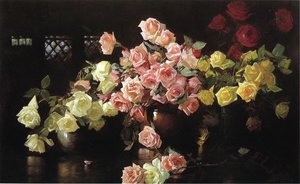
11Portrait of Frank Duveneck (1911) de Joseph Rodefer De CampPortrait of Frank Duveneck1911 · Cincinnati Art Museum 12Sir General Arthur William Currie (1920) de Joseph Rodefer De CampSir General Arthur William Currie1920 · Smithsonian American Art Museum 13Pauline de Joseph Rodefer De CampPauline 14Woman Drying Her Hair de Joseph Rodefer De CampWoman Drying Her HairCincinnati Art Museum 15Josiah Dwight Whitney (1819-1896) de Joseph Rodefer De CampJosiah Dwight Whitney (1819-1896)Harvard Art Museums 16Roses de Joseph Rodefer De CampRoses 17Street Scene, in Venice (1881) de Joseph Rodefer De CampStreet Scene, in Venice1881 · Cincinnati Art Museum 18Moorland Path, Cape Ann, Massachusetts (1886) de Joseph Rodefer De CampMoorland Path, Cape Ann, Massachusetts1886 19Magdalen (1896) de Joseph Rodefer De CampMagdalen1896 · Cincinnati Art Museum 20Summer Landscape (also known as Summertime) (1893) de Joseph Rodefer De CampSummer Landscape (also known as Summertime)1893 21untitled (8353) de Joseph Rodefer De Campuntitled (8353) 22untitled (9989) de Joseph Rodefer De Campuntitled (9989) 23Sally de Joseph Rodefer De CampSallyWorcester Art Museum 24Portrait of the Artist's Daughter de Joseph Rodefer De CampPortrait of the Artist's Daughter 25untitled (4947) de Joseph Rodefer De Campuntitled (4947) 26Mrs. Ernest Major de Joseph Rodefer De CampMrs. Ernest MajorCincinnati Art Museum 27Lambert Decamp de Joseph Rodefer De CampLambert Decamp 28The Blue Cup de Joseph Rodefer De CampThe Blue CupMuseu de Belas Artes de Boston 29Portrait of the Artist's Wive Edity de Joseph Rodefer De CampPortrait of the Artist's Wive Edity 30The Blue Mandarin Coat (Aka The Blue Kimono) de Joseph Rodefer De CampThe Blue Mandarin Coat (Aka The Blue Kimono)High Museum of Art 31The Pink Feather (Aka The Brown Veil) de Joseph Rodefer De CampThe Pink Feather (Aka The Brown Veil) 32The Cellist (1908) de Joseph Rodefer De CampThe Cellist1908 33The Guitar Player (1913) de Joseph Rodefer De CampThe Guitar Player1913 34Portrait in Red and Gold of Miss Pearson (1921) de Joseph Rodefer De CampPortrait in Red and Gold of Miss Pearson1921 35Red Comunion (1919) de Joseph Rodefer De CampRed Comunion1919 36The Guitar Player (1908) de Joseph Rodefer De CampThe Guitar Player1908 · Museu de Belas Artes de Boston 37Girl With A Green Shawl de Joseph Rodefer De CampGirl With A Green Shawl 38Jetty at Low Tide (also known as The Water Pier) (1901) de Joseph Rodefer De CampJetty at Low Tide (also known as The Water Pier)1901 39untitled (6833) de Joseph Rodefer De Campuntitled (6833)Cincinnati Art Museum 40De camp joseph sally de Joseph Rodefer De CampDe camp joseph sally 41The Steward (Aka Lewis Of The Porcellian) de Joseph Rodefer De CampThe Steward (Aka Lewis Of The Porcellian) 42untitled (5568) de Joseph Rodefer De Campuntitled (5568) 43The Fur Jacket de Joseph Rodefer De CampThe Fur Jacket 44In The Studio de Joseph Rodefer De CampIn The Studio 45Venice (Aka Becalmed) de Joseph Rodefer De CampVenice (Aka Becalmed) 46At Gloucester (Aka Gloucester Harbor) de Joseph Rodefer De CampAt Gloucester (Aka Gloucester Harbor) 47Summer In The Country de Joseph Rodefer De CampSummer In The Country 48A Murky Day de Joseph Rodefer De CampA Murky Day 49Miss Alice Boit de Joseph Rodefer De CampMiss Alice BoitNew Britain Museum of American Art 50Blue Bird de Joseph Rodefer De CampBlue Bird 51June Sunlight de Joseph Rodefer De CampJune Sunlight 52The Violinist (Aka The Violin. Girl With A Violin Iii) de Joseph Rodefer De CampThe Violinist (Aka The Violin. Girl With A Violin Iii) 53Reflections (Aka Arrangement In Pink And Blue) de Joseph Rodefer De CampReflections (Aka Arrangement In Pink And Blue) 54phlox de Joseph Rodefer De Campphlox 55Portrait of Albert H. Chatfield, Sr de Joseph Rodefer De CampPortrait of Albert H. Chatfield, Sr 56The Heliotrope Gown de Joseph Rodefer De CampThe Heliotrope Gown 57Red And Gold (Aka Portrait Of Miss Pearson) de Joseph Rodefer De CampRed And Gold (Aka Portrait Of Miss Pearson) 58Seascape de Joseph Rodefer De CampSeascape 59The Pear Orchard de Joseph Rodefer De CampThe Pear Orchard 60The Music Lesson de Joseph Rodefer De CampThe Music Lesson 61The Little Hotel de Joseph Rodefer De CampThe Little Hotel 62La Penserosa de Joseph Rodefer De CampLa Penserosa 63The Hammock de Joseph Rodefer De CampThe Hammock 64R woman drying her hair de Joseph Rodefer De CampR woman drying her hair 65The Kreutzer Sonata (Aka Violinist Ii) de Joseph Rodefer De CampThe Kreutzer Sonata (Aka Violinist Ii) 66Trees Along The Coast (Aka Road To The Sea) de Joseph Rodefer De CampTrees Along The Coast (Aka Road To The Sea) 67The Guitar Player de Joseph Rodefer De CampThe Guitar Player 68September Afternoon de Joseph Rodefer De CampSeptember Afternoon 69The Window Blind de Joseph Rodefer De CampThe Window Blind

Os temas que cativaram o olhar de Joseph Rodefer De Camp

Os quatro temas que mais se repetem nestas obras originais, cada um com o seu melhor exemplo.

Os museus que guardam os originais de Joseph Rodefer De Camp

Os 8 museus que detêm a maioria das pinturas desta página.

Museus Cidade Obras de Joseph Rodefer De Camp Pinturas desta lista
Cincinnati Art Museum, CincinnatiCincinnati Art Museum Cincinnati 6 Portrait of Frank Duveneck, Woman Drying Her Hair, Street Scene, in Venice
Harvard Art Museums, CambridgeHarvard Art Museums Cambridge 4 Frederick Cheever Shattuck (1847-1929), Frederic Bayard Winthrop (1868-1932), Nathaniel Southgate Shaler (1841-1906)
Smithsonian American Art Museum, Washington, D.C.Smithsonian American Art Museum Washington, D.C. 2 Sir Robert Laird Borden, Sir General Arthur William Currie
Museu de Belas Artes de Boston, BostonMuseu de Belas Artes de Boston Boston 2 The Blue Cup, The Guitar Player
National Gallery of Art, WashingtonNational Gallery of Art Washington 1 The Seamstress
Currier Gallery of Art, ManchesterCurrier Gallery of Art Manchester 1 Carnation and Black
Worcester Art Museum, WorcesterWorcester Art Museum Worcester 1 Sally
High Museum of Art, AtlantaHigh Museum of Art Atlanta 1 The Blue Mandarin Coat (Aka The Blue Kimono)

Joseph Rodefer De Camp, uma pintura emblemática por década

Obras por década

Escolha uma década para ver a obra original que a define.

Pinturas de Joseph Rodefer De Camp: a galeria responde

Qual pintura de Joseph Rodefer De Camp é a mais famosa de todas?Revelar a resposta

Frederick Cheever Shattuck (1847-1929) (1912), Harvard Art Museums, Cambridge. Frederic Bayard Winthrop (1868-1932) (1909) e The Seamstress (1916) vêm a seguir.

Qual era a idade de Joseph Rodefer De Camp ao concluir Frederick Cheever Shattuck (1847-1929)?Revelar a resposta

54 anos: Frederick Cheever Shattuck (1847-1929) data de 1912, e Joseph Rodefer De Camp nasceu em 1858.

Quais são as 10 principais pinturas de Joseph Rodefer De Camp?Revelar a resposta

Frederick Cheever Shattuck (1847-1929), Frederic Bayard Winthrop (1868-1932), The Seamstress, Nathaniel Southgate Shaler (1841-1906), Portrait of a Boy (Ted), Sir Robert Laird Borden, Carnation and Black, Portrait of a Young Lady, Our Nanny e The Listener (Woman at the Theatre). O ranking acima apresenta o ano e o museu de cada uma.

Quantas obras Joseph Rodefer De Camp criou?Revelar a resposta

Nosso catálogo contém 86 obras de Joseph Rodefer De Camp, datadas de 1881 a 1921.

Onde estão expostos os originais mais famosos de Joseph Rodefer De Camp?Revelar a resposta

Principalmente em Cincinnati Art Museum (Cincinnati), Harvard Art Museums (Cambridge) e Smithsonian American Art Museum (Washington, D.C.). A tabela de museus acima lista todos eles.

Quando é que Joseph Rodefer De Camp criou as suas pinturas mais famosas?Revelar a resposta

Em 1900s: 7 das 69 obras nesta página foram feitas então, sendo Frederic Bayard Winthrop (1868-1932) delas.

Quais são as obras mais famosas de Joseph Rodefer De Camp no início e no fim de sua carreira?Revelar a resposta

Nesta página, a mais antiga é Street Scene, in Venice (1881) e a mais recente é Portrait in Red and Gold of Miss Pearson (1921).

Quais temas Joseph Rodefer De Camp mais explorou?Revelar a resposta

Portrait (11), Girls (10) e Man (7), entre as 69 obras nesta página.

Em qual técnica Joseph Rodefer De Camp mais trabalhou?Revelar a resposta

Oil On Canvas, para 14 das 69 obras nesta página.

Com qual movimento Joseph Rodefer De Camp está associado(a)?Revelar a resposta

Impressionism e American impressionism, a julgar pelos originais nesta página.

Quais obras originais de Joseph Rodefer De Camp o Cincinnati Art Museum possui?Revelar a resposta

Portrait of Frank Duveneck, Woman Drying Her Hair e Street Scene, in Venice: o Cincinnati Art Museum, Cincinnati detém 6 das obras desta página.

Joseph Rodefer De Camp: o artista

Joseph Rodefer DeCamp (1858-1923): A Luminist of American Life – The World of Joseph Rodefer DeCamp

Joseph Rodefer DeCamp, a name synonymous with the refined elegance of American Impressionism and the distinctive style of the Boston School, occupies a pivotal position in the narrative of late 19th and early 20th-century American art. Born in Cincinnati, Ohio, in 1858, DeCamp’s artistic journey was one of dedicated study, evolving influences, and ultimately, a masterful synthesis of realism, impressionistic light, and an enduring fascination with the subtleties of human experience. His canvases offer glimpses into a world of quiet domesticity, luminous interiors, and portraits that capture not merely likeness but also the inner lives of his subjects. From early training under Thomas S. Noble and Frank Duveneck in Cincinnati to formative years spent absorbing artistic traditions in Munich and Florence, DeCamp’s foundation was built upon rigorous academic principles before blossoming into a uniquely American vision.

Formative Years and European Influences

DeCamp's initial exposure to art came at the McMicken School of Design in Cincinnati, where he honed his foundational skills under Noble, whose emphasis on draftsmanship would remain a cornerstone of DeCamp’s technique. However, it was his association with Frank Duveneck that proved particularly impactful, steering him towards a bolder, more direct approach to painting. This influence propelled DeCamp across the Atlantic in the 1870s, joining Duveneck and a cohort of American students at the Royal Academy of Munich. While initially embracing the academic rigor of the academy, DeCamp soon gravitated toward Duveneck’s independent spirit and followed him to Florence, immersing himself in the rich artistic heritage of Italy. These European experiences were crucial, providing not only technical training but also exposure to the Old Masters – particularly the Dutch painters like Jan Vermeer – whose influence would become increasingly apparent in his later work. The meticulous detail, subtle lighting, and quiet intimacy found in Vermeer’s interiors resonated deeply with DeCamp, shaping his aesthetic sensibilities and informing his approach to composition and atmosphere. He meticulously studied the techniques of Rembrandt and Hals, absorbing their mastery of chiaroscuro—the dramatic interplay of light and shadow—which would become a hallmark of his own artistic style.

The Boston School and a Distinctive Style

Upon returning to America in 1883, DeCamp settled in Boston, becoming an integral part of what would soon emerge as the Boston School. Alongside artists like Edmund C. Tarbell and Emil Otto Grundmann, he championed a style that blended Impressionist techniques with traditional academic training. This wasn’t a wholesale abandonment of academic tradition; rather, it was a uniquely American adaptation, prioritizing solid draftsmanship, carefully considered compositions, and a luminous quality of light achieved through subtle color harmonies. DeCamp's work during this period often depicted women engaged in everyday activities – sewing, reading, or simply lost in thought – bathed in the soft glow of interior light. He skillfully captured these scenes with a remarkable sensitivity to detail and atmosphere, reflecting the influence of Impressionist luminism—the deliberate use of diffused light to create an ethereal effect. His incorporation of Japonisme—the influence of Japanese art and design—added another layer to his artistic vocabulary, introducing delicate patterns and a sense of refined elegance into his compositions. The Boston School’s aesthetic was characterized by its rejection of the dark tonalities favored by earlier Romantic painters, opting instead for a brighter palette and an emphasis on capturing fleeting moments of beauty.

Notable Achievements and Recognition

Throughout his prolific career, DeCamp achieved considerable acclaim for his artistic endeavors. He earned the Temple Gold Medal in 1899 for *Woman Drying Her Hair*, recognizing his exceptional skill in portraying human subjects with grace and dignity. Similarly, he secured the Beck Gold Medal in 1912 for *Portrait of Francis I. Amory*, demonstrating his ability to convey psychological depth through portraiture—a testament to his understanding of human emotion and character. Furthermore, DeCamp received an honorable mention at the 1900 Exposition Universelle in Paris, acknowledging his contribution to the burgeoning international art scene. His work was celebrated by critics and collectors alike, establishing him as one of the foremost figures in American Impressionism. He was elected an associate member of the National Academy in 1902, solidifying his position within the established artistic community.

Legacy and Enduring Influence

Joseph Rodefer DeCamp’s legacy extends far beyond his individual paintings; he profoundly shaped the trajectory of American art history. His pioneering efforts to establish a distinctively American Impressionist idiom—one that honored both tradition and innovation—served as an inspiration for subsequent generations of artists. He championed the pursuit of naturalistic observation combined with expressive artistic vision, fostering a dialogue between realism and impressionism that continues to resonate today. DeCamp’s canvases remain treasured examples of luminous portraiture and serene landscape painting, embodying the spirit of American Luminism—a movement dedicated to capturing the beauty of everyday life through subtle light and color. His enduring influence can be seen in the works of countless artists who followed him, cementing his place as a pivotal figure in the history of American art.