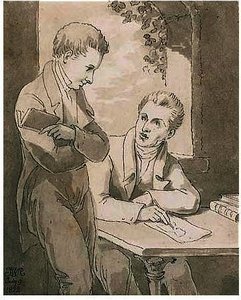
Retrato de John White Abbott

Pinturas de John White Abbott: As 56 mais famosas, sob o olhar de uma galeria

Atualizado em Novembro 2026 · classificado pela nossa pontuação de popularidade (pesquisas, visitas e pedidos de cada obra) · 57 obras de John White Abbott em nosso catálogo

Em resumo

Aos olhos da galeria, a pintura mais famosa de John White Abbott é An Italianate Landscape (1800), cuja obra original está exposta no Yale Center for British Art, em New Haven. The Old Lime Kilns near Topsham on the Exe, Devon (1808) e Thirlmere and Skiddaw, Lake District completam o trio que todos reconhecem. Dos 57 trabalhos de John White Abbott em nosso catálogo, a galeria apresenta abaixo as 56 obras mais famosas, cada uma original, com seu ano, seu museu e o que a torna única.

1763 – 1851, Exeter Romanticism Mais obras: Yale Center for British Art

As 10 principais pinturas de John White Abbott na galeria

1
An Italianate Landscape (1800) de John White Abbott

An Italianate Landscape

1800 · Oil On Canvas · Yale Center for British Art, New Haven

An Italianate Landscape is an oil on canvas painting by the British artist John White Abbott. Created about 1800, the work presents an Italianate (Romanist) landscape. The artist, John White Abbott, was born in 1763 in Cowick near Exeter, Devon. This specific composition focuses on a wide natural setting characterized by hills, mountains, and various rock landforms.

2
The Old Lime Kilns near Topsham on the Exe, Devon (1808) de John White Abbott

The Old Lime Kilns near Topsham on the Exe, Devon

1808 · Oil On Canvas

In this 1808 oil on canvas, we find ourselves standing on the banks of the Exe, looking toward the old lime kilns near Topsham. The scene is one of profound stillness, a pastoral moment captured with a gentle, observant hand. To the right, a cluster of mature, heavy-canopied trees anchors the composition, their dark trunks and textured bark providing a sturdy frame for the view. Beneath these trees, a rustic…

3
Thirlmere and Skiddaw, Lake District de John White Abbott

Thirlmere and Skiddaw, Lake District

Watercolor

In this work, titled Thirlmere and Skiddaw, Lake District, the artist John White Abbott presents a quiet view of the English Lake District. The composition centers on a valley where a river flows through a landscape of lush greenery. Above the terrain, mountains rise toward a sky where clouds hover, casting a soft light over the scene. It is a moment of stillness captured in the natural world.

4
John White Abbott, Hill Crag on Grasmere Lake de John White Abbott

John White Abbott, Hill Crag on Grasmere Lake

Watercolor · Wordsworth Grasmere, Grasmere

The watercolor painting titled John White Abbott, Hill Crag on Grasmere Lake by John White Abbott captures a specific moment of stillness. This work measures 19 x 29 cm. It presents a view of the rugged terrain and the quiet waters of the Lake District. The paper holds the light of a soft sky and the shadows of the hills.

5
Near New Bridge on the Dart Devon de John White Abbott

Near New Bridge on the Dart Devon

Watercolor

The landscape unfolds with a quiet focus on the grazing life near the River Dart. A herd of cattle occupies the central meadow, their forms scattered across the grass in various stages of repose and movement. Among the cows, several sheep are interspersed, adding a subtle layer of variety to the pastoral assembly. The composition is anchored by rugged rocks in the foreground, which provide a textural contrast to the…

Pinturas de John White Abbott, classificadas de 11 a 56

11THE HURDY-GURDY PLAYER AND HIS MONKEY de John White AbbottTHE HURDY-GURDY PLAYER AND HIS MONKEY 12A Bacchanal de John White AbbottA Bacchanal 13CATTLE ON THE VILLAGE ROAD de John White AbbottCATTLE ON THE VILLAGE ROAD 14The head of the Lake of Geneva from Vevay de John White AbbottThe head of the Lake of Geneva from Vevay 15Figures on the shore at Dawlish, Devon de John White AbbottFigures on the shore at Dawlish, Devon 16A View of Bristol from the down de John White AbbottA View of Bristol from the down 17Naples, The Island of Capria.Evening de John White AbbottNaples, The Island of Capria.Evening 18New Road to Twerton de John White AbbottNew Road to Twerton 19HAVEN BANK, EXETER; EXETER CATHEDRAL FROM THE HAVEN BANK de John White AbbottHAVEN BANK, EXETER; EXETER CATHEDRAL FROM THE HAVEN BANK 20Linmouth, Devon de John White AbbottLinmouth, Devon 21ON THE WARREN NEAR DAWLISH, DEVON de John White AbbottON THE WARREN NEAR DAWLISH, DEVON 22A study of undergrowth at Chudleigh, Devon de John White AbbottA study of undergrowth at Chudleigh, Devon 23Sheepstor and village, Devon de John White AbbottSheepstor and village, Devon 24Chudleigh, Devon de John White AbbottChudleigh, Devon 25Peamore, Devon de John White AbbottPeamore, Devon 26Sharper Tor with Sheep Tor beyond, Devon de John White AbbottSharper Tor with Sheep Tor beyond, Devon 27Landscape with a view on the Teign de John White AbbottLandscape with a view on the Teign 28The river near Hawthornden, Devon de John White AbbottThe river near Hawthornden, Devon 29DUNSFORD BRIDGE, EAST DEVON de John White AbbottDUNSFORD BRIDGE, EAST DEVON 30Borrowdale and Derwentwater, Lake District de John White AbbottBorrowdale and Derwentwater, Lake District 31Ugbrooke, Devon 1 de John White AbbottUgbrooke, Devon 1 32Watendlath, Cumberland de John White AbbottWatendlath, Cumberland 33VIEW OF BUCKLAND, DEVON de John White AbbottVIEW OF BUCKLAND, DEVON 34Chepstow Castle on the Wye, Monmouthshire de John White AbbottChepstow Castle on the Wye, MonmouthshireBirmingham Museum and Art Gallery 35Near Canonteign de John White AbbottNear Canonteign 36On the Dart, from Holne Chase de John White AbbottOn the Dart, from Holne Chase 37A folio of thirty-nine landscape, animal and figure studies, including Barton de John White AbbottA folio of thirty-nine landscape, animal and figure studies, including Barton 38Portrait of the artist and his friend, William Jackson of Exeter de John White AbbottPortrait of the artist and his friend, William Jackson of Exeter 39Near Roslyn Castle, Edinburgh de John White AbbottNear Roslyn Castle, Edinburgh 40VIEW OF LOCH LONG FROM A HILL NEAR ARROCHAR, SCOTLAND de John White AbbottVIEW OF LOCH LONG FROM A HILL NEAR ARROCHAR, SCOTLAND 41Near Chudleigh de John White AbbottNear Chudleigh 42LANDSCAPE WITH RUSTICS MEETING ON A PATH de John White AbbottLANDSCAPE WITH RUSTICS MEETING ON A PATH 43From the churchyard at Dulverton, Somerset de John White AbbottFrom the churchyard at Dulverton, Somerset 44Houses at the Edge of a Wood de John White AbbottHouses at the Edge of a Wood 45A view of Bideford on the River Torridge, Devon de John White AbbottA view of Bideford on the River Torridge, Devon 46Canonteign, Devon de John White AbbottCanonteign, Devon 47Fishermen unloading their boats on the shore de John White AbbottFishermen unloading their boats on the shore 48Cascade of the Aray at Inveraray (Scotland) de John White AbbottCascade of the Aray at Inveraray (Scotland) 49The lower part of Corra Lynn, one of the Falls of the Clyde, Lanarkshire de John White AbbottThe lower part of Corra Lynn, one of the Falls of the Clyde, Lanarkshire 50View near Canonteign, Devon de John White AbbottView near Canonteign, Devon 51Fishermen hauling a boat to shore, Devon de John White AbbottFishermen hauling a boat to shore, Devon 52VIEW OF MORPETH, NORTHUMBERLAND de John White AbbottVIEW OF MORPETH, NORTHUMBERLAND 53Trees in Ugbrooke Park, Devon de John White AbbottTrees in Ugbrooke Park, Devon 54Trees in Peamore Park, Exeter de John White AbbottTrees in Peamore Park, Exeter 55Caton-Clam-Bridge near Ivy Bridge on the Erme, Devon de John White AbbottCaton-Clam-Bridge near Ivy Bridge on the Erme, Devon 56Canonteign, Devon 2 de John White AbbottCanonteign, Devon 2

Pinturas famosas de John White Abbott, período por período

Os temas que cativaram o olhar de John White Abbott

Os quatro temas que mais se repetem nestas obras originais, cada um com o seu melhor exemplo.

Os museus que guardam os originais de John White Abbott

Os 3 museus que detêm a maioria das pinturas desta página.

Museus Cidade Obras de John White Abbott Pinturas desta lista
Yale Center for British Art, New HavenYale Center for British Art New Haven 1 An Italianate Landscape
Wordsworth Grasmere, GrasmereWordsworth Grasmere Grasmere 1 John White Abbott, Hill Crag on Grasmere Lake
Birmingham Museum and Art Gallery, BirminghamBirmingham Museum and Art Gallery Birmingham 1 Chepstow Castle on the Wye, Monmouthshire

John White Abbott, as pinturas emblemáticas de cada ano

Cerca de dez anos, de 1800 a 1808, foram suficientes para John White Abbott: a galeria percorre-os ano a ano, um original famoso após o outro.

Obras por ano

Escolha um ano para ver as obras originais.

Pinturas de John White Abbott: a galeria responde

Qual pintura de John White Abbott é a mais famosa de todas?Revelar a resposta

An Italianate Landscape (1800), Yale Center for British Art, New Haven. The Old Lime Kilns near Topsham on the Exe, Devon (1808) e Thirlmere and Skiddaw, Lake District vêm a seguir.

Qual era a idade de John White Abbott ao concluir An Italianate Landscape?Revelar a resposta

37 anos: An Italianate Landscape data de 1800, e John White Abbott nasceu em 1763.

Quais são as 10 principais pinturas de John White Abbott?Revelar a resposta

An Italianate Landscape, The Old Lime Kilns near Topsham on the Exe, Devon, Thirlmere and Skiddaw, Lake District, John White Abbott, Hill Crag on Grasmere Lake, Near New Bridge on the Dart Devon, Landscape with Abraham and Isaac, THE COTTAGE BY THE BRIDGE, GATHERING FIREWOOD, WOODCUTTERS e CHILDREN BATHING IN A MOUNTAIN STREAM. O ranking acima apresenta o ano e o museu de cada uma.

Quantas obras John White Abbott criou?Revelar a resposta

Nosso catálogo contém 57 obras de John White Abbott, datadas de 1800 a 1808.

Onde estão expostos os originais mais famosos de John White Abbott?Revelar a resposta

Principalmente em Yale Center for British Art (New Haven), Wordsworth Grasmere (Grasmere) e Birmingham Museum and Art Gallery (Birmingham). A tabela de museus acima lista todos eles.

Quais são as obras mais famosas de John White Abbott no início e no fim de sua carreira?Revelar a resposta

Nesta página, a mais antiga é An Italianate Landscape (1800) e a mais recente é The Old Lime Kilns near Topsham on the Exe, Devon (1808).

Quais temas John White Abbott mais explorou?Revelar a resposta

Forests (13), Landscape (10) e Scenes (8), entre as 56 obras nesta página.

Em qual técnica John White Abbott mais trabalhou?Revelar a resposta

Watercolor, para 3 das 56 obras nesta página.

Com qual movimento John White Abbott está associado(a)?Revelar a resposta

Romanticism, a julgar pelos originais nesta página.

John White Abbott: o artista

John White Abbott: O Mestre Silencioso das Paisagens de Devon

John White Abbott, nascido em Exeter em 1763 e falecido em 1851, permanece como uma figura de silenciosa importância na história da aguarela britânica. Frequentemente eclipsado pelo seu influente mestre, Francis Towne, a obra de Abbott revela uma sensibilidade distinta — uma observação meticulosa da luz, da textura e da beleza sutil do campo de Devon e das Terras Altas da Escócia. Sua vida foi marcada por uma dedicação contida tanto à arte quanto à profissão; ele atuou como cirurgião e boticário enquanto, simultaneamente, perseguia suas paixões artísticas com uma consistência notável ao longo de várias décadas. O legado de Abbott não se compõe de telas grandiosas ou dramáticas, mas sim de uma coleção de paisagens primorosamente renderizadas que oferecem vislumbres íntimos do mundo ao seu redor, refletindo uma conexão profunda com a terra e um olhar artístico refinado.

A formação inicial de Abbott foi inegavelmente moldada por Towne, cuja influência é prontamente perceptível na pincelada solta e na perspectiva atmosférica de Abbott. No entanto, enquanto Towne frequentemente retratava cenas italianas — muitas vezes com um toque teatral — Abbott concentrou-se primordialmente em sua terra natal, Devon, e na Escócia. Essa mudança reflete um interesse crescente pelo mundo natural e o desejo de capturar o caráter autêntico dessas regiões. Ele passou um tempo considerável explorando o Lake District em 1791, esboçando e estudando meticulosamente as paisagens dramáticas, o que sem dúvida informou seu trabalho posterior. Seu estilo evoluiu com o tempo, partindo de uma imitação mais direta das técnicas de Towne para um maior grau de independência, caracterizado por um manuseio delicado da cor e uma ênfima ênfase em capturar os efeitos fugazes da luz.

Uma Vida Dividida: Cirurgião, Boticário e Pintor

Nascido em uma família próspera com propriedades em Exeter, a vida de Abbott foi estruturada em torno de responsabilidades profissionais e de aspirações artísticas. Ele recebeu seu treinamento médico em Exeter, tornando-se um respeitado cirurgião e boticário — habilidades que lhe proporcionaram uma renda estável, permitindo-lhe o tempo e os recursos necessários para se dedicar à pintura. A riqueza de sua família garantiu-lhe acesso a materiais e oportunidades indisponíveis para muitos artistas da época. Essa existência confortável permitiu que Abbott buscasse seus empreendimentos artísticos sem a pressão constante da insegurança financeira, fomentando um compromisso sustentado com seu ofício.

A carreira de Abbott como artista desenrolou-se gradualmente, começando na década de 1790 e continuando até pouco antes de sua morte. Ele exibiu regularmente na Royal Academy entre 1795 e 1822, embora sua presença ali tenha diminuído significativamente após o início da década de 1820. Notavelmente, Abbott nunca vendeu ativamente suas pinturas durante sua vida; elas foram, em grande parte, mantidas na coleção de sua família, sugerindo um profundo apego pessoal ao seu trabalho e uma ausência de ambição comercial. Essa obscuridade relativa contribuiu para que ele fosse subestimado por historiadores da arte durante muitos anos, até que estudos mais recentes começaram a reconhecer a profundidade e a sutileza de sua visão artística.

A Linguagem da Paisagem: Técnica e Temática

A técnica de aguarela de Abbott é caracterizada por um controle notável de cor e textura. Ele empregava uma abordagem delicada de camadas, construindo tons gradualmente para criar gradações sutis de luz e sombra. Sua pincelada é, em geral, solta e expressiva, mas sempre meticulosamente observada — capturando as nuances da folhagem, das superfícies da água e das condições atmosféricas com uma precisão impressionante. Ele era particularmente hábil em retratar os efeitos da luz sobre os elementos da paisagem, criando uma sensação de profundidade e atmosfera que é, ao mesmo tempo, cativante e serena.

Embora suas obras iniciais muitas vezes espelhassem o estilo de Towne, Abbott desenvolveu sua própria abordagem distintiva para a temática. Ele frequentemente retratava cenas do Lake District — colinas ondulantes, lagos cintilantes e paisagens montanhosas dramáticas — mas também produziu inúmeras paisagens de Devon, incluindo locais familiares como o Gowerbarrow Park em Ullswater e Sharper Tor, perto de Exeter. Ocasionalmente, ele aventurou-se na pintura histórica, como evidenciado por suas pinturas a óleo “Macbeth Recoiling from the Apparition of the Crowned Child” e “Prospero Commanding Ariel”, demonstrando uma gama artística mais ampla do que parecia inicialmente. Essas obras históricas, embora menos numerosas que suas paisagens, demonstram sua habilidade em renderizar figuras dramáticas e composições complexas com considerável perícia.

Legado e Redescoberta

Apesar de sua produção constante e do reconhecimento ocasional na Royal Academy, a obra de John White Abbott permaneceu amplamente desconhecida durante grande parte do século XX. O grosso de suas pinturas foi mantido na propriedade de sua família até bem avançada a segunda metade do século, limitando sua exposição ao mundo da arte em geral. No entanto, nas últimas décadas, tem havido uma crescente apreciação pelo domínio silencioso e pela beleza contida de Abbott. Suas aguarelas são agora reconhecidas como exemplos significativos da pintura de paisagem britânica dos séculos XVIII e XIX, oferecendo uma janela valiosa para as sensibilidades artísticas de sua época.

Hoje, as obras de Abbott podem ser encontradas em coleções ao redor do mundo, e reproduções estão cada vez mais disponíveis através de plataformas como OriginalUniqueArt.com. Seu legado é um de dedicação silenciosa, observação meticulosa e uma conexão profunda com o mundo natural — um testemunho do poder duradouro da pintura de paisagem.