Retrato de Sir John Gilbert

As 100 Pinturas Mais Famosas de Sir John Gilbert, uma Seleção da Galeria

Atualizado em Novembro 2026 · classificado pela nossa pontuação de popularidade (pesquisas, visitas e pedidos de cada obra) · 204 obras de Sir John Gilbert em nosso catálogo

Em resumo

De todas as obras originais deixadas por Sir John Gilbert, a mais famosa é Fair Saint George (1881), da coleção do Guildhall Art Gallery, em Londres. Logo atrás vêm The Taming of the Shrew (1860) e Sir John Falstaff Reviewing His Ragged Regiment (1858). Nosso catálogo contém 204 obras de Sir John Gilbert; a galeria preservou as 100 que o mundo mais admira, cada uma exibida com sua data, seu museu e sua história.

1817 – 1897, Blackheath Victorian romanticism Mais obras: Guildhall Art Gallery

As 10 principais pinturas de Sir John Gilbert: a escolha da galeria

1
Fair Saint George (1881) de Sir John Gilbert

Fair Saint George

1881 · Oil On Canvas · Guildhall Art Gallery, Londres

The air feels heavy with the scent of damp earth and the metallic tang of polished steel. In this frozen moment, a knight stands as a pillar of strength against a backdrop of rolling hills and a restless, cloudy sky. He holds his lance upright, his hands gripping the shaft with a steady, practiced ease that suggests a pause in a much longer, more perilous trek. His armor catches the…

2
The Taming of the Shrew (1860) de Sir John Gilbert

The Taming of the Shrew

1860 · Oil On Canvas · Birmingham Museum and Art Gallery, Birmingham

The Taming of the Shrew is a dramatic scene rendered by the English artist John Gilbert. This work captures a moment of friction from a comedy written by William Shakespeare between 1590 and 1592. The image functions as an illustration for the publication of Tales from Shakespeare by Charles Lamb. George Routledge released this specific version of the work.

3
Sir John Falstaff Reviewing His Ragged Regiment (1858) de Sir John Gilbert

Sir John Falstaff Reviewing His Ragged Regiment

1858 · Oil · Birmingham Museum and Art Gallery, Birmingham

In this 1858 work, we find ourselves drawn into a dense, theatrical scene that feels less like a static image and more like a captured moment from a stage play. The composition centers on Sir John Falstaff, draped in heavy red robes, as he conducts a meticulous review of his ragged regiment. Around him, a crowd of rustic characters gathers, their presence creating a sense of bustling, lived-in energy. The…
4
Scene From Shakespeare's The Merchant Of Venice (1864) de Sir John Gilbert

Scene From Shakespeare's The Merchant Of Venice

1864 · Watercolor · Birmingham Museum and Art Gallery, Birmingham

Scene From Shakespeare's The Merchant Of Venice by John Gilbert, a 19th-century watercolor painting, captures a dramatic moment from the play. Created about 1864, the work reflects the artist's deep engagement with literary narratives and the theatricality of the era. Gilbert, a prominent figure in British art, utilized the medium of watercolor to translate dramatic tension into a visual format.

5
The Return Of The Victors (1878) de Sir John Gilbert

The Return Of The Victors

1878 · Oil On Canvas · Birmingham Museum and Art Gallery, Birmingham

The air thickens with the dust of a thousand marching feet in The Return Of The Victors. This grand scene, painted in 1878, captures a moment of triumphant movement as a victorious army sweeps through the landscape. The scale of the work suggests a panoramic view of history in motion, where the weight of victory meets the chaotic energy of a returning crowd. Every figure contributes to a sense of…

6
Margaret of Anjou Taken Prisoner after the Battle of Tewkesbury (1875) de Sir John Gilbert

Margaret of Anjou Taken Prisoner after the Battle of Tewkesbury

1875 · Oil On Canvas · Guildhall Art Gallery, Londres

The oil painting titled Margaret of Anjou Taken Prisoner after the Battle of Tewkesbury was executed by the British artist John Gilbert in 1875. This work depicts a specific historical event centered on the aftermath of the Battle of Tewkesbury. The subject matter focuses on the immediate consequences of the conflict, specifically capturing the brutality and the state of the battlefield following the engagement.

7
Don Quixote and Sancho at the Castle of the Duke (1883) de Sir John Gilbert

Don Quixote and Sancho at the Castle of the Duke

1883 · Oil On Canvas

The scene unfolds within a stone courtyard, where the heavy architecture of a castle provides a rigid backdrop to a moment of profound human interaction. Two figures dominate the composition, their physical presence defined by a stark contrast in stature and temperament. One figure, clad in the metallic sheen of armor, reaches upward with an air of lofty idealism, his posture embodying the very essence of knightly fantasy. Beside him,…

8
Landscape with a Gypsy Encampment (1888) de Sir John Gilbert

Landscape with a Gypsy Encampment

1888 · Oil On Canvas

A steep hillside descends toward a valley, where the earth meets a turbulent sky. Beneath a canopy of dark, heavy clouds, a small fire flickers, casting a warm glow against the encroaching gloom. Figures huddle near the flames, surrounded by the quiet presence of horses, camels, and sheep. The air feels thick with the scent of woodsmoke and the weight of an approaching storm. Light breaks through the darkness in…

9
Lancelot du Lac (1886) de Sir John Gilbert

Lancelot du Lac

1886 · Oil On Canvas · Guildhall Art Gallery, Londres

The river churns with a heavy, white froth, swallowing the light beneath the weight of armored horses. Two knights collide in the center of the surge, their swords and shields cutting through the spray. A tree leans precariously over the bank, its branches heavy with the threat of falling into the chaos below. In the foreground, a woman watches. Her face is a pale study in melancholy, a quiet stillness…

10
Ego et Rex Meus (1888) de Sir John Gilbert

Ego et Rex Meus

1888 · Oil · Guildhall Art Gallery, Londres

In this 1888 oil painting, two men are positioned in a close, vertical composition against the architectural backdrop of a stone building. The figure on the left wears a crown and is draped in heavy red robes accented with gold. He is turned toward the second man, his posture suggesting he is in the middle of speaking. The second man, characterized by a beard, is dressed in similar red and…

A seleção de Sir John Gilbert continua, de 11 a 100

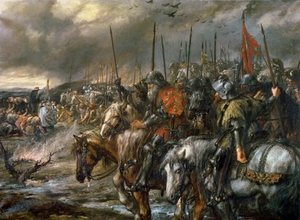
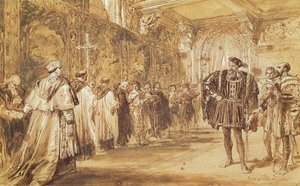
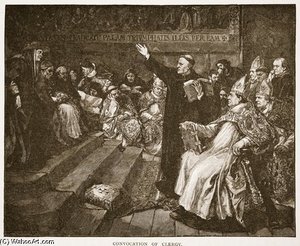
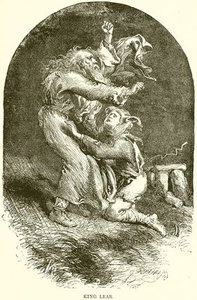
11The Ford (1891) de Sir John GilbertThe Ford1891 · Guildhall Art Gallery 12Don Quixote and Sancho Panza (1840) de Sir John GilbertDon Quixote and Sancho Panza1840 13Don Quixote Disputing with the Priest and the Barber (1844) de Sir John GilbertDon Quixote Disputing with the Priest and the Barber1844 14Her Majesty the Queen Holding a Drawing Room at St James's Palace (1851) de Sir John GilbertHer Majesty the Queen Holding a Drawing Room at St James's Palace1851 15'Henry VIII', Act I, Scene 1, Cardinal Wolsey and Buckingham (1861) de Sir John Gilbert'Henry VIII', Act I, Scene 1, Cardinal Wolsey and Buckingham1861 · Royal Shakespeare Company Collection 16Keston Common, Kent (1856) de Sir John GilbertKeston Common, Kent1856 17Study Of Trees (1874) de Sir John GilbertStudy Of Trees1874 · Birmingham Museum and Art Gallery 18Old Cottages At Lewisham (1876) de Sir John GilbertOld Cottages At Lewisham1876 · Birmingham Museum and Art Gallery 19Preparing For The Charge (1873) de Sir John GilbertPreparing For The Charge1873 · Birmingham Museum and Art Gallery 20Landscape Sketch (1877) de Sir John GilbertLandscape Sketch1877 · Birmingham Museums And Art Gallery 21Don Sancho Panza, Governor of Barataria (1875) de Sir John GilbertDon Sancho Panza, Governor of Barataria1875 · Manchester Art Gallery 22The Baggage Wagon (1884) de Sir John GilbertThe Baggage Wagon1884 · Birmingham Museum and Art Gallery 23A Windy Day (1885) de Sir John GilbertA Windy Day1885 · Birmingham Museum and Art Gallery 24The Horse Pond at Tarring, Sussex (1882) de Sir John GilbertThe Horse Pond at Tarring, Sussex1882 25The Morning of the Battle of Agincourt (1884) de Sir John GilbertThe Morning of the Battle of Agincourt1884 · Guildhall Art Gallery 26Don Quixote's Niece and Housekeeper (1891) de Sir John GilbertDon Quixote's Niece and Housekeeper1891 · Guildhall Art Gallery 27Stock exchange de Sir John GilbertStock exchange 28The aberdeen cabinet de Sir John GilbertThe aberdeen cabinet 29King John de Sir John GilbertKing John 30King Henry's Forces At The Siege Of Harfleur, de Sir John GilbertKing Henry's Forces At The Siege Of Harfleur, 31Richard Ii de Sir John GilbertRichard Ii 32Henry Iv, Part I de Sir John GilbertHenry Iv, Part I 33War - After The Battle de Sir John GilbertWar - After The Battle 34Marmion's Defence to Douglas de Sir John GilbertMarmion's Defence to Douglas 35Queen Elizabeth I Knighting Francis Drake de Sir John GilbertQueen Elizabeth I Knighting Francis Drake 36Coriolanus, de Sir John GilbertCoriolanus, 37As You Like It de Sir John GilbertAs You Like It 38King Lear de Sir John GilbertKing Lear 39King Lear de Sir John GilbertKing Lear 40The Battle Of The Standard de Sir John GilbertThe Battle Of The Standard 41Morning Of The Battle Of Agincourt de Sir John GilbertMorning Of The Battle Of Agincourt 42Titus Andronicus de Sir John GilbertTitus Andronicus 43The Heir Of Linne de Sir John GilbertThe Heir Of Linne 44Guy Fawkes Before King James de Sir John GilbertGuy Fawkes Before King James 45Much Ado About Nothing de Sir John GilbertMuch Ado About Nothing 46King Henry Vi de Sir John GilbertKing Henry Vi 47The Merchant Of Venice de Sir John GilbertThe Merchant Of Venice 48The Merchant Of Venice de Sir John GilbertThe Merchant Of Venice 49Battle of the Standard, de Sir John GilbertBattle of the Standard, 50Henry Viii And Cardinal Thomas Wolsey de Sir John GilbertHenry Viii And Cardinal Thomas Wolsey 51Cordelia de Sir John GilbertCordelia 52Convocation Of Clergy de Sir John GilbertConvocation Of Clergy 53What Shall He Have That Killed The Deer de Sir John GilbertWhat Shall He Have That Killed The Deer 54Wolsey de Sir John GilbertWolsey 55King Henry VI, Part I de Sir John GilbertKing Henry VI, Part I 56Cardinal Wolsey On His Way To Westminster Hall, de Sir John GilbertCardinal Wolsey On His Way To Westminster Hall, 57The Brave Lord Willoughby de Sir John GilbertThe Brave Lord Willoughby 58Valentine And Ursine de Sir John GilbertValentine And Ursine 59Under The Greenwood Tree de Sir John GilbertUnder The Greenwood Tree 60Rembrandt in his Studio de Sir John GilbertRembrandt in his Studio 61Fairies In A Bird's Nest de Sir John GilbertFairies In A Bird's Nest 62A Girl with Fruit (1882) de Sir John GilbertA Girl with Fruit1882 · Guildhall Art Gallery 63Landscape with Hunting Party (1893) de Sir John GilbertLandscape with Hunting Party1893 · Guildhall Art Gallery 64King Henry's Fleet Sails For France, de Sir John GilbertKing Henry's Fleet Sails For France, 65Malvolio de Sir John GilbertMalvolio 66Measure For Measure, de Sir John GilbertMeasure For Measure, 67The Tempest de Sir John GilbertThe Tempest 68Julius Caesar de Sir John GilbertJulius Caesar 69Henry Iv, Part Ii de Sir John GilbertHenry Iv, Part Ii 70Henry Vi, Part I, de Sir John GilbertHenry Vi, Part I, 71Come Away, Come Away, Death de Sir John GilbertCome Away, Come Away, Death 72The Merchant Of Venice, de Sir John GilbertThe Merchant Of Venice, 73The Two Gentlemen Of Verona de Sir John GilbertThe Two Gentlemen Of Verona 74Romeo And Juliet, de Sir John GilbertRomeo And Juliet, 75Othello de Sir John GilbertOthello 76Henry Vi, Part Iii, de Sir John GilbertHenry Vi, Part Iii, 77After The Battle Of Naseby de Sir John GilbertAfter The Battle Of Naseby 78Twelfth Night de Sir John GilbertTwelfth Night 79The Merry Wives Of Windsor de Sir John GilbertThe Merry Wives Of Windsor 80Joan La Pucelle Abandoned de Sir John GilbertJoan La Pucelle Abandoned 81Valentine And Ursine de Sir John GilbertValentine And Ursine 82As You Like It de Sir John GilbertAs You Like It 83The Yellow Dwarf, de Sir John GilbertThe Yellow Dwarf, 84Investiture Of A Knight Of The Garter de Sir John GilbertInvestiture Of A Knight Of The Garter 85Andrew Barton de Sir John GilbertAndrew Barton 86Macbeth de Sir John GilbertMacbeth 87Henry Viii de Sir John GilbertHenry Viii 88Hamlet de Sir John GilbertHamlet 89Tempest de Sir John GilbertTempest 90Taming Of The Shrew de Sir John GilbertTaming Of The Shrew 91Othello de Sir John GilbertOthello 92A Midsummer Night's Dream de Sir John GilbertA Midsummer Night's Dream 93King Richard Ii de Sir John GilbertKing Richard Ii 94Henry V de Sir John GilbertHenry VMuseu de Belas Artes de Boston 95Timon Of Athens de Sir John GilbertTimon Of Athens 96Joan Of Arc de Sir John GilbertJoan Of Arc 97Apotheosis Of Shakespeare's Characters de Sir John GilbertApotheosis Of Shakespeare's Characters 98Guy Fawkes Brought Before James I And His Council de Sir John GilbertGuy Fawkes Brought Before James I And His Council 99Come Away Death de Sir John GilbertCome Away Death 100The Merchant Of Venice de Sir John GilbertThe Merchant Of Venice

Pinturas famosas de Sir John Gilbert, período por período

Os temas que cativaram o olhar de Sir John Gilbert

Os quatro temas que mais se repetem nestas obras originais, cada um com o seu melhor exemplo.

Os museus que guardam os originais de Sir John Gilbert

Os 6 museus que detêm a maioria das pinturas desta página.

Museus Cidade Obras de Sir John Gilbert Pinturas desta lista
Guildhall Art Gallery, LondresGuildhall Art Gallery Londres 9 Fair Saint George, Margaret of Anjou Taken Prisoner after the Battle of Tewkesbury, Lancelot du Lac
Birmingham Museum and Art Gallery, BirminghamBirmingham Museum and Art Gallery Birmingham 9 The Taming of the Shrew, Sir John Falstaff Reviewing His Ragged Regiment, Scene From Shakespeare's The Merchant Of Venice
Manchester Art Gallery, ManchesterManchester Art Gallery Manchester 2 Don Sancho Panza, Governor of Barataria
Royal Shakespeare Company Collection, AvonRoyal Shakespeare Company Collection Avon 1 'Henry VIII', Act I, Scene 1, Cardinal Wolsey and Buckingham
Birmingham Museums And Art Gallery, BirminghamBirmingham Museums And Art Gallery Birmingham 1 Landscape Sketch
Museu de Belas Artes de Boston, BostonMuseu de Belas Artes de Boston Boston 1 Henry V

Sir John Gilbert década a década: a obra original que define cada uma

Obras por década

Escolha uma década para ver a obra original que a define.

Perguntas de colecionadores sobre as pinturas de Sir John Gilbert

Por qual obra Sir John Gilbert é mais conhecido(a)?Revelar a resposta

Fair Saint George (1881), Guildhall Art Gallery, Londres. The Taming of the Shrew (1860) e Sir John Falstaff Reviewing His Ragged Regiment (1858) vêm a seguir.

Qual era a idade de Sir John Gilbert quando Fair Saint George foi feita?Revelar a resposta

64 anos: Fair Saint George data de 1881, e Sir John Gilbert nasceu em 1817.

Quais são as dez pinturas mais famosas de Sir John Gilbert?Revelar a resposta

Fair Saint George, The Taming of the Shrew, Sir John Falstaff Reviewing His Ragged Regiment, Scene From Shakespeare's The Merchant Of Venice, The Return Of The Victors, Margaret of Anjou Taken Prisoner after the Battle of Tewkesbury, Don Quixote and Sancho at the Castle of the Duke, Landscape with a Gypsy Encampment, Lancelot du Lac e Ego et Rex Meus. O ranking acima apresenta o ano e o museu de cada uma.

Quantas pinturas Sir John Gilbert deixou?Revelar a resposta

Nosso catálogo contém 204 obras de Sir John Gilbert, datadas de 1840 a 1893.

Em quais museus estão expostas as obras-primas de Sir John Gilbert?Revelar a resposta

Principalmente em Guildhall Art Gallery (Londres), Birmingham Museum and Art Gallery (Birmingham) e Manchester Art Gallery (Manchester). A tabela de museus acima lista todos eles.

Em que anos Sir John Gilbert pintou as suas obras mais famosas?Revelar a resposta

Em 1880s: 10 das 100 obras nesta página foram feitas então, sendo Fair Saint George delas.

Quais são as primeiras e as últimas obras originais famosas de Sir John Gilbert?Revelar a resposta

Nesta página, a mais antiga é Don Quixote and Sancho Panza (1840) e a mais recente é Landscape with Hunting Party (1893).

Quais temas Sir John Gilbert escolheu com mais frequência?Revelar a resposta

Battle scene (6), Dramatic lighting (5) e Royalty (4), entre as 100 obras nesta página.

Qual técnica Sir John Gilbert mais utilizou?Revelar a resposta

Oil On Canvas, para 8 das 100 obras nesta página.

A qual movimento artístico pertence Sir John Gilbert?Revelar a resposta

Victorian romanticism, a julgar pelos originais nesta página.

Quais obras de Sir John Gilbert estão expostas no Guildhall Art Gallery?Revelar a resposta

Fair Saint George, Margaret of Anjou Taken Prisoner after the Battle of Tewkesbury e Lancelot du Lac: o Guildhall Art Gallery, Londres detém 9 das obras desta página.

Sir John Gilbert: vida e obra

Sir John Gilbert RA: O Escultor da Imaginação Vitoriana

John Gilbert (21 de julho de 1817 – 5 de outubro de 1897), nascido em Blackheath, Surrey, foi um artista britânico cuja produção prolífica consolidou sua reputação como “o Scott da pintura”, um elogio que reflete sua habilidade inigualável em capturar o espírito e a grandeza dos clássicos literários. Diferente de muitos artistas de sua época que buscaram formação formal, Gilbert aperfeiçoou seu ofício por meio da autodisciplina e de uma observação meticulosa — principalmente copiando gravuras — estabelecendo-se como um mestre da aquarela, do óleo e, crucialmente, da xilogravura. Sua jornada artística começou com um aprendizado em uma imobiliária, mas rapidamente transicionou para uma paixão pela narrativa visual que definiria toda a sua carreira.

Primeiros Anos e Inícios Artísticos

Os anos formativos de Gilbert instilaram nele um profundo apreço pelo detalhe e pela precisência — qualidades que ele mais tarde traduziria em ilustrações de tirar o fôlego. George Lance, seu único instrutor, nutriu o talento de Gilbert, incentivando-o a experimentar diversos meios e fomentando uma dedicação inabalável à excelência artística. Apesar de ter tido sua admissão nas Escolas da Royal Academy negada, a determinação de Gilbert o impulsionou adiante, dominando técnicas que lhe permitiram produzir obras de beleza e complexidade notáveis. Sua exposição inicial à arte ocorreu através da gravura, uma prática que ele abraçou de todo o coração, reconhecendo sua capacidade de transmitir emoção e narrativa com um impacto impressionante.

The Illustrated London News e Shakespeare

O grande salto na carreira de Gilbert ocorreu em 1856, quando aceitou um convite de William Mulready e Thomas Sheepshanks para contribuir com xilogravuras para o The Illustrated London News. Esta colaboração marcou o início de uma parceria prolífica que resultaria em mais de 2000 gravuras — uma conquista estonteante para a época — demonstrando o domínio de Gilbert sobre este meio tão exigente. No entanto, seu legado mais duradouro reside em sua empreitada monumental: o folio ilustrado de Shakespeare (1862–63). Com quase 750 desenhos meticulosamente elaborados para capturar a essência das peças de Shakespeare, Gilbert realizou um feito considerado impossível por muitos contemporâneos e estabeleceu-se como o principal intérprete da visão dramática do bardo. A magnitude e a ambição deste projeto sublinharam sua crença no poder transformador da arte — especificamente em sua capacidade de iluminar a condição humana.

Técnica e Estilo

O estilo artístico de Gilbert era caracterizado por um comando magistral do chiaroscuro, empregando contrastes dramáticos entre luz e sombra para intensificar o impacto emocional e transmitir profundidade de sentimento. Ele favorecia o detalhe meticuloso, renderizando texturas e superfícies com uma precisão admirável — uma marca registrada de sua obra que o distingue de muitos outros artistas do período vitoriano. Suas pinturas frequentemente retratavam paisagens imbuídas de uma grandeza atmosférica, refletindo um fascínio pelos ideais românticos e um compromisso inabalável em capturar a beleza sublime. Além disso, as explorações artísticas de Gilbert estenderam-se para além da pintura, alcançando a escultura, onde criou figuras evocativas que personificavam tanto força quanto graça.

Legado e Reconhecimento

A influência de Gilbert na arte e na ilustração vitoriana é inegável. Ele serviu como presidente da Royal Watercolour Society a partir de 1871, consolidando sua posição como uma figura de liderança nos círculos artísticos britânicos. Em reconhecimento às suas contribuições às artes visuais, foi condecorado com o título de cavaleiro em 1872 e, posteriormente, eleito para a Royal Academy em 1876 — um testemunho de sua reputação duradoura de excelência e inovação. Sua obra continua a inspirar artistas hoje, servindo como um exemplo de disciplina artística, virtuosismo técnico e narrativa imaginativa. O Concurso Gilbert-Garret para Clubes de Esboço, estabelecido em 1870 na St. Martins School of Art, permanece como um tributo duradouro ao seu espírito pioneiro e à sua crença inabalável na importância da educação artística. O legado de John Gilbert vai além de suas conquistas artísticas; ele é lembrado como um defensor dos valores humanistas — um homem que buscou elevar o espírito humano através da beleza e da contemplação. Ele repousa pacificamente nos cemitérios de Brockley e Ladywell, em Surrey.