Retrato de John Crome

As 54 Pinturas Mais Famosas de John Crome, Cada Uma Única

Atualizado em Outubro 2026 · classificado pela nossa pontuação de popularidade (pesquisas, visitas e pedidos de cada obra) · 54 obras de John Crome em nosso catálogo

Em resumo

Boys Bathing on the River Wensum, Norwich (1817) é a pintura de John Crome que mais atrai olhares; a obra original pertence ao Yale Center for British Art, New Haven. Depois disso, o olhar recai sobre Grove Scene (1820) e Slate Quarries (1803). Entre as 54 obras de John Crome em nosso catálogo, estas 54 são as mais famosas, cada uma uma original única apresentada com o seu ano, o seu museu e a razão pela qual perdura.

1768 – 1821, Norwich Romanticism Mais obras: Yale Center for British Art

As 10 principais pinturas de John Crome, sob o olhar da galeria

1
Boys Bathing on the River Wensum, Norwich (1817) de John Crome

Boys Bathing on the River Wensum, Norwich

1817 · Oil On Canvas · Yale Center for British Art, New Haven

Boys Bathing on the River Wensum, Norwich – A Reflection of Norfolk’s Soul John Crome's “Boys Bathing on the River Wensum, Norwich” isn’t merely a depiction of a picturesque riverside scene; it’s a distillation of the very spirit of Norfolk—a region steeped in tradition and celebrated for its understated beauty. Painted in 1817 during the height of the Romantic era, this landscape masterpiece encapsulates the fascination with nature that characterized…

2
Grove Scene (1820) de John Crome

Grove Scene

1820 · Oil On Canvas · Norwich Castle Museum And Art Gallery, Norwich

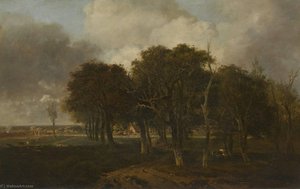
A small clearing within a Norfolk forest provides the setting for this 1820 oil on canvas. Two figures stand amidst the trees, appearing as quiet observers of the landscape. Nearby, a horse grazes in the grass, contributing to the pastoral stillness of the scene. The composition uses these figures to anchor the expansive vista, establishing a connection between the human presence and the natural environment.

6
A Mountain Scene (1806) de John Crome

A Mountain Scene

1806 · Oil · Scottish National Gallery, Edimburgo

In his 1806 masterpiece, A Mountain Scene, John Crome captures a panoramic vista of East Anglian hills, a scene that serves as a profound embodiment of Romantic ideals. The composition is dominated by a substantial rock outcrop in the foreground, its rugged presence acting as a symbol of resilience and permanence against the relentless forces of time and weather. Through a skillful application of perspective, Crome draws the viewer’s gaze…

Pinturas famosas de John Crome, números 11 a 54

11The Beaters (1810) de John CromeThe Beaters1810 · Scottish National Gallery 12Yarmouth Jetty (1810) de John CromeYarmouth Jetty1810 · Yale Center for British Art 13Woodland Landscape near Norwich (1810) de John CromeWoodland Landscape near Norwich1810 · Yale Center for British Art 14View near Thorpe; Moonlight scene (1807) de John CromeView near Thorpe; Moonlight scene1807 · Vanderbilt Museum of Art 15Hautbois Common, Norfolk (1810) de John CromeHautbois Common, Norfolk1810 · Metropolitan Museum of Art 16High Tor, Matlock (1811) de John CromeHigh Tor, Matlock1811 · Fitzwilliam Museum 17Hautbois Common, Norfolk (1810) de John CromeHautbois Common, Norfolk1810 18Dock Leaves (1813) de John CromeDock Leaves1813 · Norwich Castle Museum And Art Gallery 19A Heath Scene: Sun after Storm (1818) de John CromeA Heath Scene: Sun after Storm1818 · National Gallery of Ireland 20A Windmill near Norwich (1816) de John CromeA Windmill near Norwich1816 21Yarmouth Harbour - Evening (1817) de John CromeYarmouth Harbour - Evening1817 22The Poringland Oak (1819) de John CromeThe Poringland Oak1819 23A Sandy Bank (1820) de John CromeA Sandy Bank1820 · Scottish National Gallery 24The Harling Gate (1817) de John CromeThe Harling Gate1817 · Vanderbilt Museum of Art 25The Edge of the Forest (1821) de John CromeThe Edge of the Forest1821 · Vanderbilt Museum of Art 26Landscape with Trees and Cattle (1820) de John CromeLandscape with Trees and Cattle1820 27Marlingford Grove (1815) de John CromeMarlingford Grove1815 28Mousehold Heath, Norwich (1820) de John CromeMousehold Heath, Norwich1820 29The Fish Market, Boulogne, France (1820) de John CromeThe Fish Market, Boulogne, France1820 · Norwich Castle Museum And Art Gallery 30Moonlight on the Yare (1817) de John CromeMoonlight on the Yare1817 · National Gallery of Art 31Moonrise on the Yare ( ) (1816) de John CromeMoonrise on the Yare ( )1816 32Ruined Buildings de John CromeRuined BuildingsGaleria Nacional do Canadá 33Windmill near Norwich de John CromeWindmill near NorwichMuseu de Belas Artes de Boston 34Landscape Edge of a Wood (1820) de John CromeLandscape Edge of a Wood1820 · Courtauld Gallery 35The Lime Kiln (1806) de John CromeThe Lime Kiln1806 36An Egyptian Poppy and a Water Mole (1812) de John CromeAn Egyptian Poppy and a Water Mole1812 · Yale Center for British Art 37View near Weymouth de John CromeView near WeymouthDetroit Institute of Arts 38A sandy hollow de John CromeA sandy hollowFitzwilliam Museum 39Yarmouth Beach de John CromeYarmouth BeachYale University Art Gallery 40A Barge with a Wounded Soldier de John CromeA Barge with a Wounded SoldierYale Center for British Art 41Moonlight Norwich, Norfolk de John CromeMoonlight Norwich, NorfolkRussell 42The Edge of the Forest de John CromeThe Edge of the Forest 43Landscape with a Waterfall near Norwich, Norfolk, 1819 de John CromeLandscape with a Waterfall near Norwich, Norfolk, 1819The Wilson: Cheltenham Art Gallery And Museum 44Wooded Landscape with an Oak de John CromeWooded Landscape with an Oak 45The Mill de John CromeThe MillNorfolk Museums 46Moonlight de John CromeMoonlight 47Mousehold Heath de John CromeMousehold Heath 48The Mill (after Rembrandt van Rijn) de John CromeThe Mill (after Rembrandt van Rijn)Norfolk Museums 49Lane near Norwich de John CromeLane near NorwichWolverhampton Art Gallery 50Landscape with a Cottage and Trees de John CromeLandscape with a Cottage and TreesNorfolk Museums 51O Arado de John CromeO AradoSheffield City Art Galleries 52Paisagem com um Rio de John CromePaisagem com um RioSheffield City Art Galleries 53Mousehold Heath, Norwich (1819) de John CromeMousehold Heath, Norwich1819 54The River Wensum, Norwich (1814) de John CromeThe River Wensum, Norwich1814 · Yale Center for British Art

Os temas que cativaram o olhar de John Crome

Os quatro temas que mais se repetem nestas obras originais, cada um com o seu melhor exemplo.

Os museus que guardam os originais de John Crome

Os 8 museus que detêm a maioria das pinturas desta página.

Museus Cidade Obras de John Crome Pinturas desta lista
Yale Center for British Art, New HavenYale Center for British Art New Haven 6 Boys Bathing on the River Wensum, Norwich, Yarmouth Jetty, Woodland Landscape near Norwich
Scottish National Gallery, EdimburgoScottish National Gallery Edimburgo 4 A Mountain Scene, The Bell Inn, The Beaters
Norwich Castle Museum And Art Gallery, NorwichNorwich Castle Museum And Art Gallery Norwich 3 Grove Scene, Dock Leaves, The Fish Market, Boulogne, France
Vanderbilt Museum of Art Nashville 3 View near Thorpe; Moonlight scene, The Harling Gate, The Edge of the Forest
Norfolk Museums, NorwichNorfolk Museums Norwich 3 The Mill, The Mill (after Rembrandt van Rijn), Landscape with a Cottage and Trees
Birmingham Museum and Art Gallery, BirminghamBirmingham Museum and Art Gallery Birmingham 2 The Way Through the Wood, View At Blofield, Near Norwich
Galeria Nacional do Canadá, OttawaGaleria Nacional do Canadá Ottawa 2 The Old Oak, Ruined Buildings
Fitzwilliam MuseumFitzwilliam Museum 2 High Tor, Matlock, A sandy hollow

John Crome ao longo das décadas: uma obra original única para cada uma

Obras por década

Escolha uma década para ver a obra original que a define.

Pinturas de John Crome: perguntas para a galeria

Qual é a obra mais famosa de John Crome?Revelar a resposta

Boys Bathing on the River Wensum, Norwich (1817), Yale Center for British Art, New Haven. Grove Scene (1820) e Slate Quarries (1803) vêm a seguir.

Com que idade John Crome criou Boys Bathing on the River Wensum, Norwich?Revelar a resposta

49 anos: Boys Bathing on the River Wensum, Norwich data de 1817, e John Crome nasceu em 1768.

Quais são as dez pinturas mais famosas de John Crome?Revelar a resposta

Boys Bathing on the River Wensum, Norwich, Grove Scene, Slate Quarries, The Willow, Sheds and Old Houses on the Yare, A Mountain Scene, The Way Through the Wood, View At Blofield, Near Norwich, The Old Oak e The Bell Inn. O ranking acima apresenta o ano e o museu de cada uma.

Quantas obras de John Crome são conhecidas?Revelar a resposta

Nosso catálogo contém 54 obras de John Crome, datadas de 1800 a 1821.

Onde se pode ver os originais mais famosos de John Crome?Revelar a resposta

Principalmente em Yale Center for British Art (New Haven), Scottish National Gallery (Edimburgo) e Norwich Castle Museum And Art Gallery (Norwich). A tabela de museus acima lista todos eles.

Em que período John Crome criou as suas pinturas mais conhecidas?Revelar a resposta

Em 1810s: 22 das 54 obras nesta página foram feitas então, sendo Boys Bathing on the River Wensum, Norwich delas.

Qual pintura famosa de John Crome é a mais antiga e qual é a mais recente?Revelar a resposta

Nesta página, a mais antiga é The Willow (1800) e a mais recente é The Edge of the Forest (1821).

Quais temas John Crome preferia?Revelar a resposta

Landscape (10), Norfolk (5) e Rural scene (4), entre as 54 obras nesta página.

Com quais materiais John Crome mais pintou?Revelar a resposta

Oil On Canvas, para 4 das 54 obras nesta página.

A qual movimento pertence a obra de John Crome?Revelar a resposta

Romanticism, a julgar pelos originais nesta página.

Quais originais de John Crome posso ver no Yale Center for British Art?Revelar a resposta

Boys Bathing on the River Wensum, Norwich, Yarmouth Jetty e Woodland Landscape near Norwich: o Yale Center for British Art, New Haven detém 6 das obras desta página.

John Crome: um retrato do artista

A Norfolk Son: The Life and Art of John Crome

John Crome, affectionately known as “Old Crome” to distinguish him from his artist son, stands as a pivotal figure in British art history—a founder and leading light of the celebrated Norwich School. Born in 1768 in the bustling market town of Norwich, Norfolk, Crome’s journey was one of remarkable self-education and dedication, rising from humble beginnings to become a respected landscape painter who captured the very essence of his beloved East Anglian countryside. His father, a weaver, instilled a strong work ethic, but it was an apprenticeship with house, coach, and sign painter Francis Whisler that first nurtured Crome’s artistic inclinations, providing him with foundational skills in design and color. This practical training proved invaluable as he began to explore his passion for depicting the natural world around him. A formative friendship with Robert Ladbrooke, a fellow aspiring artist, further fueled his development; together they sketched en plein air, honing their observational abilities and sharing a burgeoning enthusiasm for art.

Early Life and Artistic Training

John Crome’s early life was marked by modest circumstances—his father operated a weaving workshop, shaping young John’s understanding of labor and craftsmanship. Recognizing his innate talent, Whisler secured him an apprenticeship at the age of fourteen, granting him access to invaluable artistic instruction. This formative experience encompassed not only painting techniques but also design principles and color theory—skills that would prove instrumental in Crome’s subsequent artistic endeavors. Crucially, Ladbrooke became a lifelong companion and collaborator, fostering a shared passion for art and encouraging Crome's exploration of the Norfolk landscape. Their sketching expeditions cemented their observational prowess and instilled within him a profound appreciation for capturing the subtleties of natural light and atmosphere—a characteristic that would define his distinctive style.

The Norwich School: Founding Principles

In 1803, John Crome irrevocably altered the course of British art history by co-founding the Norwich Society of Artists with Robert Ladbrooke. This bold initiative represented a decisive break from the prevailing artistic conventions of London and signaled the formal genesis of the Norwich School—a movement that championed direct observation of nature as paramount to artistic expression. Unlike many artists of his time who sought inspiration in idealized representations or classical models, Crome’s vision centered on portraying Norfolk’s rural landscapes with uncompromising honesty and accuracy. The Society's members embraced a shared commitment to capturing the region’s distinctive character—its rolling hills, meandering rivers, and ancient woodlands—rejecting academic formalism for a more emotive and responsive approach. This ethos profoundly influenced subsequent generations of painters who hailed from Norwich and established a lasting legacy as one of England’s most influential artistic movements.

Influences and Artistic Style

Crome’s artistic sensibilities were deeply rooted in the traditions of Dutch landscape painting, particularly those championed by Jacob van Ruisdael and Rembrandt Hobbema—artists whose mastery of light and atmosphere captivated him from a young age. He meticulously studied their techniques, absorbing their compositional strategies and striving to emulate their ability to convey mood and emotion through subtle tonal variations. Furthermore, Crome acknowledged the influence of Richard Wilson’s lyrical landscapes, recognizing Wilson's dedication to portraying the beauty of England with poetic sensitivity. However, Crome distinguished himself from his peers by prioritizing meticulous botanical observation—a skill honed during his apprenticeship and reinforced throughout his life—resulting in paintings that accurately depict tree species and their habitats. His distinctive style is characterized by loose brushwork, atmospheric perspective, and a luminous palette—elements that contribute to the profound emotional resonance of his works.

Legacy and Recognition

John Crome’s contribution extended far beyond his artistic output. He served as president of the Norwich Society of Artists for many years, fostering a vibrant community of painters who embraced his unwavering belief in the importance of direct observation and truthful representation. Despite initial skepticism from London art critics—who questioned the merits of his seemingly unpolished technique—Crome gained national acclaim through thirteen exhibitions at the Royal Academy between 1806 and 1818, securing a place among England’s most respected artists. His etchings, though unpublished during his lifetime, revealed another facet of his talent—a meticulous attention to detail and an unwavering commitment to capturing the essence of Norfolk scenery. Even today, Crome’s legacy endures—not merely through his paintings but also in the geographical landmarks that bear his name: Crome’s Broad and Crome ward stand as enduring testaments to his lasting impact on Norwich and Norfolk. His life serves as an inspiring example of how artistic vision, combined with a deep connection to one's surroundings, can create a body of work that resonates across generations. His paintings continue to captivate viewers with their quiet beauty, evocative atmosphere, and enduring connection to the heart of Norfolk