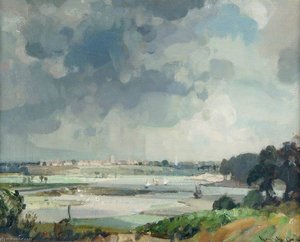
Retrato de John Arnesby Brown

As 57 Pinturas Mais Famosas de John Arnesby Brown, uma Seleção da Galeria

Atualizado em Novembro 2026 · classificado pela nossa pontuação de popularidade (pesquisas, visitas e pedidos de cada obra) · 65 obras de John Arnesby Brown em nosso catálogo

Em resumo

De todas as obras originais deixadas por John Arnesby Brown, a mais famosa é Full Summer, Ludham, Norfolk (1902), da coleção do Nottingham Castle Museum And Art Gallery, em Nottingham. Logo atrás vêm Dr John Brown Paton, Principal of the Nottingham Congregational Institute for 35 Years (1899) e The Riverbank (1902). Nosso catálogo contém 65 obras de John Arnesby Brown; a galeria preservou as 57 que o mundo mais admira, cada uma exibida com sua data, seu museu e sua história.

1866 – 1955, Nottingham Impressionism Mais obras: Nottingham Castle Museum And Art Gallery

As 10 principais pinturas de John Arnesby Brown: a escolha da galeria

1
Full Summer, Ludham, Norfolk (1902) de John Arnesby Brown

Full Summer, Ludham, Norfolk

1902 · Oil · Nottingham Castle Museum And Art Gallery, Nottingham

A man occupies the center of a dirt road, his gaze cast backward toward a pair of cows. He holds a gun, a detail that introduces a subtle tension to the otherwise quiet pastoral scene. The landscape of Ludham unfolds around him, framed by the dense greenery of trees that line the path. Other figures appear in the periphery, one near the left edge and two others positioned further in…

2
Dr John Brown Paton, Principal of the Nottingham Congregational Institute for 35 Years (1899) de John Arnesby Brown

Dr John Brown Paton, Principal of the Nottingham Congregational Institute for 35 Years

1899 · Oil · Nottingham Castle Museum And Art Gallery, Nottingham

Dr John Brown Paton, Principal of the Nottingham Congregational Institute for 35 Years, is a portrait executed by the English painter John Arnesby Brown. The work, dating to about 1899, captures the likeness of Dr John Brown Paton, a Scottish Congregationalist minister and educator who served as the first principal of the Nottingham Congregational Institute. His tenure at the institution spanned thirty-five years, from 1863 until 1898.

3
The Riverbank (1902) de John Arnesby Brown

The Riverbank

1902 · Oil · Guildhall Art Gallery, Londres

The Riverbank is a work by John Arnesby Brown, painted in 1902. This piece emerged during a period when the artist was establishing his presence within the British landscape tradition. Brown, who was born in Nottingham, United Kingdom, brought a specific sensitivity to the English countryside that would define much of his career.

4
Dr Paton (1830–1911) (1899) de John Arnesby Brown

Dr Paton (1830–1911)

1899 · Oil · The Congregational Memorial Hall, Nottingham

In this 1899 portrait, we find ourselves in the presence of Dr Paton. The subject is a man of considerable presence, defined by a thick, white beard that catches the light against a deep, saturated red background. He is captured in a moment of quiet composure, dressed in a formal suit and tie, with his hands clasped together in a gesture that suggests both patience and gravity. There is a…

5
The Marshes from Burgh Castle, Norfolk (1919) de John Arnesby Brown

The Marshes from Burgh Castle, Norfolk

1919 · Oil On Canvas

In The Marshes from Burgh Castle, Norfolk, John Arnesby Brown captures a quiet moment within a rural coastal landscape. Painted about 1919, the scene unfolds across a wide vista where the earth meets the sky in a soft, hazy embrace. A weathered stone wall anchors the left side of the view, providing a solid, tactile presence against the shifting elements. Beyond this boundary, a field stretches toward a body of…

6
Haddiscoe Church, Norfolk de John Arnesby Brown

Haddiscoe Church, Norfolk

Oil

Haddiscoe Church, Norfolk is a landscape painting by John Arnesby Brown. The work focuses on a church situated atop a hill, overlooking the surrounding terrain. A road winds through the landscape, leading the eye toward the structure.

7
The Hayfield (1910) de John Arnesby Brown

The Hayfield

1910 · Oil On Canvas

The Hayfield is a work by John Arnesby Brown, painted in 1910. The artist, born in 1866 in Nottingham, United Kingdom, captured this rural scene during a period of significant development in his career. He lived until 1955, passing away in Haddiscoe, Norfolk.

8
Haymaking (1890) de John Arnesby Brown

Haymaking

1890 · Oil On Canvas · Nottingham Castle Museum And Art Gallery, Nottingham

In this work, titled Haymaking, the artist John Arnesby Brown presents a quiet, rural scene centered on the seasonal rhythms of agricultural labor. Painted about 1890, the piece captures a moment of harvest within the English countryside. The subject matter focuses on the traditional process of gathering hay, a scene that reflects the pastoral life of the late nineteenth century.

9
Myra Plater, Sister of the Artist (1892) de John Arnesby Brown

Myra Plater, Sister of the Artist

1892 · Oil · Norfolk Museums, Norwich

In this 1892 portrait, we find ourselves in a private, domestic space, observing a woman lost in thought. Myra Plater, the artist's sister, is the central figure, her presence commanding the frame with a quiet, steady dignity. She is depicted with brown hair pulled back into a ponytail, her gaze directed downward toward a book. The dark, somber tones of her black dress anchor the composition, creating a sense of…

10
Poppy Field (verso) (1890) de John Arnesby Brown

Poppy Field (verso)

1890 · Oil On Canvas · Nottingham Castle Museum And Art Gallery, Nottingham

The canvas known as Poppy Field (verso) presents a quiet moment from the year 1890. This work emerges from the hand of John Arnesby Brown, an artist whose life moved between the physical intensity of professional football and the delicate observation of the English landscape. Born in Nottingham, United Kingdom, Brown brings a specific sensitivity to the natural world that defines this piece. The painting resides within the collection of…

A seleção de John Arnesby Brown continua, de 11 a 57

11The Drinking Pool (1895) de John Arnesby BrownThe Drinking Pool1895 · Manchester Art Gallery 12The Drinking Pool (1895) de John Arnesby BrownThe Drinking Pool1895 13Homeward (1896) de John Arnesby BrownHomeward1896 · Harris Museum - Art Gallery 14The Pier (1905) de John Arnesby BrownThe Pier1905 · Ferens Art Gallery 15The Bridge (1904) de John Arnesby BrownThe Bridge1904 · Walker Art Gallery 16Hay Cutting on the Norfolk Marshes de John Arnesby BrownHay Cutting on the Norfolk Marshes 17The Coming Day de John Arnesby BrownThe Coming Day 18Calves de John Arnesby BrownCalves 19Silver Morning (1910) de John Arnesby BrownSilver Morning1910 20Fading Day (1910) de John Arnesby BrownFading Day1910 · Harris Museum - Art Gallery 21Sheepfold (1908) de John Arnesby BrownSheepfold1908 22A Norfolk Landscape (1912) de John Arnesby BrownA Norfolk Landscape1912 23Sir Edward Henry Fraser (1913) de John Arnesby BrownSir Edward Henry Fraser1913 24In June (1917) de John Arnesby BrownIn June1917 25A Summer Day (1912) de John Arnesby BrownA Summer Day1912 26The Raincloud (1915) de John Arnesby BrownThe Raincloud1915 27The Line of the Plough (1919) de John Arnesby BrownThe Line of the Plough1919 28The Smug and Silver Trent (1924) de John Arnesby BrownThe Smug and Silver Trent1924 29Spring (1925) de John Arnesby BrownSpring1925 30The Watch Tower (1923) de John Arnesby BrownThe Watch Tower1923 · Laing Art Gallery 31Nottingham Castle The Centre of Medieval England (London, Midland and Scottish Railway poster artwork) (1924) de John Arnesby BrownNottingham Castle The Centre of Medieval England (London, Midland and Scottish Railway poster artwork)1924 32The Cloud (September) (1930) de John Arnesby BrownThe Cloud (September)1930 33Sketch for 'The Estuary, Gathering Clouds' (1931) de John Arnesby BrownSketch for 'The Estuary, Gathering Clouds'1931 34View of Norwich from the Bungay Road, Norfolk (1935) de John Arnesby BrownView of Norwich from the Bungay Road, Norfolk1935 35A Fellside Cumberland Village (1939) de John Arnesby BrownA Fellside Cumberland Village1939 · Touchstones Rochdale 36Panoramic View of Nottingham de John Arnesby BrownPanoramic View of Nottingham 37Herald of Night de John Arnesby BrownHerald of Night 38May Morning, Nottingham de John Arnesby BrownMay Morning, Nottingham 39Wymondham Abbey, Norfolk de John Arnesby BrownWymondham Abbey, Norfolk 40Seascape with Yacht de John Arnesby BrownSeascape with Yacht 41The Dutch Windmill de John Arnesby BrownThe Dutch Windmill 42Cattle in a Field de John Arnesby BrownCattle in a Field 43Blythsburgh (Beccles across the Marshes) de John Arnesby BrownBlythsburgh (Beccles across the Marshes) 44A Norfolk Landscape with Potato Pickers de John Arnesby BrownA Norfolk Landscape with Potato PickersThe National Trust For Scotland 45The Yacht Race de John Arnesby BrownThe Yacht RaceMuseu Fitzwilliam 46Morston Church, Norfolk de John Arnesby BrownMorston Church, Norfolk 47The Old Silk Mill, Derby de John Arnesby BrownThe Old Silk Mill, Derby 48Haystacks, Evening de John Arnesby BrownHaystacks, Evening 49Landscape with Church de John Arnesby BrownLandscape with Church 50Suffolk River de John Arnesby BrownSuffolk RiverBristol Museum - Art Gallery 51Landscape de John Arnesby BrownLandscape 52The White Bull de John Arnesby BrownThe White Bull 53Study for 'The Two Piers' de John Arnesby BrownStudy for 'The Two Piers'Nottingham Castle Museum And Art Gallery 54Autumn Morning de John Arnesby BrownAutumn MorningRoyal Albert Memorial Museum 55Spring de John Arnesby BrownSpring 56Alderman William Lambert de John Arnesby BrownAlderman William LambertNottingham Castle Museum And Art Gallery 57Near Nottingham de John Arnesby BrownNear NottinghamNottingham Castle Museum And Art Gallery

Pinturas famosas de John Arnesby Brown, período por período

Os temas que cativaram o olhar de John Arnesby Brown

Os quatro temas que mais se repetem nestas obras originais, cada um com o seu melhor exemplo.

Os museus que guardam os originais de John Arnesby Brown

Os 8 museus que detêm a maioria das pinturas desta página.

Museus Cidade Obras de John Arnesby Brown Pinturas desta lista
Nottingham Castle Museum And Art Gallery, NottinghamNottingham Castle Museum And Art Gallery Nottingham 7 Full Summer, Ludham, Norfolk, Dr John Brown Paton, Principal of the Nottingham Congregational Institute for 35 Years, Haymaking
Harris Museum - Art Gallery, PrestonHarris Museum - Art Gallery Preston 2 Homeward, Fading Day
Guildhall Art Gallery, LondresGuildhall Art Gallery Londres 1 The Riverbank
The Congregational Memorial Hall, NottinghamThe Congregational Memorial Hall Nottingham 1 Dr Paton (1830–1911)
Norfolk Museums, NorwichNorfolk Museums Norwich 1 Myra Plater, Sister of the Artist
Manchester Art Gallery, ManchesterManchester Art Gallery Manchester 1 The Drinking Pool
Ferens Art Gallery, HullFerens Art Gallery Hull 1 The Pier
Walker Art Gallery, LiverpoolWalker Art Gallery Liverpool 1 The Bridge

John Arnesby Brown década a década: a obra original que define cada uma

Obras por década

Escolha uma década para ver a obra original que a define.

Perguntas de colecionadores sobre as pinturas de John Arnesby Brown

Por qual obra John Arnesby Brown é mais conhecido(a)?Revelar a resposta

Full Summer, Ludham, Norfolk (1902), Nottingham Castle Museum And Art Gallery, Nottingham. Dr John Brown Paton, Principal of the Nottingham Congregational Institute for 35 Years (1899) e The Riverbank (1902) vêm a seguir.

Qual era a idade de John Arnesby Brown quando Full Summer, Ludham, Norfolk foi feita?Revelar a resposta

36 anos: Full Summer, Ludham, Norfolk data de 1902, e John Arnesby Brown nasceu em 1866.

Quais são as dez pinturas mais famosas de John Arnesby Brown?Revelar a resposta

Full Summer, Ludham, Norfolk, Dr John Brown Paton, Principal of the Nottingham Congregational Institute for 35 Years, The Riverbank, Dr Paton (1830–1911), The Marshes from Burgh Castle, Norfolk, Haddiscoe Church, Norfolk, The Hayfield, Haymaking, Myra Plater, Sister of the Artist e Poppy Field (verso). O ranking acima apresenta o ano e o museu de cada uma.

Quantas pinturas John Arnesby Brown deixou?Revelar a resposta

Nosso catálogo contém 65 obras de John Arnesby Brown, datadas de 1890 a 1939.

Em quais museus estão expostas as obras-primas de John Arnesby Brown?Revelar a resposta

Principalmente em Nottingham Castle Museum And Art Gallery (Nottingham), Harris Museum - Art Gallery (Preston) e Guildhall Art Gallery (Londres). A tabela de museus acima lista todos eles.

Em que anos John Arnesby Brown pintou as suas obras mais famosas?Revelar a resposta

Em 1910s: 10 das 57 obras nesta página foram feitas então, sendo The Marshes from Burgh Castle, Norfolk delas.

Quais são as primeiras e as últimas obras originais famosas de John Arnesby Brown?Revelar a resposta

Nesta página, a mais antiga é Haymaking (1890) e a mais recente é A Fellside Cumberland Village (1939).

Quais temas John Arnesby Brown escolheu com mais frequência?Revelar a resposta

Rural landscape (5), British countryside (5) e Man (4), entre as 57 obras nesta página.

Qual técnica John Arnesby Brown mais utilizou?Revelar a resposta

Oil, para 6 das 57 obras nesta página.

A qual movimento artístico pertence John Arnesby Brown?Revelar a resposta

Impressionism, a julgar pelos originais nesta página.

Quais obras de John Arnesby Brown estão expostas no Nottingham Castle Museum And Art Gallery?Revelar a resposta

Full Summer, Ludham, Norfolk, Dr John Brown Paton, Principal of the Nottingham Congregational Institute for 35 Years e Haymaking: o Nottingham Castle Museum And Art Gallery, Nottingham detém 7 das obras desta página.

John Arnesby Brown: vida e obra

Uma Vida de Luz e Paisagem

Sir John Alfred Arnesby Brown foi uma figura de uma dualidade notável, um homem que navegou entre o vigor físico do esporte profissional e as nuances delicadas e atmosféricas das belas artes com igual distinção. Nascido em Nottingham, seus primeiros anos foram marcados pela busca da excelência atlética; ele foi um jogador de futebol inglês que, famosamente, atuou pelo Notts County na Football League. No entanto, foi através da lente do pintor de paisagens que ele consolidaria seu legado duradouro como um dos principais artistas de paisagem britânicos do século XX. Sua jornada, partindo dos campos competitivos do final do século XIX até os prestigiados salões da Royal Academy, é um testemunho de uma profunda devoção ao mundo natural.

Sua educação artística foi rigorosa e transformadora, começando com lições sob um tutor local em Nottingham, antes de se mudar para a renomada Bushey School of Art, em Hertfordshire. Lá, estudando com Hubert von Herkomer, John Arnesby Brown começou a cultivar uma técnica que se tornaria sua marca registrada. Sua obra foi profundamente influenciada pelo ideal plein air e pelas tradições evocativas da Escola de Barbizon e dos Impressionistas franceses. Essa influência manifestou-se em sua habilidade de capturar as qualidades fugazes da luz e da atmosfera, transformando a campiña inglesa em um palco para uma narrativa luminosa e emotiva.

A Visão Pastoral

A obra de John Arnesby Brown é mais celebrada por suas representações impressionistas de paisagens pastorais, onde a majestade silenciosa do campo é frequentemente pontuada pela presença do gado. Ele possuía uma capacidade única de renderizar as texturas da terra e as mudanças de humor do céu, criando cenas que pareciam simultaneamente atemporais e intensamente imediatas. Embora seu coração residisse frequentemente nos prados tranquilos de Norfolk — especificamente ao redor de Haddiscoe, onde acabou por se estabelecer — sua visão não se limitava a uma única geografia. Seu trabalho capturava com frequência a beleza serena dos pântanos e a vida rítmica da Inglaterra rural.

À medida que sua carreira amadurecia, os interesses de Brown passaram por uma evolução fascinante. Embora tenha permanecido um mestre do pastoral, após 1905, ele começou a direcionar seu olhar observador para a paisagem industrial. Ele encontrou um novo tipo de beleza nas complexidades estruturais de pátios ferroviários e fábricas de tijolos ao redor de Kings Lynn, provando que sua sensibilidade à luz e à forma poderia transcender o idílico e abraçar a modernidade emergente de sua era. Essa expansão de temática demonstrou uma profunda maturidade artística e um compromisso inabalável em documentar o rosto em constante mudança da paisagem britânica.

Legado e Reconhecimento

A importância de Sir John Alfred Arnesby Brown estende-se muito além da tela, alcançando o próprio tecido da história cultural britânica. Sua dedicação ao seu ofício foi reconhecida com as mais altas honrarias, culminando em sua cavalaria em 1938, por seus serviços às artes da nação. Este galardão serviu como um reconhecimento formal de uma carreira que conseguiu unir com sucesso os valores tradicionais da paisagem e as sensibilidades evolutivas do impressionismo moderno.
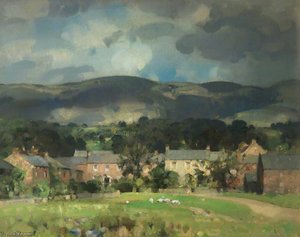
Sua vida também esteve entrelaçada com a comunidade artística através de seu casamento com Mia Edwards, uma talentosa pintora galesa conhecida por seus retratos de crianças. Juntos, eles compartilharam uma vida imersa na criatividade, movendo-se entre as colônias de artistas de St Ives, na Cornualha, e a beleza sazonal de Norfolk. Hoje, as obras de John Arnesby Brown continuam a ressoar em prestigiadas coleções públicas do Reino Unido, servindo como janelas duradouras para uma era desaparecida de paz pastoral e maravilha atmosférica.