A Legacy Rooted in Dutch Soil: The Life and Art of Johannes Hermanus Koekkoek
Johannes Hermanus Koekkoek, born in the tranquil village of Vierslag in 1778, wasn’t merely a painter; he was the cornerstone of an extraordinary artistic lineage – a family whose name would forever be intertwined with the rich tradition of Dutch landscape and maritime art. His early life, steeped in creativity thanks to his father, Hermanus Koekkoek, himself a respected artist, provided him with an unparalleled foundation for his own artistic journey. This familial influence wasn’t simply circumstantial; it fostered a vibrant environment brimming with shared passion, constant critique, and a deep-seated love of art that profoundly shaped young Johannes's development from the outset. Initially trained under his father’s guidance and later honing his skills at the prestigious Drawing Academy in Middelburg, Koekkoek began his career firmly rooted in the Romantic movement, producing idealized landscapes characterized by dramatic skies and evocative scenes – a direct reflection of his father’s artistic sensibilities. These early works showcased a masterful command of light and color, capturing the grandeur and emotional intensity that defined the era.From Romantic Visions to Realistic Depictions
Koekkoek's artistic evolution wasn’t a sudden departure but rather a gradual, nuanced transformation – a process heavily influenced by the burgeoning Hague School. Around 1864 (though scholarly sources present slight variations on this timeline), he began subtly shifting his approach, moving away from the overtly emotional and idealized landscapes of his earlier work. This transition wasn't abrupt; it was a deliberate refinement driven by a desire to capture the essence of reality with greater accuracy and detail. The Hague School, a group of Dutch artists dedicated to *plein air* painting – working directly outdoors to observe and record nature’s effects – profoundly impacted Koekkoek’s thinking. Their emphasis on honest representation, rejecting the exaggerated emotionalism prevalent in Romanticism, resonated deeply with his artistic sensibilities. He began prioritizing direct observation, meticulously studying light, atmosphere, and the unvarnished realities of the Dutch countryside and its maritime environment. This shift is particularly evident in his later works, where a newfound sense of realism emerges, replacing the dramatic flourishes of Romanticism with a more grounded and nuanced portrayal of everyday life.A Diverse Oeuvre: Seascapes, Landscapes, and Daily Life
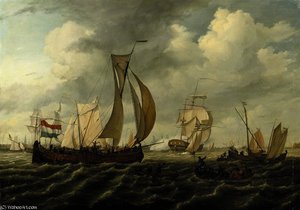
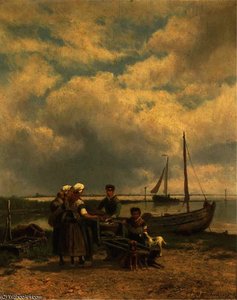
The breadth of Koekkoek’s artistic output reflects both his exceptional technical skill and his evolving interests. He became particularly renowned for his captivating seascapes – dramatic depictions of ships battling turbulent storms, serene coastal views bathed in the soft glow of dawn, and the raw power of the ocean itself. These weren't simply illustrations of maritime activity; they were profound explorations of humanity’s relationship with nature, conveying both its breathtaking beauty and its formidable strength. Alongside these powerful marine paintings, Koekkoek produced a vast collection of Dutch rural landscapes, capturing the quintessential charm of the countryside – rolling fields dotted with quaint villages, expansive skies stretching towards the horizon, and scenes imbued with a sense of tranquility and timelessness. He possessed an extraordinary ability to capture the unique character of the Dutch landscape, imbuing his paintings with a palpable sense of authenticity and serenity. However, Koekkoek’s artistic vision wasn't limited to landscapes; he also turned his attention to scenes of daily life – farmers diligently working their fields, travelers traversing country roads, and the quiet routines that defined 19th-century Dutch society. Works such as “Vessels on a Lee Shore in a Gale of Wind” (1844) exemplify his mastery of composition and atmospheric perspective, while pieces like "On the Beach" showcase his remarkable ability to capture the subtle nuances of coastal life.Technique, Legacy, and Historical Significance
Koekkoek’s artistic style is characterized by an unwavering attention to detail, particularly in his rendering of natural elements and everyday objects. He possessed a keen eye for light and shadow, skillfully employing these tools to create depth, atmosphere, and a profound sense of realism within his compositions. His commitment to portraying scenes as they appeared in reality – especially during his later period – distinguished him from many of his contemporaries. This dedication to authenticity, combined with his exceptional technical skill, cemented his place as an important figure in the transition from Romanticism to Realism in Dutch painting. While perhaps not as widely celebrated as some of the more prominent members of the Hague School, Johannes Hermanus Koekkoek played a crucial role in shaping the artistic landscape of 19th-century Netherlands. His work provides invaluable insights into Dutch life and culture during this period, offering a glimpse into the everyday realities of a nation undergoing significant social and economic transformation. Moreover, his influence extended far beyond his own lifetime, inspiring generations of Dutch artists who continued to explore themes of realism, naturalism, and the enduring beauty of their homeland. The Koekkoek name itself became synonymous with artistic excellence, ensuring that his legacy would continue to flourish through the work of his sons, grandsons, and great-grandsons – a testament to the power of family, tradition, and an unwavering dedication to the art of painting.Key Works
* **Vessels on a Lee Shore in a Gale of Wind (1844):** A dramatic depiction of a ship battling a fierce storm at sea, showcasing Koekkoek’s mastery of composition and atmospheric perspective. * **On the Beach (circa 1850):** A serene coastal scene capturing the quiet beauty of the Dutch coastline. * **Shipping in estuary (circa 1847):** A detailed portrayal of maritime activity within a sheltered waterway, demonstrating Koekkoek’s ability to capture the nuances of light and shadow. * **Dutch Farm (circa 1850):** An idyllic depiction of a traditional Dutch farmhouse nestled amidst rolling fields, reflecting Koekkoek's interest in capturing rural life.Perguntas e Respostas
Como posso encontrar obras de Johannes Hermanus Koekkoek em uma paleta específica?
As obras de Johannes Hermanus Koekkoek podem ser exploradas por paleta de cores na página de Por paleta de cores do artista.
Que sentimentos as obras de Johannes Hermanus Koekkoek expressam?
As obras de Johannes Hermanus Koekkoek podem ser exploradas por humor na página Coleção por Humor, que organiza as artes de acordo com seus humores registrados.
Onde as obras de Johannes Hermanus Koekkoek estão organizadas por cor?
As obras de Johannes Hermanus Koekkoek podem ser exploradas por cor na página Índice de Cores do artista.