Jean-Jacques Grandville: A Visionary of Victorian Satire
Jean-Jacques Grandville (1803 – 1847) stands as a singular figure in the annals of French illustration, renowned for his exquisitely detailed engravings that deftly blended fantasy and social critique during the Victorian era. Born in Nancy, France, Grandville’s artistic journey began with an early fascination for drawing and sculpture, nurtured by his father, who instilled in him a profound appreciation for classical art and design—influences that would permeate his distinctive style. Though largely self-taught, Grandville honed his skills through meticulous observation of the natural world and a keen understanding of human psychology, translating these insights into breathtaking visual narratives.
- Early Life & Training: Grandville’s formative years were marked by a dedication to artistic pursuits despite facing considerable financial hardship. He pursued independent study alongside occasional commissions for decorative arts projects, establishing himself as a craftsman with an unwavering commitment to excellence.
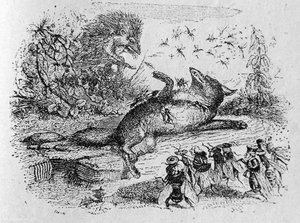
- The Fables of La Fontaine: Grandville achieved international acclaim through his adaptation and illustration of François de la Fontaine’s moral fables. His interpretations weren't merely reproductions; he imbued each fable with vibrant characters and fantastical settings, transforming simple tales into powerful commentaries on human behavior and societal injustices—a hallmark of his artistic vision.
- Illustrator for Alexandre Dumas Père: Grandville gained considerable recognition as the illustrator for Alexandre Dumas père’s novels, notably *La Dame aux Camélias* and *Les Misérables*. His meticulous attention to detail and expressive compositions captured the spirit of Victorian melodrama, cementing his reputation as a storyteller capable of conveying complex emotions through visual imagery.
- Notable Engravings & Artistic Style: Grandville's oeuvre encompasses a vast array of subjects—historical scenes, literary adaptations, botanical studies, and fantastical narratives—all rendered with unparalleled precision and artistry. His technique involved painstaking etching processes, utilizing mezzotint and aquatint to achieve tonal gradations that conveyed depth and atmosphere with remarkable subtlety.
- Legacy & Historical Significance: Grandville’s work transcends mere decoration; it serves as a window into the anxieties and aspirations of Victorian society. He confronted pressing social issues—such as poverty, inequality, and political corruption—with unflinching honesty and imaginative storytelling, leaving an indelible mark on the history of illustration and demonstrating the transformative power of art to provoke thought and inspire empathy.
Influences & Artistic Development
Grandville’s artistic sensibilities were profoundly shaped by several key influences. Firstly, he possessed a deep admiration for classical sculpture, particularly Michelangelo's David—a figure whose anatomical accuracy and heroic posture served as an exemplar of artistic excellence. Secondly, his exposure to Romantic art fostered a fascination with dramatic landscapes and emotionally charged narratives. However, Grandville’s most significant inspiration stemmed from the burgeoning field of natural history, where he meticulously documented plant and animal specimens with scientific rigor and artistic sensitivity—a practice that would inform his depictions of the natural world in his engravings.
Major Achievements & Recognition
Grandville's contribution to Victorian illustration is undeniable. His adaptation of La Fontaine’s fables captivated audiences worldwide, establishing him as a master storyteller capable of distilling moral lessons into visually arresting narratives. Furthermore, his collaborations with Alexandre Dumas père elevated the dramatic arts and solidified his position as one of France’s foremost illustrators. The British Museum holds a substantial collection of Grandville's engravings, testifying to their enduring artistic merit and historical significance—a testament to his singular talent and unwavering dedication to craftmanship.
Exploring Grandville's Artistic Technique
Grandville’s distinctive style was characterized by an extraordinary level of detail and tonal subtlety achieved through innovative etching techniques. He skillfully employed mezzotint and aquatint, layering multiple plates with varying degrees of burnishing to create nuanced gradations of tone—a technique that allowed him to convey atmospheric depth and psychological complexity with remarkable precision. His meticulous observation of nature combined with his profound understanding of human emotion resulted in engravings that remain remarkably evocative and intellectually stimulating even today.