Retrato de Jan Wyck

Pinturas de Jan Wyck: As 45 mais famosas, sob o olhar de uma galeria

Atualizado em Novembro 2026 · classificado pela nossa pontuação de popularidade (pesquisas, visitas e pedidos de cada obra) · 45 obras de Jan Wyck em nosso catálogo

Em resumo

Aos olhos da galeria, a pintura mais famosa de Jan Wyck é William III (1650-1702) on Horseback (1695), cuja obra original está exposta no Royal Collection, em Londres. Hare Hunting (1690) e King William III (1650–1702) (1700) completam o trio que todos reconhecem. Dos 45 trabalhos de Jan Wyck em nosso catálogo, a galeria apresenta abaixo as 45 obras mais famosas, cada uma original, com seu ano, seu museu e o que a torna única.

1640 – 1700, Haarlem Baroque Mais obras: National Gallery of Ireland

As 10 principais pinturas de Jan Wyck na galeria

1
William III (1650-1702) on Horseback (1695) de Jan Wyck

William III (1650-1702) on Horseback

1695 · Oil On Canvas · Royal Collection, Londres

The air feels heavy with the scent of damp earth and the metallic tang of impending conflict. High above, a turbulent sky churns with bruised, heavy clouds, casting a dramatic light that slices through the gloom to illuminate a singular, powerful figure. William III sits atop a massive white horse, its muscles coiled and straining in a dynamic levade. The animal’s strength is palpable, a living force of nature caught…

2
Hare Hunting (1690) de Jan Wyck

Hare Hunting

1690 · Oil On Canvas · Yale Center for British Art, New Haven

The chase unfolds in Hare Hunting, a work that captures the sudden, frantic energy of a pursuit. Painted by Jan Wyck, the scene places the viewer directly into a landscape where the nobility of the hunt meets the raw movement of the chase. The air feels thick with the urgency of the moment, as horses and hounds push through the terrain in pursuit of their quarry.

3
King William III (1650–1702) (1700) de Jan Wyck

King William III (1650–1702)

1700 · Oil On Canvas · Castle Ward

A single figure commands the space, anchored by the heavy stillness of polished steel. King William III stands in a confident contrapposto pose, his body a pillar of authority amidst a sea of shadow. The light catches the sharp, metallic edges of his plate armor, casting a bright sheen across his chest and the delicate, intricate folds of a white lace cravat. A red sash cuts through the darkness, a…

4
William III Landing at Brixham, Torbay (1688) de Jan Wyck

William III Landing at Brixham, Torbay

1688 · Oil On Canvas · National Maritime Museum, Londres

The scene unfolds in the immediate aftermath of a monumental arrival. In "William III Landing at Brixham, Torbay," Jan Wyck captures the precise moment of Prince William of Orange's landing in Torbay on 5 November 1688. The air feels heavy with the weight of impending change as the Prince descends toward the English shore. He does not arrive in quiet solitude; instead, he brings with him a massive force of…

6
Landscape with a Stag Hunt (1674) de Jan Wyck

Landscape with a Stag Hunt

1674 · Oil On Canvas · Royal Collection, Londres

Landscape with a Stag Hunt is an oil painting by Jan Wyck, created about 1674. The canvas captures a dramatic hunting scene set within a vast, atmospheric wilderness. In the lower left, small figures of hunters on horseback move through the terrain. The mid-ground holds animals in motion, caught in the sudden energy of the chase.

7
The French Army crossing the Rhine, 12 June 1672 (1685) de Jan Wyck

The French Army crossing the Rhine, 12 June 1672

1685 · Oil On Canvas · Royal Collection, Londres

The painting titled The French Army crossing the Rhine, 12 June 1672 is a work by the artist Jan Wyck. This large-scale composition depicts a specific historical military event involving the movement of French troops. The canvas captures the scale of the army as it maneuvers through a landscape, focusing on the organized passage of soldiers and cavalry.

8
The Battle of the Boyne (1693) de Jan Wyck

The Battle of the Boyne

1693 · Oil On Canvas · National Gallery of Ireland, Dublin

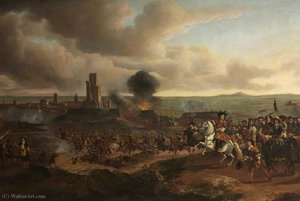
The air thickens with the scent of gunpowder and the heavy musk of horses in The Battle of the Boyne. This expansive oil on canvas, painted by Jan Wyck, captures a moment of immense scale and historical weight. The work stretches across a vast surface, measuring 223.0 x 386.5cm, pulling the viewer into a wide, panoramic landscape where the chaos of war unfolds. It is a scene of movement and…

9
A Hawking Party (1690) de Jan Wyck

A Hawking Party

1690 · Oil On Canvas · Yale Center for British Art, New Haven

The scene unfolds in A Hawking Party, a lively composition by the Dutch painter Jan Wyck. Created about 1690, the work captures a moment of aristocratic pursuit amidst an expansive, atmospheric countryside. We find ourselves watching a dynamic gathering where riders and dogs move through a landscape of earthy ochre and deep greens, all set under a vast, shifting sky. The air feels heavy with the soft light of a…

10
Extensive Landscape (1694) de Jan Wyck

Extensive Landscape

1694 · Oil

The oil painting titled Extensive Landscape was executed by the artist Jan Wyck. This work dates from about 1694. The composition presents a large-scale view of a natural environment, featuring a river, various trees, and mountains situated in the background. In the foreground, several figures are depicted engaging in activities such as riding horses and interacting with one another.

Pinturas de Jan Wyck, classificadas de 11 a 45

11King William III at the Siege of Namur de Jan WyckKing William III at the Siege of NamurNational Gallery of Ireland 12King William III (William of Orange) (1650–1702) at the Second Seige of Namur, 2 July – 1 September 1695 de Jan WyckKing William III (William of Orange) (1650–1702) at the Second Seige of Namur, 2 July – 1 September 1695Mount Stewart 13Equestrian Portrait of King William III de Jan WyckEquestrian Portrait of King William III 14A battle scene de Jan WyckA battle sceneMuseu Nacional de Varsóvia 15The Battle of the Boyne de Jan WyckThe Battle of the Boyne 16Battle scene de Jan WyckBattle scene 17Major-General Randolph Egerton de Jan WyckMajor-General Randolph Egerton 18Portrait of a Gentleman with a Roan Charger de Jan WyckPortrait of a Gentleman with a Roan Charger 19After the Combat de Jan WyckAfter the CombatNational Gallery of Ireland 20Cavalry Combat de Jan WyckCavalry CombatNational Gallery of Ireland 21Stag Hunt de Jan WyckStag HuntTe Whare O Rehua Sarjeant Gallery 22A cavalry skirmish de Jan WyckA cavalry skirmish 23Landscape with Haymakers de Jan WyckLandscape with Haymakers 24The Battle of Lepanto, 7 October (1571) de Jan WyckThe Battle of Lepanto, 7 October (1571) 25William III (1650–1702), and His Army at the Siege of Namur, 1695 de Jan WyckWilliam III (1650–1702), and His Army at the Siege of Namur, 1695 26View of Windsor Castle from the South de Jan WyckView of Windsor Castle from the SouthAnglesey Abbey 27A Pointer in a Landscape de Jan WyckA Pointer in a Landscape 28A Battlepiece, of Christians against Turks de Jan WyckA Battlepiece, of Christians against TurksHam House 29William III Landing at Brixham, Torbay, 5 November de Jan WyckWilliam III Landing at Brixham, Torbay, 5 NovemberNational Maritime Museum 30King William III de Jan WyckKing William III 31A stag hunt de Jan WyckA stag hunt 32James Scott, Duke of Monmouth and Buccleuch de Jan WyckJames Scott, Duke of Monmouth and BuccleuchNational Portrait Gallery 33Hawking party de Jan WyckHawking party 34A stag hunt de Jan WyckA stag hunt 35King William III (1650–1702) giving Orders in the Field de Jan WyckKing William III (1650–1702) giving Orders in the Field 36William III and Prince George of Denmark at the Battle of the Boyne de Jan WyckWilliam III and Prince George of Denmark at the Battle of the Boyne 37A Landscape with Horsemen, Including a Falconer de Jan WyckA Landscape with Horsemen, Including a FalconerLytes Cary 38Gilbert Coventry, Later 4th Earl of Coventry, in the Hunting Field de Jan WyckGilbert Coventry, Later 4th Earl of Coventry, in the Hunting FieldAntony House 39An Imaginary Winter Scene with People Amusing Themselves upon a Frozen River with Tents and a Sleigh de Jan WyckAn Imaginary Winter Scene with People Amusing Themselves upon a Frozen River with Tents and a Sleigh 40A Dutch Mastiff with Dunham Massey in the Background de Jan WyckA Dutch Mastiff with Dunham Massey in the BackgroundDunham Massey Hall 41Hunting Scene de Jan WyckHunting Scene 42A Cavalry Battle Scene de Jan WyckA Cavalry Battle Scene 43Prince rupert de Jan WyckPrince rupert 44'Swallow' and Old William, Groom to Sir T. S. Bonnet de Jan Wyck'Swallow' and Old William, Groom to Sir T. S. Bonnet 45King William III de Jan WyckKing William III

Pinturas famosas de Jan Wyck, período por período

Os temas que cativaram o olhar de Jan Wyck

Os quatro temas que mais se repetem nestas obras originais, cada um com o seu melhor exemplo.

Os museus que guardam os originais de Jan Wyck

Os 8 museus que detêm a maioria das pinturas desta página.

Museus Cidade Obras de Jan Wyck Pinturas desta lista
National Gallery of Ireland, DublinNational Gallery of Ireland Dublin 4 The Battle of the Boyne, King William III at the Siege of Namur, After the Combat
Royal Collection, LondresRoyal Collection Londres 3 William III (1650-1702) on Horseback, Landscape with a Stag Hunt, The French Army crossing the Rhine, 12 June 1672
Yale Center for British Art, New HavenYale Center for British Art New Haven 3 Hare Hunting, Heron Hawking below Stirling Castle, A Hawking Party
National Maritime Museum, LondresNational Maritime Museum Londres 2 William III Landing at Brixham, Torbay, William III Landing at Brixham, Torbay, 5 November
Castle WardCastle Ward 1 King William III (1650–1702)
Mount Stewart, NewtownardsMount Stewart Newtownards 1 King William III (William of Orange) (1650–1702) at the Second Seige of Namur, 2 July – 1 September 1695
Museu Nacional de Varsóvia, VarsóviaMuseu Nacional de Varsóvia Varsóvia 1 A battle scene
Te Whare O Rehua Sarjeant GalleryTe Whare O Rehua Sarjeant Gallery 1 Stag Hunt

Jan Wyck, uma pintura emblemática por década

Obras por década

Escolha uma década para ver a obra original que a define.

Pinturas de Jan Wyck: a galeria responde

Qual pintura de Jan Wyck é a mais famosa de todas?Revelar a resposta

William III (1650-1702) on Horseback (1695), Royal Collection, Londres. Hare Hunting (1690) e King William III (1650–1702) (1700) vêm a seguir.

Qual era a idade de Jan Wyck ao concluir William III (1650-1702) on Horseback?Revelar a resposta

55 anos: William III (1650-1702) on Horseback data de 1695, e Jan Wyck nasceu em 1640.

Quais são as 10 principais pinturas de Jan Wyck?Revelar a resposta

William III (1650-1702) on Horseback, Hare Hunting, King William III (1650–1702), William III Landing at Brixham, Torbay, Heron Hawking below Stirling Castle, Landscape with a Stag Hunt, The French Army crossing the Rhine, 12 June 1672, The Battle of the Boyne, A Hawking Party e Extensive Landscape. O ranking acima apresenta o ano e o museu de cada uma.

Quantas obras Jan Wyck criou?Revelar a resposta

Nosso catálogo contém 45 obras de Jan Wyck, datadas de 1674 a 1700.

Onde estão expostos os originais mais famosos de Jan Wyck?Revelar a resposta

Principalmente em National Gallery of Ireland (Dublin), Royal Collection (Londres) e Yale Center for British Art (New Haven). A tabela de museus acima lista todos eles.

Quando é que Jan Wyck criou as suas pinturas mais famosas?Revelar a resposta

Em 1690s: 6 das 45 obras nesta página foram feitas então, sendo William III (1650-1702) on Horseback delas.

Quais são as obras mais famosas de Jan Wyck no início e no fim de sua carreira?Revelar a resposta

Nesta página, a mais antiga é Landscape with a Stag Hunt (1674) e a mais recente é King William III (1650–1702) (1700).

Quais temas Jan Wyck mais explorou?Revelar a resposta

Horse (15), Sky (12) e Man (10), entre as 45 obras nesta página.

Em qual técnica Jan Wyck mais trabalhou?Revelar a resposta

Oil On Canvas, para 24 das 45 obras nesta página.

Com qual movimento Jan Wyck está associado(a)?Revelar a resposta

Baroque, a julgar pelos originais nesta página.

Quais obras originais de Jan Wyck o National Gallery of Ireland possui?Revelar a resposta

The Battle of the Boyne, King William III at the Siege of Namur e After the Combat: o National Gallery of Ireland, Dublin detém 4 das obras desta página.

Jan Wyck: o artista

Jan Wyck: O Pintor que Trouxe a Batalha à Tela

Nascido em Haarlem, na Holanda, em 1652, Jan Wyck emergiu como uma figura central no mundo da arte europeia do final do século XVII. Seu legado não se define por obras-primas grandiosas e solitárias, mas sim por um impressionante corpo de mais de 150 trabalhos—principalmente cenas militares dinâmicas, paisagens evocativas e retratos equestres marcantes—que mudaram fundamentalmente a forma como a guerra era representada nas telas. A influência de Wyck se estendeu muito além de sua terra natal; ele desempenhou um papel crucial na consolidação da arte britânica como uma força a ser reconhecida, introduzindo uma sensibilidade holandesa que impactou profundamente as gerações de artistas britânicos.

A vida inicial de Wyck permanece, em grande parte, envolta em mistério, devido à escassez de documentação disponível. Ele era filho de Thomas Wyck, outro pintor que havia passado considerável tempo aprimorando sua arte na Itália, absorvendo a influência do estilo italiano evidente em algumas obras de seu pai. Acredita-se que Jan recebeu seu treinamento artístico inicial de seu pai, embora os detalhes precisos sejam escassos. A mudança da família para a Inglaterra durante o reinado de Carlos II—provavelmente por volta de 1664—marcou um ponto de virada, abrindo caminho para a contribuição duradoura de Wyck à história da arte britânica. Esse movimento coincidiu com um período de intenso intercâmbio cultural entre a Grã-Bretanha e os Países Baixos, impulsionado pela Restauração e por um renovado interesse em estilos clássicos e aprendizados.

Um Patrono Real e Influências Continentais

A chegada de Wyck à Inglaterra se mostrou notavelmente favorável. Ele rapidamente ganhou reconhecimento por sua habilidade e versatilidade, conquistando o patrocínio de figuras influentes como o Duque de Ormond e, posteriormente, William III. Sua capacidade de capturar o caos e a dramaticidade da batalha—um tema dominado principalmente por artistas franceses na época—foi particularmente valorizada. O trabalho de Wyck não era simplesmente um registro de eventos militares; ele impregnava suas cenas com uma sensação palpável de imediatismo e realismo, buscando inspiração tanto nas tradições holandesas quanto flamengas. Ele combinou habilmente elementos do dinamismo barroco com um olhar atento aos detalhes, retratando meticulosamente as texturas das armaduras, o brilho do aço e as expressões dos soldados imersos no calor da batalha.

A influência de Dirk Maas, outro artista proeminente dos Países Baixos que trabalhava na Inglaterra, é evidente no trabalho inicial de Wyck. No entanto, Wyck rapidamente desenvolveu seu próprio estilo distinto—caracterizado por uma paleta vibrante, iluminação dramática e uma capacidade incomparável de capturar a energia e o movimento de seus assuntos. Ele não se contentou em simplesmente representar batalhas de uma perspectiva distante; em vez disso, buscou imergir o espectador diretamente no meio da ação, destacando soldados individuais, suas armas e o drama em evolução com notável precisão.

O Visionário da Batalha

A contribuição mais significativa de Wyck reside em sua abordagem inovadora à representação de campos de batalha. Enquanto muitos artistas da época favoreciam uma visão aérea, oferecendo uma visão estratégica das formações táticas, Wyck escolheu focar nas experiências individuais dos soldados—sua bravura, seu medo e sua luta desesperada pela sobrevivência. Ele retratou meticulosamente detalhes como sabres flamejantes, mosquetes disparando, cavalos com narinas em chamas e a fumaça densa das canhões, criando uma sensação visceral de realismo sem precedentes na arte militar. Essa mudança para uma representação mais íntima e emocionalmente ressonante da batalha influenciou profundamente as gerações subsequentes de artistas britânicos.

Sua obra sobre a Batalha do Boyne, por exemplo, é um testemunho de sua visão artística. Embora os relatos da batalha em si sejam abundantes, a pintura de Wyck captura não apenas os manobras táticas, mas também o custo humano—os rostos exaustos dos soldados, os companheiros caídos e a incerteza palpável que permeava as fileiras. Da mesma forma, suas representações do Cerco de Derry transmitem vividamente a resiliência da cidade sitiada e a determinação de seus defensores.

Um Homem da Família e um Legado Duradouro

Além de suas conquistas artísticas, a vida pessoal de Wyck oferece vislumbres das realidades do século XVII na Inglaterra. Ele se casou duas vezes—primeiro com uma mulher desconhecida, depois com Anne Skinner em 1676, com quem teve quatro filhos que tragicamente morreram jovens. Seu terceiro casamento o uniu a uma esposa holandesa, Elizabeth Holomberg, e dois filhos e uma filha, consolidando ainda mais sua vida familiar em Mortlake. Apesar das tragédias pessoais que pontuaram sua vida, Wyck permaneceu dedicado à sua arte, continuando a produzir obras sob patrocínio real até sua morte em 1702.

O legado de Jan Wyck se estende muito além das pinturas individuais que ele criou. Ele desempenhou um papel crucial no fomento do intercâmbio artístico entre a Grã-Bretanha e os Países Baixos, introduzindo novas técnicas e perspectivas que enriqueceram a história da arte britânica. Sua abordagem inovadora à representação de campos de batalha—seu foco em soldados individuais e sua maestria na renderização dos detalhes—estabeleceu-o como um pioneiro na arte militar, deixando uma marca indelével no desenvolvimento das tradições pictóricas holandesa e britânica. Hoje, suas obras são apreciadas por seu significado histórico, mérito artístico e as histórias cativantes que contam sobre coragem, conflito e o espírito humano.