Retrato de Mabuse

Pinturas de Mabuse: As 100 mais famosas, sob o olhar de uma galeria

Atualizado em Outubro 2026 · classificado pela nossa pontuação de popularidade (pesquisas, visitas e pedidos de cada obra) · 241 obras de Mabuse em nosso catálogo

Em resumo

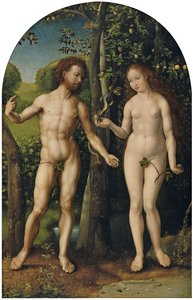
Aos olhos da galeria, a pintura mais famosa de Mabuse é Adam and Eve (1525), cuja obra original está exposta no Rhode Island School of Design Museum of Art, em Providence. Portrait of a man (1528) e Man of Sorrow (1525) completam o trio que todos reconhecem. Dos 241 trabalhos de Mabuse em nosso catálogo, a galeria apresenta abaixo as 100 obras mais famosas, cada uma original, com seu ano, seu museu e o que a torna única.

1478 – 1532, Maubeuge Renascimento nórdico Mais obras: Statens Museum For Kunst

As 10 principais pinturas de Mabuse na galeria

1
Adam and Eve (1525) de Mabuse

Adam and Eve

In the profound stillness of Jan Gossaert’s 1525 masterpiece, Adam and Eve, we are invited into a moment of primordial intimacy that transcends the boundaries of time. This breathtaking oil painting serves as a cornerstone of Northern Renaissance artistry, capturing the very dawn of humanity with a level of anatomical precision and dramatic flair that was revolutionary for its era. The composition centers on the tender, almost vulnerable embrace of…

2
Portrait of a man (1528) de Mabuse

Portrait of a man

1528 · Oil On Panel · Museus Reais de Belas Artes da Bélgica, Bruxelas

The gaze of the subject in Portrait of a man by Jan Gossaert meets the viewer with a steady, unwavering presence. Created about 1530, this work captures a man seated within a space that feels both cramped and cozy, a private nook where the tools of a specific life reside. The artist, Jan Gossaert, who is also known by the moniker Mabuse, renders the figure with a profound sense of…

3
Man of Sorrow (1525) de Mabuse

Man of Sorrow

1525 · Oil On Panel · Museu Nacional de Cracóvia, Cracóvia

The body of Christ hangs heavy, a pale anchor in a sea of deep reds and shadows. Every muscle is rendered with a sharp, anatomical clarity that feels almost tactile, as if the skin might still hold warmth despite the stillness of death. Light strikes the torso from a single direction, carving out the hollows of the ribs and the tension in the limbs. Around this central suffering, figures gather…

4
Portrait of a Man (1525) de Mabuse

Portrait of a Man

1525 · Oil On Panel · Royal Museum of Fine Arts Antwerp, Antuérpia

Step closer and observe the stillness of this young man. He is presented in a bust-length view, framed within a gentle oval that focuses our attention entirely on his psychological state. There is a certain gravity in his gaze, a stoic and thoughtful expression that suggests a life of intellectual depth and high social standing. He does not perform for us; he simply exists in a moment of quiet contemplation.…

5
Two Wings from a Triptych (exterior) (1521) de Mabuse

Two Wings from a Triptych (exterior)

1521 · Oil On Panel

The heavy wooden panels of the triptych stand partially open, revealing a world caught in a moment of sacred stillness. These two exterior wings, crafted in 1521, act as a threshold between the mundane and the divine. On one side, a woman holds a book, her gaze steady and quiet; on the other, an angel appears, bringing a celestial presence to the earthly realm. They exist within a framework of…

6
Virgin and child enthroned (1527) de Mabuse

Virgin and child enthroned

1527 · Oil On Canvas · Kunsthistorisches Museum, Viena

To gaze upon Jan Gossaert’s Virgin and Child Enthroned is to step directly into the luminous, deeply spiritual atmosphere of the Northern Renaissance. This masterpiece, painted in 1527, transcends mere portraiture; it is a profound theological statement rendered with breathtaking technical skill. At its heart sits the Virgin Mary, regal and serene, enthroned as she cradles the infant Jesus. The immediate visual impact is drawn to the vibrant sweep of…

7
Portrait of a man (1527) de Mabuse

Portrait of a man

1527 · Oil On Panel · Kunsthistorisches Museum, Viena

A middle-aged man is captured in a bust-length composition, his gaze directed toward the left of the frame. He wears a dark, beret-style hat and a black doublet over a white undershirt, with a single gold ring featuring a gemstone visible on his hand. The lighting is directional, descending from the upper left to cast soft shadows across the right side of his face and neck. This chiaroscuro effect provides…

8
The Holy Family (1507) de Mabuse

The Holy Family

1507 · Oil On Panel · J. Paul Getty Museum, Los Angeles

The Holy Family is a painting by Jan Gossaert, executed in 1507. This oil on panel work captures a quiet, domestic moment within a grander architectural framework. The Virgin Mary occupies the center of the scene, her hands cradling the Christ Child. Their presence forms the heart of the composition, anchored by the weight of their figures against the stone and sky.

9
Hercules and Deianeira (1517) de Mabuse

Hercules and Deianeira

1517 · Oil On Panel · The Barber Institute of Fine Arts, Birmingham

Two figures sit locked in a quiet, muscular embrace. Hercules and Deianeira occupy a marble-paneled niche, their limbs entwined in a way that feels both heavy and strangely delicate. The man’s skin carries the sculptural weight of antiquity, his form defined by the tension of bone and muscle. Beside him, Deianeira rests, her pose a study in soft curves and sudden stillness. They do not look at the viewer; they…

10
Triptych of the Holy Family (1501) de Mabuse

Triptych of the Holy Family

1501 · Oil On Panel · Museu Nacional de Arte Antiga, Lisboa

The Triptych of the Holy Family is a religious oil on panel painting dating to 1501. This work is presented in a classic triptych format, housed within an ornate, carved wooden frame featuring scalloped tops. The central panel is the largest and most complex, depicting the Holy Family—the Virgin Mary, Saint Joseph, and the Christ Child—arranged in a pyramidal composition and surrounded by an angelic host within a lush landscape.…

Pinturas de Mabuse, classificadas de 11 a 100

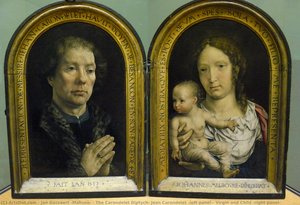
11The Virgin preparing the bath of the Child (1500) de MabuseThe Virgin preparing the bath of the Child1500 · Bob Jones University Museum and Gallery 12Madonna with the Child (1500) de MabuseMadonna with the Child1500 · Hämeenlinna Art Museum 13Virgin and child in the veil (1500) de MabuseVirgin and child in the veil1500 · Museus Reais de Belas Artes da Bélgica 14Madonna with child (1495) de MabuseMadonna with child1495 15Portrait of Isabella of Austria (1514) de MabusePortrait of Isabella of Austria1514 16Floris van Egmond, Count of Buren (1510) de MabuseFloris van Egmond, Count of Buren1510 · Brighton Museum & Art Gallery 17Saint Jerome (1512) de MabuseSaint Jerome1512 · Statens Museum For Kunst 18Christ on the Mount of Olives (1507) de MabuseChrist on the Mount of Olives1507 · Gemäldegalerie 19Portrait of a Man (1515) de MabusePortrait of a Man1515 · Museu Estatal Pushkin de Artes Visuais 20The Beheading of St John the Baptist (1510) de MabuseThe Beheading of St John the Baptist1510 · École Nationale Supérieure des Beaux-Arts 21Saint Jerome Penitent [right panel] (1512) de MabuseSaint Jerome Penitent [right panel]1512 · National Gallery of Art 22Saint Jerome Penitent [left panel] (1512) de MabuseSaint Jerome Penitent [left panel]1512 · National Gallery of Art 23The Malvagna Altarpiece (centre panel, detail) (1513) de MabuseThe Malvagna Altarpiece (centre panel, detail)1513 24Agony in the Garden (1510) de MabuseAgony in the Garden1510 25Holy Family with Coats of Arms of Charles... (1528) de MabuseHoly Family with Coats of Arms of Charles...1528 · Saint Louis Art Museum 26Virgin and Child in a Landscape (1531) de MabuseVirgin and Child in a Landscape1531 · Cleveland Museum of Art 27Self-portrait (1525) de MabuseSelf-portrait1525 · Currier Gallery of Art 28Madonna and Child (1529) de MabuseMadonna and Child1529 · Rijksmuseum Twenthe 29Christ on Mount Olive (1525) de MabuseChrist on Mount Olive1525 · Bavarian State Painting Collections 30The Holy Family (1520) de MabuseThe Holy Family1520 · Museum of Fine Arts 31Portrait of Henry III, Count of Nassau (1530) de MabusePortrait of Henry III, Count of Nassau1530 · Museu Nacional d'Art de Catalunya 32Christ sitting on the Cold Stone (1531) de MabuseChrist sitting on the Cold Stone1531 · Royal Museum of Fine Arts Antwerp 33Virgin and Child with a Patron (1530) de MabuseVirgin and Child with a Patron1530 · Statens Museum For Kunst 34Portrait of Anna de Bergh, Marquise de Veere (1530) de MabusePortrait of Anna de Bergh, Marquise de Veere1530 · McNay Art Museum 35Saint Luke painting the Virgin (1520) de MabuseSaint Luke painting the Virgin1520 · National Gallery Prague 36Portrait of a Man (1524) de MabusePortrait of a Man1524 37Madonna with Child Jesus (1531) de MabuseMadonna with Child Jesus1531 · Museu Nacional de Varsóvia 38Christus rust na de geseling (1527) de MabuseChristus rust na de geseling1527 · Staatliche Kunsthalle Karlsruhe 39Madonna and Child (1532) de MabuseMadonna and Child1532 40Madonna and Child playing with the veil (1530) de MabuseMadonna and Child playing with the veil1530 41Cain Killing Abel (1525) de MabuseCain Killing Abel1525 42Portrait of a Man (1524) de MabusePortrait of a Man1524 43Scenes from the Life of St Giles (1520) de MabuseScenes from the Life of St Giles1520 · Statens Museum For Kunst 44The Martyrdom of St Cyriacus and His Companions (1520) de MabuseThe Martyrdom of St Cyriacus and His Companions1520 · Statens Museum For Kunst 45Virgin Mary, Christ Blessing, and St John the Baptist (Deesis) (1525) de MabuseVirgin Mary, Christ Blessing, and St John the Baptist (Deesis)1525 46Abbot Johann Ingenray (1535) de MabuseAbbot Johann Ingenray1535 · Detroit Institute of Arts 47The Adoration of the Kings (1510) de MabuseThe Adoration of the Kings1510 · National Gallery 48Wings of the Norfolk Triptych (1525) de MabuseWings of the Norfolk Triptych1525 · Musées Royaux des Beaux-Arts 49Virgin and Child (1525) de MabuseVirgin and Child1525 · Art Institute of Chicago 50Adam and Eve (1510) de MabuseAdam and Eve1510 · Museu Thyssen-Bornemisza 51Danaë (detail) (1527) de MabuseDanaë (detail)1527 · Alte Pinakothek 52The Carondelet Diptych: Jean Carondelet (left panel), Virgin and Child (right panel) (1517) de MabuseThe Carondelet Diptych: Jean Carondelet (left panel), Virgin and Child (right panel)1517 · Museu do Louvre 53Danaë (1527) de MabuseDanaë1527 · Alte Pinakothek 54Two Kings and a Woman Leaving a Palace (1510) de MabuseTwo Kings and a Woman Leaving a Palace1510 55Madonna and Child (1527) de MabuseMadonna and Child1527 · Museu do Prado 56The Adoration of the Kings (detail) (1500) de MabuseThe Adoration of the Kings (detail)1500 57Holy Family with St. Catherine and St. Barbara (1515) de MabuseHoly Family with St. Catherine and St. Barbara1515 58St Jerome Penitent (1510) de MabuseSt Jerome Penitent1510 59Hercules and Deianira (1517) de MabuseHercules and Deianira1517 · Barber Institute of Fine Arts 60Hercules of the Forum Boarium (1509) de MabuseHercules of the Forum Boarium1509 61Neptune and Amphitrite (1516) de MabuseNeptune and Amphitrite1516 62Virgin and Child with Musical Angels (1510) de MabuseVirgin and Child with Musical Angels1510 63A Reliquary (1510) de MabuseA Reliquary1510 · Biblioteca e Museu Morgan 64The Agony in the Garden (1510) de MabuseThe Agony in the Garden1510 65Standing Warrior in Fantastic Armour (1509) de MabuseStanding Warrior in Fantastic Armour1509 66The Carondelet Diptych left wing, Jean Carondelet (1517) de MabuseThe Carondelet Diptych left wing, Jean Carondelet1517 67St John the Evangelist on Patmos (1515) de MabuseSt John the Evangelist on Patmos1515 68The Holy Family Seated at the Foot of a Tree (1510) de MabuseThe Holy Family Seated at the Foot of a Tree1510 69Apollo Citharoedus of the Casa Sassi (1509) de MabuseApollo Citharoedus of the Casa Sassi1509 70Neptune and Amphitrite (detail) (1516) de MabuseNeptune and Amphitrite (detail)1516 71The Malvagna Altarpiece (right wing, detail) (1513) de MabuseThe Malvagna Altarpiece (right wing, detail)1513 72Jean Carondelet (1503) de MabuseJean Carondelet1503 · Toledo Museum of Art 73The Adoration of the Magi (1515) de MabuseThe Adoration of the Magi1515 74Agony in the Garden (detail) (1510) de MabuseAgony in the Garden (detail)1510 75Bust of a Warrior in Fantastic Armour (1509) de MabuseBust of a Warrior in Fantastic Armour1509 76Study after the Spinario (detail) (1509) de MabuseStudy after the Spinario (detail)1509 · Universiteitsbibliotheek 77The Doria Pamphilj Diptych (right wing) (1510) de MabuseThe Doria Pamphilj Diptych (right wing)1510 · Galleria Doria Pamphilj 78Carondelet Diptych (left wing) (1517) de MabuseCarondelet Diptych (left wing)1517 79Study after the Spinario (recto) (1509) de MabuseStudy after the Spinario (recto)1509 · Universiteitsbibliotheek 80The Malvagna Altarpiece (exterior wings) (1513) de MabuseThe Malvagna Altarpiece (exterior wings)1513 81The Mystic Marriage of St Catherine (1503) de MabuseThe Mystic Marriage of St Catherine1503 · Statens Museum For Kunst 82Carondelet Diptych (right wing) (1517) de MabuseCarondelet Diptych (right wing)1517 83Emperor Augustus and the Tiburtine Sibyl (1503) de MabuseEmperor Augustus and the Tiburtine Sibyl1503 84Carondelet Diptych (1517) de MabuseCarondelet Diptych1517 85The Malvagna Altarpiece (side wings) (1513) de MabuseThe Malvagna Altarpiece (side wings)1513 86View of the Colosseum Seen from the West (1509) de MabuseView of the Colosseum Seen from the West1509 87Carondelet Diptych (verso) (1517) de MabuseCarondelet Diptych (verso)1517 88The Malvagna Altarpiece (centre panel) (1513) de MabuseThe Malvagna Altarpiece (centre panel)1513 89Portrait of a Man, possibly Jan Snoeck (1530) de MabusePortrait of a Man, possibly Jan Snoeck1530 · National Gallery of Art 90The Mocking of Christ or the Man of Sorrows (1525) de MabuseThe Mocking of Christ or the Man of Sorrows1525 91King Christian II of Denmark (1525) de MabuseKing Christian II of Denmark1525 92Virgin and Child Seated at the Foot of a Tree (1522) de MabuseVirgin and Child Seated at the Foot of a Tree1522 93The children of King Christian II of Denmark, Norway and Sweden (1526) de MabuseThe children of King Christian II of Denmark, Norway and Sweden1526 94Portrait of a Merchant, National (1530) de MabusePortrait of a Merchant, National1530 95Adam and Eve in Paradise (1525) de MabuseAdam and Eve in Paradise1525 96The Adoration of the Shepherds (1520) de MabuseThe Adoration of the Shepherds1520 97Portrait of a Man (1520) de MabusePortrait of a Man1520 · Metropolitan Museum of Art 98The Presentation in the Temple (1520) de MabuseThe Presentation in the Temple1520 99Christ Carrying the Cross (1520) de MabuseChrist Carrying the Cross1520 · Metropolitan Museum of Art 100The Norfolk Triptych (left wing) (1525) de MabuseThe Norfolk Triptych (left wing)1525 · Musées Royaux des Beaux-Arts

Pinturas famosas de Mabuse, período por período

Os temas que cativaram o olhar de Mabuse

Os quatro temas que mais se repetem nestas obras originais, cada um com o seu melhor exemplo.

Os museus que guardam os originais de Mabuse

Os 8 museus que detêm a maioria das pinturas desta página.

Museus Cidade Obras de Mabuse Pinturas desta lista
Statens Museum For Kunst, CopenhagueStatens Museum For Kunst Copenhague 5 Saint Jerome, Virgin and Child with a Patron, Scenes from the Life of St Giles
National Gallery of Art, WashingtonNational Gallery of Art Washington 4 Saint Jerome Penitent [right panel], Saint Jerome Penitent [left panel], Portrait of a Man, possibly Jan Snoeck
Musées Royaux des Beaux-Arts, BruxelasMusées Royaux des Beaux-Arts Bruxelas 7 Wings of the Norfolk Triptych, The Norfolk Triptych (left wing)
Royal Museum of Fine Arts Antwerp, AntuérpiaRoyal Museum of Fine Arts Antwerp Antuérpia 4 Portrait of a Man, Christ sitting on the Cold Stone
Museus Reais de Belas Artes da Bélgica, BruxelasMuseus Reais de Belas Artes da Bélgica Bruxelas 3 Portrait of a man, Virgin and child in the veil
Kunsthistorisches Museum, VienaKunsthistorisches Museum Viena 3 Virgin and child enthroned, Portrait of a man
Alte Pinakothek, MuniqueAlte Pinakothek Munique 2 Danaë (detail), Danaë
Universiteitsbibliotheek, LeidenUniversiteitsbibliotheek Leiden 2 Study after the Spinario (detail), Study after the Spinario (recto)

Mabuse, uma pintura emblemática por década

Obras por década

Escolha uma década para ver a obra original que a define.

Pinturas de Mabuse: a galeria responde

Qual pintura de Mabuse é a mais famosa de todas?Revelar a resposta

Adam and Eve (1525), Rhode Island School of Design Museum of Art, Providence. Portrait of a man (1528) e Man of Sorrow (1525) vêm a seguir.

Qual era a idade de Mabuse ao concluir Adam and Eve?Revelar a resposta

47 anos: Adam and Eve data de 1525, e Mabuse nasceu em 1478.

Quais são as 10 principais pinturas de Mabuse?Revelar a resposta

Adam and Eve, Portrait of a man, Man of Sorrow, Portrait of a Man, Two Wings from a Triptych (exterior), Virgin and child enthroned, Portrait of a man, The Holy Family, Hercules and Deianeira e Triptych of the Holy Family. O ranking acima apresenta o ano e o museu de cada uma.

Quantas obras Mabuse criou?Revelar a resposta

Nosso catálogo contém 241 obras de Mabuse, datadas de 1495 a 1532.

Onde estão expostos os originais mais famosos de Mabuse?Revelar a resposta

Principalmente em Statens Museum For Kunst (Copenhague), National Gallery of Art (Washington) e Musées Royaux des Beaux-Arts (Bruxelas). A tabela de museus acima lista todos eles.

Quando é que Mabuse criou as suas pinturas mais famosas?Revelar a resposta

Em 1510s: 36 das 100 obras nesta página foram feitas então, sendo Hercules and Deianeira delas.

Quais são as obras mais famosas de Mabuse no início e no fim de sua carreira?Revelar a resposta

Nesta página, a mais antiga é Madonna with child (1495) e a mais recente é Madonna and Child (1532).

Quais temas Mabuse mais explorou?Revelar a resposta

Woman (25), Man (24) e Child (15), entre as 100 obras nesta página.

Em qual técnica Mabuse mais trabalhou?Revelar a resposta

Oil On Panel, para 38 das 100 obras nesta página.

Com qual movimento Mabuse está associado(a)?Revelar a resposta

Renascimento nórdico, a julgar pelos originais nesta página.

Quais obras originais de Mabuse o Statens Museum For Kunst possui?Revelar a resposta

Saint Jerome, Virgin and Child with a Patron e Scenes from the Life of St Giles: o Statens Museum For Kunst, Copenhague detém 5 das obras desta página.

Mabuse: o artista

O Pioneiro do Renascimento: A Vida e o Legado de Jan Gossaert

Na paisagem mutável do início do século XVI, poucos artistas uniram a lacuna entre as tradições meticulosas do Norte e o humanismo emergente do Sul com tanta maestria quanto Jan Gossaert. Conhecido pela história pelo evocativo apelido de Mabuse, este pintor visionário surgiu de Maubeuge, na França, para se tornar um pilar do movimento Romanista. A obra de sua vida representa uma metamorfose profunda na arte neerlandesa, onde o realismo nítido e tátil dos mestres flamengos encontrou a elegância grandiosa e escultural do Renascimento italiano. Estudar Gossaert é testemunhar o exato momento em que a alma medieval começou a abraçar a luz clássica da antiguidade.

Embora os detalhes precisos de sua formação inicial permaneçam envoltos nas névoas do tempo, o DNA artístico de Gossaert estava profundamente enraizado nas tradições dos Países Baixos. Acredita-se amplamente que seus anos formativos foram dedicados à absorção do rigor técnico de mestres como Rogier van der Weyden e Hugo van der Goes. De seus predecessores, ele herdou uma devoção inigualável ao detalhe — uma forma de renderizar texturas, tecidos e luz que parecia quase tangível para o espectador. No entanto, Gossaert estava longe de ser um mero imitador do passado; ele possuía uma curiosidade insaciável pelo novo, voltando-se para o sul para integrar a precisão anatômica e a grandiosidade arquitetônica do Renascimento italiano ao seu estilo nativo.

Uma Síntese entre o Norte e o Sul

O verdadeiro gênio de Mabuse reside em sua capacidade de harmonizar dois mundos aparentemente díspares. Seu desenvolvimento como pintor Romanista marcou um afastamento das sensibilidades puramente góticas que haviam dominado o norte da Europa por tanto tempo. Onde artistas anteriores focavam na profundidade simbólica e na iconografia espiritual, Gossaerto introduziu uma sensação de peso físico e proporção clássica. Ele estudou a forma humana com um novo vigor científico, permitindo que suas figuras ocupassem o espaço com uma presença escultural que parecia revolucionária para sua era.

Esta evolução estilística é mais evidente em seu tratamento da luz e da atmosfera. Em suas mãos, a luz não apenas ilumina uma cena; ela a esculpe. Ele utilizou a perspectiva atmosférica para criar paisagens vastas e imersivas que parecem recuar infinitamente no horizonte, proporcionando um palco dramático para seus temas. Suas composições frequentemente apresentam um complexo jogo de sombras e brilho, uma técnica que confere às suas cenas religiosas e mitológicas uma intensidade quase teatral. Esse domínio permitiu-lhe navegar pelo delicado equilíbrio entre a profunda contemplação espiritual exigida pelos encargos religiosos e a grandiosidade intelectual demandada pelos estudiosos humanistas de seu tempo.

Obras-Primas e Significância Histórica

A carreira prolífica de Gossaert foi sustentada por uma prestigiada rede de patronos, que variavam de mercadores ricos ao alto clero e à nobreza. Sua produção era notavelmente diversa, abrangendo desde monumentais retábulos que ancoravam os interiores das catedrais até retratos íntimos que capturavam a essência psicológica de seus modelos. Algumas de suas contribuições mais duradouras incluem:

  • Iconografia Religiosa: Obras como Deesis demonstram sua habilidade em usar a luz e a cor para evocar uma profunda reverência espiritual, retratando Cristo com uma majestade que é, ao mesmo tempo, humana e divina.
  • Narrativas Mitológicas: Em peças como Hércules e Dejanira, Gossaert exibiu seu domínio de temas clássicos, utilizando a musculatura do mito antigo para expandir os limites da pintura anatômica do Norte.
  • Retratística: Seus retratos permanecem como documentos históricos vitais, caracterizados por uma representação meticulosa dos trajes e um olhar digno e constante que reflete a ascensão do status do indivíduo na sociedade renascentista.

A importância histórica de Jan Gossaert não pode ser subestimada. Ele atuou como um conduto vital, transportando os ideais clássicos da Itália através dos Alpes e plantando-os firmemente no solo fértil dos Países Baixos. Ao fundir o artesanato meticuloso da tradição flamenga com as inovações estruturais do Renascimento Romano, ele pavimentou o caminho para as futuras gerações de artistas do Norte. Seu legado permanece gravado na própria trama da história da arte, representando uma era triunfante de síntese cultural e renascimento artístico.