Retrato de Jan Baptist Weenix

As 78 Pinturas Mais Famosas de Jan Baptist Weenix, uma Seleção da Galeria

Atualizado em Novembro 2026 · classificado pela nossa pontuação de popularidade (pesquisas, visitas e pedidos de cada obra) · 86 obras de Jan Baptist Weenix em nosso catálogo

Em resumo

De todas as obras originais deixadas por Jan Baptist Weenix, a mais famosa é Tobit, asleep under a vine, is blinded (1642), da coleção do Museum Boijmans Van Beuningen, em Roterdã. Logo atrás vêm Italian landscape with shelter and antiques ruins (1658) e Still Life with a Dead Swan (1651). Nosso catálogo contém 86 obras de Jan Baptist Weenix; a galeria preservou as 78 que o mundo mais admira, cada uma exibida com sua data, seu museu e sua história.

1621 – 1659, Amesterdão Dutch golden age Mais obras: Bavarian State Painting Collections

As 10 principais pinturas de Jan Baptist Weenix: a escolha da galeria

1
Tobit, asleep under a vine, is blinded (1642) de Jan Baptist Weenix

Tobit, asleep under a vine, is blinded

1642 · Oil On Canvas · Museum Boijmans Van Beuningen, Roterdã

A single man reclines in the heavy shade of a vine. He is Tobit, lost to a deep, unsuspecting sleep. The air around him feels thick, weighted by the muted tones of ochre and forest green. Sunlight does not flood this scene; instead, it pierces through the foliage in sharp, controlled beams, illuminating the textures of his slumped posture and the coarse fabric of his clothing. He rests amidst a…

2
Italian landscape with shelter and antiques ruins (1658) de Jan Baptist Weenix

Italian landscape with shelter and antiques ruins

1658 · Oil On Panel · Mauritshuis, Haia

The oil on panel painting titled Italian landscape with shelter and antiques ruins was executed by the artist Jan Baptist Weenix in 1658. This landscape painting depicts a specific pastoral setting within an Italianate environment. The scene is populated by a group of peasants and various livestock, including sheep and goats. These figures are situated near a rustic cottage and several ancient architectural ruins that occupy the landscape.

3
Still Life with a Dead Swan (1651) de Jan Baptist Weenix

Still Life with a Dead Swan

1651 · Oil On Canvas · Detroit Institute of Arts, Detroit

The painting Still Life with a Dead Swan by Jan Baptist Weenix captures a heavy, silent moment of the hunt. Created about 1651, the work presents a collection of fallen game as a trophy of the chase. A white swan rests at the center, its pale plumage a stark contrast to the darker forms surrounding it. This central figure is accompanied by a turkey, two partridges, and a small finch,…

4
Tobit Sleeping Under the Vine (1641) de Jan Baptist Weenix

Tobit Sleeping Under the Vine

1641 · Oil · Museum Catharijneconvent, Utrecht

In this work, titled Tobit Sleeping Under the Vine, we encounter a significant piece by the Dutch Golden Age painter Jan Baptist Weenix. Created around 1642, the painting belongs to the Baroque period, a time when the interplay of light and shadow began to define the dramatic tension of Northern European art. Weenix, born in Amsterdam, Netherlands, brought a disciplined approach to his subjects, often blending meticulous observation with a…

5
The Scissors Grinder (1641) de Jan Baptist Weenix

The Scissors Grinder

1641 · Oil · Bavarian State Painting Collections, Munique

The air feels heavy with the scent of damp stone and the rhythmic, metallic scrape of steel against stone. Under a vast, expansive sky, a group of figures gathers within the skeletal remains of a classical ruin. A man leans into his work, operating a grinding wheel that cuts through the quietude of the scene. Beside him, a woman sits in repose, while a small child stands close by, watching…

6
Hunters Near Ruins (1648) de Jan Baptist Weenix

Hunters Near Ruins

1648 · Oil On Canvas · Cleveland Museum of Art, Cleveland

Hunters Near Ruins is an oil on canvas painting by Jan Baptist Weenix. The work is dated 1648. This piece belongs to the Dutch Golden Age, a period during which the artist developed a specific approach to landscape and human figures.

7
Portrait of René Descartes (1647) de Jan Baptist Weenix

Portrait of René Descartes

1647 · Oil · Centraal Museum, Utrecht

In this 1647 oil painting, Jan Baptist Weenix captures the French philosopher René Descartes. The subject appears in a medium close-up, his presence defined by a heavy, somber stillness. He is an elderly man, his face marked by the weight of thought and the passage of years. A bright white collar cuts through the darkness of his attire, framing a pale countenance that emerges from a deep, umber shadow.

8
Monument at a Harbour (1648) de Jan Baptist Weenix

Monument at a Harbour

1648 · Oil · Statens Museum For Kunst, Copenhague

The composition relies on strong vertical elements, primarily through imposing columns and a central, highly ornate pedestal topped with a large urn. These structures anchor the scene, providing a sense of scale against the scattered human figures in the foreground and middle ground. Through a use of deep recession, the perspective draws the eye past a colonnade toward a distant, hazy horizon where the masts of ships are visible.

9
Harbour with Antique Ruins (1648) de Jan Baptist Weenix

Harbour with Antique Ruins

1648 · Oil On Canvas · Nationalmuseum, Estocolmo

The scene unfolds in 1648, a moment captured in the oil on canvas known as Harbour with Antique Ruins. This work belongs to the hand of Jan Baptist Weenix, an artist who brings the weight of history into a living, breathing maritime setting. The painting presents a world where the weathered stone of classical antiquity meets the constant, rhythmic movement of a working harbor. It is a vision of a…

10
The Angel Raphael Leaving Tobias's Family (1648) de Jan Baptist Weenix

The Angel Raphael Leaving Tobias's Family

1648 · Oil · Nationalmuseum, Estocolmo

In "The Angel Raphael Leaving Tobias's Family" by Jan Baptist Weenix, a divine departure unfolds with sudden, celestial energy. The scene captures the exact moment the Angel Raphael ascends toward the heavens, leaving the family below in a state of profound awe and reverence. A powerful diagonal movement pulls the eye from the lower left foreground upward toward the upper left, where the angelic figure climbs into a swirling formation…

A seleção de Jan Baptist Weenix continua, de 11 a 78

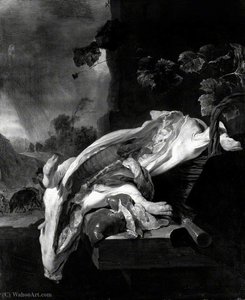
11vegetable-sellers at the house-door, 5 figures (1646) de Jan Baptist Weenixvegetable-sellers at the house-door, 5 figures1646 12caravane near the shore (1646) de Jan Baptist Weenixcaravane near the shore1646 13Mother and Child (1647) de Jan Baptist WeenixMother and Child1647 14Circumcision of Moses' son (1640) de Jan Baptist WeenixCircumcision of Moses' son1640 · Museu Nacional de Varsóvia 15Still Life with Game, Hunter and Two Dogs (1652) de Jan Baptist WeenixStill Life with Game, Hunter and Two Dogs1652 · Bavarian State Painting Collections 16Butterfly Dog and Dead Bird (1649) de Jan Baptist WeenixButterfly Dog and Dead Bird1649 · Museum Mayer van den Bergh 17Pleasure boating (1650) de Jan Baptist WeenixPleasure boating1650 18The Sleeping Shepherdess (1658) de Jan Baptist WeenixThe Sleeping Shepherdess1658 · National Gallery of Ireland 19Roman Tinker (1656) de Jan Baptist WeenixRoman Tinker1656 · Städel Museum 20The love letter (1650) de Jan Baptist WeenixThe love letter1650 · National Museum of Art, Architecture and Design 21Italian Harbour (1651) de Jan Baptist WeenixItalian Harbour1651 · Museu Hermitage 22Italian Peasants among Ruins (1650) de Jan Baptist WeenixItalian Peasants among Ruins1650 · Detroit Institute of Arts 23Sleeping girl (1656) de Jan Baptist WeenixSleeping girl1656 · Bavarian State Painting Collections 24Rest on the Flight into Egypt (1657) de Jan Baptist WeenixRest on the Flight into Egypt1657 · Museum Boijmans Van Beuningen 25Merry Company on a Ferry (1649) de Jan Baptist WeenixMerry Company on a Ferry1649 · Museum Gouda 26Battle at the foot of the mountain. (1650) de Jan Baptist WeenixBattle at the foot of the mountain.1650 · Museu Nacional de Varsóvia 27Christina Lepper de Kempenaer and Her Children (1653) de Jan Baptist WeenixChristina Lepper de Kempenaer and Her Children1653 28Italian port scene, 1649 (1649) de Jan Baptist WeenixItalian port scene, 16491649 · Centraal Museum 29Italian Landscape with Horsemen by a Spring (1657) de Jan Baptist WeenixItalian Landscape with Horsemen by a Spring1657 · Centraal Museum 30Before the walls of Rome (1650) de Jan Baptist WeenixBefore the walls of Rome1650 · National Museum in Wrocław 31Portrait of a man with a letter (1650) de Jan Baptist WeenixPortrait of a man with a letter1650 · Agnes Etherington Art Center 32A Landscape with a Ford (1660) de Jan Baptist WeenixA Landscape with a Ford1660 · Regional Gallery in Liberec 33In the Campagna (1669) de Jan Baptist WeenixIn the Campagna1669 · National Gallery of Ireland 34Dead Fowl Being Eaten by a Cat (1653) de Jan Baptist WeenixDead Fowl Being Eaten by a Cat1653 · Städel Museum 35Departure of an Oriental Entourage (1647) de Jan Baptist WeenixDeparture of an Oriental Entourage1647 · Museu do Louvre 36Display of Dead Game (1641) de Jan Baptist WeenixDisplay of Dead Game1641 · Petit Palais 37Dead Game (1641) de Jan Baptist WeenixDead Game1641 38River Landscape with a Ferry (1650) de Jan Baptist WeenixRiver Landscape with a Ferry1650 · Montreal Museum of Fine Arts 39Still Life with Dead Game and Poultry (1656) de Jan Baptist WeenixStill Life with Dead Game and Poultry1656 · Centraal Museum 40Still Life with Fowl (1650) de Jan Baptist WeenixStill Life with Fowl1650 · Museum of Fine Arts Ghent (MSK) 41Marine with a Venetian Bucintoro (1650) de Jan Baptist WeenixMarine with a Venetian Bucintoro1650 · Staatliche Kunsthalle Karlsruhe 42The Dutch Ambassador on his Way to Isfahan, Jan Baptist Weenix, 1653 - 1659 (1659) de Jan Baptist WeenixThe Dutch Ambassador on his Way to Isfahan, Jan Baptist Weenix, 1653 - 16591659 · Rijksmuseum 43After the Hunt, Jan Baptist Weenix, c. 1656 (1656) de Jan Baptist WeenixAfter the Hunt, Jan Baptist Weenix, c. 16561656 · Rijksmuseum 44Still Life with White Mouse (1680) de Jan Baptist WeenixStill Life with White Mouse1680 · Ernest Zmeták Art Gallery 45Still Life with Game de Jan Baptist WeenixStill Life with GameHarvard Art Museums 46The Ford in the River (1647) de Jan Baptist WeenixThe Ford in the River1647 · Museu Hermitage 47Harbor View with Rider in Oriental Dress, de Jan Baptist WeenixHarbor View with Rider in Oriental Dress,Groninger Museum 48The Holy Women at the Tomb de Jan Baptist WeenixThe Holy Women at the TombNational Gallery of Ireland 49An Italian Seaport de Jan Baptist WeenixAn Italian SeaportRoyal Museum of Fine Arts Antwerp 50Architectural interior with foreign shippers, ruins and a shipyard beyond de Jan Baptist WeenixArchitectural interior with foreign shippers, ruins and a shipyard beyond 51Study of a sheep de Jan Baptist WeenixStudy of a sheep 52A pig's carcase de Jan Baptist WeenixA pig's carcase 53The Tinker and His Dog de Jan Baptist WeenixThe Tinker and His Dog 54Landscape with Peasants and Animals de Jan Baptist WeenixLandscape with Peasants and Animals 55Dead Partridge (1650) de Jan Baptist WeenixDead Partridge1650 · Mauritshuis 56Goat Lying Down, Jan Baptist Weenix, 1645 - 1660 (1660) de Jan Baptist WeenixGoat Lying Down, Jan Baptist Weenix, 1645 - 16601660 · Rijksmuseum 57A Dog and a Cat near a partially disembowelled Deer, Jan Baptist Weenix, 1645 - 1660 (1660) de Jan Baptist WeenixA Dog and a Cat near a partially disembowelled Deer, Jan Baptist Weenix, 1645 - 16601660 · Rijksmuseum 58Still Life with Dead Poultry, Lidded Pitcher and Passglas de Jan Baptist WeenixStill Life with Dead Poultry, Lidded Pitcher and PassglasBavarian State Painting Collections 59Game-piece de Jan Baptist WeenixGame-pieceNational Gallery of Ireland 60Dead game and hunting tackle in landscape de Jan Baptist WeenixDead game and hunting tackle in landscape 61Hound with a Joint of Meat and a Cat Looking on de Jan Baptist WeenixHound with a Joint of Meat and a Cat Looking on 62Bouquet of flowers de Jan Baptist WeenixBouquet of flowersGemäldegalerie 63Shipping in Harbour de Jan Baptist WeenixShipping in Harbour 64Herons and Lapwings de Jan Baptist WeenixHerons and Lapwings 65Still Life of Dead Game in a Landscape with a Huntsman de Jan Baptist WeenixStill Life of Dead Game in a Landscape with a Huntsman 66An italian port scene de Jan Baptist WeenixAn italian port scene 67Shepherds and Flocks among Classical Ruins de Jan Baptist WeenixShepherds and Flocks among Classical Ruins 68A Coast Scene with Classical Ruins de Jan Baptist WeenixA Coast Scene with Classical RuinsWallace Collection 69Still Life with Dead Game de Jan Baptist WeenixStill Life with Dead Game 70Hounds and an Owl with Dead Birds and Sculptures in a Landscape de Jan Baptist WeenixHounds and an Owl with Dead Birds and Sculptures in a Landscape 71Still Life with Dead Birds de Jan Baptist WeenixStill Life with Dead Birds 72Family in a Mediterranean Seaport de Jan Baptist WeenixFamily in a Mediterranean Seaport 73Figures near a Seaport de Jan Baptist WeenixFigures near a SeaportScottish National Gallery 74A Huntsman cutting up a Dead Deer, with Two Deerhounds de Jan Baptist WeenixA Huntsman cutting up a Dead Deer, with Two DeerhoundsNational Gallery 75Ancient Ruins de Jan Baptist WeenixAncient RuinsSzépművészeti Múzeum 76Figures among ruins de Jan Baptist WeenixFigures among ruinsThe Kremer Collection 77Ancient Ruins (detail) de Jan Baptist WeenixAncient Ruins (detail)Szépművészeti Múzeum 78Girl as Shepherdess (1650) de Jan Baptist WeenixGirl as Shepherdess1650 · Musée de Picardie

Pinturas famosas de Jan Baptist Weenix, período por período

Os temas que cativaram o olhar de Jan Baptist Weenix

Os quatro temas que mais se repetem nestas obras originais, cada um com o seu melhor exemplo.

Os museus que guardam os originais de Jan Baptist Weenix

Os 8 museus que detêm a maioria das pinturas desta página.

Museus Cidade Obras de Jan Baptist Weenix Pinturas desta lista
Bavarian State Painting Collections, MuniqueBavarian State Painting Collections Munique 4 The Scissors Grinder, Still Life with Game, Hunter and Two Dogs, Sleeping girl
Centraal Museum, UtrechtCentraal Museum Utrecht 4 Portrait of René Descartes, Italian port scene, 1649, Italian Landscape with Horsemen by a Spring
National Gallery of Ireland, DublinNational Gallery of Ireland Dublin 4 The Sleeping Shepherdess, In the Campagna, The Holy Women at the Tomb
Rijksmuseum, AmsterdãRijksmuseum Amsterdã 4 The Dutch Ambassador on his Way to Isfahan, Jan Baptist Weenix, 1653 - 1659, After the Hunt, Jan Baptist Weenix, c. 1656, Goat Lying Down, Jan Baptist Weenix, 1645 - 1660
Museum Boijmans Van Beuningen, RoterdãMuseum Boijmans Van Beuningen Roterdã 2 Tobit, asleep under a vine, is blinded, Rest on the Flight into Egypt
Mauritshuis, HaiaMauritshuis Haia 2 Italian landscape with shelter and antiques ruins, Dead Partridge
Detroit Institute of Arts, DetroitDetroit Institute of Arts Detroit 2 Still Life with a Dead Swan, Italian Peasants among Ruins
Nationalmuseum, EstocolmoNationalmuseum Estocolmo 2 Harbour with Antique Ruins, The Angel Raphael Leaving Tobias's Family

Jan Baptist Weenix ano a ano: as obras originais que definem cada um

De 1640 a 1659, Jan Baptist Weenix trabalhou durante 20 anos: a seleção acompanha essa longa carreira ano a ano, através das suas mais belas obras originais.

Obras por ano

Escolha um ano para ver as obras originais.

Perguntas de colecionadores sobre as pinturas de Jan Baptist Weenix

Por qual obra Jan Baptist Weenix é mais conhecido(a)?Revelar a resposta

Tobit, asleep under a vine, is blinded (1642), Museum Boijmans Van Beuningen, Roterdã. Italian landscape with shelter and antiques ruins (1658) e Still Life with a Dead Swan (1651) vêm a seguir.

Qual era a idade de Jan Baptist Weenix quando Tobit, asleep under a vine, is blinded foi feita?Revelar a resposta

21 anos: Tobit, asleep under a vine, is blinded data de 1642, e Jan Baptist Weenix nasceu em 1621.

Quais são as dez pinturas mais famosas de Jan Baptist Weenix?Revelar a resposta

Tobit, asleep under a vine, is blinded, Italian landscape with shelter and antiques ruins, Still Life with a Dead Swan, Tobit Sleeping Under the Vine, The Scissors Grinder, Hunters Near Ruins, Portrait of René Descartes, Monument at a Harbour, Harbour with Antique Ruins e The Angel Raphael Leaving Tobias's Family. O ranking acima apresenta o ano e o museu de cada uma.

Quantas pinturas Jan Baptist Weenix deixou?Revelar a resposta

Nosso catálogo contém 86 obras de Jan Baptist Weenix, datadas de 1640 a 1659.

Em quais museus estão expostas as obras-primas de Jan Baptist Weenix?Revelar a resposta

Principalmente em Bavarian State Painting Collections (Munique), Centraal Museum (Utrecht) e National Gallery of Ireland (Dublin). A tabela de museus acima lista todos eles.

Em que anos Jan Baptist Weenix pintou as suas obras mais famosas?Revelar a resposta

Em 1650: 11 das 78 obras nesta página foram feitas então, sendo Pleasure boating delas.

Quais são as primeiras e as últimas obras originais famosas de Jan Baptist Weenix?Revelar a resposta

Nesta página, a mais antiga é Circumcision of Moses' son (1640) e a mais recente é The Dutch Ambassador on his Way to Isfahan, Jan Baptist Weenix, 1653 - 1659 (1659).

Quais temas Jan Baptist Weenix escolheu com mais frequência?Revelar a resposta

Landscape (18), Ruins (17) e Sky (13), entre as 78 obras nesta página.

Qual técnica Jan Baptist Weenix mais utilizou?Revelar a resposta

Oil On Canvas, para 30 das 78 obras nesta página.

A qual movimento artístico pertence Jan Baptist Weenix?Revelar a resposta

Dutch golden age e Baroque, a julgar pelos originais nesta página.

Quais obras de Jan Baptist Weenix estão expostas no Bavarian State Painting Collections?Revelar a resposta

The Scissors Grinder, Still Life with Game, Hunter and Two Dogs e Sleeping girl: o Bavarian State Painting Collections, Munique detém 4 das obras desta página.

Jan Baptist Weenix: vida e obra

O Visionário da Era de Ouro Holandesa

Jan Baptist Weenix ergue-se como uma figura singular dentro da Era de Ouro Holandesa, celebrado por sua mistura distinta de observação meticulosa e visão imaginativa. Embora sua produção artística tenha sido relativamente modesta em comparação com contemporâneos como Rembrandt ou Vermeer, a contribuição de Weenix para a história da arte holandesa é inegável — particularmente sua exploração inovadora de paisagens italianas infundidas com figuras humanas, estabelecendo um precedente estilístico que ecoaria por gerações subsequentes. Nascido em Amsterdã, próximo ao movimentado porto, em 1621, Weenix descendia de uma família de arquitetos, uma linhagem que provavelmente moldou seus anos formativos em meio ao fermento intelectual e estrutural da época.

Apesar de enfrentar desafios pessoais — relatos sugerem que ele lutava com a fala devido a uma condição médica — Weenix possuíam uma paixão ardente pela literatura e pela arte, fomentada por uma mãe que agiu proativamente para que ele aprendesse o ofício sob a tutela de Jan Micker, cunhado de Rembrandt. Este treinamento precoce instilou nele uma abordagem disciplinada ao desenho e à observação que se tornariam as marcas registradas de sua obra. Ele aperfeiçoou ainda mais suas habilidades em Utrecht, sob a orientação de Abraham Bloemaert, e retornou a Amsterdã para estudar com Claes Corneliszoon Moeyaert, consolidando sua base nas correntes artísticas predominantes dos Países Baixos.

Uma Jornada Através da Luz e da Paisagem

A trajetória da carreira de Weenix foi profundamente alterada por suas viagens, mais notavelmente sua jornada a Roma em 1643 ao lado de Nicolaes Pieterszoon Berchem. Esta excursão permitiu que ele encontrasse o vibrante meio intelectual e artístico da guilda Bentvueghels, uma experiência que o impulsionou em direção a um alcance estilístico mais expansivo. Em Roma, ele abraçou o estilo italianizante, caracterizado por uma luz dourada e quente e paisagens clássicas que contrastavam belamente com os tons mais frios e sombrios da pintura holandesa tradicional. Este período de influência romana permitiu-lhe dominar a arte da "paisagem italianizante", onde a beleza rústica do sul da Europa era reimaginada através de uma lente do norte da Europa.

Seu trabalho durante esta era frequentemente fundia a grandiosidade de cenários clássicos com elementos humanos íntimos. Seja retratando cenas portuárias que sussurravam sobre o comércio marítimo ou vistas expansivas que evocavam uma sensação de atemporalidade, Weenix possuía uma habilidade única de capturar a atmosfera de um lugar. Sua maestria não se limitava a vastos horizontes; ele era igualmente adepto de capturar a realidade silenciosa e muitas vezes visceral da vida através de suas naturezas-mortas. Suas representações de caça e animais eram marcadas por um realismo surpreendente, onde cada textura — desde o pelo áspero de um cão de caça até o brilho delicado das penas — era renderizada com uma precisão de tirar o fôlego.

Legado de Realismo e Arte

A importância de Jan Baptist Weenix reside em sua capacidade de construir uma ponte entre o realismo cru da tradição holandesa e a beleza idealizada do movimento italianizante. Sua versatilidade permitiu-lhe navegar por diversos temas, desde a tensão dramática encontrada em obras como Após a Caçada até a intensidade silenciosa e quase sombria de seus estudos animais. Através de seu pincel, o espectador é convidado a entrar em um mundo onde as fronteiras entre o mundo natural observado e o passado clássico imaginado são belamente desfeitas.

Ao refletirmos sobre sua vida e obra, vários elementos fundamentais definem sua importância duradoura:

  • Inovação Estilística: Ele foi um pioneiro na integração de elementos da paisagem italianizante na tradição holandesa, criando uma nova linguagem visual para seus contemporâneos.
  • Maestria Técnica: Seu treinamento disciplinado permitiu um nível extraordinário de detalhe tanto em paisagens de grande escala quanto em naturezas-mortas íntimas.
  • Versatilidade: Sua habilidade de transitar perfeitamente entre cenas portuárias, motivos de caça e retratos de animais demonstra uma rara amplitude de talento.
  • Impacto Histórico: Como membro dos Bentvueghels, ele ajudou a promover o intercâmbio internacional de ideias artísticas que definiram o mundo da arte do século XVII.

Embora sua vida tenha sido relativamente curta, terminando em 1661, a marca deixada por Jan Baptist Weenix permanece visível na evolução da pintura de paisagem. Ele ensinou às gerações futuras como olhar para o horizonte não apenas como um limite, mas como uma tela para a luz, a história e a emoção humana.